

The four Bengal Tigers, who lived 15 years in a train carriage in Argentina, have now been at their new home in South Africa for two years.
FAMILY OF FOUR
In 2007, a travelling circus abandoned the 18-year-old male and 15-year-old female Tiger in a train carriage in San Luis province in the west of Argentina. The circus asked a local farmer to temporarily take care of them, but never returned. The animals remained in the train carriage and had two babies.
The farmer didn’t inform the authorities of the situation given that it is illegal to keep wild animals privately in Argentina and simply tried to take care of them as best he could.
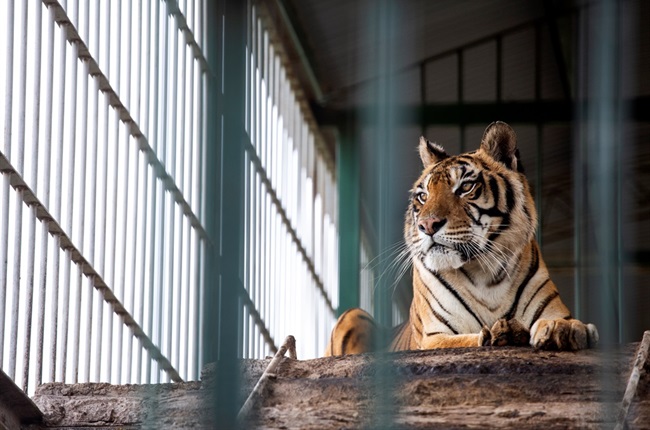
In 2021, Argentinian authorities became aware of the bad living conditions of the Tigers and began looking for solutions for the animals.
FOUR PAWS TO THE RESCUE
By February 2022, through the bars of their cages, the four Tigers had watched the sunrise over the meadow more than 5,000 times. Freedom had always been right in front of them, yet so far away.
The cages were barely larger than the size of two parking spaces and were part of an old train carriage – unfit for any animal. In the beginning, it was only two of them. Then two cubs were born, who are 10 years old today. They were trapped behind bars in dirty conditions, with little space to move on a train wagon – which has been stood still since then.
Animal welfare organization Four Paws rescued Sandro, Mafalda, Messi and Gustavo from their cages and transferred them to LionsRock Big Cat Sanctuary.
Veterinarians of Four Paws spent weeks on-site to prepare the Tigers with positive reinforcement so that the transfer would be as safe as possible for the animals.
“These Tigers spent over 15 years in the same 75m² space, surrounded by the same landscape and without any stimulation of their instincts or natural behaviour. Our team needed to be around them so they would stay calm in our presence and during the transfer,” Four Paws veterinarian Amir Khalil, who led the rescue mission, said.
The Tigers had to be taken out of their cages, moved into transport crates and on a truck to the airport, flown from Argentina to South Africa, and taken off the airport on trucks to their new home. The total journey took more than 70 hours.
At LionsRock, Mafalda took a little time before leaving her transport crate, but the three other Tigers started to explore the new surroundings almost immediately, Four Paws said.
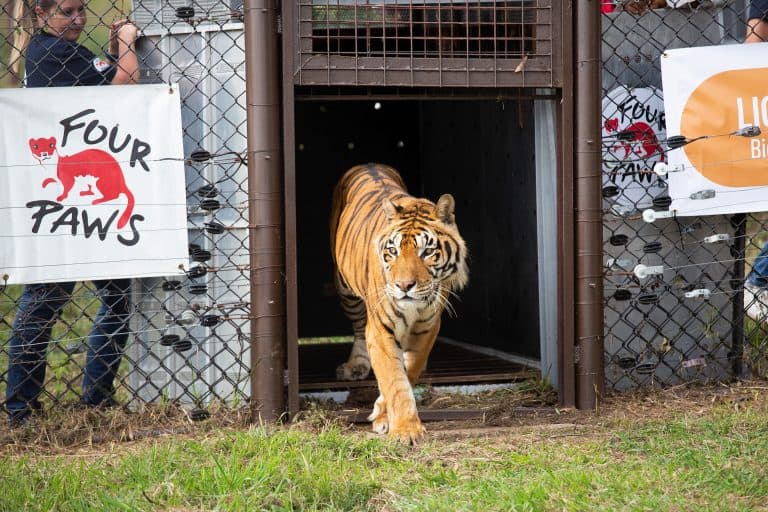
“These Tigers have never felt grass or earth under their paws. It’s the first time they can see the sky above them, not just metal bars and a roof,” Khalil said.
“Now they have hundreds of square meters full of new feelings, tastes and smells. It is overwhelming for them to be in a completely new environment, but animals are quick at adapting to better living conditions,” he added.
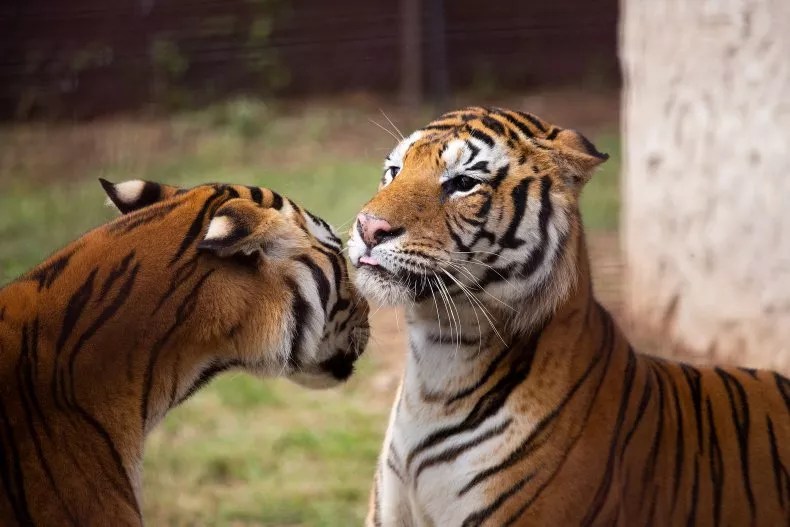
“The road to rehabilitation for these animals now begins,” Hildegard Pirker, who manages LionsRock Big Cat Sanctuary, said
There are only around 3,900 Tigers left in the wild, Four Paws said, adding that due to a lack of regulations, Tigers are kept in captivity and traded around the world for human entertainment and killed for their skin, fur, bones, and teeth.

WHAT YOU CAN DO TO HELP WILDLIFE
You can support ‘Protect All Wildlife’ by donating as little as £1 – It only takes a minute but it can last a lifetime for an animal in need. Please donate below.

Everyone who donates will receive a Certificate of Appreciation as a thank you for helping animals in need.

The Mission of Protect All Wildlife is to prevent cruelty and promote the welfare of ALL animals.
We believe EVERY animal should be treated with respect, empathy, and understanding. We raise awareness to protect and conserve wild, captive, companion and farm animals.
It is vital that we protect animals against acts of cruelty, abuse, and neglect by enforcing established animal welfare laws and, when necessary, take action to ensure that those who abuse animals are brought to justice.
Protect All Wildlife are involved in many projects to protect animals’ rights, welfare, and habitats. Money contributed to Protect All Wildlife supports ALL of our worthy programmes and gives us the flexibility to respond to emerging needs. Your donations make our work possible.
 PROTECT ALL WILDLIFE