They Spent Years Locked In A Train Carriage In Argentina. Now The Four Tigers, Known As The ‘Train Tigers’, Can Feel The Grass Beneath Their Feet.

The train carriage that was ‘home’ to four Bengal Tigers. Credit: Four Paws/Nicolas Cabona.

The four Bengal Tigers, who lived 15 years in a train carriage in Argentina, have now been at their new home in South Africa for two years.

FAMILY OF FOUR

In 2007, a travelling circus abandoned the 18-year-old male and 15-year-old female Tiger in a train carriage in San Luis province in the west of Argentina. The circus asked a local farmer to temporarily take care of them, but never returned. The animals remained in the train carriage and had two babies.

The farmer didn’t inform the authorities of the situation given that it is illegal to keep wild animals privately in Argentina and simply tried to take care of them as best he could.
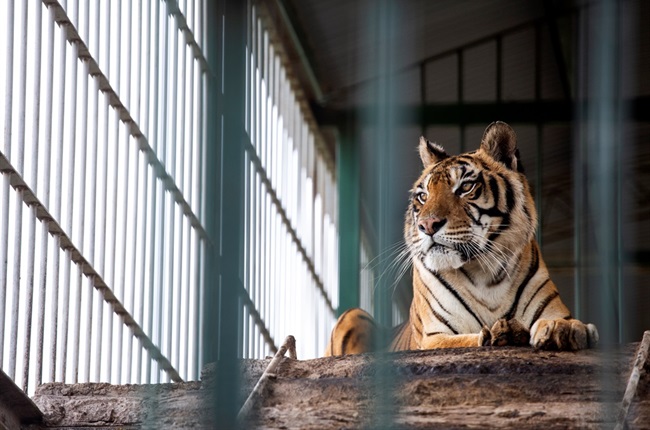
PRISON. Credit: Four Paws/Hristo Vladev

In 2021, Argentinian authorities became aware of the bad living conditions of the Tigers and began looking for solutions for the animals.

FOUR PAWS TO THE RESCUE

By February 2022, through the bars of their cages, the four Tigers had watched the sunrise over the meadow more than 5,000 times. Freedom had always been right in front of them, yet so far away.

The cages were barely larger than the size of two parking spaces and were part of an old train carriage – unfit for any animal. In the beginning, it was only two of them. Then two cubs were born, who are 10 years old today. They were trapped behind bars in dirty conditions, with little space to move on a train wagon – which has been stood still since then.

Animal welfare organization Four Paws rescued Sandro, Mafalda, Messi and Gustavo from their cages and transferred them to LionsRock Big Cat Sanctuary.

Veterinarians of Four Paws spent weeks on-site to prepare the Tigers with positive reinforcement so that the transfer would be as safe as possible for the animals.

“These Tigers spent over 15 years in the same 75m² space, surrounded by the same landscape and without any stimulation of their instincts or natural behaviour. Our team needed to be around them so they would stay calm in our presence and during the transfer,” Four Paws veterinarian Amir Khalil, who led the rescue mission, said.

The Tigers had to be taken out of their cages, moved into transport crates and on a truck to the airport, flown from Argentina to South Africa, and taken off the airport on trucks to their new home. The total journey took more than 70 hours.

At LionsRock, Mafalda took a little time before leaving her transport crate, but the three other Tigers started to explore the new surroundings almost immediately, Four Paws said.
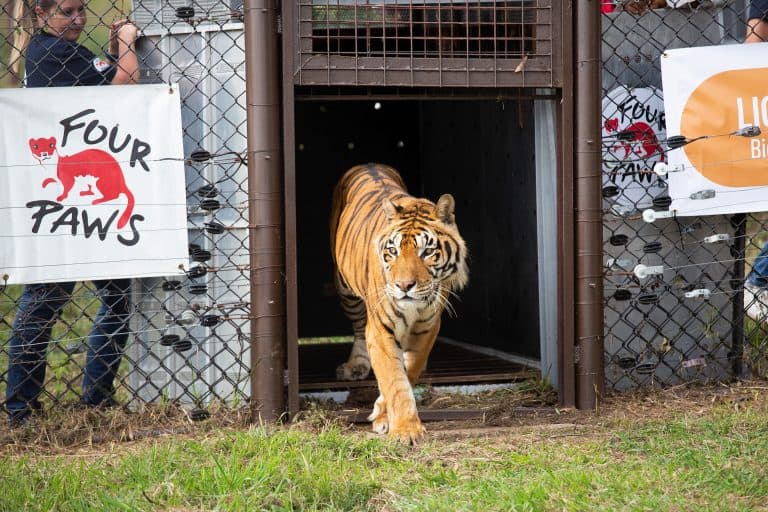
Mafalda hesitantly enters her new life of freedom. Credit: Four Paws

“These Tigers have never felt grass or earth under their paws. It’s the first time they can see the sky above them, not just metal bars and a roof,” Khalil said.

“Now they have hundreds of square meters full of new feelings, tastes and smells. It is overwhelming for them to be in a completely new environment, but animals are quick at adapting to better living conditions,” he added.
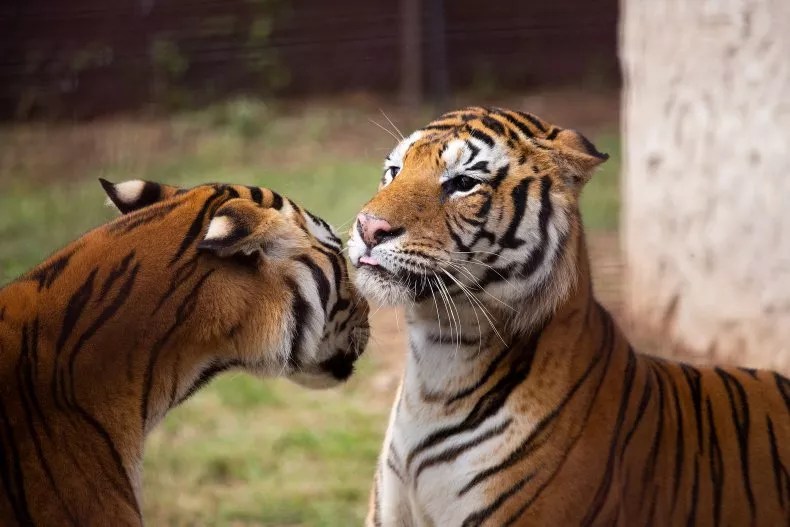
Messi and Sandro enjoying their freedom. Credit: Four Paws/Daniel Born

“The road to rehabilitation for these animals now begins,” Hildegard Pirker, who manages LionsRock Big Cat Sanctuary, said

There are only around 3,900 Tigers left in the wild, Four Paws said, adding that due to a lack of regulations, Tigers are kept in captivity and traded around the world for human entertainment and killed for their skin, fur, bones, and teeth.

The Train Tigers of Argentina – two years on. Credit: Four Paws.

WHAT YOU CAN DO TO HELP WILDLIFE

You can support ‘Protect All Wildlife’ by donating as little as £1 – It only takes a minute but it can last a lifetime for an animal in need. Please donate below.

Everyone who donates will receive a Certificate of Appreciation as a thank you for helping animals in need.

The Mission of Protect All Wildlife is to prevent cruelty and promote the welfare of ALL animals.

We believe EVERY animal should be treated with respect, empathy, and understanding. We raise awareness to protect and conserve wild, captive, companion and farm animals.

It is vital that we protect animals against acts of cruelty, abuse, and neglect by enforcing established animal welfare laws and, when necessary, take action to ensure that those who abuse animals are brought to justice.

Protect All Wildlife are involved in many projects to protect animals’ rights, welfare, and habitats. Money contributed to Protect All Wildlife supports ALL of our worthy programmes and gives us the flexibility to respond to emerging needs. Your donations make our work possible.
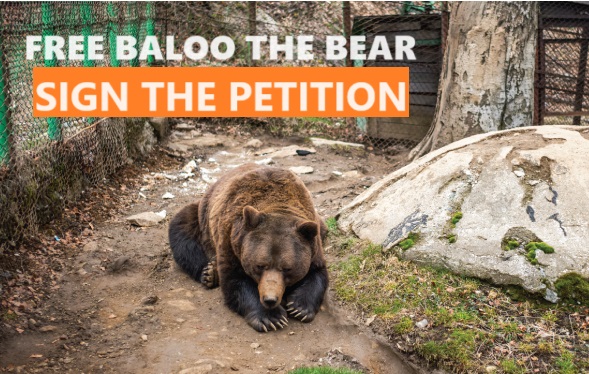
Help Save Baloo: A Bear Trapped In A Cage For The Last 23-YEARS!

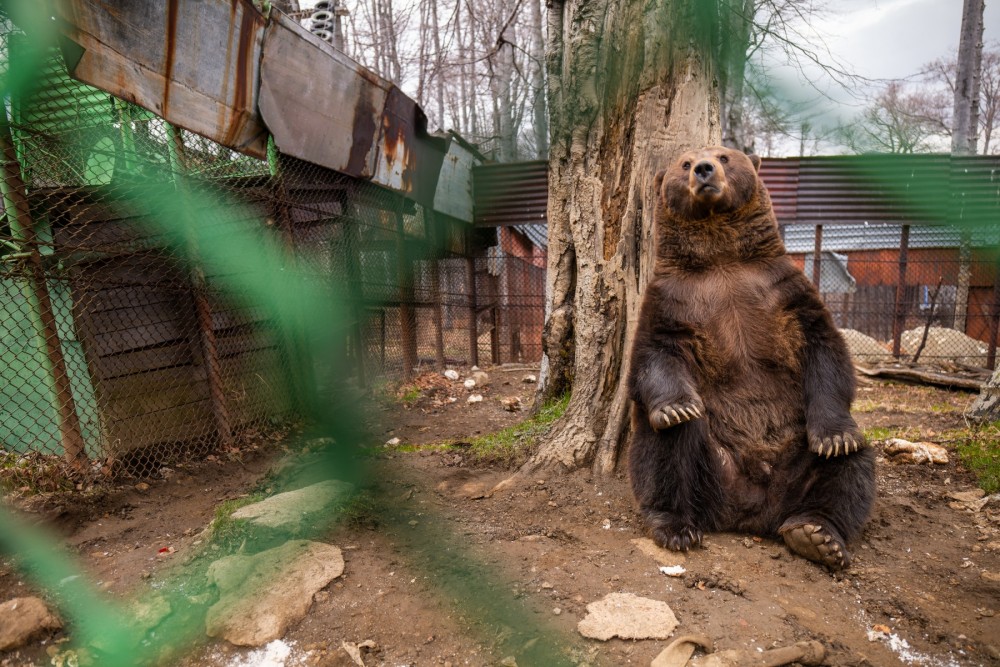
BALOO THE BEAR HAS BEEN LOCKED UP IN A CAGE FOR 23 YEARS CREDIT: JASPER DOEST

Baloo the Bear has been locked up in a cage at a ski resort in Romania under horrific conditions for 23 years. But together with our supporters around the world, we are working to rescue Baloo from this nightmare.

Baloo was found injured as a cub in the Romanian wilderness and was taken in by park rangers for medical care. However, instead of being released back into the wild, Baloo ended up as private property of a ski resort. Despite a 2005 ban by the Romanian government on private individuals keeping Bears, enforcement of the law has been lax, resulting in the bear’s ongoing confinement.

Baloo has been living on display in a tiny cage next to a ski lift and is poorly cared for. He is fed cornflakes and lemonade, sometimes even alcohol to drink, and children frequently poke him through the bars of the cage with sticks. This is no life for a bear.

HELL ON EARTH! CREDIT: JASPER DOEST

23 years ago, Baloo was found wounded in the mountains and he was taken to a hospital by the mountain rescuers from Straja. When he recovered, he came into the care of the businessman Emil Părău, who turned him into the resort’s mascot and has refused to give him up under any circumstances. Although it is obvious that it would be better for him to live among the old oaks of the Bear Sanctuary in Zărnești.

Two other Bears, Puppy and Pamy, would have tasted the same cake of frustration if they hadn’t been confiscated and released in the sanctuary at Zarnesti. They grew big and handsome, while poor Baloo remains to serve his punishment.

Animal protection organisations have been trying for years to free Baloo with no success. But fortunately, a petition started by Dutch television host, Floortje Dessing, is drawing much needed global attention to his cause. Floortje’s show “Floortje gaat mee” (“Floortje Goes Along” in English), explores the complex relationships between humans and animals. In the episode, she shows first-hand the distressing conditions Baloo faces. 

BALOO THE BEAR: AN UNWILLING MASCOT!

Join us in our efforts to liberate Baloo from a lifetime of misery by signing the petition now!

23 years in an undeserved prison!

23 years of stress, inappropriate food, even alcohol given to him through steel bars!

23 years of objects thrown at him, noise, and lack of hibernation!

A mascot in a European resort, for selfish “love”… This is how Baloo lives his life in Straja, Hunedoara county.

HELP FREE BALOO FROM HIS LIVING HELL! CREDIT: JASPER DOEST

Please The Petition Here: FREE BALOO FROM A LIFE OF SUFFERING!

WHAT YOU CAN DO TO HELP ANIMALS IN NEED

You can support our work by donating as little as £5 – It only takes a minute but it can last a lifetime for an animal in need.

CLICK HERE TO DONATE PLEASE HELP ANIMALS IN NEED

Everyone who donates will receive a Certificate of Appreciation as a thank you for helping animals in need.

The Mission of Protect All Wildlife is to prevent cruelty and promote the welfare of ALL animals.

We believe EVERY animal should be treated with respect, empathy, and understanding. We raise awareness to protect and conserve wild, captive, companion and farm animals.

It is vital that we protect animals against acts of cruelty, abuse, and neglect by enforcing established animal welfare laws and, when necessary, take action to ensure that those who abuse animals are brought to justice.

Protect All Wildlife are involved in many projects to protect animals’ rights, welfare, and habitats. Money contributed to Protect All Wildlife supports ALL of our worthy programmes and gives us the flexibility to respond to emerging needs. Your donations make our work possible.
Bob Barker, Longtime ‘The Price Is Right’ Host And Legendary Animal Rights Activist, Has Died Aged 99.

Through Philanthropy and Activism, Bob Barker Fought Animal Cruelty.

All about Bob Barker’s animal activism — from refusing fur prizes to launching a non-profit charity that funds Spay & Neuter clinics.

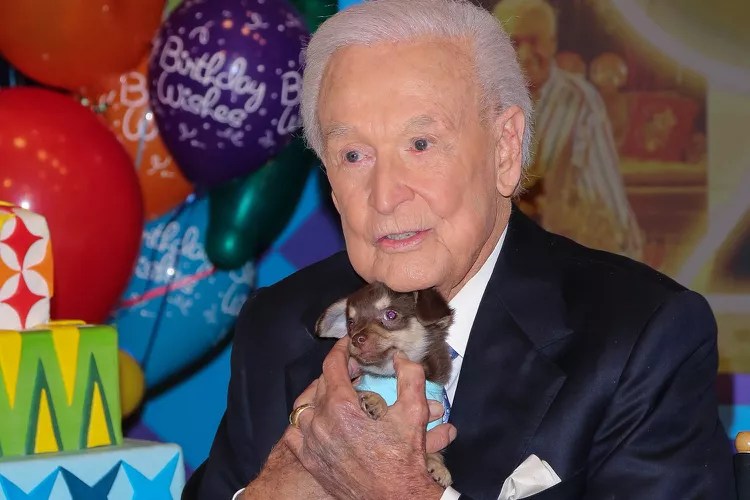
Bob Barker, an affable fixture on US television for half a century who hosted the popular game show The Price Is Right for 35 years and was a committed animal rights activist, has died at age 99, NBC News and Fox reported on Saturday.

Barker died on Saturday morning of natural causes at his Hollywood Hills, California, home, his publicist Roger Neal said.

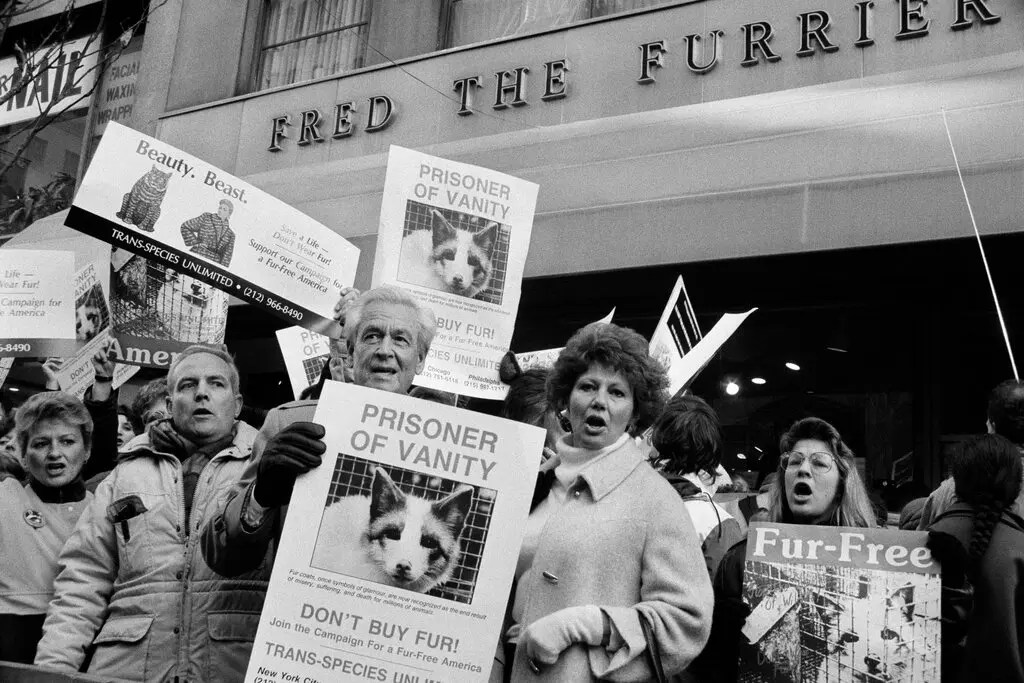
Bob Barker with Nancy Burnet, president of United Activist for Animal Rights, in front of a Fifth Avenue furrier in New York in 1988. Credit…Don Hogan Charles/The New York Times

Barker was known for pro-animal causes and campaigned for them into his 90s. He would end episodes of The Price Is Right by urging viewers to get their pets spayed and neutered to control the animal population and began a foundation to subsidise the practices. He also spoke out against the treatment of animals in zoos, rodeos and circuses.

Over decades as the host of The Price Is Right, the longest-running game show in American television history, Mr. Barker, beginning in the 1980, used his pulpit to remind millions of viewers to “help control the pet population; have your pet spayed or neutered.”

“There are just too many cats and dogs being born,” he explained in an interview with The New York Times in 2004. “Animals are being euthanized by the millions simply because there are not enough homes for them.

He put $25 million into founding the DJ & T Foundation which finances clinics that specialize in spaying and neutering. The foundation was named after Mr. Barker’s wife, Dorothy Jo, and his mother, Matilda Valandra, who was known as Tilly.

In 2004, he donated $1 million to Columbia University School of Law to further the study of animal rights law. 

“The Law School is extremely grateful for this generous gift,” said Dean David M. Schizer. “And we look forward to giving our students exposure to this growing area of legal scholarship.”

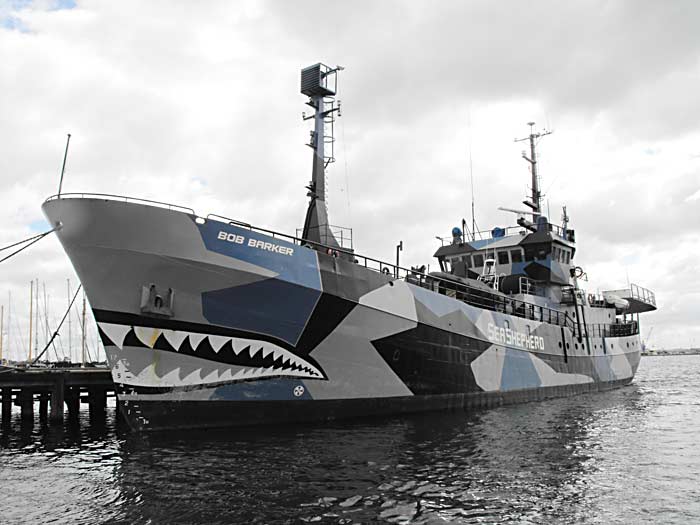
In 2010 he donated US$5 million for a 1,200-ton ship named the Bob Barker that was operated by the Sea Shepherd Conservation Society to stop Japanese whaling ships from killing whales off Antarctica.

The Sea Shepherd Conservation Society Anti-Whaling Ship ‘Bob Barker’

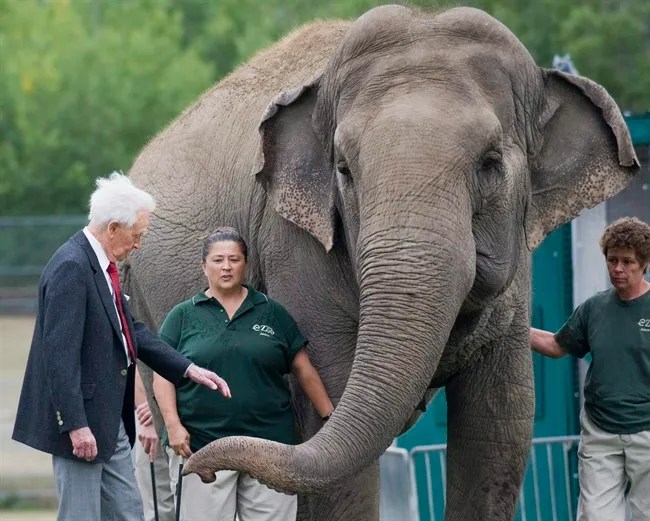
In 2012 Bob funded the travel costs for three Elephants to travel from the Toronto Zoo to a sanctuary in California aboard a private plane.

A spokesman for the TV icon says Barker offered to fund the $880,000 flight after learning that one of the Elephants wasn’t well enough to withstand the long trip by truck.

Henri Bollinger said that the Toronto Zoo agreed to move Thika, Iringa and Toka to the Performing Animals Welfare Society Elephant sanctuary in San Andreas, Calif., but that one of the animals suffers from “a serious foot problem.”

Barker described the Elephants’ new home as a “paradise” and said “to think that one of them might not survive the trip in a truck touched my heart and purse strings.”

Bob Barker with one of the Elephants that he helped travel to PAWS sanctuary

In 2012 he donated $2.5 million to renovate a Los Angeles building that become the West Coast headquarters of People for the Ethical Treatment of Animals (PETA).

“It is money well-spent. I don’t know where you get more for your dollar, so far as protecting animals is concerned, than you get from PETA,” Barker said.

Bob Barker and Ingrid Newkirk at the opening of the PETA Bob Barker building in Los Angeles

In 2015, he stood behind a podium in an eleventh-floor conference room at the Millennium Biltmore Hotel in downtown Los Angeles. His mission: to publicly shame Foster Farms — among the biggest poultry producers on the West Coast — for cruelty toward animals.

Reporters at the event were shown a secretly taped video, narrated by Barker and shot in May and June at two Foster Farms slaughtering plants in Fresno, Calif. The video showed scenes of thousands of chickens being carelessly hung by their legs on conveyor belts. Factory workers execute the process with brutal efficiency, occasionally punching live birds and plucking out their feathers.

Bob Barker speaking for Mercy For Animals in Los Angeles in 2015. Barker criticised poultry producer Foster Farms after an animal-rights group released video showing chickens being
shackled, punched and having their feathers pulled out while still alive. Photo: AP

Julie Woodyer, campaigns director at Zoocheck, knew Barker for years as they collaborated on both successful and failed efforts to free animals from captivity at Canada’s zoos.

She says Barker brought a determination and generosity that was unmatched by other celebrities, often opening his chequebook to support the cause and willingly making public appearances to raise awareness.

“I just can’t imagine there will be somebody to replace that ever,” Woodyer said in a phone interview.

Woodyer first connected with the TV host and his partner Nancy Burnet over email in 2010 as Zoocheck — in co-operation with other animal rights organizations –attempted to free Lucy the elephant from the Edmonton Valley Zoo.

In 2011, Barker appeared on CTV’s “Canada AM” morning show where he explained that elephants were not adapted to brave Canada’s harsh winter climate and Lucy’s health was deteriorating.

While the campaign to relocate Lucy was unsuccessful, Woodyer said a bond was formed with Barker over their shared interest in animal rights.

Together, they were involved in a controversial and years-long effort to move three elephants — Toka, Thika and Iringa — from the Toronto Zoo to a sanctuary in California. The campaign included Barker making public appearances and mingling with local city councillors to explain his view in hopes they would lend their support.

Ultimately, Barker donated $800,000 to the Peoples Animal Welfare Society for the successful transport and care of the animals.

“It would have been years and years for us to try to fundraise that,” Woodyer said, “And it would’ve been too late for some of those elephants.”

Barker later donated $50,000 to help build Manitoba’s first black bear cub rehabilitation centre.

“Lending his celebrity voice … really boosted those campaigns significantly and allowed us to have a broader audience,” Woodyer said.

“He was the funniest man I’ve ever met, extremely sharp, even in his very late years, and he could always come up with something funny, and make us all laugh even in the midst of difficult times in our campaigns.”

Bob Barker was a passionate animal rights advocate throughout his life. PHOTO: PAUL ARCHULETA/FILMMAGIC

I’d like to see animals removed from the entertainment business. Chimpanzees and apes won’t perform unless you beat them. Circuses keep elephants in chains 90 percent of the time. Elephants need freedom of movement. In circuses, they live in cramped quarters, which is not the life intended for them by nature. Some are beaten daily, forced to do ridiculous tricks and robbed of every shred of dignity. ~ Bob Barker.

RIP BOB BARKER

In What Way Can This Be Considered Educational: Polar Bears In The Zoo

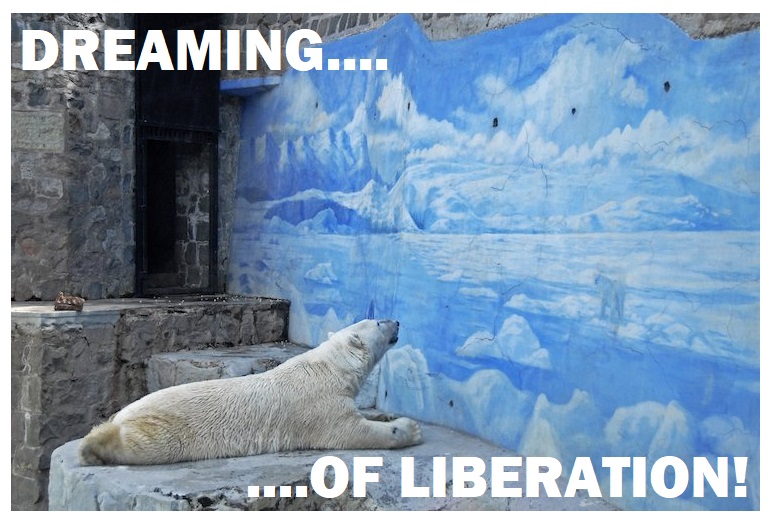
Sadly, unhealthy and dreary polar bear enclosures such as this still exist. Chile’s only polar bear “Taco” died in 2015 at the age of 18 at the National Zoo in Santiago. For years, activists protested its captivity, sometimes with blockades and burning barricades. [Photo by Aldo Fontana]

In urban areas of the western hemisphere, polar bears have lived in our midst since the Middle Ages—a result of our fascination with these charismatic carnivores. As early as 1252, Henry III of England kept a muzzled and chained polar bear, which was allowed to catch fish and frolic about in the Thames. The first undisputed documentation of polar bears in Europe shows that the bears arrived by way of Greenlandic Norse traders and from Iceland, where sea currents still sometimes maroon them. Viking entrepreneurs distributed them to royalty throughout Europe, who kept them in ostentatious menageries or passed them on as gifts to grease diplomatic gears and careers.

Beginning in 1693, the first King of Prussia, Frederick I, kept a polar bear and other large mammals for public amusement in a baroque-style hunting enclosure inspired by Roman arenas. These rare animals were too valuable to be killed but, defanged and de-clawed, were pitted against each other in faux fights. During medieval times in England, entertainers displayed all sorts of animals at carnivals and fairs. The traveling menagerie, which derived from the processions of Europe’s ambulatory monarchs and their entourages, first took to the roads at the turn of the eighteenth century. In a bid for respectability, the owner of one bragged he was doing “more to familiarize the minds of the masses of our people with the denizens of the forest than all the books of natural history ever printed.”

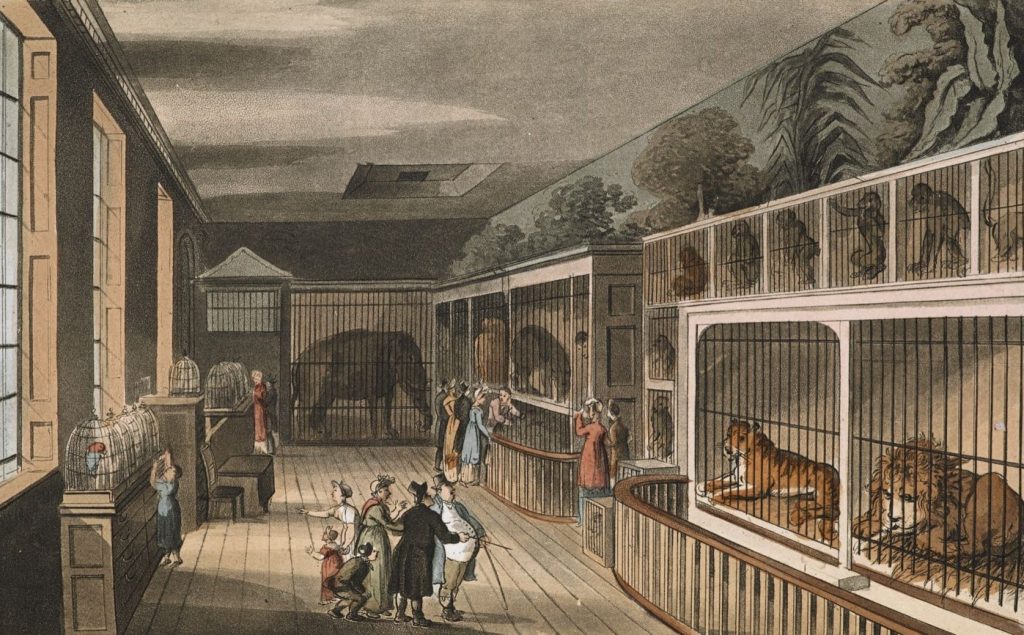
Around this same period of time, a burgeoning middle class and expeditions to the Americas, Asia, and Africa, as well as new developments in science and philosophy, brought about changes in how polar bears were displayed. Animal collections in Europe—until then largely a privilege of nobility—increasingly welcomed the public. Featured in these publicly accessible collections, polar bears drew a good deal of attention, just as they did in medieval wildlife collections or “menageries” (such as the one in the Tower of London).

The Royal Menagerie: An illustration of how the zoo within the Tower looked in 1816

Nobody contributed more to the popularity of captive polar bears or the looks of modern zoos than Carl Hagenbeck. In 1848, Carl Hagenbeck Sr., a Hamburg fishmonger, exhibited six seals he’d received as bycatch from fishermen before selling the seals at a handsome profit. At age fifteen, Carl Hagenbeck Jr. took over what would become Europe’s most famous animal-trade business. He soon supplied zoos, menageries, and wealthy individuals, including the Kaiser. In his early twenties, Hagenbeck already ranked among Europe’s top dealers in exotics. With a nose for opportunity, he branched out into the budding entertainment industry, mounting “ethnological” and large carnivore shows as well as a circus.

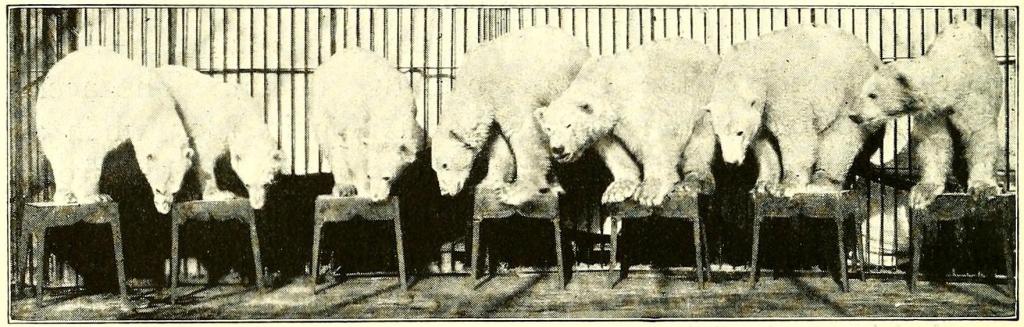
Some of the Polar Bears abducted by the Hagenbecks faced a fate worse than zoo captivity. These seven polar bears were forced to become performers by Carl’s relative Wilhelm Hagenbeck. 

From their very beginnings as cultural institutions, zoos have tried to balance entertainment and education. Today, with climate change and habitat loss from development threatening the polar bear’s natural habitat, many zoos have added conservation to their mission, contributing to captive breeding programs and scientific research.

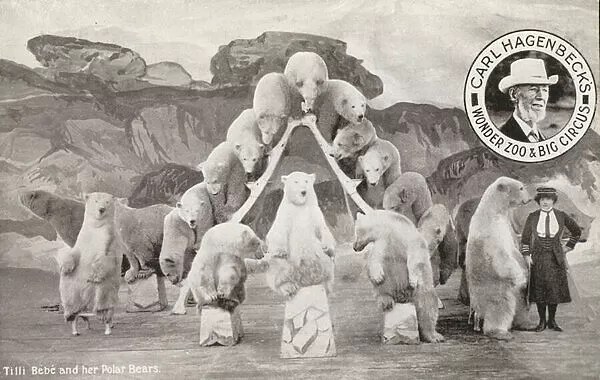
Austrian circus performer Mathilde Rupp (stage name Tilly Bébé) and her Polar Bears at Carl Hagenbeck’s Wonder Zoo in 1918.

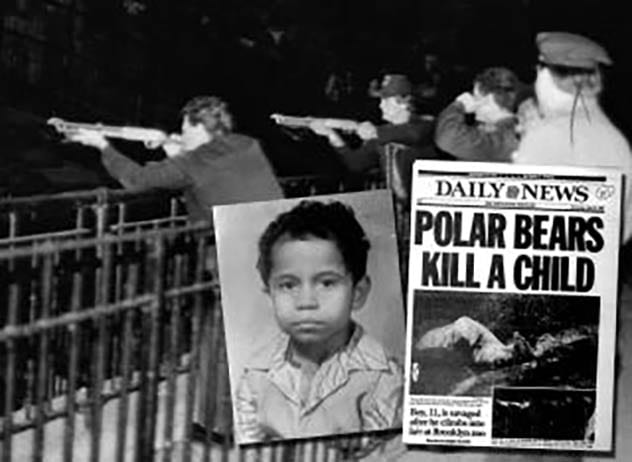
The urge to be close to the wildness (fettered as it may be) that cannot be bred out of zoo polar bears, or perhaps a desire to better get to know these ursine celebrities, has caused numerous incidents at zoos. Such trespassing is not a recent phenomenon. In 1891, a female servant from Bavaria, Karoline Wolf, climbed down a rope into the Frankfurt Zoo’s bear pit—after undressing and neatly folding her clothes—in order to be “eaten alive by a white bear.” People will forever seek operatic ways to end their lives, but accidental zoo maulings are telling because of what these incidents reveal about attitudes toward the animal. In 1987, two polar bears at the Brooklyn Zoo dragged into their den and then killed eleven-year-old Juan Perez, who had entered the enclosure after hours on a dare. The boy thought the bears were slow and afraid of people and water. After invading their space, he provoked the female, throwing bottles and sticks. Police, who suspected that more kids were in danger, riddled both bears with shotgun slugs and pistol bullets.

On May 19, 1987, 11-year-old Juan Perez and two of his friends were visiting the Prospect Park Zoo in Brooklyn, New York, after the zoo had closed for the day.

The old animal magic, that attraction of people to bears, remains strong. Drawn like foxes to a bear kill, we take risks to breach barriers that once, long ago, did not exist. Juan Perez’s death and similar cases recall an Inuit boy’s test of courage and coming-of-age rite: his first polar bear kill. The crucial difference, of course, is the cultural context. Whereas Inuit children grew up listening to their elders, respecting the animal, observing bear habits and how bears are hunted, young Juan had never been inducted into the White Bear’s ways.

A Polar Bear riding a motorcycle circa 1960. (Photo by John Cuneo)

——–((((((()))))))——–

WHAT YOU CAN DO TO HELP WILDLIFE:

You can support ‘Protect All Wildlife’ by donating as little as £1 – It only takes a minute but it can last a lifetime for an animal in need. Please donate below.

Everyone who donates will receive a Certificate of Appreciation as a thank you for helping animals in need.

The Mission of Protect All Wildlife is to prevent cruelty and promote the welfare of ALL animals.

We believe EVERY animal should be treated with respect, empathy, and understanding. We raise awareness to protect and conserve wild, captive, companion and farm animals.

It is vital that we protect animals against acts of cruelty, abuse, and neglect by enforcing established animal welfare laws and, when necessary, take action to ensure that those who abuse animals are brought to justice.

Protect All Wildlife are involved in many projects to protect animals’ rights, welfare, and habitats. Money contributed to Protect All Wildlife supports ALL of our worthy programmes and gives us the flexibility to respond to emerging needs. Your donations make our work possible.
“Empty Shell” (Brain Damage)

HAPPY THE ELEPHANT

I want my money back I came to see an Elephant I paid to see a conservation ambassador Inspire me to help conserve the species Especially her kind

I saw an empty shell

She looks like an Elephant But what is there to see, not Happy She is a poor teacher of Elephant lessons She is no solitary animal, but kept confined Like all captives, neurones scrambled, brain denied Stereotypy is not a dance – no, a pathetic trance A sign she can’t be happy in mind She’s not right in the head.

She is an empty shell

They have broken personalities All the Elephants with names, captive They are poor Elephant facsimiles They have the stature, the thick skin and bones They are devoid of Elephant spirit, truncated They are subjected to Floydian ‘Brain Damage’ They are all caught on the dark side (“‘As a matter of fact, it’s all dark’*) Cut off from the herd

They are empty shells

We pay the price to see: see the price they pay We fall for the old ‘conservation /education’ story We fail to see the oppression and the damage done We should be able to see for ourselves We could accept they are Sentients like us We could see them better in a sanctuary We could do the right thing Will we?

Collect all the empty shells

Put them back where they can refill Regain their freedom and society Be Elephants again, herd mentality That would be something to see Is it just a Zoological fantasy?

I find myself unhappy for Happy, again

If I find myself outside her enclosure (But I wouldn’t pay to go in anyway) Watching her sway song, groundhog days One day closer to her end of days Inspired to write yet another Happy poem Adding to ‘Not Happy’ ‘Personable’ ‘Elephant Stomp’ After the first setback of her legal person court case What would I do if I were you?

Might just as well go to a museum Pay to see a stuffed Elephant This one already is

I want my money back I came to see an Elephant Largest land animal, majestic Social fellow-sentient being Exemplary, salutary

I got an empty shell

*From ‘Brain Damage’ on the Pink Floyd album ‘Dark Side of the Moon’

**From ‘The Needle and the Damage Done’ by Neil Young

For all captive Elephants – Happy, Lucy, Shankar, The Fresno Elephants and so many more.

Written By Anthony Lovell.

What you can do to help wildlife:

Please Sign The Petition  To Free Happy From Her Imprisonment At The Bronx Zoo HERE!

Happy the Elephant had her day in court. We humans are better for it.

Support ‘Protect All Wildlife’ by donating as little as £1 – It only takes a minute but it can last a lifetime for an animal in need. Thank you.

We believe EVERY animal should be treated with respect, empathy, and understanding. We raise awareness to protect and conserve wild, captive, companion and farm animals. It is vital that we protect animals against acts of cruelty, abuse, and neglect by enforcing established animal welfare laws and, when necessary, take action to ensure that those who abuse animals are brought to justice.

Protect All Wildlife are involved in many projects to protect animals’ rights, welfare, and habitats. Money contributed to Protect All Wildlife supports ALL of our worthy programmes and gives us the flexibility to respond to emerging needs. Your donations make our work possible. Thank you for your support.
Everyone who donates will receive a Certificate of Appreciation as a thank you for supporting wildlife.

CERTIFICATE OF APPRECIATION

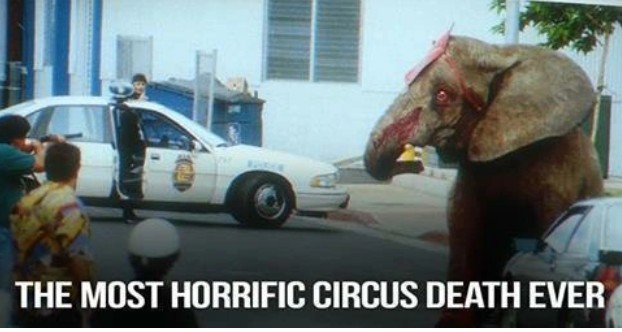
The Tragic Story Of Tyke The Circus Elephant: The Most Horrific Circus Death Ever!

20TH AUGUST 1994: THE DAY THAT TYKE THE ELEPHANT WAS SHOT 86 TIMES!

Mention “Tyke the Elephant” to anyone who lived in Honolulu 27 years ago and chances are they’ll shake their head and talk about what a dark moment it was in their city’s history.

Tyke was a wild-born African Elephant captured from the wild in Mozambique when just a baby. She was sold into the circus industry in the U.S. and for twenty years abused and exploited. Tyke was tortured during this time, forced to wear a degrading clown costume and dance for the audience, and even forced to ride a giant tricycle.

In August 1994, Tyke spent several days locked in the hull of a tanker ship on a long ocean journey from California to Hawaii. When they finally let her out she was immediately forced into performing in from of an audience. Unable to take the abuse any longer, she finally snapped. Tyke entered the ring at the Blaisdell Arena, kicking around what looked to audience members like a dummy. “We thought it was part of the show,” one witness told the Honolulu Star-Advertiser. They soon realized the supposed dummy was a severely injured groomer. Panicked, audience members fled for the exits. Tyke went on to fatally crush her trainer, who was trying to intervene, before fleeing the arena herself.

For nearly 30 minutes, Tyke ran through the streets of the Kakaako neighborhood’s business district at rush hour, nearly trampling circus promoter Steve Hirano when he tried to fence her in. It was a foot chase between her and the Honolulu police, who eventually shot her 86 times before she succumbed to nerve damage and brain haemorrhages. People watched aghast from their cars, apartments and the sidewalk.

Image result for tyke the elephant

Twenty seven years later, witnesses still remember it vividly, and the attitude in Honolulu toward animal-driven circuses is distrusting. No circus elephants have performed since Tyke, even though there is no prohibition against it.

In 2014, when the Moscow International Circus announced that it would perform in Honolulu with “wild animals”, activist group People for the Ethical Treatment of Animals circulated a petition against it. A circus spokesman recently told the Honolulu Star-Advertiser that animals would be excluded from the shows, and PETA applauded the decision in a press release:

While the Tyke incident challenged people around the world to think about our relationship to circus animals, many circuses such as the Kelly Miller Circus, UniverSoul Circus, Cole Bros. Circus of the Stars and Carson & Barnes  still use exotic animals, including Elephants, in their shows today. Ringling Bros. and Barnum & Bailey Circus has only recently stopped using Elephants in their circus.

What can you do? PETA encourages you to avoid supporting any circus that includes animals and provides a list of animal-free circuses, as well as a list of things you can do if the circus comes to your town.

THE PETRIFIED LOOK OF FEAR

IF THIS VIDEO DOESN’T CONVINCE YOU THAT ANIMAL CIRCUSES ARE HELL!