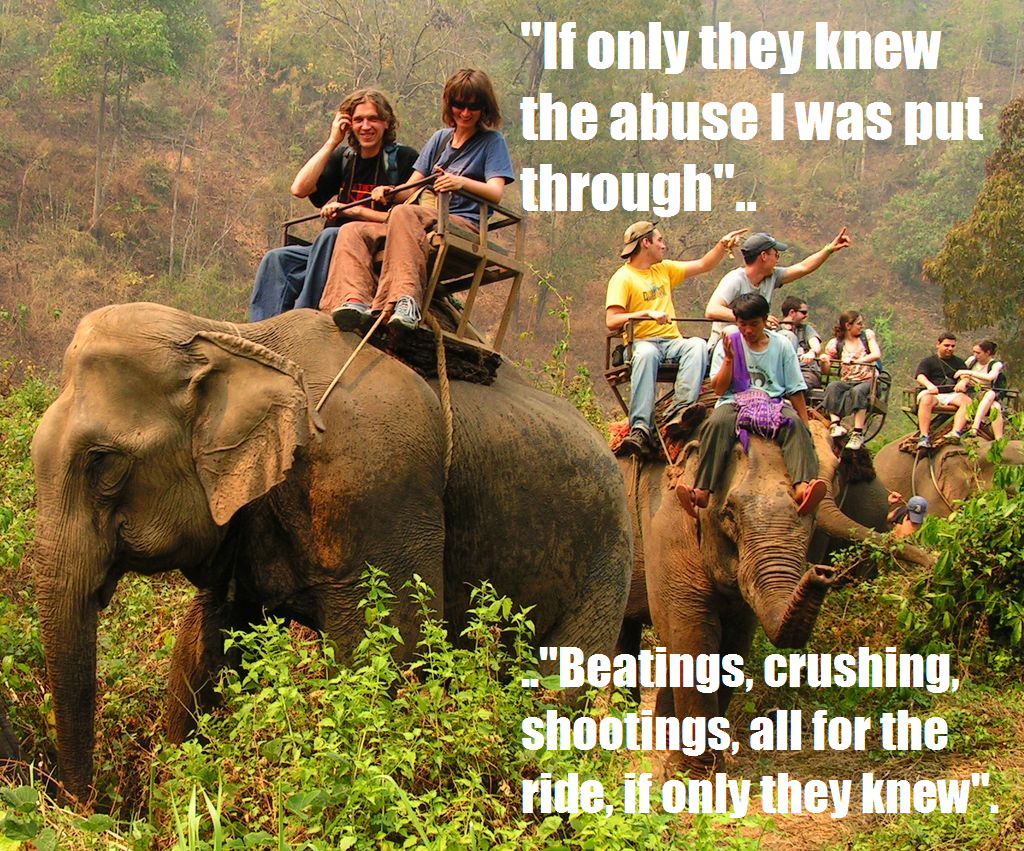
Elephant rides are an attraction regularly offered to tourists in several Asian countries including Thailand. But to get there, the animals undergo a very particular training that is actually akin to real torture.
Between 35 and 40,000, is the number of wild Elephants that remain in Asia, according to estimates. A figure to which should be added the more than 15,000 domesticated Elephants. If you go to Asia one day, you will certainly meet these majestic pachyderms with big ears. You may even be asked to ride on their backs for a ride.
This attraction attracts millions of tourists every year in Asia, especially in Thailand. Nevertheless, it hides a reality that few tourists are aware of: to get there, the animals suffer a real torture. If the words can seem strong, they are not, as all those who have seen with their eyes what is really happening. Indeed, to be trained, Elephants undergo a ritual called “phajaan”.
The principle is simple: “break the spirit” of the Elephant. As two globetrotters, Seth and Lise, explain, “the origin of phajaan comes from the ancestral belief that one can separate the mind of an Elephant from its body so that it loses its reflexes and instinct natural wilderness and be completely under the control of man “. Concretely, it is to submit the Elephant until he agrees to do everything asked of him.
Beaten, hungry and sleep-deprived
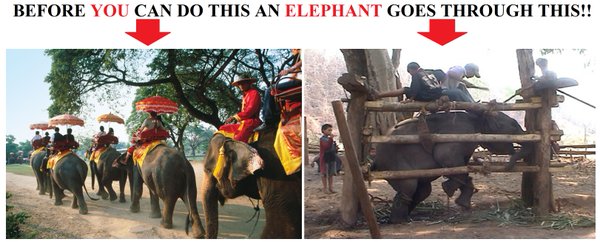
From a practical point of view, it is only by using violence that the trainers achieve it. Phajaan lasts between 4 and 6 days and is carried out on young Elephants. The animals are separated from their mothers and locked in narrow cages where they are chained. Without being able to struggle or even move a limb, they are then repeatedly hit in strategic places, the most sensitive.
THE PHAJAAN
In addition to being beaten, Elephants are kept awake, deprived of food and water under the eyes of trainers (“mahout”) who recite prayers that can be translated as “Elephant, if you stop fighting, we do not you’ll hurt more, “says a documentary. The torture does not stop until after several days, when the trainers believe that the spirit of the Elephant is broken, that his behaviour has changed.
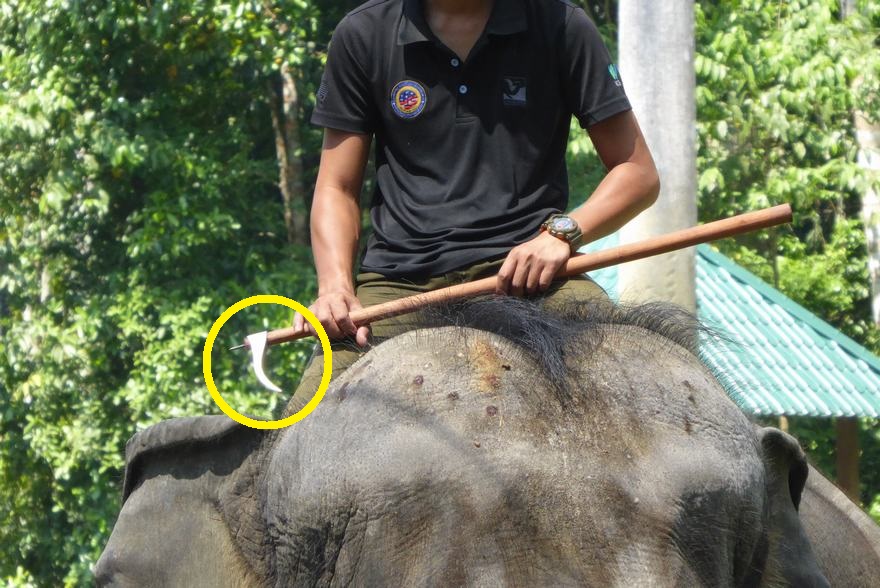
The Bullhook
Out of his cage, the animal appears submissive, impressed by the fear of the man who subjected him to this torture. Then begins a real training that will consist in teaching the Elephant all the necessary commands or gestures intended to amuse the tourists. Once the specimen is formed, it can be used as an attraction for most of its life.
50% of Elephants die during the ritual
It is estimated that half of the Elephants would not survive phajaan. Others would become aggressive: about 100 mahouts are killed each year by their animals. Still others would go insane or have trouble with their experience, rendering them unusable for attractions. Most would then be killed.
The surviving Elephants are used to wander among the tourists, to beg or for work. In order for them to remain submissive, they are given a few booster shots by hitting them or pressing the sensitive spots again. In tourism, an Elephant can spend the day carrying people without a minute to rest, eat or drink. The rest of the time, most animals are tied up so that they are not dangerous.
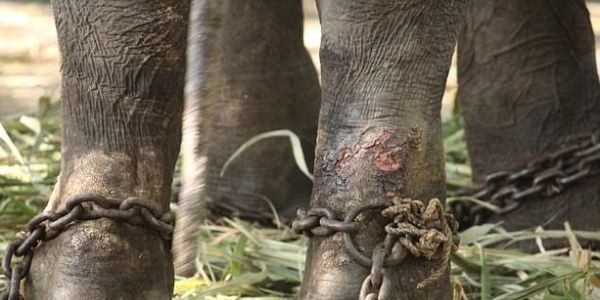
WHEN NOT BEING EXPLOITED BY TOURISTS THE ELEPHANTS ARE CHAINED
A life that would often lead to the appearance of disorders including neurological. “If you ever have a chance to spot domestic Elephants, watch them,” Seth and Lise explain. “Chance or not, all the Elephants we’ve seen had signs of recent abuse, scars, obvious signs of poor health, some are more damaged than others, and it’s extremely rare to see one of these well-treated animals. “.
“It is largely because of tourists that this business works, so it is up to tourists to make the right decisions. The future and especially the well-being of thousands of Elephants is at stake,” they conclude in their blog.
#BeKindToElephants ~ Please SHARE this page to raise awareness to the so-called Elephant tourist ‘industry’ in Asia. You can also SUBSCRIBE to Protect All Wildlife to receive news and updates direct to your inbox.
They are the country’s icon – but behind the dazzle of religious festivals, these giants of the wild are painfully abused in Kerala.
When Audrey Gaffney first read about Raju, an Elephant kept in chains with spikes embedded in his ankles, she couldn’t stop the tears pouring down her face. “In fact, I cried again and again: I found over the next few days I just couldn’t get this story out of my head, I couldn’t stop thinking about Raju,” she recalls.
“I couldn’t believe the cruelty of my race.”
The young Elephant had been snatched from his family, she
explains – his mother either would have been killed or spent weeks searching
and crying for him – and he was beaten into submission. Raju then spent the
next 50 years forced by his handler to beg in the street, starved, frightened
and suffering infected wounds to his flesh. By the time of his rescue, he had
resorted to eating plastic and paper.
Going on to discover that Raju was just one of thousands of
Elephants treated this way in India, Ms Gaffney, a single mother from
Liverpool, was spurred into becoming an activist for the first time. In the
four years since, she says, her life has changed beyond recognition as she
dropped her wariness of social media and teamed up with other volunteers
working to raise awareness of the horrors to which the temple Elephants of
India are subjected.
Taken from their families in the wild, shackled, beaten,
whipped and exploited like slaves, these Elephants – ironically India’s icons –
are painted and dressed in colourful decorations, to be paraded in regular
festivals and processions organised by religious temples.
They are the world’s forgotten Elephant victims of mankind. While the world has focused on the threat of extinction to Africa’s Elephants caused by the ivory poaching crisis and the cruelty of tourist Elephant rides in Thailand and Cambodia, the plight of their captive counterparts in India has remained largely hidden from public gaze.
Fed the wrong diets, Kerala’s Elephants suffer malnourishment (Action for Elephants UK)
Photographs and videos posted online have shown how, away from the glitz of the festivals, these sensitive, intelligent and naturally sociable creatures are tied to the spot by ropes or chains that eat into their skin and inflict agonising injuries to their legs; they are hit with metal rods or bull-hooks – sharp tools – and “trained” with punishments to hold their heads high.
When the six-month festival season begins in December, they are forced to walk for miles in searing heat on hot, stinging tar roads and ridden into processions noisy with crowds and fireworks – terrifying for a creature whose home is the forest. While still shackled in chains they are made to run races or carry people and are subjected to “painful and unnatural” “head-lifting” competitions.
Some Elephants are carted from one festival to another – in
some cases hundreds of miles – and despite suffering sometimes infected wounds
from the chains, are ridden in searing temperatures by people who apparently
see no harm in what they do.
The southern coastal state of Kerala has the highest number of festival Elephants, about 500 out of 3,500-4,000 across the country. Action for Elephants UK (AfE) brands Kerala “ground zero for elephant torture” and has called their illegal treatment “the worst case of animal cruelty in the world”. The plight of the 150 captive elephants in neighbouring Tamil Nadu is feared to be just as BAD.
Footage posted by local group Kerala Suffering Elephants (KSE) reveals how an Elephant named Gurvayur Nandan was paraded at a festival until dawn, before being transported for eight hours standing on the back of a truck in the scorching sun for eight hours without rest to a separate event that ran until midnight.
Malnourished and deprived of medical care, captive individuals of the endangered species rarely survive this “unrelenting neglect and torture” for a natural lifespan. The mortality rate in Kerala is shocking: 58 have died in 27 months, and already in 2018, 12 have succumbed, according to KSE. In seven years, the death toll is 350. “There could be no more damning proof of the hellish conditions and treatment meted out to these Elephants,” says Maria Mossman, founder of AfE.
Elephants are shackled in heavy chains that wound the flesh (Action for Elephants UK
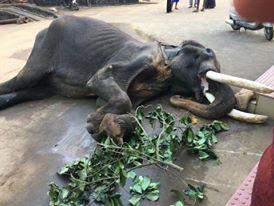
For all the abuse, injuries and mental torment, it’s not the pain or infections that usually kills them early, it’s “intestinal impactions”: a blocked colon caused by being fed the wrong diet and insufficient quantities of water. The condition means they die “a miserable and painful” early death.
Campaigners have had enough. Gathering outside the Indian
High Commission in London, they staged a protest to draw the attention of the
New Delhi government and the world at large to the animals’ plight. Wearing
large Elephant masks and waving placards, they came from a variety of
backgrounds; some had travelled hundreds of miles to be there.
What unites these women – and yes, the campaigners are
nearly all women – is a shared abhorrence of the “abuse and torture”. They
adamantly deny attempting to interfere with religious culture.
“Temple Elephants are not part of any tradition,” explains
Ms Mossman.
Their use in temples and festivals is not part of Indian
culture, nor do Hindu scriptures anywhere say that Elephants should be used in
temple rituals. On the contrary, the barbaric treatment of these elephants goes
completely against the core beliefs of Hinduism”
In fact, the cruelty behind Kerala’s rituals is thought to
have begun about a century ago as India’s nouveaux riches started to buy
Elephants to flaunt their wealth. Denise Dresner, a co-organiser of AfE,
recalls the heart-wrenching moment that opened her eyes to the scale of the
problem: “In 2013 I saw a video by Peta of Sunder the temple Elephant being
beaten. This was something I’d never witnessed before.
“An Elephant was on its side on the ground, struggling to
get up. His feet were shackled and he was being beaten violently by several
men, over and over again. He kept struggling, unable to get away from the blows
raining down on him. I learned later he had been kept in a dark shed and beaten
incessantly for seven years.
“That moment of seeing him being beaten and tortured was
seared into my brain and heart. It’s an image that will never leave me, one
that shows the extremes of human violence and brutality towards other living
beings. The unspeakable cruelty perpetrated on these majestic, sentient and
highly intelligent creatures must end.”
For Maria Harper, another protester, it’s the duration of
the suffering that is worst. “What upset me most was when I realised the length
of time the temple and festival Elephants suffer,” she says.
“They can endure cruelty and abuse for more than 50 years –
if they are unfortunate enough to survive that long. It’s a life sentence”
Seeing the photos and hearing the accounts is harrowing. But
Ms Mossman says it’s vital if their welfare is to improve. “The world needs to
know how handlers use banned weapons and restrain them with heavy shackles,
often tightened so severely that they cut through the flesh, causing raw
bleeding wounds that are seldom treated. “They are often forced to stand in the
same position 24/7, in their own urine and excrement, suffering from foot rot.
They are beaten and tortured time and again.”
Some mahouts think nothing of whipping an Elephant to make
it bend to his will, such as climbing into a truck. But the abuse doesn’t end
there.
Most of Kerala’s captive Elephants are bulls. When they
enter their annual musth – mating season – their testosterone levels and energy
surge, so the mahouts tighten their shackles further until the creatures are
unable to move. In addition, food and water are restricted to weaken them.
But then comes the cruellest torture yet. Several men, often
drunken, beat the chained Elephant for up to 72 hours relentlessly. The
practice is based on a superstitious belief that the Elephants may have
forgotten their commands during their musth, and is designed to break the
Elephant’s spirit, “reminding him that his masters are in control”.
All bull Elephants in Kerala undergo this horror every year.
These practices are banned by the Prevention of Cruelty to
Animals Act 1960 and the Wildlife Protection Act 1972, but campaigners point
out that the laws are routinely ignored.
Elephants are paraded with no ownership papers or parade certificates, or with fake fitness certificates, breaking the Wildlife Protection Act 1972, which says they cannot be exploited for profit, AfE says. Recent laws banning the use of disabled, sick or pregnant elephants in festivals are also ignored.
“The plight of these Elephants is arguably the worst case of
animal abuse in the world. The suffering that temple Elephants endure is
unimaginable”
“India has very good laws, but they are ignored daily and
the abusers go unpunished,” says Ms Mossman. “Not only are Elephants
intelligent and sentient beings, they are an endangered species. It is the duty
not only of India to enforce the laws to protect them, but of the world to hear
their cries of suffering and respond to end the brutality against them.”
She and KSE agree that making profits and keeping the status
quo are at the root of the problem. “These sentient animals are seen only as
commodities, earning huge sums of money for their owners and the temples,” says
Ms Mossman. “Exploited under the veneer of culture and religion, they are big
business. Everyone, from the chief minister downwards, has a stake.”
The 3,000 temples that rent out Elephants to festival
organisers are run by four devaswom (socio-religious trusts), appointed by the
state government, and each temple earns many millions of rupees from festivals.
Any Elephant that makes it beyond 60 is purposely neglected
and abused – treated as a disposable item – so the owners can make hefty
insurance claims, according to AfE.
Sangita Iyer, who was born and raised in Kerala and made an
award-winning 2016 film, Gods in Shackles, revealing what goes on behind the
scenes at the festivals, is convinced greed is to blame.
“Elephants are allowed to die so the owners can receive the pay-outs.
There’s a whole insurance industry surrounding this, in which the owners and
brokers make the most profit.”
A dead tusker that suffered intestinal blockages is covered
with a cloth. Most captive elephants die young after years of pain (Action for
Elephants UK)
According to India’s Wildlife Rescue and Rehabilitation Centre, which in 2014 petitioned the Supreme Court of India to order better conditions for the animals, another factor is young men showing off. “Today’s mahouts are in it for the glamour and the thrill. Unlike the mahouts of the old, who learnt the ways of handling the Elephants over time, these guys know only oppression and violence,” one rescuer says.
Nor does Ms Iyer particularly blame festival-goers. “Most
people are unaware of the crushing burden these Elephants carry, in the literal
sense, on their backs, and in their hearts and souls. Most people don’t realise
the brutality that these sentient beings undergo to entertain them. They are so
hypnotised by the majestic, ornate Elephants and lost in their own selfish
world that they don’t even look at the raw bleeding ankles.”
However bad the suffering of the individuals, the abuse has
wider repercussions. KSE warns it could even lead to the extinction of Indian
Elephants.
“As each of these Elephants die from overwork, intestinal
impactions etc, the surviving ones are going to be overworked even more. It’s a
vicious cycle and will probably end only when there are no Elephants left”
Taking young Elephants from the wild has a serious impact on
wild Elephant populations in India and elsewhere, activists fear. People’s
lives, too, are being put at risk. Some elephants, driven frantic by their
suffering, break free and run amok. Behind media reports of people being killed
by a rampaging Elephant there almost always lies a story of a brutalised
animal.
There have also been 300 incidents of Elephants running amok
in the first three months of this year. Earlier this month there were
unconfirmed reports of Elephants running amok at festivals in Ernakulam and
Kollam districts. Unofficial counts put it at 20 incidents in one week.
Action for Elephants is warning prime minister Narendra Modi
these rituals are not just harming the country’s most iconic wildlife, but also
India’s multi-million-pound tourism industry and reputation. “We hope tourists
and visitors to India will make ethical choices and will shun all forms of
Elephant tourism that use elephants in any unnatural way, whether in festivals
or for trekking or rides or any other purpose,” a statement by the group says.
“In this day and age, when we have gained so much knowledge about the intelligence, emotional capacity, and social bonds of these majestic creatures, and when we know how endangered they are, we believe that all countries have a duty to protect them, treat them humanely, and give them sanctuary.”
India is positioned to take a global lead in ethical
wildlife tourism, the letter says.
As long as the current system of cruelty is allowed to
continue, the more it will negatively impact India’s tourism and tarnish
India’s reputation and image in the world
Signatories include primatologist Jane Goodall, TV star
Michael Palin, author Jilly Cooper, TV presenter Anneka Svenska and radio
presenter Nicky Campbell, as well as MP Zac Goldsmith.
Filmmaker Ms Iyer believes educating the public is the only
way to achieve change. “Ignorance and arrogance make for a bad potion, and
unless and until we are able to create attitude shifts in the public eye,
there’s little hope for these sentient beings.
“There is no point in fighting the owners or brokers.
Enlightening the people is the only way to stop the audience from participating
in festivals that use live Elephants and reduce demand for such cultural
festivals. When the demand dies down, the Elephants will be ultimately phased
out.”
The Indian High Commission in London did not respond to a
request by The Independent to comment and refused to send anybody to open the
door when visited in person.
There are some glimmers of hope, however. Occasionally, news
of progress made by welfare workers on the ground emerges, and an elephant
rescue can become a stand-out memory for followers. The film that startled Ms
Gaffney was called Raju the Elephant Cried on the Day he was Released from
Chains. His rescue made headlines.
Ms Dresner says she followed each step in a protracted legal case to free Sunder with her heart in her throat. “Finally, when he was freed, the joy was overwhelming. Like so many others, I then followed his progress in his new home at Bannerghatta Biological Park, crying (happily) with every bit of good news: his healing leg, his first swim in the pond, his making new friends, his putting weight on his skeletal frame.”
Fellow demonstrator Joanne Smith agrees. “The terrible
delays with the court case were so hard to take but the day Sunder was given
his freedom was thrilling,” she recalls. “It proved to me that we can make a
difference with hard work and determination.”
In the past two years, three temples have done away with
renting Elephants for festivals. One used mechanical stand-in; another used an
8ft dummy made of plaster of Paris and bamboo. Organisers say they may even
offer the model to neighbouring temples for their own festivals, allowing the
idea to catch on.
The London protest and letter also have the support of
Absolutely Fabulous star Joanna Lumley, whose message was: “One of the most
influential Indians of all time, Mahatma Gandhi, said: ‘The greatness of a
nation and its moral progress can be judged by the way its animals are treated.’
“India! Listen to his words and implement them. The world
supports your laws against cruelties to temple Elephants, but only you can
ensure that they are enforced.”
And that, say campaigners, really would be worth a
celebration.
Another
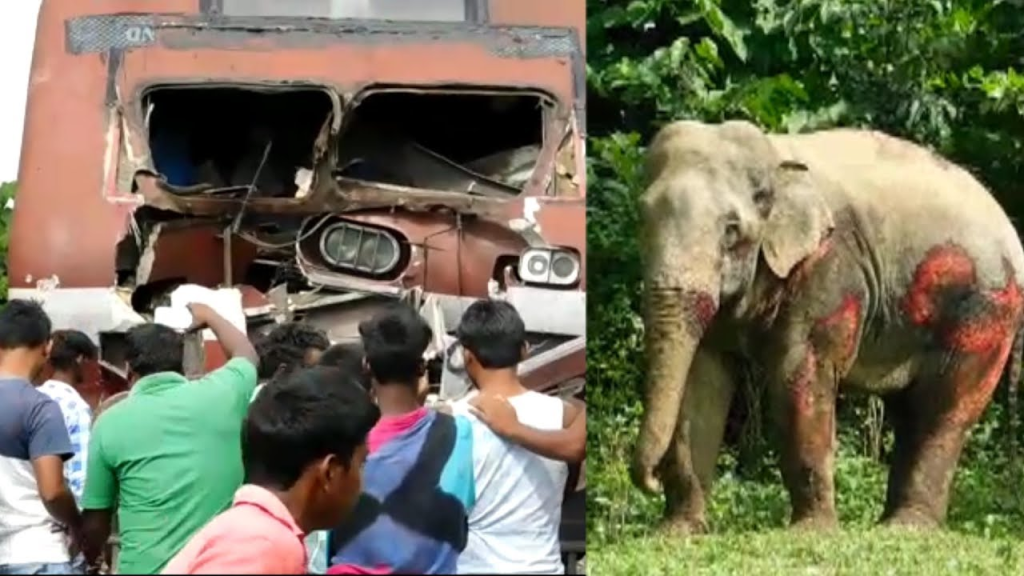
man-animal conflict story was reported in West Bengal when a train engine hit
an Elephant trying to cross the tracks, critically injuring the animal.
The
incident happened in the Jalpaiguri district of the state.
The
Banarhat-Nagrakata train route passes through a major Elephant corridor often
leading to such tragic accidents involving Elephants.
The heart-wrenching video that surfaced on various social media platforms showed the critically injured Elephant trying hard to drag itself out of the railway track, as people watched in helplessness, after being hit by the engine of the intercity express.
The video
shows the impact of the injury on the poor animal while people watch
helplessly. In 2004, the Dooars line was converted from metre gauge to broad
gauge; a move that saw a sharp increase in Elephant deaths.
But despite
all the precautionary measures and efforts, such as speed limits and buzzers,
trains on the Dooars route have continued to kill Elephants.
In the
period between 2013 to June 2019, a total of 67 Elephants were killed in
train-related accidents.
Actor Randeep
Hooda said in a twitter post “The agony of the Elephant is quite evident in the
video, the impact can be gauged by the damage to the engine.
I humbly
urge the ministry to drastically reduce speed of trains through this area,
humans can easily manage slight delay to keep wildlife safe”
For the
sake of the Elephants, let’s hope they listen and reduce the speed of trains
through the corridor.
A petition
is being filed asking Indian Railway to review the permitted speed of 50kmph in
the day time in dense forest areas. The maximum speed before the increase was 25kmpg
and had shown a sharp decrease in the accidents and death of Elephants.


 PROTECT ALL WILDLIFE