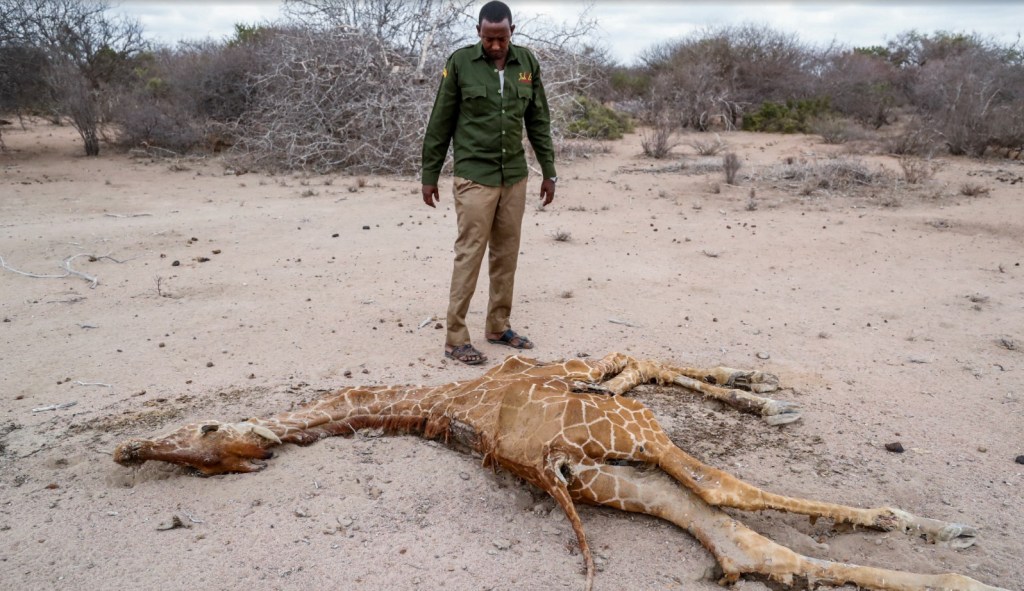
The withered carcasses of livestock are reminders that drought has descended yet again in northern Kenya, the latest in a series of climate shocks rippling through the Horn of Africa.
Mohamed Mohamud, a ranger from the Sabuli Wildlife Conservancy, looks at the carcass of a giraffe that died from hunger. (AP Photo)
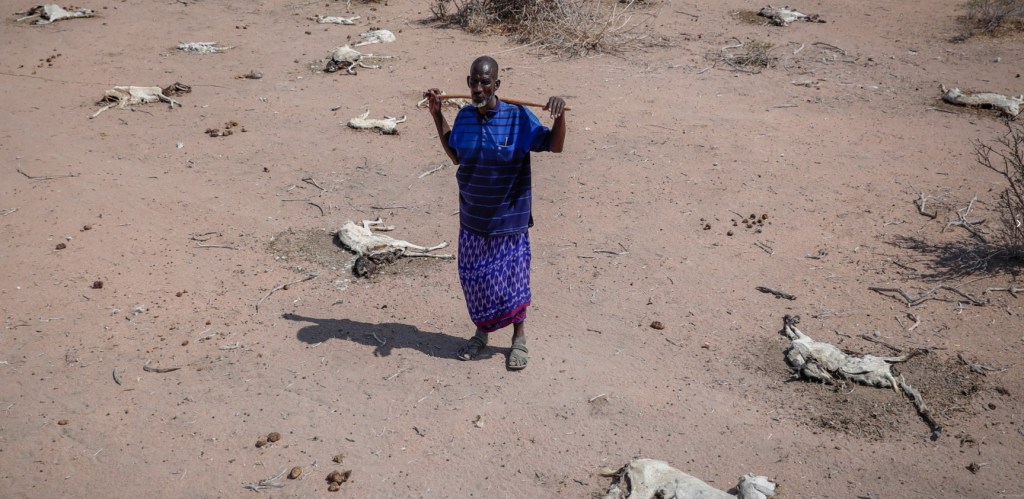
As world leaders addressed the global climate summit in Glasgow, pastoralists watched their beloved animals suffer from lack of water and food. Yusuf Abdullahi says he has lost 40 goats. “If they die, we all die,” he says.
Herder Yusuf Abdullahi walks past the carcasses of his forty goats that died of hunger in Dertu, Wajir County, Kenya. He said “If theY die, we all die!” (AP Photo)
Kenya’s authorities has declared a nationwide catastrophe in 10 of its 47 counties. The United Nations says greater than 2 million individuals are severely meals insecure. And with individuals trekking farther in quest of meals and water, observers warn that tensions amongst communities may sharpen.
“The warmth on the bottom tells you the signal of hunger we’re going through,” he says.
Rain has failed for two seasons in the east African country, leaving families without enough food and water. It also has snuffed out pasture for livestock, crippling herder communities throughout the nation.
In September, Nairobi and aid agencies estimated that 2.1 million people in 10 counties were affected by the drought. The numbers are expected to rise to 2.4 million by this month, relief agencies reported.
The harrowing footage was taken by Kevin Mtai, a climate campaigner from Pokot in Kenya.
He said: “In Kenya we have contributed less carbon emissions, but we are the ones paying the highest price.
“Animals are dying and people are suffering because of the climate crisis.”
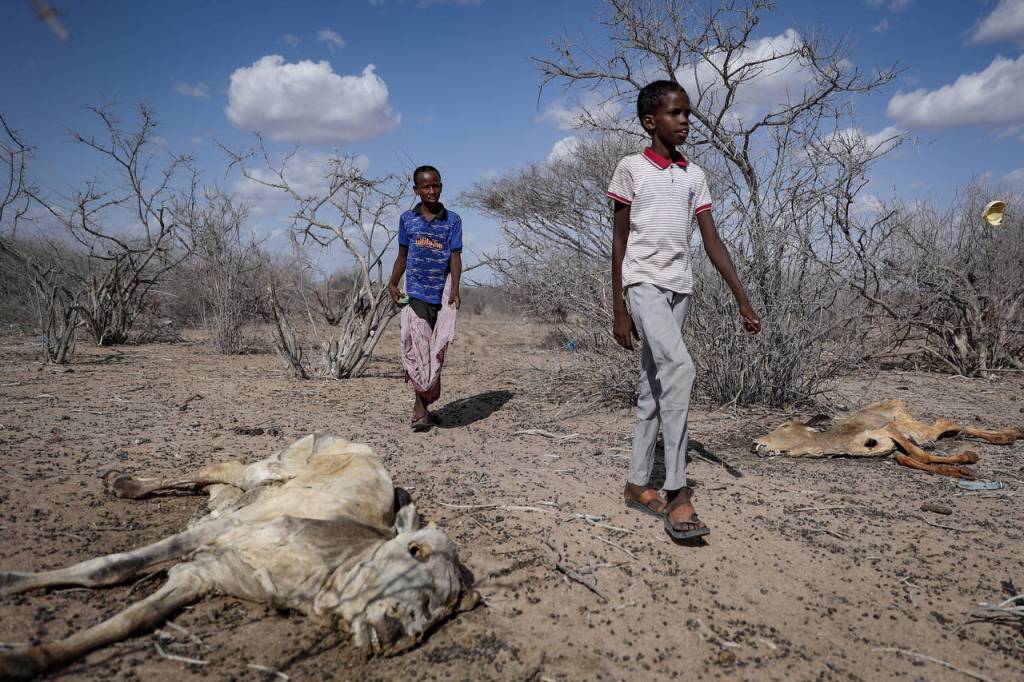
The children of herders walk past cattle carcasses in the desert near Dertu, Wajir County, Kenya. (AP Photo)
Experts warn that such climate shocks will become more common across Africa, which contributes the least to global warming, but will suffer from it the most.
“We do not have a spare planet in which we will seek refuge once we have succeeded in destroying this one,” the executive director of East Africa’s Intergovernmental Authority on Development, Workneh Gebeyehu, said last month.
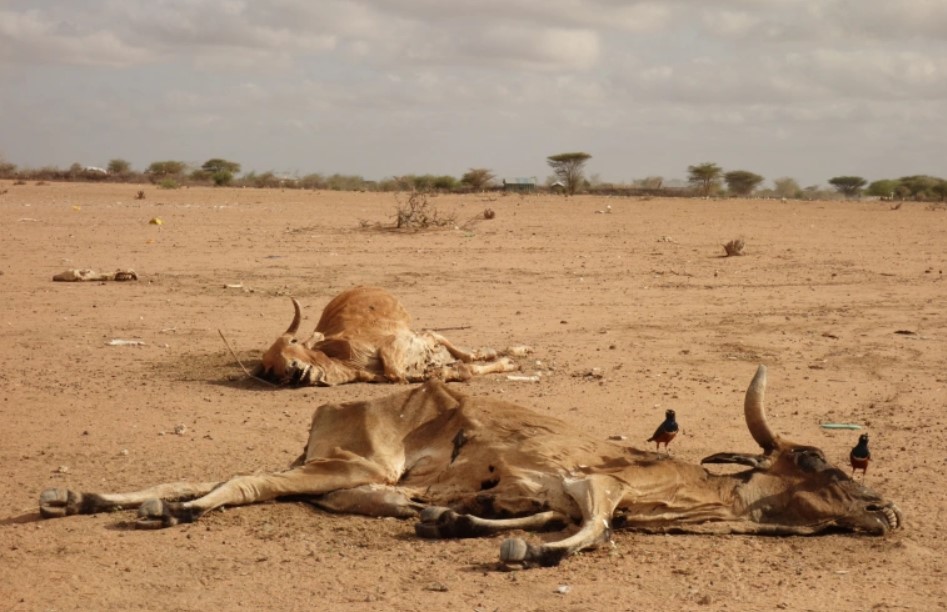
As if in a macabre parade, cattle carcasses line the two sides of the dusty road leading into Biyamadow, a sleepy village in northern Kenya’s Wajir county.
The grisly spectacle of dismembered animals rotting beneath the scorching sun is the result of a prolonged drought that has been pushing pastoral communities here – and the livestock they exclusively rely on – to the brink of disaster, reports Aljazeera.
“In 72 years of life, I have never seen something like this,” said Ibrahim Adow, a Biyamadow resident.
cattle carcasses line the two sides of the dusty road leading into Biyamadow, a sleepy village in northern Kenya’s Wajir county. [Virginia Pietromarchi/Al Jazeera]
Gabriel Ekaale, a policy officer for the World Food Programme based in Lodwar told Sky News: “It’s estimated about 600,000 members of the population in Turkana County are in need of food or cash assistance.”
Kenya’s Catholic Bishops met in Nairobi this week to ask the country’s Catholic faithful to donate food to regions affected by severe drought, the Vatican News reports.
They released an open letter stating: “It is becoming clear that the frequent droughts that we are experiencing in many parts of our country are as a result of global climate change and environmental degradation.
“Here in Kenya, it seems our model of development has led to a culture of degradation of our environment and the depletion of our natural resources.”
Please SHARE to raise awareness to this tragedy. You can also SIGN UP to receive news and updates straight to your inbox.
Deep in the Alaskan wilderness, a prospector came to the rescue of an injured mother wolf and her pups, and a lasting connection is formed.
One spring morning many years ago, I had been prospecting for gold along Coho Creek on south-eastern Alaska’s Kupreanof Island, and as I emerged from a forest of spruce and hemlock, I froze in my tracks. No more than 20 paces away in the bog was a huge Alaskan timber wolf—caught in one of Trapper George’s traps.
Old George had died the previous week of a heart attack, so the wolf was lucky I had happened along. Confused and frightened at my approach, the wolf backed away, straining at the trap chain. Then I noticed something else: It was a female, and her teats were full of milk. Somewhere there was a den of hungry pups waiting for their mother.
From her appearance, I guessed that she had been trapped only a few days. That meant her pups were probably still alive, surely no more than a few miles away. But I suspected that if I tried to release the wolf, she would turn aggressive and try to tear me to pieces. Here are the proven skills to survive any emergency.
So I decided to search for her pups instead and began to look for incoming tracks that might lead me to her den. Fortunately, there were still a few remaining patches of snow. After several moments, I spotted paw marks on a trail skirting the bog.
The tracks led a half mile through the forest, then up a rock-strewn slope. I finally spotted the den at the base of an enormous spruce. There wasn’t a sound inside. Wolf pups are shy and cautious, and I didn’t have much hope of luring them outside. But I had to try. So I began imitating the high-pitched squeak of a mother wolf calling her young. No response. A few moments later, after I tried another call, four tiny pups appeared.
They couldn’t have been more than a few weeks old. I extended my hands, and they tentatively suckled at my fingers. Perhaps hunger had helped overcome their natural fear. Then, one by one, I placed them in a burlap bag and headed back down the slope.
When the mother wolf spotted me, she stood erect. Possibly picking up the scent of her young, she let out a high-pitched, plaintive whine. I released the pups, and they raced to her. Within seconds, they were slurping at her belly.
What next? I wondered. The mother wolf was clearly suffering. Yet each time I moved in her direction, a menacing growl rumbled in her throat. With her young to protect, she was becoming belligerent. She needs nourishment, I thought. I have to find her something to eat.
I hiked toward Coho Creek and spotted the leg of a dead deer sticking out of a snowbank. I cut off a hindquarter, then returned the remains to nature’s icebox. Toting the venison haunch back to the wolf, I whispered in a soothing tone, “OK, Mother, your dinner is served. But only if you stop growling at me. C’mon, now. Easy.” I tossed chunks of venison in her direction. She sniffed them, then gobbled them up.
Cutting hemlock boughs, I fashioned a rough shelter for myself and was soon asleep nearby. At dawn, I was awakened by four fluffy bundles of fur sniffing at my face and hands. I glanced toward the agitated mother wolf. If I could only win her confidence, I thought. It was her only hope.
Over the next few days, I divided my time between prospecting and trying to win the wolf’s trust. I talked gently with her, threw her more venison, and played with the pups. Little by little, I kept edging closer—though I was careful to remain beyond the length of her chain. The big animal never took her dark eyes off me. “Come on, Mother,” I pleaded. “You want to go back to your friends on the mountain. Relax.”
At dusk on the fifth day, I delivered her daily fare of venison. “Here’s dinner,” I said softly as I approached. “C’mon, girl. Nothing to be afraid of.” Suddenly, the pups came bounding to me. At least I had their trust. But I was beginning to lose hope of ever winning over the mother. Then I thought I saw a slight wagging of her tail. I moved within the length of her chain. She remained motionless. My heart in my mouth, I sat down eight feet from her. One snap of her huge jaws and she could break my arm … or my neck. I wrapped my blanket around myself and slowly settled onto the cold ground. It was a long time before I fell asleep.
I awoke at dawn, stirred by the sound of the pups nursing. Gently, I leaned over and petted them. The mother wolf stiffened. “Good morning, friends,” I said tentatively. Then I slowly placed my hand on the wolf’s injured leg. She flinched but made no threatening move. This can’t be happening, I thought. Yet it was.
I could see that the trap’s steel jaws had imprisoned only two toes. They were swollen and lacerated, but she wouldn’t lose the paw—if I could free her.
“OK,” I said. “Just a little longer and we’ll have you out of there.” I applied pressure, the trap sprang open, and the wolf pulled free.
Whimpering, she loped about, favouring the injured paw. My experience in the wild suggested that the wolf would now gather her pups and vanish into the woods. But cautiously, she crept toward me. The pups nipped playfully at their mother as she stopped at my elbow. Slowly, she sniffed my hands and arms. Then the wolf began licking my fingers. I was astonished. This went against everything I’d ever heard about timber wolves. Yet, strangely, it all seemed so natural.
After a while, with her pups scurrying around her, the mother wolf was ready to leave and began to limp off toward the forest. Then she turned back to me.
“You want me to come with you, girl?” I asked. Curious, I packed my gear and set off.
Following Coho Creek for a few miles, we ascended Mount Kupreanof until we reached an alpine meadow. There, lurking in the forested perimeter, was a wolf pack—I counted nine adults and, judging by their playful antics, four nearly full-grown pups. After a few minutes of greeting, the pack broke into howling. It was an eerie sound, ranging from low wails to high-pitched yodelling.
At dark, I set up camp. By the light of my fire and a glistening moon, I could see furtive wolf shapes dodging in and out of the shadows, eyes shining. I had no fear. They were merely curious. So was I.
I awoke at first light. It was time to leave the wolf to her pack. She watched as I assembled my gear and started walking across the meadow.
Reaching the far side, I looked back. The mother and her pups were sitting where I had left them, watching me. I don’t know why, but I waved. At the same time, the mother wolf sent a long, mournful howl into the crisp air.
Four years later, after serving in World War II, I returned to Coho Creek. It was the fall of 1945. After the horrors of the war, it was good to be back among the soaring spruce and breathing the familiar, bracing air of the Alaskan bush. Then I saw, hanging in the red cedar where I had placed it four years before, the now-rusted steel trap that had ensnared the mother wolf. The sight of it gave me a strange feeling, and something made me climb Kupreanof Mountain to the meadow where I had last seen her. There, standing on a lofty ledge, I gave out a long, low wolf call—something I had done many times before.
An echo came back across the distance. Again, I called. And again the echo reverberated, this time followed by a wolf call from a ridge about a half mile away.
I had no fear. The wolves were merely curious. So was I.
Then, far off, I saw a dark shape moving slowly in my direction. As it crossed the meadow, I could see it was a timber wolf. A chill spread through my whole body. I knew at once that familiar shape, even after four years. “Hello, old girl,” I called gently. The wolf edged closer, ears erect, body tense, and stopped a few yards off, her bushy tail wagging slightly.
Moments later, the wolf was gone. I left Kupreanof Island a short time after that, and I never saw the animal again. But the memory she left with me—vivid, haunting, a little eerie—will always be there, a reminder that there are things in nature that exist outside the laws and understanding of man.
With four tiny pups to feed, the mother wolf would need to stay nourished.
During that brief instant in time, this injured animal and I had somehow penetrated each other’s worlds, bridging barriers that were never meant to be bridged. There is no explaining experiences like this. We can only accept them and—because they’re tinged with an air of mystery and strangeness—perhaps treasure them all the more.
This story originally appeared in the May 1987 issue of Reader’s Digest.
Please SHARE this beautiful story for others to enjoy. You can also SIGN UP to receive news and stories straight to your inbox.
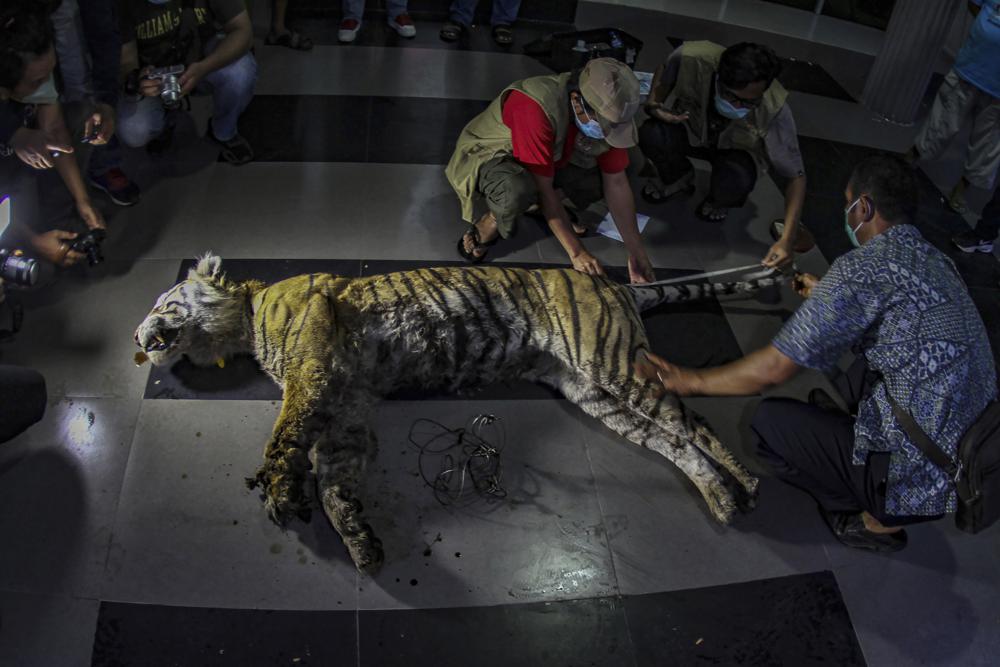
MEMBERS OF NATURAL RESOURCES CONSERVATION AGENCY INSPECT A SUMATRAN TIGER FOUND DEAD AFTER BEING CAUGHT IN A SNARE TRAP IN PEKANBARU, RIAU
A critically endangered Sumatran Tiger was found dead after being caught in a trap on Indonesia’s Sumatra island, authorities said on Monday, in the latest setback for a species whose numbers are estimated to have dwindled to about 400.
A STUNNING SUMATRAN TIGER
The female Tiger, aged between 4 and 5 years, was found dead Sunday near Bukit Batu Wildlife Reserve in the Bengkalis district of Riau province, said Fifin Arfiana Jogasara, the head of Riau’s conservation agency.
Jogasara said an examination determined the Tiger died from dehydration five days after being caught in the snare trap, apparently set by a poacher, which broke one of its legs.
She said her agency will cooperate with law enforcement agencies in an investigation.
Sumatran Tigers, the most critically endangered Tiger subspecies, are under increasing pressure due to poaching as their jungle habitat shrinks, according to the IUCN Red List of Threatened Species. It estimated fewer than 400 Sumatran Tigers remain in the wild.
It was the latest killing of endangered animals on Sumatra island. Conservationists say the coronavirus pandemic has led to increased poaching as villagers turn to hunting for economic reasons.
Three Sumatran Tigers, including two cubs, were found dead in late August after being caught in traps in the Leuser Ecosystem Area, a region for tiger conservation in Aceh province.
In early July, a female Tiger was found dead with injuries caused by a snare trap in South Aceh district.
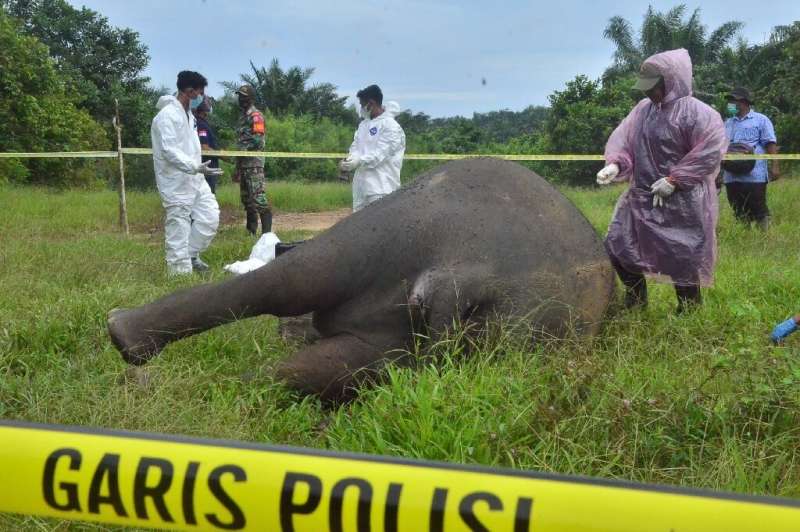
An Elephant was found without its head on July 11 in a palm plantation in East Aceh. Police arrested a suspected poacher along with four people accused of buying ivory from the dead animal.
AN ELEPHANT FOUND WITHOUT ITS HEAD AFTER BEING KILLED BY POACHERS
Aceh police also arrested four men in June for allegedly catching a Tiger with a snare trap and selling its remains for 100 million rupiah ($6,900). Days later, another Sumatran Tiger died after it ate a goat laced with rat poison in neighbouring North Sumatra province.
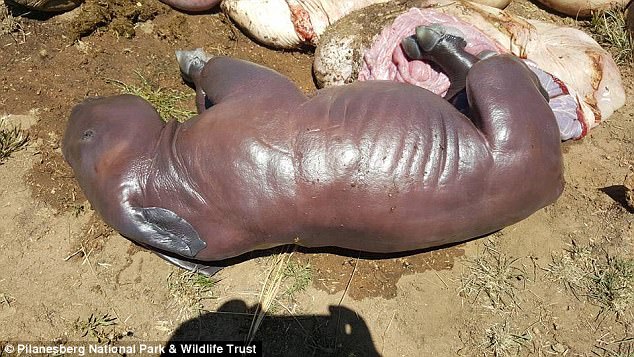
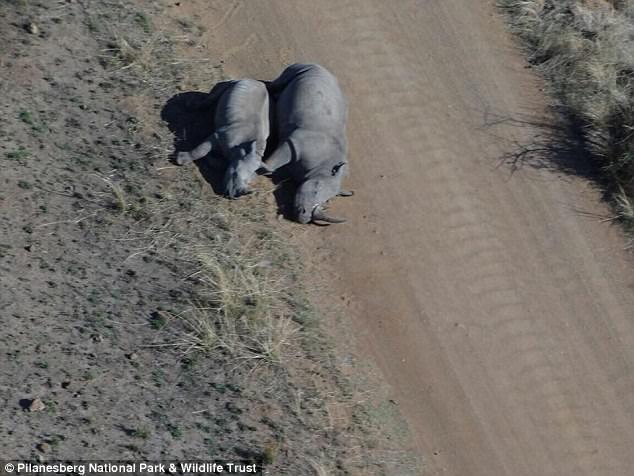
No chance: An unborn Rhino calf who died in its mother’s womb after she and its sibling were shot dead by poachers in South Africa
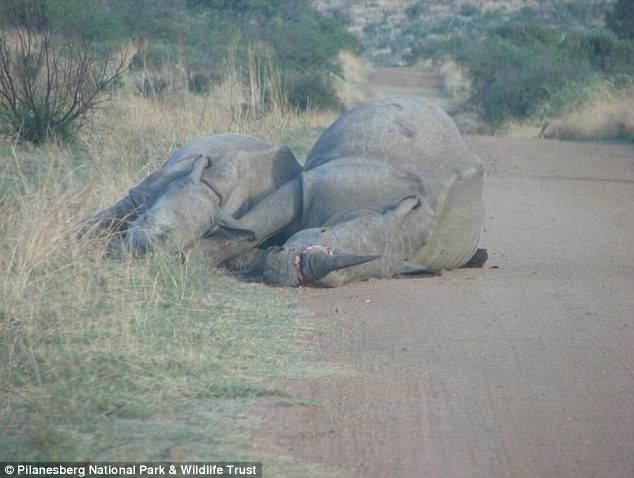
Heartbreaking: The markings around the mother’s horn show that the poachers had made an attempt to cut it off, but fled the scene when park staff arrived
The Rhino was heavily pregnant and roaming Pilanesberg National Park in Mogwase, north-west South Africa, with its calf when they were hunted down for their horns.
These heartbreaking images show an unborn Rhino calf who died after its mother and sibling were shot and killed by poachers.
Photos show the poachers began hacking off the mother’s prized horn, but they were interrupted by park rangers and fled before they had time to remove it.
When park staff tried to save the unborn calf, it was found to have died inside its mother’s womb.
Pilanesberg National Park wrote on its official Facebook page: ‘There are no words.
‘Mom and calf shot and killed by poachers. Horns are still on as the murderers fled the scene when they heard a game drive approach. Mom looks very pregnant as well. We are devastated.’
Pilanesberg National Park added in the post that a reward will be issued for any information leading to an arrest and prosecution of the poachers.
A spokesperson for the park told MailOnline that the mother Rhino was aged eight and the calf just two years old. The unborn foetus would have been due in February next year.
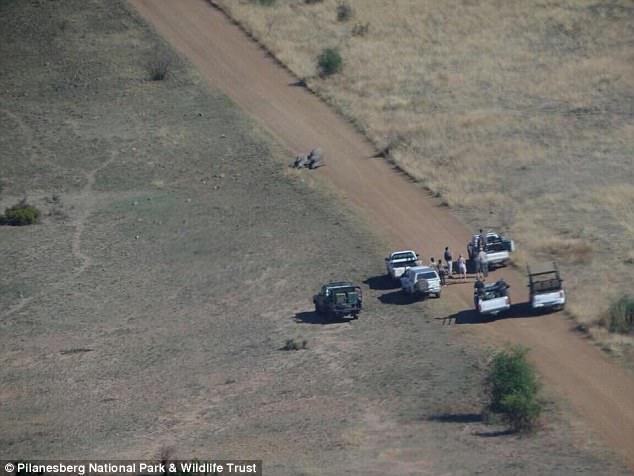
Killed: The heavily pregnant Rhino and its calf lie by the roadside where they were shot
‘We have lost 16 Rhino and 3 unborn calves so far 2017 – that we are aware of,’ the spokesperson said.
‘This loss is not due to lack of interest or effort from Park management, as this is a large park with many valleys and hills, which is a difficult territory to operate in.’
Since 2007, more than 6,000 Rhinos have been shot and butchered for their horns in South Africa alone.
The majority of those have come in the last four years with around a thousand being killed every year since 2013.
Sometimes the Rhinos are shot dead, in other cases they are brought down with a tranquiliser gun before having their horn hacked off – leaving the Rhino to wake up and bleed to death painfully and slowly.
The province of KwaZulu-Natal, which has the greatest density of Rhino in South Africa, has seen 139 slaughtered already this year.
Despite countries such as China, Vietnam, South Korea, Malaysia and even India believing Rhino has medicinal values, repeated studies have not found any evidence to support the claims.
Sad: Park rangers and guests gather at the heartbreaking scene in Pilanesberg
Rhino horns are made from a protein called keratin, the same substance that human fingernails and hair are made of. The horn is essentially just a compacted mass of hairs that continues to grow throughout the animal’s lifetime, just like human hair and nails.
It is similar in structure to horses’ hooves, turtle beaks, and cockatoo bills – however these animals are not hunted and slaughtered in the same way.
Tragically tradition and cultural beliefs in some Asian countries mean the demand for Rhino horn has not waned despite just some 20,000 white Rhino being left in the wild.
Poachers are now being supplied by international criminal gangs with sophisticated equipment to track and kill Rhinos. Based on the value of the Asian black market, Rhino horn price is estimated at $ 65,000 USD per kg*. In the near past, the Rhino horn price soared up around $65,000 per kilogram. This price hike turned the Rhino horn more valuable than gold and many other precious metals, also many times more worthy than Elephant ivory. (*2020 figures)
Please SHAREto raise awareness of the horrific result of poaching. Please SUBSCRIBE for news and updates.




 PROTECT ALL WILDLIFE