Jailed Poacher Sentenced For Killing Second Skukuza Rhino

A Mozambican national serving a prison sentence for Rhino poaching has been slapped with another lengthy jail term after being convicted of killing a second Rhino in the Skukuza National Park.

Convicted poacher Lucky Mabunda

The National Prosecuting Authority said 47-year-old Lucky Mabunda, was sentenced in the town’s  Regional Court on Thursday to ten years direct imprisonment.

NPA spokesperson, Monica Nyuswa, said he was already serving a 19-year jail term for Rhino poaching and was convicted and sentenced for the second incident in 2019.

She said the court heard that Mabunda had entered the Skukuza National Park between February and September 2019. Field Rangers were patrolling and found the accused in possession of a firearm, axe, ammunition, and other items geared for hunting. They also found the carcasses of two Rhinos.

Nyuswa said he pleaded guilty to killing one rhino, before ballistic evidence taken from the Rhino killed in February, later provided the link back to him.

“It confirmed that the bullets found on the carcass were fired from the rifle found in the accused’s possession,” she said.

State prosecutor Lot Mgiba underscored the gravity of the offense, advocating for an appropriate sentence in court.

Consequently, the accused was found guilty and received a ten-year jail term. The importance of such legal actions in combating poaching, which poses a severe threat to endangered species and the potential for species extinction, was highlighted by Director of Public Prosecutions Advocate Nkebe Kanyane.

SANParks spokesperson, Ike Phaahla, says they welcome the sentence.

“We are elated at the sentencing, which is in addition to the 18 years he has already served since he was found inside the park. In this instance, a projectile was discovered next to the carcass and taken for ballistics. They came back pointing towards the accused, and he was requisitioned from the Department of Correctional Services to get an additional 10-year sentence. It’s a well-known fact that we still have people who, around this time, want to come in, but we want to warn them that Kruger National Park is a dangerous place to come.”

Kruger has lost 70% of ITS Rhinos in 10 years
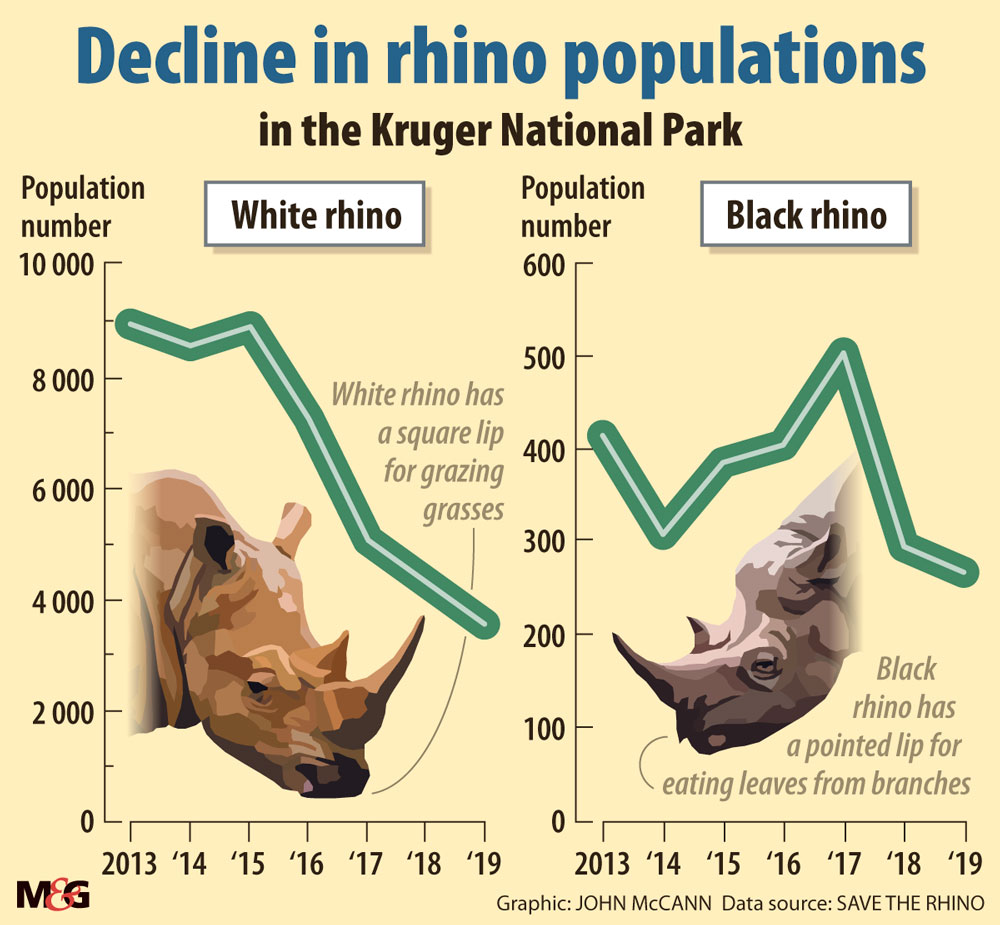
The Decline In Rhino Populations In KNP Graph: Save The Rhino

Rhino populations in the Kruger National Park have dropped by about 70% in the past decade because of the onslaught of poaching and prolonged drought. In its 2019-20 annual report, SANParks said that only about 3 549 White Rhinos and 268 Black Rhinos remain in the Kruger.

The environment department said poachers killing cows also ultimately kill dependent calves and cause future loss of calves — this effect equates to an additional five rhinos lost to the population per loss of one cow, now and in future. “Poaching also causes factors such as social disruption of Black Rhino societies. Cows then conceive less often.”

WHAT YOU CAN DO TO HELP ANIMALS IN NEED

You can support our work by donating as little as £5 – It only takes a minute but it can last a lifetime for an animal in need.

PLEASE DONATE HERE

Everyone who donates will receive a Certificate of Appreciation as a thank you for helping animals in need.

The Mission of Protect All Wildlife is to prevent cruelty and promote the welfare of ALL animals.

We believe EVERY animal should be treated with respect, empathy, and understanding. We raise awareness to protect and conserve wild, captive, companion and farm animals.

It is vital that we protect animals against acts of cruelty, abuse, and neglect by enforcing established animal welfare laws and, when necessary, take action to ensure that those who abuse animals are brought to justice.

Protect All Wildlife are involved in many projects to protect animals’ rights, welfare, and habitats. Money contributed to Protect All Wildlife supports ALL of our worthy programmes and gives us the flexibility to respond to emerging needs. Your donations make our work possible.
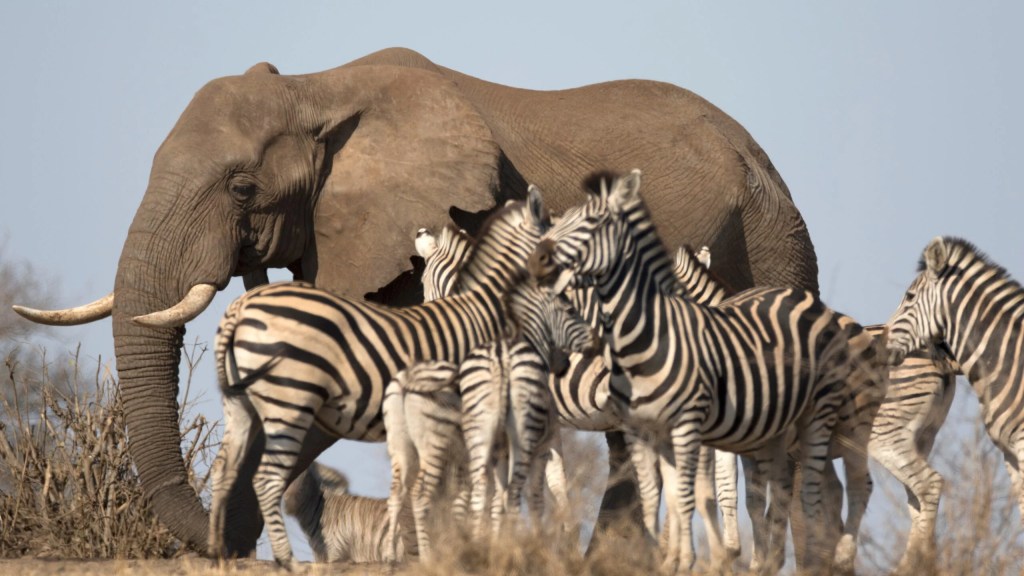
Drought Forces Zimbabwe To Relocate 2,500 Wild Animals To New Reserves

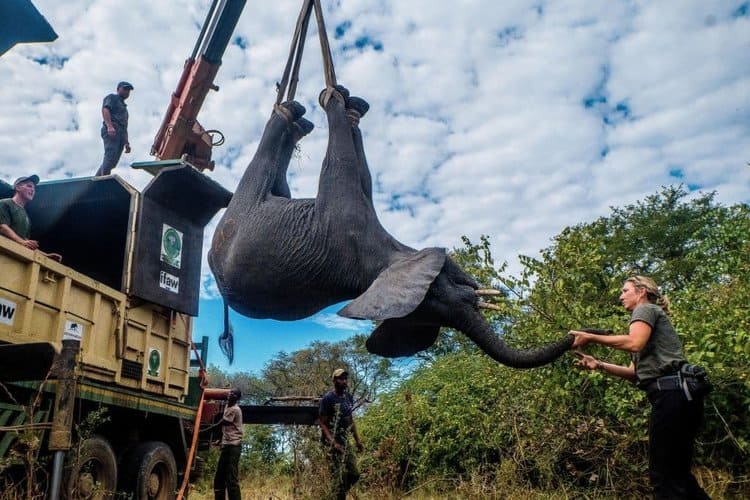
The effects of climate change are outpacing poaching as the No. 1 threat to wildlife. In Zimbabwe, officials are now moving more than 2,500 wild animals from a reserve in the southern part of the country further north due to an ongoing drought. Rangers are relying on trucks, cranes and even helicopters to move the animals from the drought-stricken area.

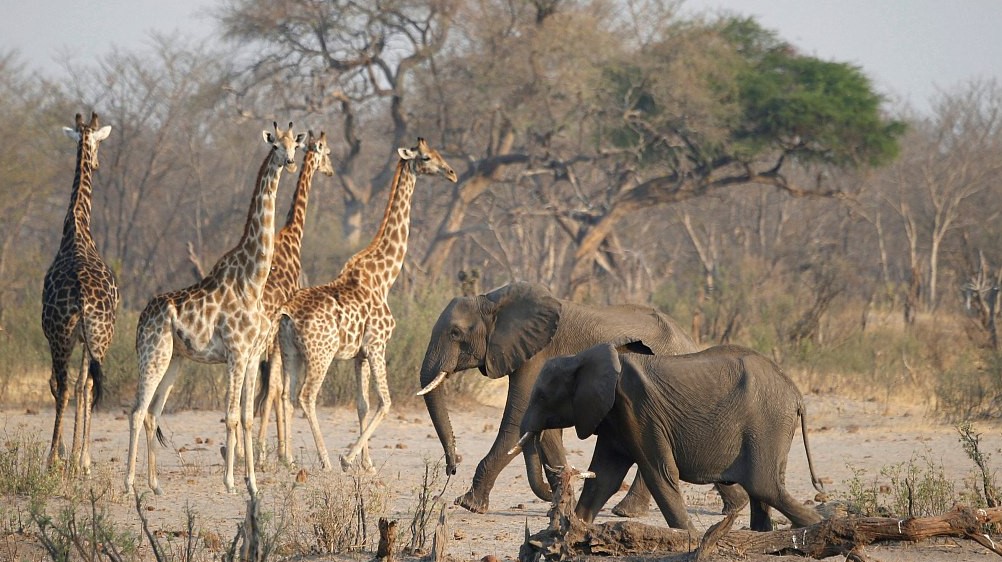
“Project Rewild Zambezi,” the operation has been dubbed, involves moving animals to the Zambezi River valley, which will also help improve wildlife populations in that area. It is one of the largest live animal relocation projects in southern Africa, with more than 2,000 impalas, 400 elephants, 70 giraffes, 50 each of buffalo, wildebeest, zebras, and elands, 10 lions and 10 wild dogs, among other animals, being moved north.

The animals are being relocated from the Save Valley Conservancy to the Sapi, Matusadonha and Chizarira conservancies in the north. According to officials, the project is necessary to avoid a crisis.

“We are doing this to relieve pressure. For years we have fought poaching and just as we are winning that war, climate change has emerged as the biggest threat to our wildlife,” Tinashe Farawo, spokesperson for the Zimbabwe National Parks and Wildlife Management Authority, told The Associated Press. “Many of our parks are becoming overpopulated and there is little water or food. The animals end up destroying their own habitat, they become a danger unto themselves and they encroach neighboring human settlements for food resulting in incessant conflict.”

One other option was to cull some of the animals to reduce competition for resources among the wildlife, but Zimbabwe has not had a culling since 1987. Conservationists argue that culling is a cruel and unnecessary solution.

The “Project Rewild Zambezi” is one of the largest in Zimbabwe. The country’s last mass relocation of wildlife occurred from 1958 to 1964, as hydro-dam construction led to rising water that ultimately created Lake Kariba. More than 5,000 animals had to be relocated at the time.

Drought is becoming an increasing threat in Zimbabwe and across Africa, reducing food and water available for wildlife, including vulnerable rhinos and giraffes. But hunting and poaching have also taken their toll. In Sapi Reserve, a UNESCO site, wildlife populations quickly declined from the 1950s until 2017, when it was taken over by the non-profit Great Plains Foundation. Relocating animals from areas affected by drought will also help in the foundation’s efforts to rewild and restore populations in Sapi Reserve.

What you can do to help wildlife:

Support ‘Protect All Wildlife’ by donating as little as £1 – It only takes a minute but it can last a lifetime for an animal in need.

We believe EVERY animal should be treated with respect, empathy, and understanding. We raise awareness to protect and conserve wild, captive, companion and farm animals. It is vital that we protect animals against acts of cruelty, abuse, and neglect by enforcing established animal welfare laws and, when necessary, take action to ensure that those who abuse animals are brought to justice.

Protect All Wildlife are involved in many projects to protect animals’ rights, welfare, and habitats. Money contributed to Protect All Wildlife supports ALL of our worthy programmes and gives us the flexibility to respond to emerging needs. Your donations make our work possible. Thank you for your support.
Everyone who donates will receive a Certificate of Appreciation as a thank you for supporting wildlife.

CERTIFICATE OF APPRECIATION

The South African National Parks (SANParks) Has Concluded Its Investigations Into Kruger Park Rangers And Others Filmed Abusing A Euthanised Leopard

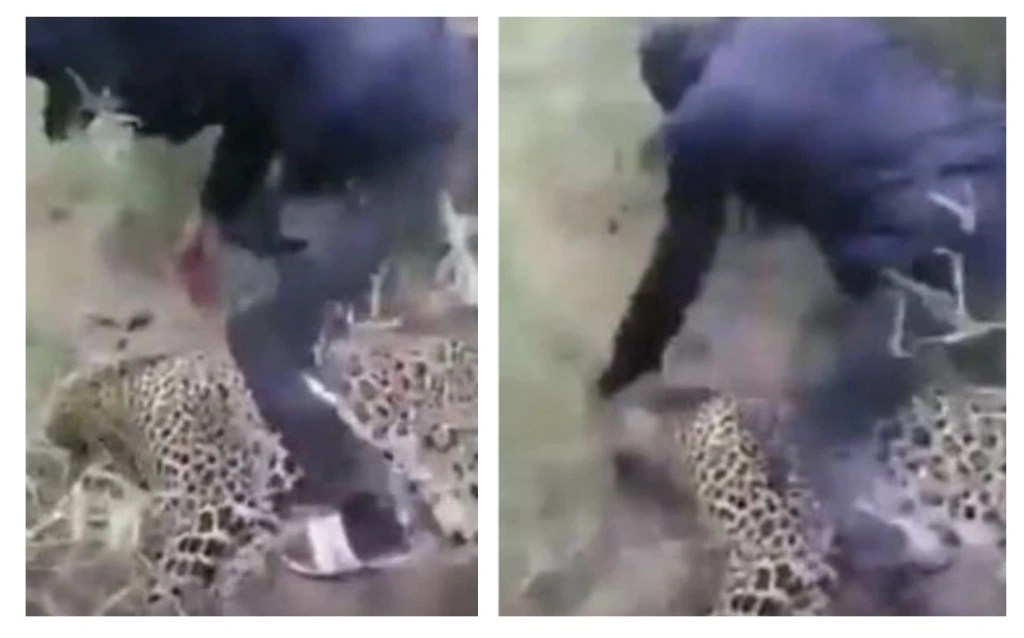
RANGER SLAPPING DEAD LEOPARD

Kruger National Park rangers and other employees were filmed abusing a euthanised Leopard. SANParks says their conduct was contrary to the ethos of the organisation whose primary goal is to act as the custodian of wildlife.

Rangers and employees at the Kruger National Park have had their statements taken after a video surfaced of them allegedly abusing a euthanised Leopard.

According to SANParks, custodian of the Kruger Park, four of the nine people seen slapping the dead animal are SANParks employees — three are rangers and one is employed as an environmental monitor. One person seen striking the Leopard was a visitor to the park.

So far, one employee has been suspended pending disciplinary action. “Line management is finalising their approach with respect to other employees who may have transgressed SANParks’ policies and code of conduct,” SANParks said. Regarding the visitor, SANParks said it “is taking legal advice on sanctions to be imposed on him”.

The incident happened on Sunday after an employee from Shalati Concession was attacked by a Leopard. According to SANParks, this was the second attack on an employee in the park in the same area since June 26.

The Leopard was shot 30 metres from where the attack happened. “In line with SANParks’ policies and standard operating procedures on the management of damage-causing animals, a decision was taken to euthanise the Leopard to safeguard human life.”

RANGER SLAPPING DEAD LEOPARD

On the abuse of the animal’s body, SANParks said it “strongly condemns the behaviour depicted in the images captured on video … Such actions are contrary to the ethos of the organisation whose primary goal is to conserve biodiversity and act as the custodian of our wildlife”.

“The actions of these individuals run counter to conservation management and the ethos of the organisation. During the next week a campaign will be embarked upon among all employees within the Kruger National Park to reinforce these values and ethics.

“The organisation commits to managing the outcomes in an open and transparent manner while respecting the requirements of legislation pertaining to this regrettable incident.

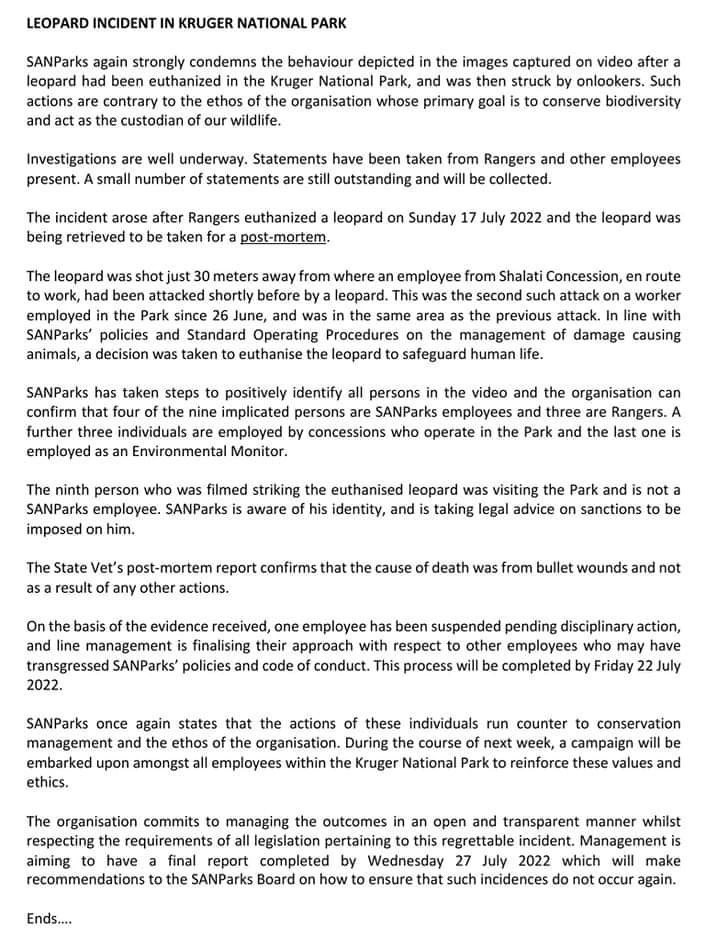
THE SOUTH AFRICAN NATIONAL PARKS STATEMENT FOLLOWING THE INCIDENT

“Management is aiming to have a final report completed by Wednesday, July 27, which will make recommendations to the SANParks board on how to ensure such incidences do not occur again.”

South African National Parks (SANParks) Investigation Findings

The South African National Parks (SANParks) says it has concluded its investigations into the abuse of a dead leopard – which was caught on film in a video which went viral; and has started implementing corrective measures… including banning the man who was seen striking the leopard’s face from entering the Kruger National Park again.

In a statement, SANParks explained that the Leopard had been found and euthanised close to employees’ living quarters (within 100m), and a crowd had subsequently gathered around the dead Leopard. A Management Incident Report found that there was insufficient crowd control.

The Report made recommendations to SANParks on ways to minimise such incidents occurring in the future, and to limit human wildlife conflict.

According to the report, the official procedures had been followed correctly in deciding to euthanise the Leopard.

The problems arose during the recovery of the carcass after the Ranger Corporal asked for assistance from bystanders to get the carcass from the bushes. It was at this point that the incident – which took place in the administrative area of Skukuza – was filmed.

SANParks said: “All identified SANParks employees were questioned and submitted statements. The individual who struck the Leopard is not a SANParks employee and has been barred from entering the Kruger National Park. Disciplinary action is ongoing for all SANParks officials as well as the individual who filmed the incident.”

The Management Report also recommended that the KNP Code of Conduct should be revisited and communicated to visitors and residents; and that procedures should be amended to improve the response to crowd control situations following an animal being euthanised near to humans.

What you can do to help animals in need:

Support ‘Protect All Wildlife’ by donating as little as £1 – It only takes a minute but it can last a lifetime for an animal in need. Thank you.

We believe EVERY animal should be treated with respect, empathy, and understanding. We raise awareness to protect and conserve wild, captive, companion and farm animals. It is vital that we protect animals against acts of cruelty, abuse, and neglect by enforcing established animal welfare laws and, when necessary, take action to ensure that those who abuse animals are brought to justice.

Protect All Wildlife are involved in many projects to protect animals’ rights, welfare, and habitats. Money contributed to Protect All Wildlife supports ALL of our worthy programmes and gives us the flexibility to respond to emerging needs. Your donations make our work possible. Thank you for your support.

Everyone who donates will receive a Certificate of Appreciation as a thank you for supporting wildlife.

CERTIFICATE OF APPRECIATION