The Elephant was a major attraction for tourists at the Kabini backwaters. The 60-year-old Elephant was found dead in the Gundre range of Karnataka’s Bandipur Tiger Reserve.
The Elephant was named Bhogeshwar by the forest department officers and tribals after he was often sighted near Bhogeshwar camp, where a temple and an anti-poaching camp are located. “Many tourists would be delighted and pleased on catching a glimpse of him, even if they were not able to sight a Tiger in Kabini. The tusker has also featured in several wildlife documentaries and films made by the department and some private organizations,” said a forest department official.
Bhogeshwara, reportedly the Elephant with the longest tusks in Asia, died of natural causes at the age of 60, according to officials. The wild Elephant, also known as Mr Kabini, was found dead in the Gundre range of Karnataka’s Bandipur Tiger Reserve on Saturday. The officials believe that he died three or four days ago.
According to forest department officials, Bhogeshwar’s tusks were 2.54 meters and 2.34 meters long.
Known for his gentle temperament, the Elephant frequented the Kabini backwaters for the last three decades. Wildlife enthusiasts who observed Bhogeshwara say that his calmness and long tusks used to attract the tourists at Kabini.
The director of the Bandipur Tiger Reserve, Ramesh Kumar, said: “The field staff found the carcass. We did not find any injury marks and the tusks were intact. Usually as they age, Elephants cannot eat properly due to the wearing of their teeth. The tusks were removed and carcass was left for the natural decomposition and scavengers to feed on,” he said.
FIELD STAFF WITH THE BODY OF BHOGESHWARA
The forest department in April came out with a notification that the carcass of the wild animals will not be incinerated or buried since they are an important source of energy and nutrients for predators and scavengers. The new rule, however, does not apply to tigers.
Meanwhile, tributes poured on social media for Bhogeshwara .
Bhogeshwara, the 58-year-old elephant of Kabini, Reserve forest. who has the longest core tooth in Asia is no more Om Shanthi pic.twitter.com/2bYJ6AWxuC
The Mission of Protect All Wildlife is to prevent cruelty and promote the welfare of ALL animals.
We believe EVERY animal should be treated with respect, empathy, and understanding. We raise awareness to protect and conserve wild, captive, companion and farm animals.
It is vital that we protect animals against acts of cruelty, abuse, and neglect by enforcing established animal welfare laws and, when necessary, take action to ensure that those who abuse animals are brought to justice.
Protect All Wildlife are involved in many projects to protect animals’ rights, welfare, and habitats. Money contributed to Protect All Wildlife supports ALL of our worthy programmes and gives us the flexibility to respond to emerging needs. Your donations make our work possible.
Please support our work by donating ANY amount, large or small. It only takes a minute and your donations make it all possible. Thank you for your support.
“Animals are not here for us to do as we please with. We are not their superiors. We are their equals. We are their family. Be kind to them.” ~ Ricky Gervais.
Cruelty to animals, also called animal abuse, animal neglect or animal cruelty, is the infliction by omission (neglect) or by commission by humans of suffering or harm upon any animal. More narrowly, it can be the causing of harm or suffering for specific achievement, such as killing animals for entertainment; cruelty to animals sometimes encompasses inflicting harm or suffering as an end in itself, defined as zoosadism.
Animal cruelty can be broken down into two main categories: active and passive. Passive cruelty is typified by cases of neglect, in which the cruelty is a lack of action rather than the action itself. Oftentimes passive animal cruelty is accidental, born of ignorance. In many cases of neglect in which an investigator believes that the cruelty occurred out of ignorance, the investigator may attempt to educate the pet owner, then revisit the situation. In more severe cases, exigent circumstances may require that the animal be removed for veterinary care.
Whether it is Elephants killed for their tusks or beaten so they comply in the Asian tourism ‘industry’, Rhino slaughtered for their horns for ‘traditional Chinese medicine (TCM), animals skinned alive for the fur trade etc, animal activists need to stand together to fight for their rights.
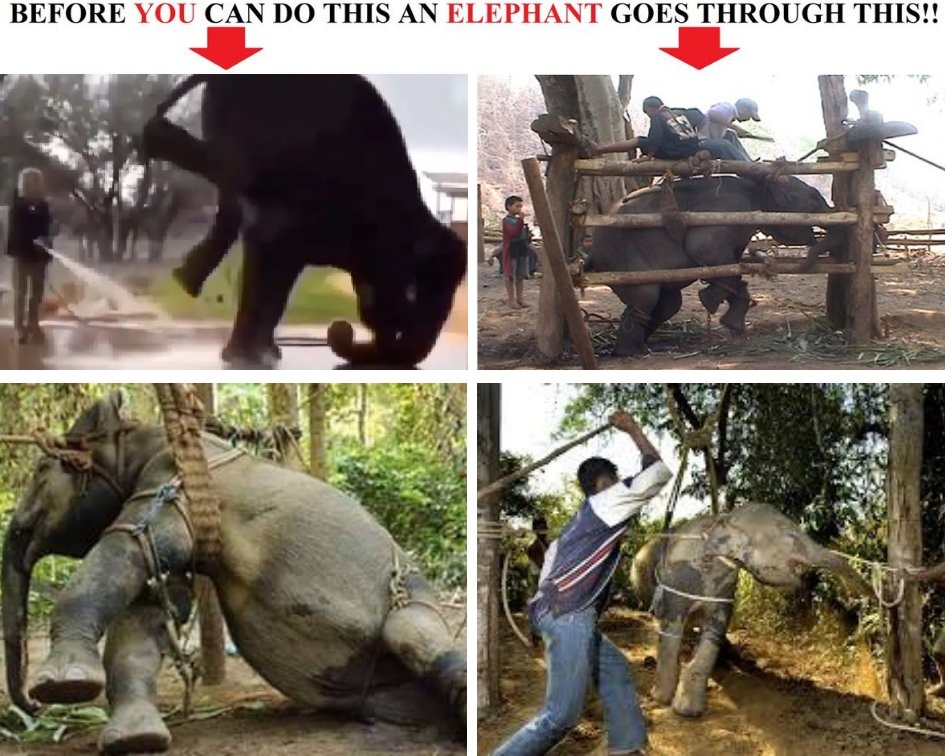
At many elephant ‘sanctuaries’ across Thailand and in other countries, the elephants are taught to fear humans. This is so that they will act with compliancy. From babies they are tied up, starved and beaten in what is known as a ‘crush’. This is the act of breaking a young elephant’s spirit. And it’s mostly true what they say: an elephant never forgets. This means that, with their long memories, elephants remember this period of abuse for the rest of their lives. It ensures that the elephants will do what the trainers (also known as mahouts) say, and are more easily trained.
They are also commonly beaten with hooks and sticks that have nails poking out of them – this is when they are seen to be misbehaving or not following orders, or being too slow to respond. The mahouts want the animals to be constantly putting on a performance for those tourists who are there for elephant riding in Thailand.
UNDERCOVER FOOTAGE SHOWS CRUEL TRAINING USED ON BABY ELEPHANTS TO BOOST THAILAND TOURISM
As poaching and habitat loss ravage rhinoceros and elephant populations, protections for these species are vitally important. Today, all five rhino species and both elephant species are threatened with extinction. Efforts are underway across the globe to save these iconic animals.
Elephants and rhinos often experience painful deaths when poached. Rhinos may have their horns cut off while they are still alive and contrary to belief, elephants do not lose their tusks; they are hacked out by poachers.
More than a thousand rhinos and tens of thousands of elephants are killed each year to feed demand for ivory and rhino horn. The international trade in elephants, rhinos, and other species is the second-largest threat to wildlife after habitat loss. If the market continues to drive poaching, both rhinos and elephants could vanish from the wild as early as 2034.
HORRIFIC IMAGES OF ELEPHANTS POACHED FOR THEIR TUSKS AND A RHINO FOR ITS HORN
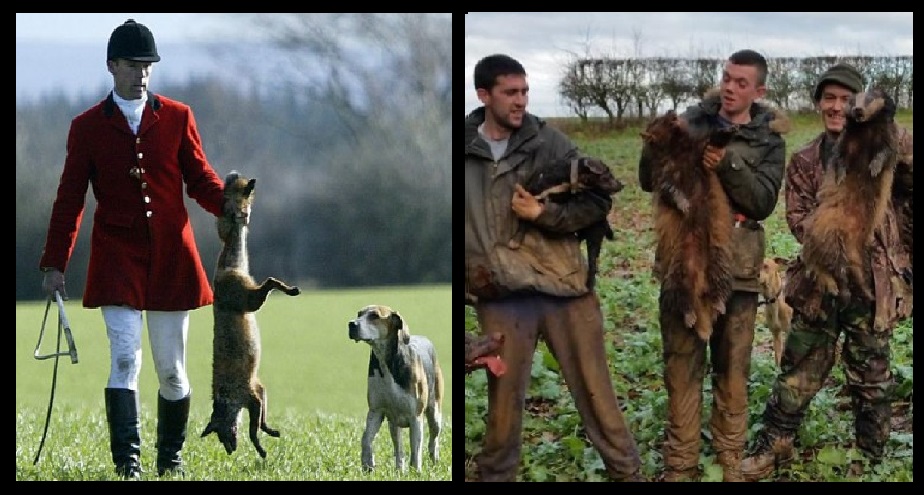
Every year, hundreds of badgers meet a horrific death in the name of ‘sport’ in the UK at the hands of terriermen. Many of those who have been caught digging into badger setts have used the excuse that they were after foxes – and many have escaped prosecution by so doing.
The Lychee and Dog Meat Festival, commonly referred to as the Yulin Dog Meat Festival is an annual event starting on 20th of June where an estimated 10,000 – 15,000 dogs and cats are slaughtered for their meat.
The ‘festival’ began in 2010 to celebrate summer solstice. Advocates and restaurant owners say that eating dog is traditional in the summertime. Around 10-20 million dogs are killed for their meat each year in China. However, critics argue there is no cultural value in the festival and it was mainly devised as a way of making money.
While slaughtering dogs is common in China, the festival is seen as representative of the cruelty and lack of hygiene associated with the largely unregulated industry. In addition, many of the animals killed are stolen pets some of which have been seen still wearing their collars.
Some are sent to the festival in small cages without food or water on trucks that can travel hundreds of miles.
Slaughtering takes place in front of the live animals, usually with a club or with a blow-torch to induce the pain and fear that some restaurant owners claim makes their adrenaline-rich meat tastier.
“Psychologically and mentally, they have already died many times,” said Peter Li, a China policy specialist with the Humane Society International.
DOGS ARE TORTURED TO DEATH IN THE BELIEF THAT IT MAKES THE MEAT TASTIER
Trophy hunters pay large sums of money, often tens of thousands of dollars, to travel around the world to kill wild animals. Who can forget the killing of Cecil the Lion in 2015 in Zimbabwe? He was hunted over many hours with a bow and arrow, before being skinned and beheaded by Dentist Walter Palmer.
More often than not animals in their prime and in breeding age are targeted by trophy hunting because of their specific characteristics; their black mane, their long tusks, the size of their antlers, in fact Safari Club International offers prizes for the largest animals killed. Where older males are targeted this can have extreme negative consequences for the herd or pride; older males offer protection to groups and keep juvenile males in line, when they are killed less experienced animals move in, increasing the risk of human wildlife conflict and killing the cubs of the older male. When the elephants with the largest tusks are killed, we have seen the size of elephant tusks in the population decrease over time, making it harder to find food and defend themselves.
CECIL THE LION WAS SHOT BY DENTIST WALTER PALMER IN JULY 2015 AND CAUSED INTERNATIONAL OUTRAGE
More than 10,000 are caught, tortured and killed in the UK each year by huntsmen with terriers – with almost a third of these illegal acts being carried out in Wales. Alarmingly, this figure is rising constantly. Terry Spamer, a former RSPCA inspector, believes that there are around 2,000 people involved in badger baiting currently. However, only around three people are caught and convicted of badger baiting each year, while the majority carry on breaking the law.
Traditional fox hunting was banned in England and Wales under the Hunting Act 2004. In spite of existing legislation, there has been 500 successful prosecutions under the Act. However, many incidents of illegal hunting have gone unpunished.
FOX HUNTING AND BADGER BAITING IS ILLEGAL IN THE UK BUT CARRIES ON WITH WITH APPARENT IMPUNITY
Dogfighting is an inhumane ‘bloodsport’ where dogs who have been bred, conditioned and trained to fight are placed in a pit to fight each other for spectator ‘entertainment’ and profit. Fights average one to two hours, ending when one of the dogs cannot continue.
Dog fights usually take part in quiet, private locations, such as in an industrial unit or farm building. Participants will spend months training their dogs in preparation, much like boxing, the fighters will have to hit a target weight to take part. Organisers will create a fighting ‘pit’ for the dogs to fight within.
Dogs who have been used in fighting often have serious injuries to their head, ears, front legs and chest that are caused as they go head-to-head in a pit. They will also have injuries of different ages, some old scars and some fresh wounds.
IT IS BELIEVED OVER 16000 DOGS DIE EACH YEAR IN ORGANIZED DOG FIGHTS
Each year, thousands of bulls are barbarically slaughtered in bullrings around the world. Over the centuries, bullfighters have found countless ways to rig the “fight” in their favor. Bulls are often weakened with drugs or by having sandbags dropped on their backs. Their horns have been shaved to keep them off balance, or petroleum jelly has been rubbed into their eyes to impair their vision.
Every year, approximately 250,000 bulls are killed in bullfights. Bullfighting is already banned by law in many countries including Argentina, Canada, Cuba, Denmark, Italy and the United Kingdom. Although legal in Spain, some Spanish cities, such as Calonge, Tossa de Mar, Vilamacolum and La Vajol, have outlawed the practice of bullfighting. There are only a few countries throughout the world where this practice still takes place (Spain, France, Portugal, Mexico, Colombia, Venezuela, Peru, and Ecuador). ~ HSI.
BULLS ARE TORTURED IN THE NAME OF CULTURE AND TRADITION
Each year from approximately September 1 to March 1, a large-scale hunt of dolphins takes place in the small village of Taiji, Japan, as featured in the 2010 Academy Award-winning documentary The Cove. During this six month season, dolphin hunters utilize drive hunt techniques to herd large numbers of dolphins to shore, resulting in their capture or death.
The captured dolphins may be selected for live trade to aquariums and marine parks for display, while others are slaughtered for their meat. The price for live captures is many times higher than those killed.
THE ANNUAL TAIJI DOLPHIN SLAUGHTER
What you can do to help end animal abuse
We believe EVERY animal should be treated with respect, empathy, and understanding. We raise awareness to protect and conserve wild, captive, companion and farm animals.
It is vital that we protect animals against acts of cruelty, abuse, and neglect by enforcing established animal welfare laws and, when necessary, taking action to ensure that those who abuse animals are brought to justice.
The Mission of Protect All Wildlife is to prevent cruelty, promote the welfare of ALL animals EVERYWHERE, and help END animal abuse.
Please support our work by donating ANY amount, large or small. It only takes a minute and your donations make it all possible. Thank you for your support.
What else you can do to help
Please SHARE to raise awareness to wildlife and environmental issues from around the world.
Baby orangutans are prized possessions on the illegal black market, where many other critically endangered species are trafficked. Aman is just one of many infant Orangutans who were stolen from their mothers in the past couple of years, but his story highlights the extent of the illegal wildlife trade and the trauma that young orangutans suffer.
An infant Orangutan cannot be taken from its mother without force. Mother Orangutans will fight to the death to save their babies. To feed this insidious illegal trade, the mothers are almost certainly killed, often with machetes or guns. Not only are the infants traumatized and smuggled far from the forest, but the whole species is also robbed of future generations through the brutal murders of female orangutans.
Traumatic Transportation
Once captured by wildlife criminals, the babies are typically forced into boxes, crates, or even postage bags to be smuggled through or out of Indonesia, often to far-flung places like Thailand, the Middle East, Europe, or Singapore. Many also end up in small wooden cages, hidden away in homes across Indonesia. Owning a baby Orangutan is seen as a status symbol, even though the practice is illegal in both Indonesia and Malaysia.
Regardless of where these highly intelligent beings end up, their freedom is gone forever unless they can be rescued. They are often fed the wrong food, are unable to climb or make nests in trees, and can become unwell and experience mental health issues. Some, like Aman, will carry the physical reminders of their early trauma for the rest of their lives.
Aman’s Story – From Trauma to Safety
Aman is missing the tops of his fingers on his left hand. His rescuers in Borneo believe his fingers were most likely hacked off while he clung to his mother as she was killed. It’s almost impossible to imagine what this young orangutan has been through in his short life: from being torn from his mother’s arms and experiencing her murder, to the pain of losing his fingers, to being shoved into a chicken coop and forced to look out at the world through wooden slats.
Aman was rescued in June 2020 by the Bornean Orangutan Rescue Alliance (BORA) from a family home in Berau in East Kalimantan, Borneo. The BKSDA (Nature and Conservation Agency) contacted the BORA rescue team to notify them about an illegally held Orangutan, who they believed was about two years of age, and asked the team to help confiscate him.
The team immediately set to work and prepared an enclosure in their rescue center for the pending arrival at their vet clinic of the rescued Orangutan. They loaded a transport cage into their vehicle, left early one morning, and traveled to the home in Berau, where they found the young Orangutan peering up at them through the slats of a chicken coop. They learned he’d been fed mostly on bananas, water, and candy, and as soon as he was in their transportation crate, he was given leaves to rest on and fruit to eat. The confiscation and transport back to the rescue center went smoothly, although that is not always the case.
Within days of being rescued, the young Orangutan was recovering, learning to eat leaves and twigs, and finding simple joy in his freedom. Soon after he arrived at the rescue center, the team at The Orangutan Project, one of the BORA partners, contacted a bequestor to ask for a new name for the young orangutan. The name Aman was chosen as it means ‘safe’ in Indonesian.
Nearly two years later, Aman still occasionally struggles to climb trees or open fruit, but he never gives up. Through the love and kindness of the Orangutan carers, the good diet of fruit, leaves, twigs, and termites; and the opportunity to learn from older orangutans and carers how to climb trees, swing through the branches and build a nest, Aman is flourishing.
Jungle School was a new experience, but despite his missing fingertips, Aman is not daunted and is learning how to climb, swing through the trees, and forage for his food. He is a sweet, courageous young Orangutan who gives everything a go. Aman’s story is a testament to the resilience of young Orangutans who have been orphaned by the illegal wildlife trade, as long as they are one of the ‘lucky’ ones to be rescued from a life of captivity.
The Most Trafficked Great Ape
Orangutans are one of the most heavily trafficked critically endangered animals sold on the black market. International Orangutan conservation organization, The Orangutan Project, estimates that only one in six orangutans are rescued. Of the hundreds that the organization and its partners care for, there are thousands more that have been killed.
Surprisingly, some baby Orangutans are even bought and sold online through sites such as Facebook, Whatsapp, and Instagram. At a price tag of $1,000 or more, baby orangutans are highly prized within the illegal wildlife trade, which is also responsible for poaching Tigers, Elephants, Pangolins, Rhinos, and many more species.
As the forests of Borneo and Sumatra are destroyed, critically endangered species become more accessible to poachers. This, in turn, helps drive biodiversity loss throughout the remaining fragmented habitat. These dense, rich forests are healthiest when species like Orangutans, elephants, and tigers are flourishing.
Less than Ten Years to Save the Orangutan
I believe, along with many other scientists and primatologists, that there are less than ten years to save orangutan populations from becoming too small, vulnerable, and fragmented to stop them from spiraling towards extinction. Without urgent action to safeguard the remaining rainforests of Indonesia, many species will die out. As forests are cut down for timber, mining, and unsustainable monocultures such as palm oil, pulp paper, or rubber trees, orangutans and other species become easier prey for wildlife traffickers.
There are still forests in Borneo and Sumatra. There are still Orangutans, Tigers, and Elephants living wild and free in these forests. But without massive injections of funds to safeguard the remaining ecosystems, it won’t matter how many Orangutans are rescued from the illegal wildlife trade. While being rescued matters to individuals like Aman, this highly sentient species will have no forest habitat to return to without intact ecosystems.
We might save individual Orangutans, but if we don’t save the right size, type, and shape of the forest, Orangutans will become extinct in the wild. In 10 years, we might still have some forest left but not enough to sustain Orangutan populations. We might have some Orangutans left, but their numbers will be too low to secure the future of the species. And zoo populations are too small and too problematic to provide meaningful help.
The most important act we can take now is to safeguard the remaining forests of Sumatra and Borneo. The Orangutan Project aims to protect eight key ecosystems across Borneo and Sumatra through legally binding agreements that put a stop to legal deforestation, unsustainable monocultures, and mining in those forests. At present, this world-renowned international organization has formed partnerships that have helped secure the future of two key ecosystems: the Bukit Tigapuluh Ecosystem in Sumatra and the Sebangau Ecosystem in Borneo.
Working with key partners in Borneo and Sumatra, The Orangutan Project is approaching the problem from all sides. To ensure these forests stay intact, they employ teams of wildlife rangers to patrol the ecosystems to reduce all illegal activities such as logging, hunting, and snares. Their teams work closely with local communities, supporting economic development projects that provide incentives for forest conservation.
They engage with and empower indigenous communities in Borneo and Sumatra, responding to their immediate, expressed needs and aspirations with projects that support strength, resilience, and education. The evidence is encouraging; everywhere these rangers patrol the forest and engage local communities, illegal activities reduce over time, and farmers, children, and villagers become protectors of the forest.
All these efforts – from rescuing and rehabilitating Orangutans like Aman to patrolling vast tracts of forest and educating and empowering communities – require significant funds each year. Without funds from donors all over the world, such as Australia, the United States, Europe, and more, these activities would not be possible. Without support, many more Orangutans would be poached and illegally traded, and the richly biodiverse forests of Sumatra and Borneo would not be protected.
Although actions now save Orangutans like little Aman, these steps taken will also bear fruit in the future – in 10, 20, or more years. Some of us will not be alive to see the outcomes of our actions and support – but we know that if we are part of this solution, we are helping bring about long-term survival, not only of Orangutans but also of Tigers, Elephants, Rhinos and the local people who live in and near the forests.
The Mission of Protect All Wildlife is to prevent cruelty, promote the welfare of ALL animals EVERYWHERE, and help END animal abuse.
Please support our work by donating ANY amount, large or small. It only takes a minute and your donations make it all possible. Thank you for your support.
Royal Bengal Tiger In The Neora Valley National Park
The Royal Bengal Tiger Seen in Neora Valley National Park was caught on camera. The picture of the Royal Bengal Tiger was captured in Neora valley national park. For the past few years, the Royal Bengal Tiger has been found in the Neora Valley National Park in the Gorumara wildlife division. Once again, the Royal Bengal Tiger can be seen roaming in the forest. Some of these images were captured on The Trap Camera on Sunday. Once again the wildlife department is excited that the picture of the Royal Bengal Tiger has been captured on the trap camera.
The state’s principal chief conservator of forests, Deval Roy, said, “We have received pictures of the Royal Bengal Tiger in the forests of Neora before. But this time the picture was caught on the trap camera several times. Earlier in the winter, pictures of the Royal Bengal Tiger were captured on camera. This time the picture has been taken from December to March. It is being investigated whether the pictures taken are of the same Tiger. “
Earlier there was a lot of evidence that there were Tigers in the jungles of Neora Valley. Once upon a time, there was a Tiger in the Neora Valley, but it was not seen for several years. The foresters thought that some of the places in the forest, which are still unfit for human transport, are suitable for Tigers to live in. At times, the Tiger seems to be scratched at the base of the tree, but no forester has seen the Tiger. On January 18, a Tiger was first spotted on the side of the road from Pedong to Lava. On January 18, a driver in the hills, Anmol Chhetri, caught him on camera.
On December 19, 2017, an automobile driver named Anmol Chhetri captured the first picture of the Tiger on his way from Lava to Rishop on his mobile camera. After that, the trap camera was created by the forest department. The camera captured pictures of the Royal Bengal Tiger several times. And that’s why they guessed that there were more than one number of Tigers in the forests of The Neora Valley. Since then, more or less pictures of Tigers have been captured every year. Even last year, the Tiger was captured on camera. And once again the picture of the Tiger was caught on the trap camera kept in the forest. Ensuring the safety of the Tigers is now the only aim of the forest department. For this, the security of the forests of Nawara is being strengthened, said an official of the concerned department.
The Buxa forest has the recognition of the Tiger Project in the North East. However, there has been a debate over whether there are Tigers or not for the past few years. Meanwhile, there is a rush to bring Tigers from Vin state to Buxa. And in the meantime, the Tiger was seen in the Neora Valley. Not once, but several times.
A Tiger was first spotted in the region in January 2017 by a car driver who took photos of the big cat. Later, the same Tiger was caught on a trail camera installed by the forest department across the 88-sq km the national park in January 2018.
The Tiger Was Earlier Caught On A Trail Camera In The 88-Sq Km Neora Valley National Park
“On December 18, 2019, a trail camera captured a tiger. We are yet to analyse the image. We cannot say right now if it is a male or a female,” said Ravi Kant Sinha, principal chief conservator of forests and chief wildlife warden of West Bengal.
“A thorough analysis of all images captured in the past three years is yet to be done. So, it is not possible for us to say if there are multiple tigers or the same one is being spotted,” Sinha added.
The Mission of Protect All Wildlife is to prevent cruelty, promote the welfare of ALL animals EVERYWHERE, and help END animal abuse.
Please support our work by donating ANY amount, large or small. It only takes a minute and your donations make it all possible. Thank you for your support.
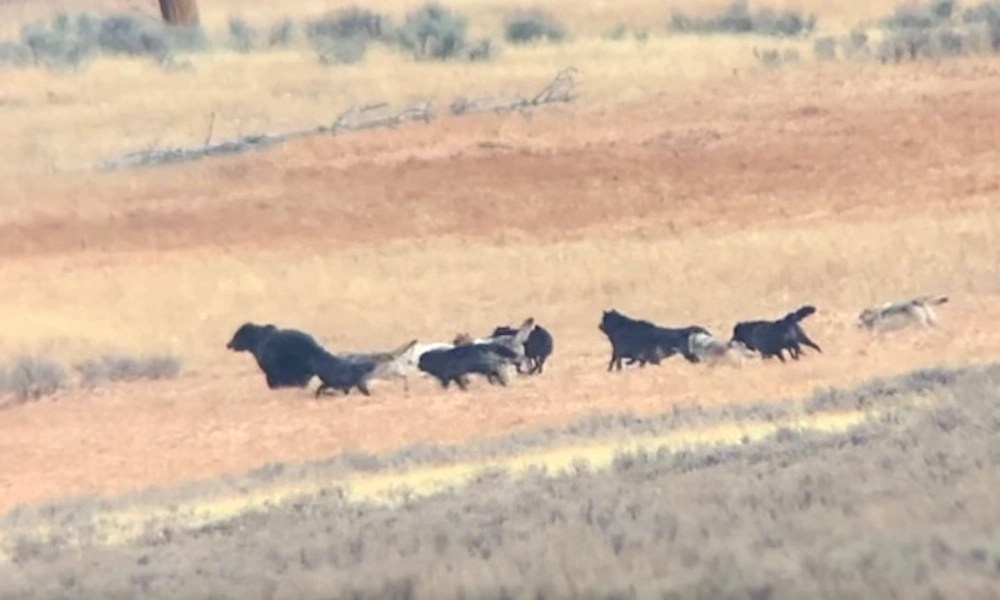
Every year, millions and millions of people visit Yellowstone National Park, but not everybody gets a show like this.
The Bear Is Chased Off By The Wolves
Captured by Yellowstone Adam Brubaker of Tied to Nature, the video picks up in the Hayden Valley area of Yellowstone with a couple of Wolves from Wapiti Lake Pack and a curious Grizzly bear.
You’d think that a bear would want to run away when he’s outnumbered by a few Wolves, but nope, this fella charges forward to get a better look.
A group of tourists have witnessed a scene straight out of a Sir David Attenborough documentary, when a pack of wild Wolves decided to take on a giant Grizzly bear.
In a stunning video shot by Tied to Nature tour operator Adam Brubaker, tourists witnessed a pack of 10 Wolves surround a bear which Mr Brubaker believes was eyeing off their kill.
The encounter, which happened at Hayden Valley in the famed Yellowstone National Park, was described as a “once in a lifetime” sighting by the qualified naturalist.
“I had the awesome opportunity to share this once in a lifetime Wolf and Grizzly sighting while on tour in Yellowstone today.” he wrote on his Facebook page alongside the video.
“This Grizzly was foraging in the far end of the valley when the Wolves started to cross his path. The Grizzly started standing up on his hind legs to get a better view of what was going on and then started to approach the Wolves.
At one point, the bear reared up on its hind legs to get a better look over the tall grass.
“Soon the rest of the Wolf pack appears and escorts the bear into the trees.”
Some thought that the Wolves might have been trying to protect their cubs, but Mr Brubaker believes they had dinner nearby – and didn’t want a hungry bear to snack on any leftovers.
“From what I could see the pups were not with them,” he told USA Today.
“The white Wolf has blood on her face and neck, so there could have been a carcass, but while I watched them they were not feeding on one.”
While grizzlies and Wolves typically avoid each other, encounters have happened before.
“Bears may benefit from the presence of Wolves by taking carcasses that Wolves have killed, making carcasses more available to Bears throughout the year,” National Park Service told Newsweek .
“If a bear wants a Wolf-killed animal, the Wolves will try to defend it; Wolves usually fail to chase the bear away, although female grizzlies with cubs are seldom successful in taking a Wolf kill.”
“I could see that the two species were probably going to cross paths but I did not expect what was going to happen.
“For many people, this would be a once-in-a-lifetime encounter. Neither the Wolves nor Bears were injured. I believe I saw the same bear yesterday out in the same place this time with no Wolves around.
“I have been a guide in Yellowstone for seven years and visiting the park for 20 and every day can offer something new or different.”
Please SHARE to raise awareness to wildlife and environmental issues from around the world. You can also receive NEWS and UPDATES by signing up in the top right of this page.
What you can do to help end animal abuse
The Mission of Protect All Wildlife is to prevent cruelty, promote the welfare of ALL animals EVERYWHERE, and help END animal abuse.
Please support our work by donating ANY amount, large or small. It only takes a minute and your donations make it all possible. Thank you for your support.
Animals Asia, with help from celebrity supporters like James Cromwell, is working to build a second sanctuary in Vietnam for Asiatic Black Bears and Sun Bears rescued from bile farms.
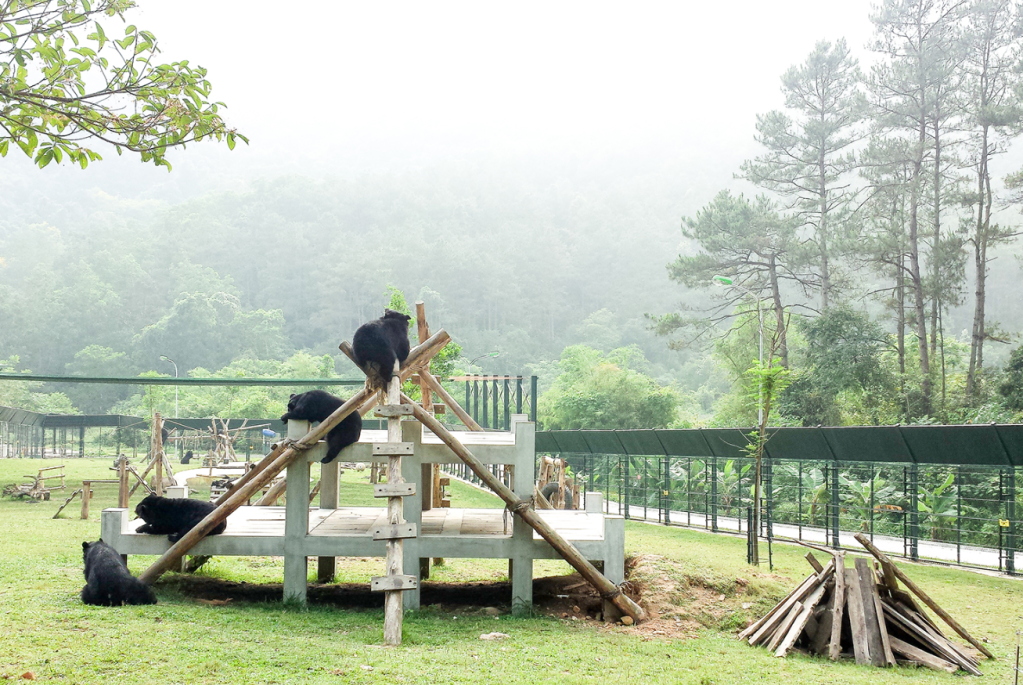
A Bile Bear Sanctuary – Credit: Animals Asia
Actor and activist James Cromwell continues to give animals a voice, this time by helping Asiatic Black Bears and Sun Bears leave bile farms for a life of freedom.
Cromwell is working with Animals Asia to raise awareness about the sanctuary the charity is building in Vietnam, which is designed to comfortably hold and care for the last Asiatic Black Bears and Sun Bears currently residing at Bear bile farms across the country. Animals Asia, in collaboration with the Vietnamese government, already has a sanctuary in Vietnam, which houses nearly 200 rescue Bears.
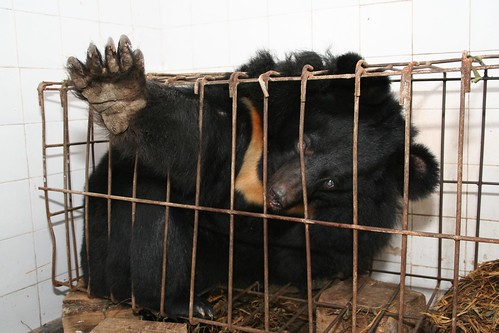
According to Animals Asia’s founder, Jill Robinson, in 2017, Vietnam called a press conference with Animals Asia to announce their commitment to ending Bear bile farming, a practice where Bears — usually Asiatic Black Bears or Sun Bears — “are contained in tiny wire cages to immobilize them so that they can have their bile extracted from their gallbladder” for use in traditional medicine.
With the help of the Vietnamese government, Animal Asia has spent years moving Bears from bile farms to the non-profit’s existing sanctuary in Vietnam.
Bears Are Kept In Tiny Cages On Bile Farms For Years, Often Decades. Credit: Animals Asia
“Because the Bears are kept in tiny wire cages for their entire life, they have multiple physical and psychological problems. Very often, when we rescue them, the first thing that we’re looking at is what we call ‘Broken Bears,'” Robinson says .
“Many of them have had abdominal mutilations from where they’ve had a crude, surgical intervention to extract their bile. Many of them are blind. Many of them are missing limbs from having been caught in the wild in leg hold traps. Many of them have horrible mobility problems. Many of them have heart problems,” she adds of the cruelty Bears endure at bile farms.
Even when faced with this despair, Animals Asia knows that each Bear deserves a second chance, no matter how long recovery takes.
“They are relentless. They are courageous. They’re superhuman,” Cromwell says of the charity, which he has partnered with several times to save animals.
Actor And Animal Activist James Cromwell. Credit: Animals Asia
Founded in 1998, Animals Asia’s decades of hard work have brought the organization “to the cusp of ending Bear farming once and for all in Vietnam, which is the most thrilling thing ever because of the collaboration of the Vietnam government there,” says Robinson.
This new sanctuary will be the final step, as the existing Animals Asia sanctuary in Vietnam is almost full. There are still an estimated 310 Bears left at bile farms in the country that need a safe, permanent home.
“Hence our commitment and sense of urgency to start building this second sanctuary in Vietnam so that we can rescue the remaining number of Bears there and commit to our promise,” Robinson says.
A Bile Bear Sanctuary. Credit: Animals Asia
Plans for the new sanctuary will be publically revealed on May 27, with an event in Vietnam that Cromwell will virtually attend. While plans are in motion for Animals Asia’s second Vietnamese sanctuary, the charity is still raising the $5.8 million needed for its construction.
Cromwell hopes that animal lovers will help Animals Asia reach its goal “because we have to learn the lesson from these creatures.”
Robinson says that the rescue Bears she meets in Vietnam continue to amaze her with their strength and forgiveness.
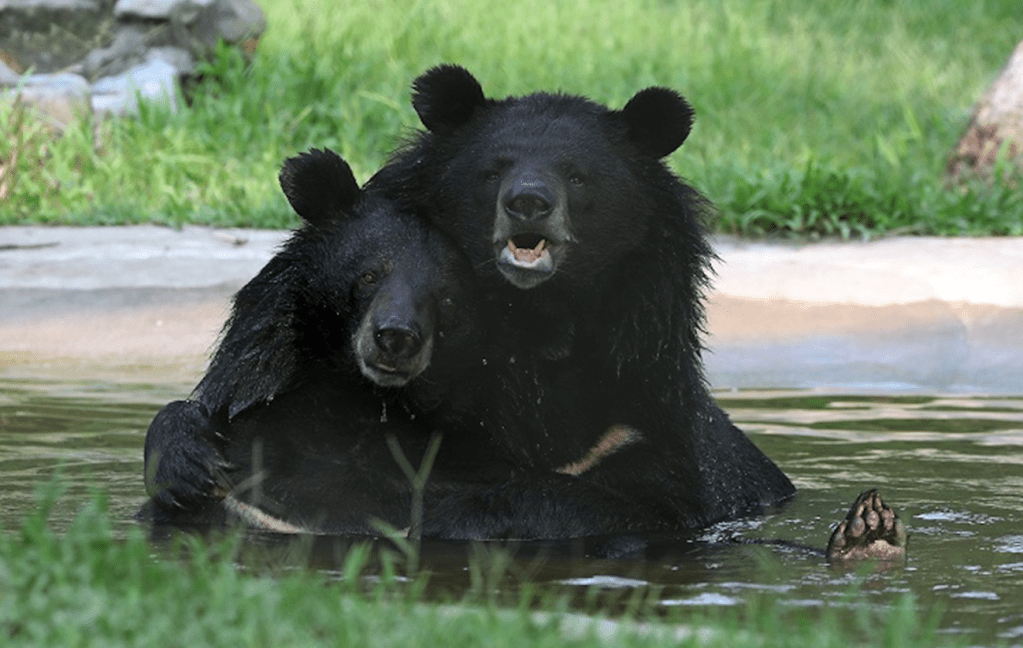
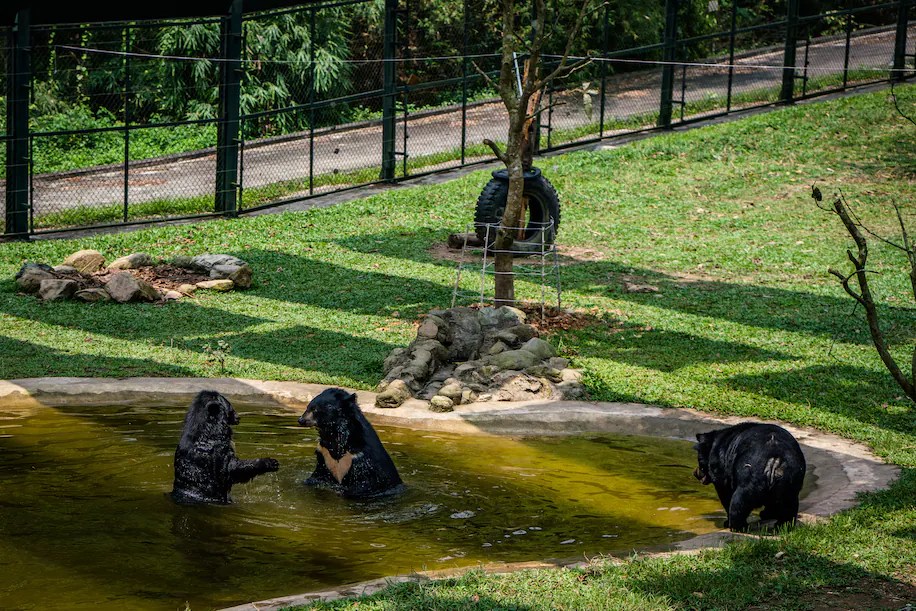
Bears Play In Their Enclosure At Animals Asia’s Sanctuary In Vietnam Credit: Animals Asia
“Once we bring them into our sanctuary, it may take days, it may take weeks, it may take months for that trust to — and you suddenly see a spark, a light that comes into their eyes. Anyone that’s rescued a dog will know exactly what I’m talking about. You suddenly see that mind-set switch,” she says.
“Their personalities start to emerge. That is the most beautiful thing to see. Bears that were horribly traumatized are now turning somersaults on their own in the grass just because they can. They’re in playful Bear bundles with their friends just because they can. They’re foraging in huge expanses of forest in the sanctuary just because they can. They have choices of whatever they want to do, of whatever they want to eat throughout the day as well. It’s a privilege to be working with these species to really begin to understand the animal they are,” she adds.
To learn more about Animals Asia and how to help with their new sanctuary in Vietnam, visit the charity’s website.
Freed From A Bear Bile Farm – Tuffy Jumps For Joy. Credit: Animals Asia
What can you do to help END animal abuse!
The Mission of Protect All Wildlife is to prevent cruelty, promote the welfare of ALL animals EVERYWHERE, and help END animal abuse.
Please support our work by donating ANY amount, large or small. It only takes a minute and your donations help make our work possible. Thank you for your support.
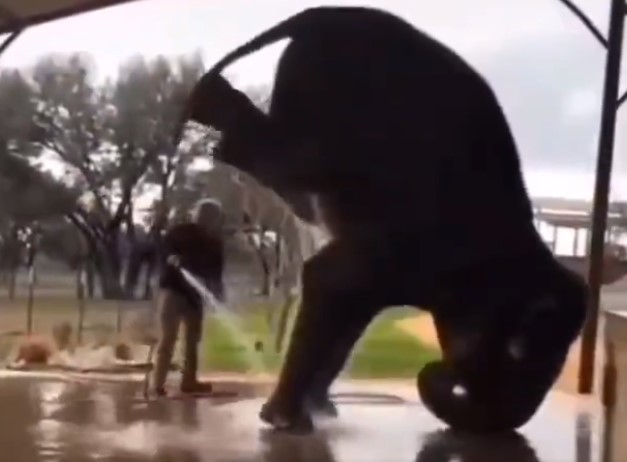
A video of an Elephant doing a headstand has gone viral online and triggered a discussion about animal cruelty.
The video shows Elephant standing on its head, like he’s doing a headstand.
A video circulating on social media shows an Elephant in a circus-like pose while taking a bath. But the viral video has angered social media users.
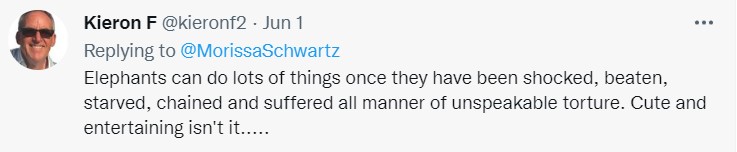
The video has been shared by Morissa Schwartz on Twitter with the caption, “I didn’t know Elephants could do this.” It has received over 380k views and has had more than 200 comments mostly expressing the belief that cruel training has been used to train the Elephant to ‘perform’.
— Morissa Schwartz (Dr. Rissy) (@MorissaSchwartz) June 1, 2022
Meanwhile, in the video, it could be heard crowd of spectators gasping and cheering at the view. After watching this act by the Elephant, angry viewers took to the comment section to express their outrage. Many of them even claimed that the headstand was not real and the big creature was trained for doing so. People also said that there are chances that the animal was unethically trained to do it to entertain the crowd. The video has spread outrage on the internet.
Here are a just a few of the comments it garnered:
It is very essential for us to understand that these animals go through a lot of fear and pain in making such moves. The humans train them and brutally torture these animals to make them do these poses.
ELEPHANTS ARE BEATEN INTO SUBMISSION FROM A VERY YOUNG AGE
But we, the citizens, can create a groundswell of changes and instil compassion in the hearts of cruel human beings while creating a safe world for Elephants. If you’re genuinely hurt and angered by the atrocities against Elephants, here are nine things you can do right now:
1. Scratch off Elephant rides from your bucket list.
2. Boycott festivals that exploit Elephants and perpetuate cruelty
3. Do not visit zoos, circuses, or any entertainment that involves Elephants or any animals for that matter.
4. Educate yourself and influence your immediate circle of family and friends, creating ripples of change. Gods in Shackles is a great educational aid that exposes the dark truth behind captivity.
6. Write letters and petitions to your elected officials.
7. Remember to vote – you have the power to vote them out.
8. Share this story and help create awareness.
9. Write a science-based review on TripAdvisor and other travel sites.
What you can do to help wildlife
The Mission of Protect All Wildlife is to prevent cruelty and promote the welfare of ALL animals EVERYWHERE.
Please support our work by donating ANY amount, large or small. It only takes a minute and your donations help make our work possible. Thank you for your support.
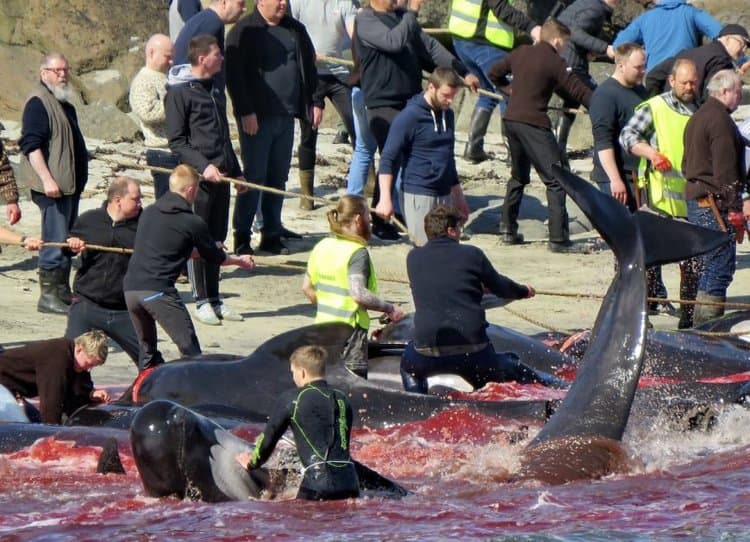
The devastating scene of pilot whales thrashing in blood-filled water as hunters converge on them with their killing tools.
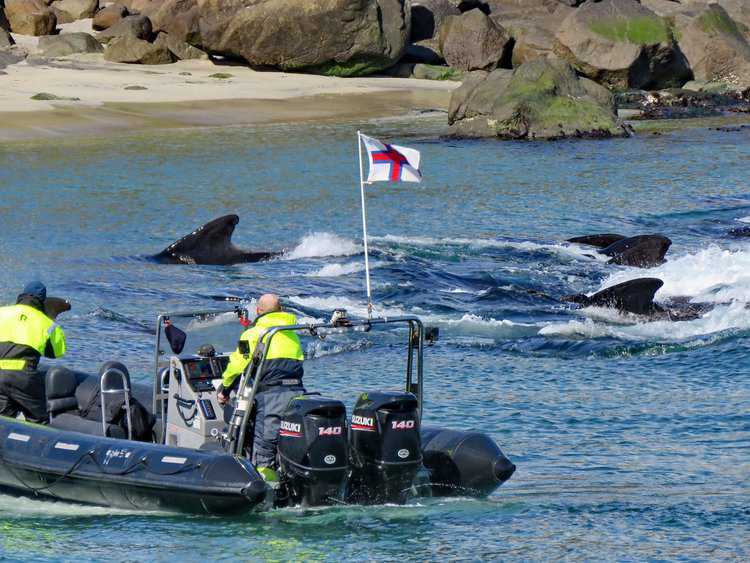
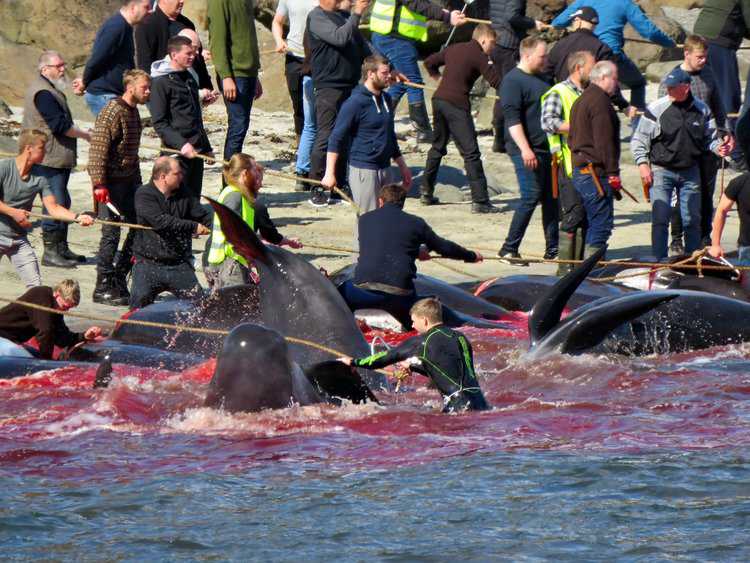
On May 7th, more than 60 pilot whales were captured and butchered in this year’s first pilot whale hunt in the Faroe Islands. Ingi Sørensen, a Faroese diver, author, and underwater photographer who is fiercely against the practice documented the slaughter, known as grindadráp in Faroese. His video recording shows several motorized boats driving the pilot whales towards the selected whaling beach in the islands’ capital of Torshavn. Images reveal the devastating scene of pilot whales thrashing in blood-filled water as hunters converge on them with their killing tools.
They hunt the long-finned species of pilot whales that inhabits the North Atlantic. It is a wide-ranging, toothed whale that belongs to the dolphin family and which, among dolphins, is second in size only to the orca. Pilot whales live in matriarchal pods with an exceptionally strong social structure. They are one of the most frequently reported whale species in events of mass strandings and are known to stay together as a group, even in a crisis. This makes it easy for hunters to drive entire pods of them ashore. And once the pod is helplessly stranded, men and women—mostly men—begin the process of killing every single member, including pregnant and lactating mothers and their offspring. When the carnage is over, calves that were cut from their mothers’ wombs can be seen lying next to their dead mothers, umbilical cords still attached.
Faroese whale hunters use motorized boats to chase pods of pilot whales ashore. Credit: Ingi Sørensen
For centuries, the people of the isolated Faroe Islands survived by hunting whales, and during times of famine, pilot whales became their rescue. But times have changed, and pilot whale meat and blubber are no longer considered everyday food in the Faroe Islands. Many toxins build up in animals’ bodies as they ascend the food chain. This bioaccumulation reaches dangerous levels in top predators, such as pilot whales. In 2008, the chief physician for the Faroese Department of Occupational Medicine and Public Health, Pál Weihe, and the islands’ chief medical officer, Høgni Debes Joensen, warned that pilot whales are contaminated with dangerously high levels of mercury and polychlorinated biphenyls (PCBs), as well as DDE, a breakdown product of the insecticide DDT. In a press statement issued in 2008, the physicians noted that mercury and PCB exposure contribute to Parkinson’s disease in adults, impaired immunity in children, and compromised fetal development. “It is recommended that pilot whale is no longer used for human consumption,” they warned.
The Faroese government chose not to follow the doctors’ recommendations. In June 2011, however, the Faroese Food and Veterinary Agency urged limited consumption of pilot whale meat and blubber. They issued special recommendations for women and girls: refrain from eating blubber while they plan to have children, and do not eat whale meat while pregnant or breastfeeding. No one should eat the kidneys and liver of pilot whales, the agency said.
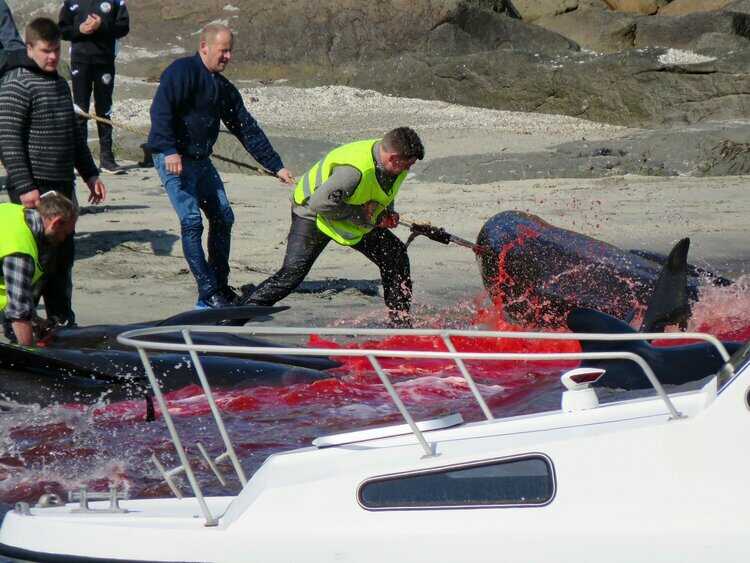
As a result of the government’s hazardous decision to downplay the risks of consumption, the pilot whale hunt continues to this day. I have heard whalers boast that they can kill a pilot whale in a few seconds. What they don’t consider is the lengthy time it often takes to drive the pod ashore. And, apparently, they also don’t think about the distress that these ocean-going marine mammals experience when forced to strand in shallow water with no possibility of escape. Once stranded, the pilot whales are subjected to complete chaos, commotion, and yelling as hunters start the practice of dragging them ashore. They do this by injecting a rounded stainless-steel hook into a whale’s blowhole. The hook is attached to a long piece of rope, and several men drag the struggling whale ashore. A pilot whale can weigh more than 5000 pounds, and it is easy to imagine how terrifying and painful it must be to be dragged out of the water in this manner. Once the whale is fully beached, a hunter finishes it off by jamming a spinal lance into its spinal canal, thereby severing the spinal cord, and cutting the blood vessels supplying blood to the brain.
A whale hunter kills a pilot whale with a so-called spinal lance, thereby severing the spinal cord and cutting off the blood supply to the brain. In 2015, the spinal lance replaced the traditional whaling knife as a killing tool. Credit: Ingi Sørensen
While hunters are killing some of the pilot whales with spinal lances, other whales are still fighting for their lives in shallow water. They can see and hear their family members being mutilated and destroyed just a few feet away from them during their desperate struggles. Swimming in the blood of their dying pod members, all they can do is await their turn. I am sure they are fully aware that their pod, which has taken several generations to build, is being demolished. Their torment, to me, is undeniable, and it is impossible for me to fathom how anyone can participate in it, especially now that the meat and blubber contain some of world’s most dangerous toxins and should not be considered food.
On a positive note, not all Faroese people agree that the pilot whale hunt should continue. Ingi Sørensen puts it this way: “There is no justification to wipe out entire schools of pilot whales, and the much-used argument of maintaining the hunt as a Faroese tradition that must be carried into future generations has no validity.” He adds: “Throughout centuries, pilot whales have saved us from starvation. Today, their meat is so toxic, our own health authorities warn us it’s too dangerous to eat. The destruction of these incredible beings needs to stop, once and for all. Now it’s our turn to save them, by leaving them be and focusing our attention on saving their habitats.”
Pilot whales are fighting for their lives as hunters jam rounded stainless steel hooks into their blowholes to drag them ashore. Credit: Ingi Sørensen
The lack of empathy is not a Faroese phenomenon. It is a human phenomenon, and people carry out animal cruelty daily in every single country of the world. Please refrain from posting derogative comments based on negative stereotyping against all Faroese people, as they shut down all possibilities of dialog.
This article by Helene O’Barry was first published by The Dolphin Project on 25 May 2022. Lead Image: Once helplessly stranded, the whales are subjected to complete chaos, commotion, and yelling as hunters start the practice of dragging them ashore. Imagine the terror these highly social and complex beings go through as the entire pod is being demonished in a tremendous bloodbath. Credit: Ingi Sørensen.
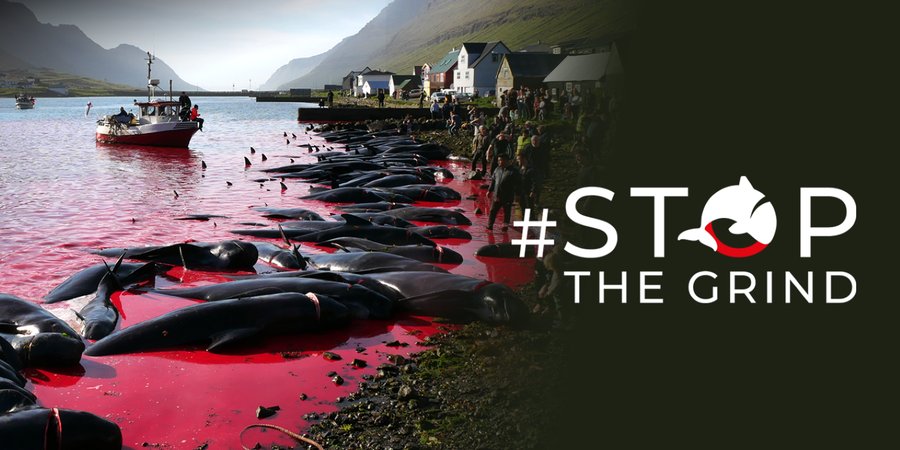
#StopTheGrind
What you can do to help wildlife
The Mission of Protect All Wildlife is to prevent cruelty and promote the welfare of ALL animals EVERYWHERE
Please support our work by donating ANY amount, large or small. It only takes a minute and your donations help make our work possible. Thank you for your support.
What else you can do to help
Please SHARE to raise awareness to wildlife and environmental issues from around the world. You can also receive NEWS and UPDATES by signing up in the top right of this page.
Campaigners report incidents of the cruel practice on several certified boats, amid allegations of a flawed auditing system. Despite documented evidence, little action was taken to prevent the boats from operating under the MSC banner nor was anyone prosecuted.
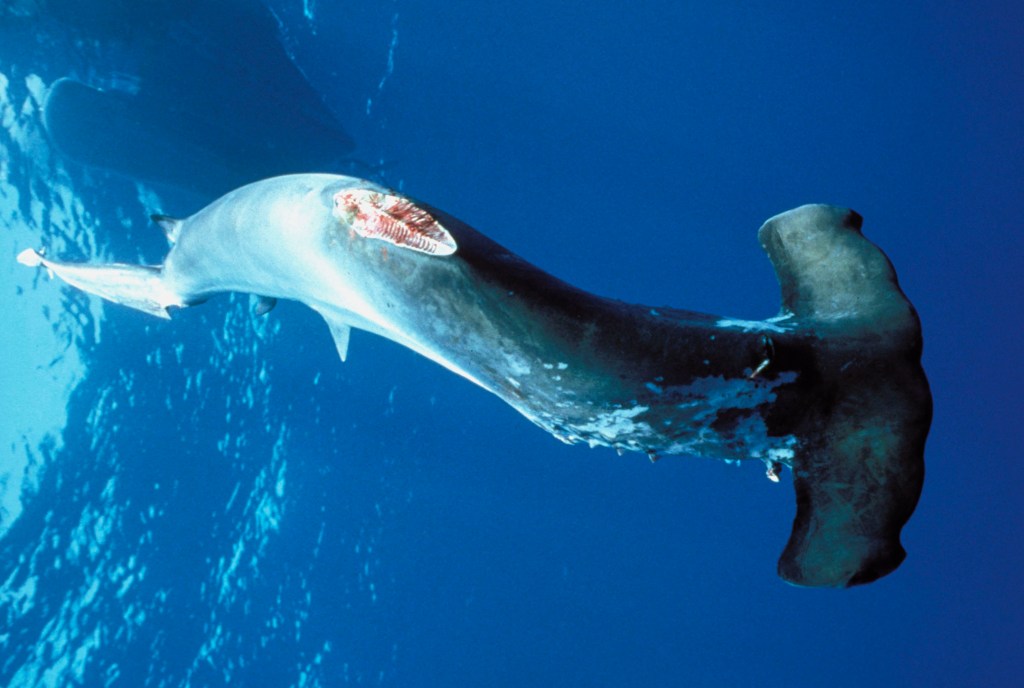
SHARK FINNING: ONE OF THE WORLD’S MOST DESTRUCTIVE FISHERIES. SHARK FINS ARE REMOVED WHILST THE REMAINDER OF THE CARCASS IS DISCARDED AT SEA
The Marine Stewardship Council, which certifies fisheries under its blue tick sustainability label, has ordered an independent investigation into allegations of shark finning on tuna vessels in certified Pacific fisheries.
Shark finning is the cruel practice of removing fins from live sharks. A report by the UK charity Shark Guardian with CNS Global Consulting, a sustainable development consultancy, has alleged it took place on board three vessels operating in the western central Pacific that were certified by the MSC, which runs the world’s largest fishery certification programme.
Official documents from independent observers who monitor fishery compliance, seen by the Guardian, said shark finning happened on board vessels in MSC-certified fisheries in 2019 and early 2020. They reported silky sharks and a black-tipped reef shark as having “DFR” or “discarded fins retained”, a reference to the practice of cutting fins off live animals and discarding their bodies overboard. Both species are classified as “near threatened” with extinction by the International Union for Conservation of Nature.
A third of shark and ray species have been overfished to near extinction, a study found last year.
Despite documented evidence, little action was taken to prevent the boats from operating under the MSC banner, the charity said, nor was anyone prosecuted.
There is no suggestion the MSC was aware of the observer reports that alleged shark finning. However, the MSC’s third-party certification boards – known as conformity assessment bodies (Cabs) – which audit fisheries and read observer reports, have a duty to remove certification if shark finning is detected, or if a vessel is convicted for it. This duty was strengthened in September 2020 to require “zero tolerance” of shark finning, the MSC said.
LIKE THOUSANDS AND PROBABLY MILLIONS OF OTHER SHARKS EACH YEAR, THIS SCALLOPED HAMMERHEAD SHARK IS FINNED ALIVE AND THROWN OVERBOARD TO DROWN
Jean-Jacques Schwenzfeier, director of CNS Global Consulting, said: “The observers told us their reports are constantly being ignored and shark finners are not being prosecuted.
“We are not saying the MSC is a bad programme. The MSC is probably unaware this is happening. But the auditing system is flawed and needs improving.”
A spokesperson for the MSC said it took the allegations “seriously” and had asked Assurance Services International, which oversees Cabs, to investigate.
European countries dominate half of Asian shark fin trade, report reveals.
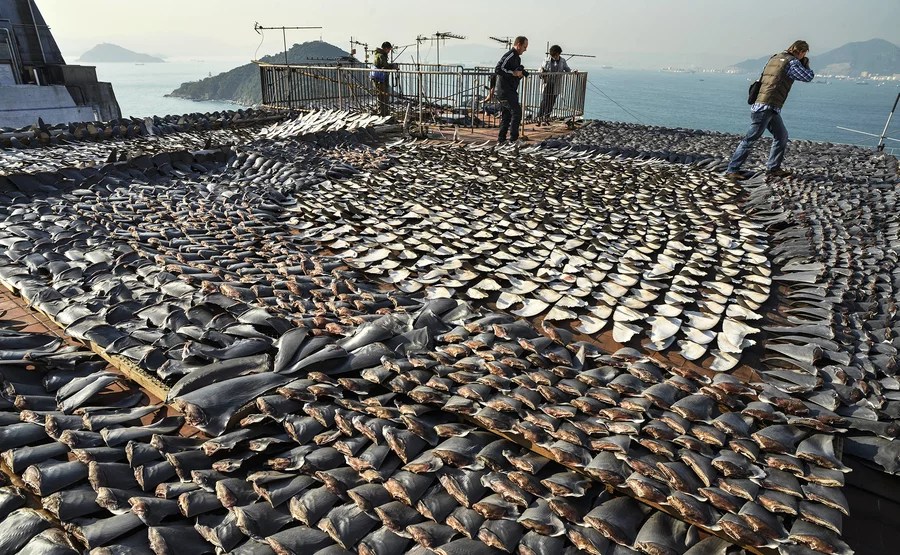
HUNDREDS OF SHARK FINS DRYING OUT ON A ROOFTOP IN KENNEDY TOWN HONG KONG.
“Shark finning is completely prohibited in MSC-certified fisheries and we take the allegations contained in the Shark Guardian report, relating to vessels fishing in the western central Pacific, seriously. On receiving notification of this report via the media, we immediately asked the independent oversight body, Assurance Services International, which oversees our third-party certification activities, to investigate the claims relating to shark finning and the other matters raised in the report.”
Any vessel convicted of shark finning is banned from MSC certification for at least two years, it said.
The MSC has come under pressure from conservation groups to reform standards on shark finning, and is now proposing new standards. Earlier this month, 90 marine conservation experts, organisations and international researchers welcomed the MSC’s move towards zero tolerance of shark finning by requiring all catch to have “fins naturally attached (FNA)” without exemptions.
A POWERFUL GRAPHIC CREATED BY STOP SHARK FINNING .NET
What you can do to help
The Mission of Protect All Wildlife is to prevent cruelty and promote the welfare of ALL animals EVERYWHERE
Please support our work by donating ANY amount, large or small,at HELP PROTECT ALL WILDLIFE. It only takes a minute. Thank you for your support.
What else you can do to help
Please SHARE to raise awareness to wildlife and environmental issues from around the world. You can also receive NEWS and UPDATES by signing up in the top right of this page.
Fitzjohn recounted most of his long career working on behalf of African wildlife in his 310-page memoir Born Wild, published in 2010.
“Growing up in England, Fitzjohn loved Scouting. Tarzan tales enchanted him,” summarized reviewer Debra J. White. “As a troubled teen, Fitzjohn landed in Outward Bound programs. A letter Fitzjohn sent to Born Free author Joy Adamson brought Fitzjohn to Kenya,” by hitchhiking.
Assistant to George Adamson
In 1971, at age 24, Fitzjohn became assistant to Adamson’s then-husband, 65-year-old conservationist George Adamson.
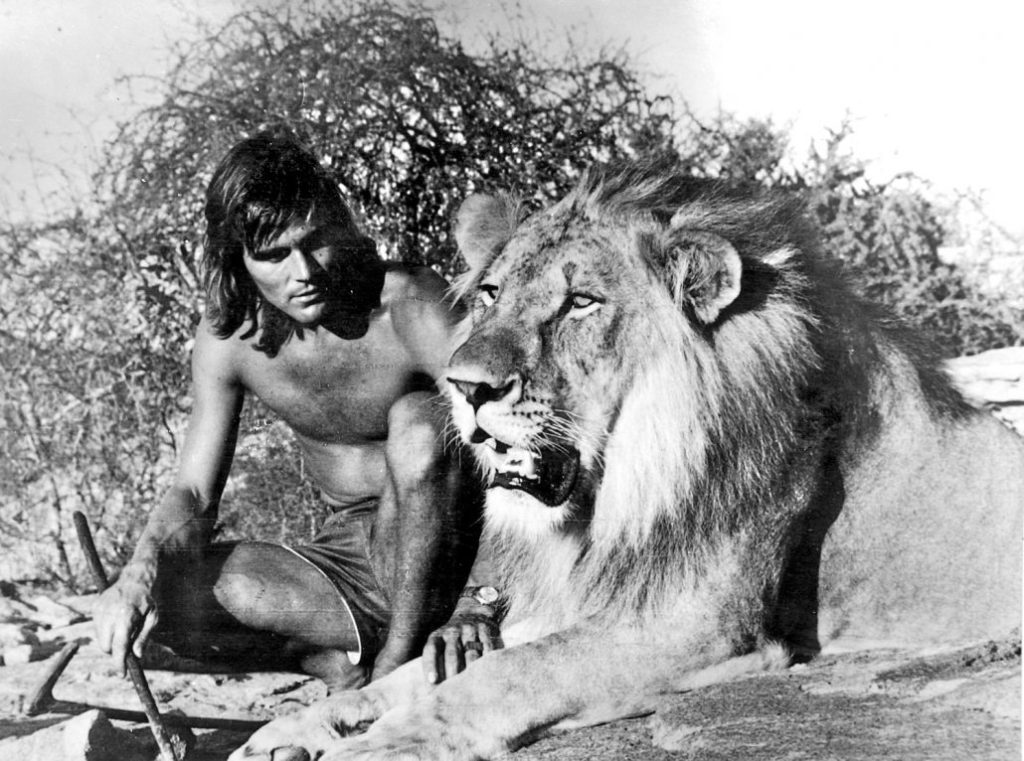
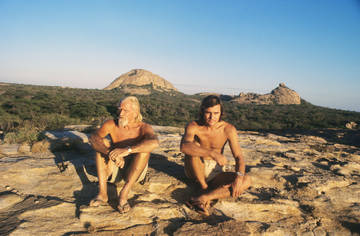
GEORGE ADAMSON AND TONY FITZJOHN SIT WATCHING THE SUNSET ON A ROCK NEAR KORA CAMP IN KENYA. AFRICA. 1987.
Fitzjohn, as a full-time volunteer, helped Adamson to rehabilitate injured or formerly captive lions, leopards, and African wild dogs for return to the wild. Tracking animals post-release was among his duties and was considerably more difficult and dangerous than it is today because radio collars had not yet been developed.
Once, in 1975, “I was incredibly lucky to survive,” Fitzjohn wrote. “My attacker’s teeth had come within millimetres of both my carotid and jugular arteries. There are holes in my throat that I could put a fist through, and I did.”
After several months of recovery Fitzjohn returned to help George Adamson at his camp called Kora, located east of Mount Kenya, near the Tana River, almost in the dead centre of the nation.
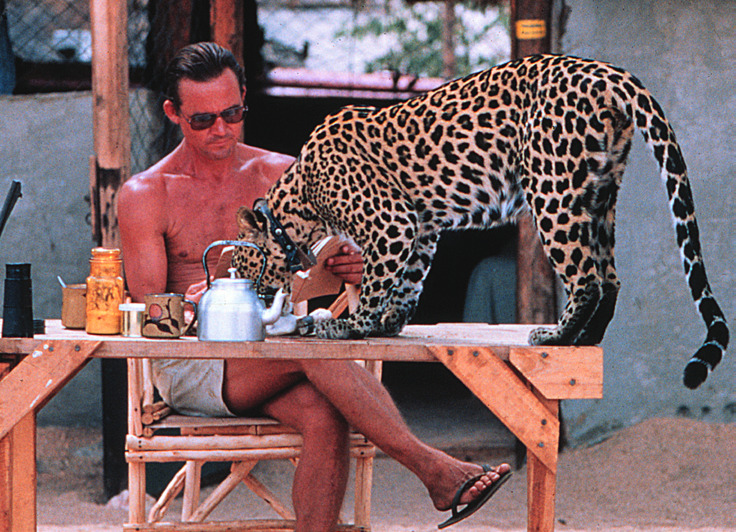
TONY FITZJOHN WITH SQUEAKS, LEOPARD FRIEND
Kenya “became a scary place”
Conflicts with poachers and illegal grazers at Kora intensified after a border conflict between Kenya and Somalia in 1978. Somalia lost the war but, Fitzjohn remembered, “There were suddenly a lot of well-armed Somali men flooding across the border into northern Kenya. They were bandits, well-trained, ruthless and armed.”
“Another camp near Kora was attacked and everything of value was looted. Two workers were killed. Poaching escalated,” White wrote.
“The Kenyan government was either unwilling or unable to stop the raiding, despite warnings that wildlife tourism could be destroyed. Political unrest, corruption, drought, and tribal strife plagued Kenya for more than a decade,” White continued.
Understated Fitzjohn, “Kenya had suddenly become a scary place.”
TONY FITZJOHN AND A RHINO FRIEND
Murders brought move to Tanzania
The Kora camp site eventually became the hub of the Kora National Reserve, initially designated in 1973 but not added to the Kenyan national park system until 1989, after George Adamson came to the aid of a tourist who had been robbed and gang-raped by poachers. Adamson was murdered while racing his jeep straight at the bad guys, who fled.
Joy Adamson had already been killed in a confrontation with an ex-employee in January 1980.
Of George Adamson’s murder, Fitzjohn said, “If I had been there, it wouldn’t have happened.”
Fitzjohn had left, temporarily, to assess the prospects for restoring the huge Mkomazi Game Reserve in Tanzania, south of Tsavo National Park in Kenya.
Fitzjohn said of Kora – Life at Kora was one of overwhelming isolation. The camp was situated two days’ travel from the Kenyan capital of Nairobi, and conditions were basic. Aside from a few camp employees and George’s brother Terence, Adamson and Fitzjohn would go months at a time without being visited by an outsider. The work was everything.
“Our whole life was based around the lions: their health, their survival, their coping with going back to the wild. I became a self-taught mechanic, and I learned to maintain all the vehicles. I would also do the supply trips to Garissa [the Somali Kenyan capital], though god knows why the bandits didn’t take me out,” Fitzjohn laughs.
“The police would get shot up, even the commissioner would get shot up. And there I was, a heathen, storming down with a beer in one hand and a joint in the other, the ghetto blaster booming. But they never touched me. I think there was someone up there looking after me. And I’ve always been prepared to take my chances for what I thought was worthwhile.”
Fitzjohn soon became Kora’s de facto PR man and fixer: dealing with the local authorities, talking to the police, keeping things cordial. “It mainly involved a lot of drinking in the police mess and the army mess in Garissa,” he says. “Drinking was a big part of life out there, I suppose, though not so much in the bush.”
At one point, Fitzjohn thought two policemen were trailing him through the city — so he hid in an alleyway and ambushed them, taking them both out with fists flailing. That afternoon, he discovered that they’d been sent to look over him and protect him, should anything turn nasty.
“So I had to go and apologise to them at the station. Well: that turned into a long night on the beers, didn’t it…” he says, slightly sheepishly. “It was the Wild West, in many ways. But the Wild West with Land Rovers.”
Having worked with Adamson for 18 years, but at odds with himself after the murder, Fitzjohn soon afterward moved to Mkomazi.
Mkomazi, in Fitzjohn’s own words, was “the perfect place for me to bury myself and reinvent myself after the events of the past few years.”
Mkomazi Game Reserve
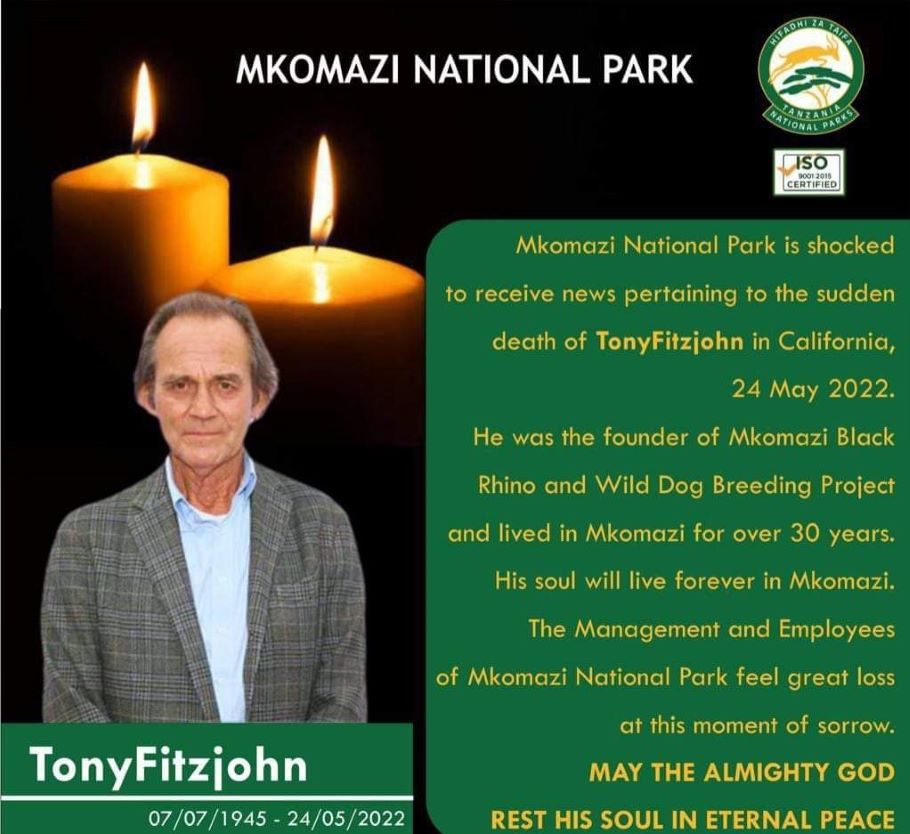
There, said the Tony Fitzjohn-Wildlife Now George Adamson Wildlife Preservation Trust statement announcing Fitzjohn’s death, “His main, towering achievement was the rehabilitation of Mkomazi.
“This was at the invitation of the Tanzanian Government in 1989,” the Tony Fitzjohn-Wildlife Now George Adamson Wildlife Preservation Trust continued. “In the next thirty years, he enlisted a formidable group of supporters, experts and famous institutions in what became an international beacon for conservation of land and wildlife.”
Fitzjohn “created programs for endangered species, including the African wild dog, and one of the most successful rhino sanctuaries in Africa, and pioneered educational programs in the local communities,” the Tony Fitzjohn-Wildlife Now George Adamson Wildlife Preservation Trust memorial statement finished.
Frustrated by the corruption of the John Magafuli regime in Tanzania, Fitzjohn returned management of Mkomazi to the Tanzanian government in 2020 and returned to Kenya to work on rehabilitating Kora.
Magafuli, ironically, who had been the most vehement COVID-19 denier in Africa, died of COVID-19 in March 2021.
Fitzjohn was admitted to the Order of the British Empire in 2006. He also received the Prince Bernhard Order of the Golden Ark, the North of England Zoological Society’s Gold Medal and the Hanno Ellenbogen Citizenship Award for public service.
A FITTING TRIBUTE TO TONY FROM MKOMAZI NATIONAL PARK
What you can do to help
The Mission of Protect All Wildlife is to prevent cruelty and promote the welfare of ALL animals EVERYWHERE
Please support our work by donating ANY amount, large or small,at HELP PROTECT ALL WILDLIFE. It only takes a minute. Thank you for your support.
What else you can do to help
Please SHARE to raise awareness to wildlife and environmental issues from around the world. You can also receive NEWS and UPDATES by signing up in the top right of this page.

















 PROTECT ALL WILDLIFE