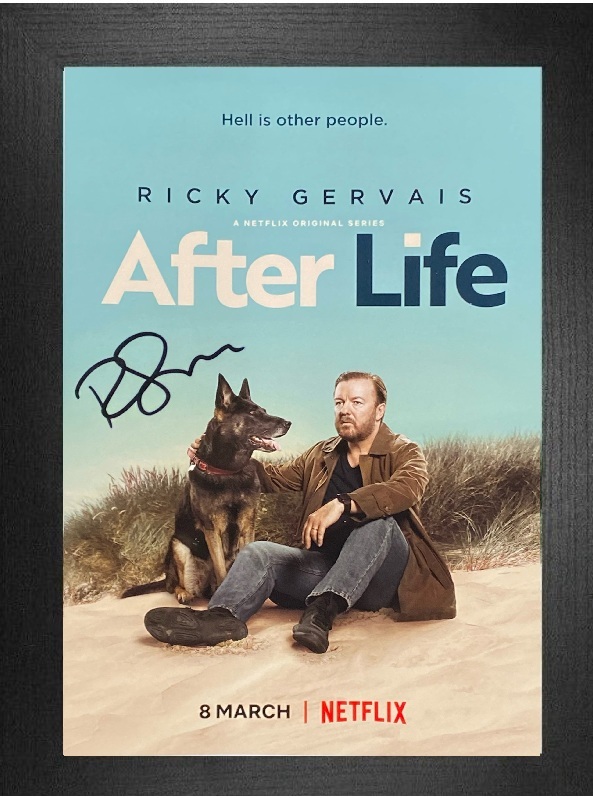
This is your chance to bid on signed pictures very kindly donated by Ricky Gervais in our ‘Charity Auction To Help Disabled Animals’.
This is a sealed bid auction, so all you need to do is decide which item you would like to bid for and send us your bid with the LOT NUMBER and name by email to protectallwildlife@btinternet.com by 21:00 on the 31st of October 2024. We will email you to let you know if your bid is the highest. Postage costs will be calculated when the auction ends. If you need any more information etc please email Paul at protectallwildlife@btinternet.com.
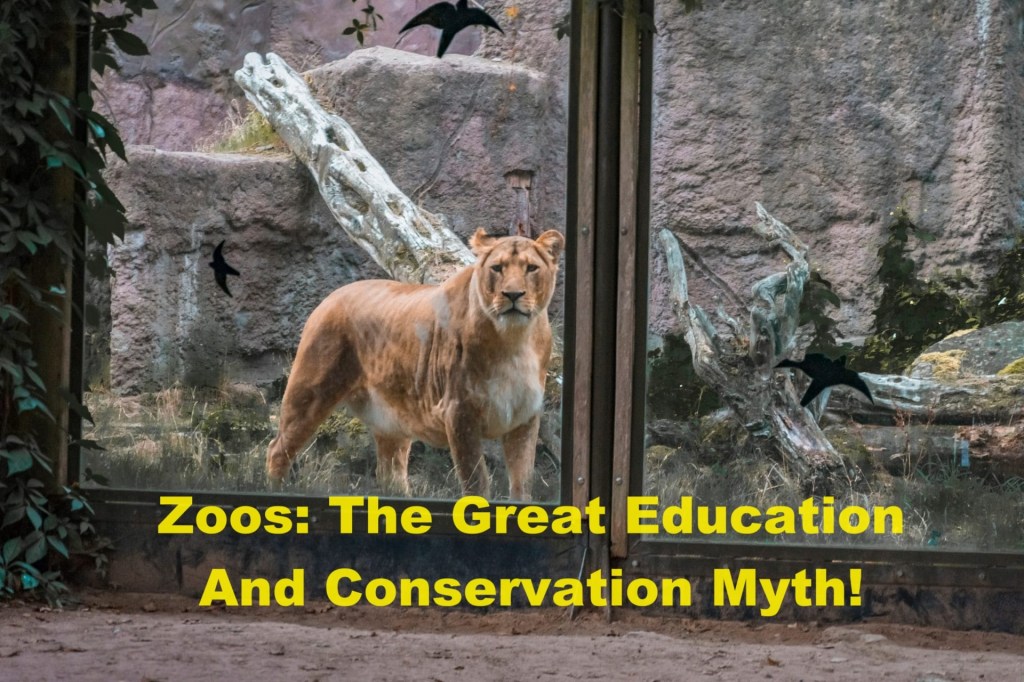
Here, Andy Davidson lists the hard-hitting facts, revealing what zoos really spend their money on, and how you’re better off spending yours elsewhere if you care about conservation.
If you’re planning to a visit a zoo this weekend, ask yourself this question. How much of your ticket fee is being used for conservation? Let’s say you pay £15 for your ticket. You may be surprised to hear that the answer is as little as 45p to £1.
Zoo expenditure is vastly different to the expenditure of conservation organisations based in the wild. For example, Chester Zoo spent £40 million on the construction of ‘the islands’, an expansion of more enclosures to the zoo site. Other Western zoos over a ten-year period have spent £400 million on updating enclosures for a mere 200 elephants.
The Kenya Wildlife Service (KWS) and South African National Parks are conservation organisations that protect animals in their natural habitats. KWS has an annual budget of £13-14 million with which they protect 2.6 million hectares of that country’s National Parks. On that land are 33,000 Elephants, 2200 Lions and many vitally important habitats that are home to thousands of species of both plant and animal. The annual budget for the South African National Parks is £58 million and this consists of 19 national parks which make up 6% of the total land of South Africa. Just one of these parks houses 600 elephants.
The money used by Western zoos to update elephant enclosures for 200 Elephants could have kept Kenya Wildlife Service going for 14 to 15 years.
Sound shocking? It is. That’s why the chief consultant to the UN Great Ape Survival Project said he was uneasy at the mismatch between lavish spending at zoos and the scarcity of resources available for conserving threatened species in the wild.
Where Is Your Money Going?
Since the 1800s, the zoo has not fundamentally changed. Well known and entertaining animals such as Elephants, Chimps and Giraffes are front and centre and baby animals give zoos a boost in visitors.
The main driver for zoos is boosting public visitation, a goal that has far reaching implications into all zoo management decisions. Conservation, research and education are not their primary goals, making it impossible to term zoos as research or education organisations. In fact, zoos are places of entertainment, where animal welfare is governed by financial feasibility and entertainment value.
90% of species encaged by European zoos are not threatened from extinction. Over 90% of zoo animals are born in captivity. These animals are then paired across zoos to ensure genetic diversity. Gender cannot be predicted and genes are sometimes over represented leading to what the zoos call a ‘surplus of animals’. 3000-5000 of these animals in European zoos are killed each year. On the 8th of February 2014, Copenhagen Zoo (in)famously killed Marius, a healthy 18-month-old male Giraffe.
Afterward, zoo officials performed a three-hour-long demonstration of how to butcher a giraffe before a large crowd of visitors, including many children. The meat was then fed to the zoo’s four Lions. The four Lions, including two young Lions, were killed to make way for a new male. The Giraffe was killed because she could not produce anymore young.
Marius, a healthy male Giraffe, lies dead after he was euthanized at Copenhagen Zoo. Visitors, including children, were invited to watch while the he was dissected. Photo: Peter Hove Olesen.
Even for threatened species such as Pandas, breeding campaigns rarely work. 400 Pandas have been bred by zoos, yet only five have been released into the wild: three survived. It’s not hard to see that captive breeding is not feasible. Animals not brought up in the wild are less likely to survive there if reintroduced. For example, captive populations of Red Junglefowl (wild ancestors of chickens) differ significantly in response to predators after just a handful of generations in captivity. And, a 2008 study by the University of Exeter found that the odds of animals such as Tigers and Wolves surviving freedom is only 33 percent. Animals in captivity do not usually have the natural behaviours needed for success in the wild.
But it’s not just endangered species that are being bred. A 2014 analysis of the European Endangered Species Breeding Programmes, conducted by the European Association of Zoos and Aquaria, showed that half of the animals being bred were not classed as endangered in the wild, while 25% were not threatened at all. In fact, all zoos only accommodate a tiny fraction of the 22,000 + species threatened with extinction.
With only 3% of budgets being spent on conversation projects, we can see why wildlife continues to disappear. Zoos show little interest in tackling the root causes of wildlife destruction. Species-rich habitats are being converted to pasture and feed crops as the human appetite for meat swells. Many of the places expected to see the greatest shift in land use from forest to livestock are in 15 ‘megadiverse’ countries, which harbour the largest number of species. As wildlife disappears, zoos ignore the problem. Instead, they contribute to it by feeding millions of customers meat.
The Education Myth
Zoos rebranded in the 1970s as the public became informed to the suffering of zoo animals. UK legislation in the form of 1981 Zoo Licensing Act forced zoos to promote ‘public education and awareness in relation to conservation’. Advocates will say zoos inspire the next generation of conservationists.
This has been categorically debunked by a number of studies, while little information is required to meet the standards of legislation. A 2014 academic study in the Conservation Biology Journal surveyed 2800 children following visits to London Zoo. 62% of the 2800 children were deemed to show no change in learning or, worse, experienced negative learning during their trip to the zoo. It was concluded that the zoo’s impact on children’s belief in their ability to actively do something about conservation was ‘weak’.
In what way could this sad image of a Bear be considered educational?
Do children need to see the animals up close to learn about them? Many children seem to have an encyclopedic knowledge about dinosaurs, far more so than Lions and Tigers. Perhaps the general public wish to see exotic animals up close as we attach closeness to care. But why, then, do they tap on the windows and show disappointment when the Lions are asleep? This is a misplaced, harmful interest, surely.
A Lion Is Taunted By Zoo Visitors At Animal City In Lebanon
In reality there is nothing sufficient in the mainstream that educates the public about animals and their conservation. Zoos, school, television – they all fail in this respect. The evidence is very clear: the World Wildlife Fund report that the planet’s fish, bird, mammal and reptile populations plunged 52 per cent from 1970 to 2010. That’s a stunning 52% of all fish, bird, mammal and reptile life lost in 40 years.
Human encroachment is destroying wildlife, but zoos do not consider that information entertaining and, as mentioned, entertainment is the only real driver of ticket sales. Paul Boyle, senior vice president for conservation and education at the Association of Zoos and Aquariums, says “People leave their homes, and the intent is not to save animals in Africa—it’s to have a family outing.”
The Imprisonment Of Animals
An Oxford University study based over four decades of observing animals in captivity and in the wild found that animals such as Polar Bears, Lions, Tigers, Cheetahs show the most evidence of stress and/or psychological dysfunction in captivity. In the same study, 80% of carnivores show abnormal repetitive behaviour. This is a major problem for zoos as these animals are the most popular with visitors.
There are approximately 3200 Tigers left in the wild. In the United States alone, there are over 5000 Tigers in captivity. This is not the result of successful breeding programmes. These Tigers are being born in captivity and they die in captivity. They are the star attraction. It’s hard to imagine a zoo without a Tiger. One particular zoo in the US houses dozens of Tigers. They let visitors handle cubs and have their picture taken while talking up their conservation programmes, despite the fact that their average Tiger enclosure is about 18,000 times smaller than the animals’ natural roaming range. It is simply impossible for these poor Tigers to express instinctive behaviour.
Tourists watch a Tiger cub play with a stuffed toy during a petting and photo opportunity at Myrtle Beach Safari. Photo Credit: Steve Winter, Nat Geo Image Collection.
In two extensive studies, it was found that the lifespan of Elephants is more than halved by living in zoos. A government-funded study of Elephants in UK zoos found that 54% of the Elephants showed behavioural problems during the daytime. In 2016 18 African Elephants, a species designated as threatened within their natural habitats in Swaziland, were captured and transported to three zoos in the US to entertain the public there.
Despite the best intentions of zoo employees to create a happy environment for an animal, zoos are fundamentally unable to recreate the wild setting. Cheetahs cannot run at maximum speed, Elephants cannot walk hundreds of miles (except in circles), birds cannot migrate and fly long distances. Animals are unable to hunt, choose who to spend time with and find their suitable home. Another problem is privacy and noise levels. Human interaction is not normal and constant noise can cause problems. Animals often become depressed and obsessive.
Sometimes zoos are nothing but cages on concrete. Here in the UK, zoos have higher welfare standards, yet its employees and its visitors are still blissfully ignorant to the damage we cause to them. Zoos are well-versed in spreading misinformation and exaggerating the small areas of conservation they achieve to placate the public, ensuring visitor numbers stay high.
Today, the decisions relating to the conservation of animals fall under the power of Western organisations and trusts, not with local communities in Africa or the Amazon. So not only does the money firmly stay within the West, but so does the decision making process. Wildlife can only be saved by empowering their protection in their natural habitats.
If you really care about putting an end to poaching, saving wildlife and keeping wild animals where they belong then pound for pound, your donation should be going to conservation organisations that protect animals in their natural habitats. You won’t receive anything in return and you will have to find somewhere else to visit on your Saturdays, BUT you will be directly saving wild animals. They are the FUTURE: zoos are the PAST.
An Original Article By Andy Davidson, Vegan Society.
Stereotypic behaviors, also known as “zoochosis” are performed sometimes for hours each day, sometimes endlessly. It is unnatural & indicates underlying stress. Credit: In Defence Of Animals
WHAT YOU CAN DO TO HELP WILDLIFE
You can support ‘Protect All Wildlife’ many projects by donating as little as £5 – It only takes a minute but it can last a lifetime for an animal in need. Please donate below.
Everyone who donates will receive a Certificate of Appreciation as a thank you for helping animals in need.
The Mission of Protect All Wildlife is to prevent cruelty and promote the welfare of ALL animals.
We believe EVERY animal should be treated with respect, empathy, and understanding. We raise awareness to protect and conserve wild, captive, companion and farm animals.
It is vital that we protect animals against acts of cruelty, abuse, and neglect by enforcing established animal welfare laws and, when necessary, take action to ensure that those who abuse animals are brought to justice.
Protect All Wildlife are involved in many projects to protect animals’ rights, welfare, and habitats. Money contributed to Protect All Wildlife supports ALL of our worthy programmes and gives us the flexibility to respond to emerging needs. Your donations make our work possible.
The train carriage that was ‘home’ to four Bengal Tigers. Credit: Four Paws/Nicolas Cabona.
The four Bengal Tigers, who lived 15 years in a train carriage in Argentina, have now been at their new home in South Africa for two years.
FAMILY OF FOUR
In 2007, a travelling circus abandoned the 18-year-old male and 15-year-old female Tiger in a train carriage in San Luis province in the west of Argentina. The circus asked a local farmer to temporarily take care of them, but never returned. The animals remained in the train carriage and had two babies.
The farmer didn’t inform the authorities of the situation given that it is illegal to keep wild animals privately in Argentina and simply tried to take care of them as best he could.
PRISON. Credit: Four Paws/Hristo Vladev
In 2021, Argentinian authorities became aware of the bad living conditions of the Tigers and began looking for solutions for the animals.
FOUR PAWS TO THE RESCUE
By February 2022, through the bars of their cages, the four Tigers had watched the sunrise over the meadow more than 5,000 times. Freedom had always been right in front of them, yet so far away.
The cages were barely larger than the size of two parking spaces and were part of an old train carriage – unfit for any animal. In the beginning, it was only two of them. Then two cubs were born, who are 10 years old today. They were trapped behind bars in dirty conditions, with little space to move on a train wagon – which has been stood still since then.
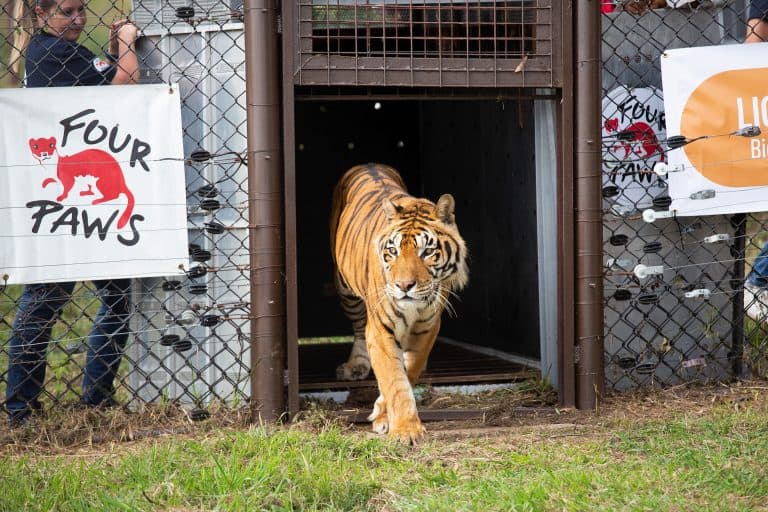
Animal welfare organization Four Paws rescued Sandro, Mafalda, Messi and Gustavo from their cages and transferred them to LionsRock Big Cat Sanctuary.
Veterinarians of Four Paws spent weeks on-site to prepare the Tigers with positive reinforcement so that the transfer would be as safe as possible for the animals.
“These Tigers spent over 15 years in the same 75m² space, surrounded by the same landscape and without any stimulation of their instincts or natural behaviour. Our team needed to be around them so they would stay calm in our presence and during the transfer,” Four Paws veterinarian Amir Khalil, who led the rescue mission, said.
The Tigers had to be taken out of their cages, moved into transport crates and on a truck to the airport, flown from Argentina to South Africa, and taken off the airport on trucks to their new home. The total journey took more than 70 hours.
At LionsRock, Mafalda took a little time before leaving her transport crate, but the three other Tigers started to explore the new surroundings almost immediately, Four Paws said.
Mafalda hesitantly enters her new life of freedom. Credit: Four Paws
“These Tigers have never felt grass or earth under their paws. It’s the first time they can see the sky above them, not just metal bars and a roof,” Khalil said.
“Now they have hundreds of square meters full of new feelings, tastes and smells. It is overwhelming for them to be in a completely new environment, but animals are quick at adapting to better living conditions,” he added.
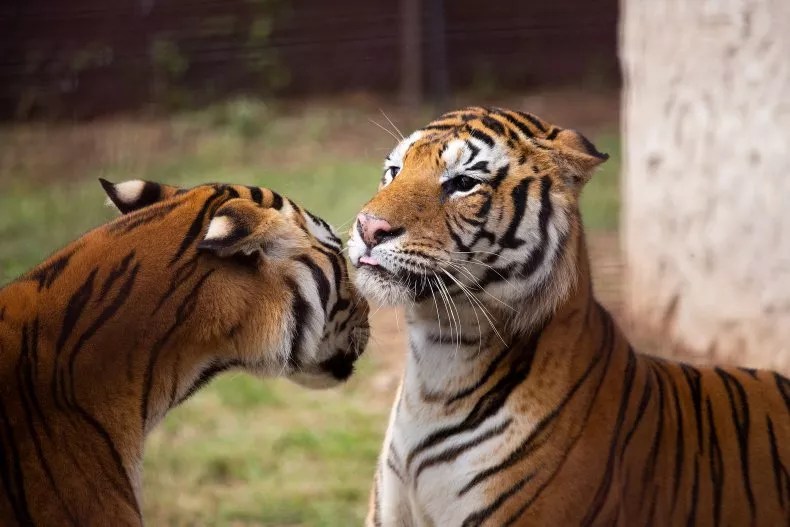
Messi and Sandro enjoying their freedom. Credit: Four Paws/Daniel Born
“The road to rehabilitation for these animals now begins,” Hildegard Pirker, who manages LionsRock Big Cat Sanctuary, said
There are only around 3,900 Tigers left in the wild, Four Paws said, adding that due to a lack of regulations, Tigers are kept in captivity and traded around the world for human entertainment and killed for their skin, fur, bones, and teeth.
The Train Tigers of Argentina – two years on. Credit: Four Paws.
WHAT YOU CAN DO TO HELP WILDLIFE
You can support ‘Protect All Wildlife’ by donating as little as £1 – It only takes a minute but it can last a lifetime for an animal in need. Please donate below.
Everyone who donates will receive a Certificate of Appreciation as a thank you for helping animals in need.
The Mission of Protect All Wildlife is to prevent cruelty and promote the welfare of ALL animals.
We believe EVERY animal should be treated with respect, empathy, and understanding. We raise awareness to protect and conserve wild, captive, companion and farm animals.
It is vital that we protect animals against acts of cruelty, abuse, and neglect by enforcing established animal welfare laws and, when necessary, take action to ensure that those who abuse animals are brought to justice.
Protect All Wildlife are involved in many projects to protect animals’ rights, welfare, and habitats. Money contributed to Protect All Wildlife supports ALL of our worthy programmes and gives us the flexibility to respond to emerging needs. Your donations make our work possible.
This is your chance to bid on beautiful original artworks in our ‘Charity Auction To Help Disabled Animals’.
This is a sealed bid auction, so all you need to do is decide which item you would like to bid for and send us your bid with the LOT NUMBER and name by email to protectallwildlife@btinternet.com by 21:00 on the 30th of June. We will email you to let you know if your bid is the highest. Postage costs will be calculated when the auction ends. If you need any more information etc please email Paul at protectallwildlife@btinternet.com.
This is an ORIGINAL watercolour, pastel and pencil study of a Badger by wildlife artist Milo. This STUNNING piece is on high grade art paper measuring 59 x 42 cms.
A Badger by Milo ~ 2020.
Lot 2
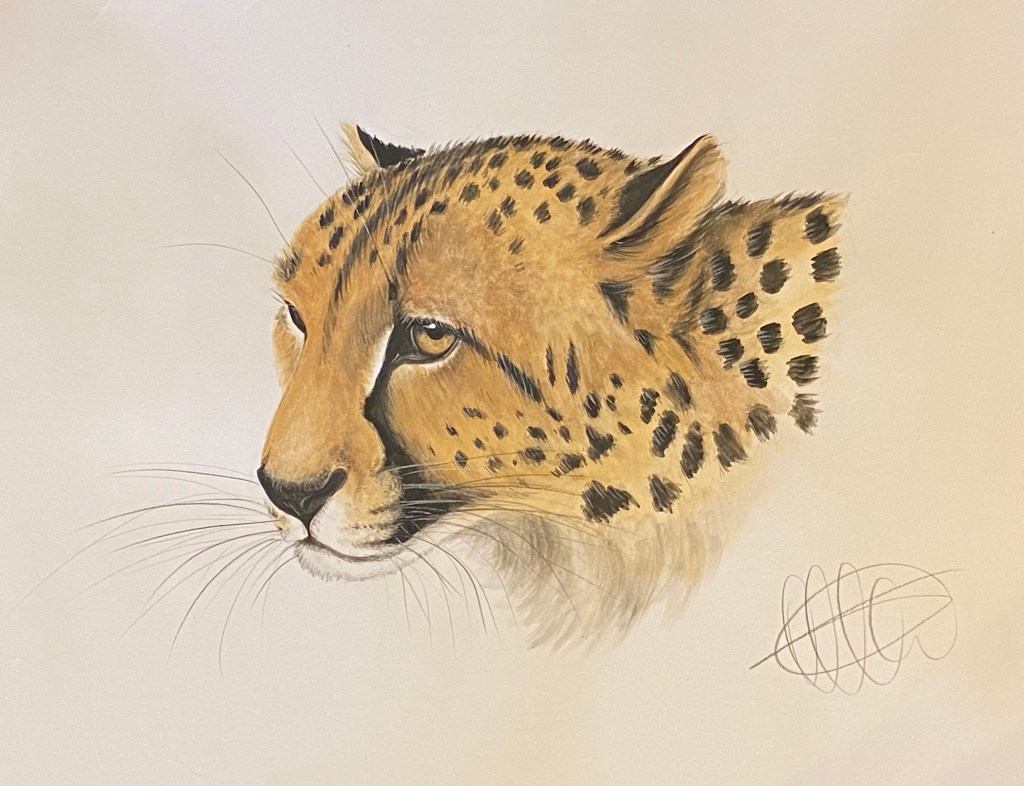
This is an ORIGINAL watercolour, pastel and pencil study of a Cheetah by wildlife artist Milo. This STUNNING piece is on high grade art paper measuring 59 x 42 cms.
A Cheetah by Milo ~ 2020.
Lot 3
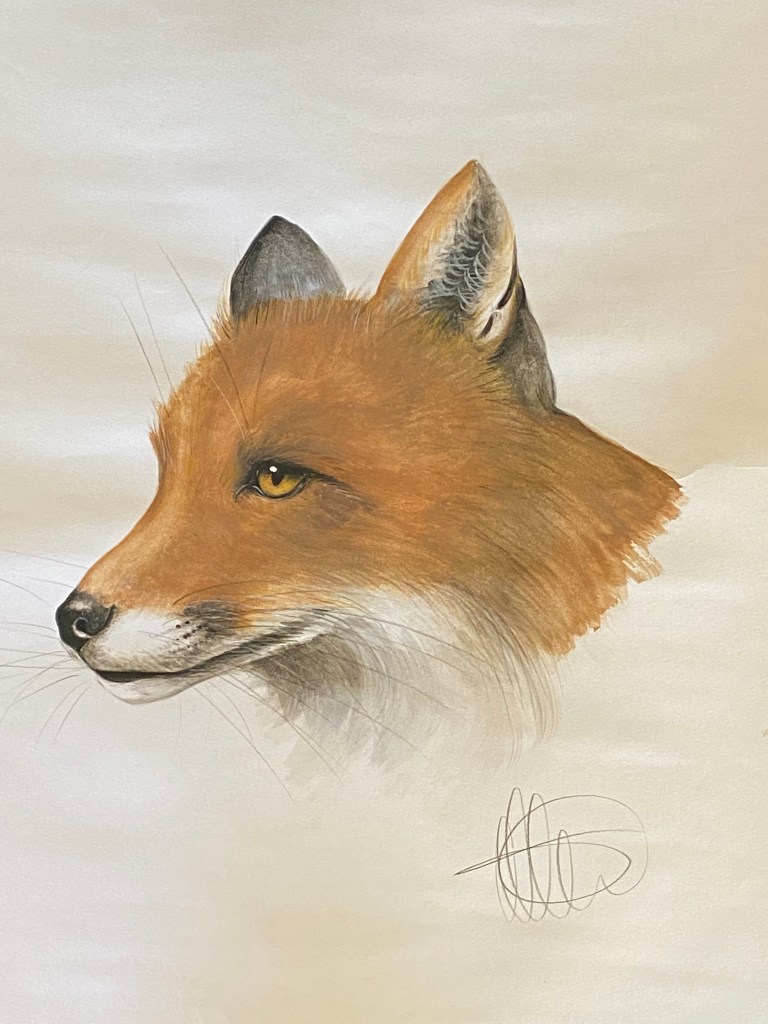
This is an ORIGINAL watercolour, pastel and pencil study of a Fox by wildlife artist Milo. This STUNNING piece is on high grade art paper measuring 42 x 59 cms. (#19).
A Fox by Milo ~ 2020.
Lot 4
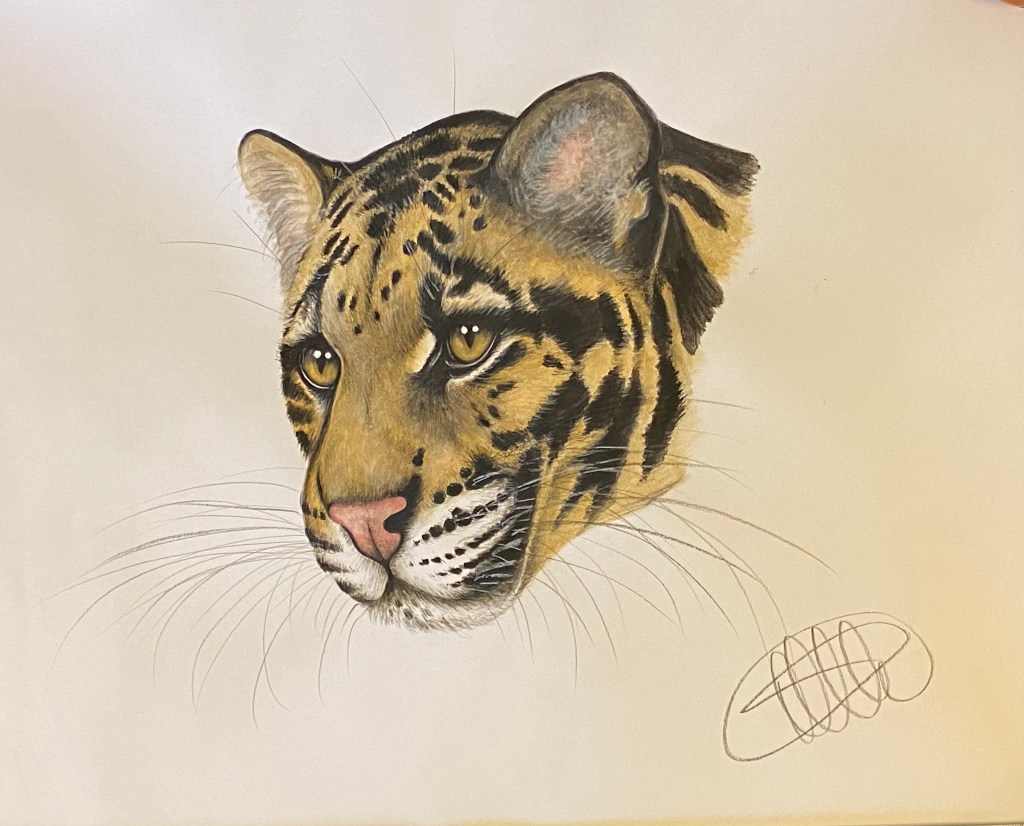
This is an ORIGINAL watercolour, pastel and pencil study of a Clouded Leopard by wildlife artist Milo. This STUNNING piece is on high grade art paper measuring 57 x 42 cms. (#34).
A Clouded Leopard by Milo ~ 2020
Lot 5
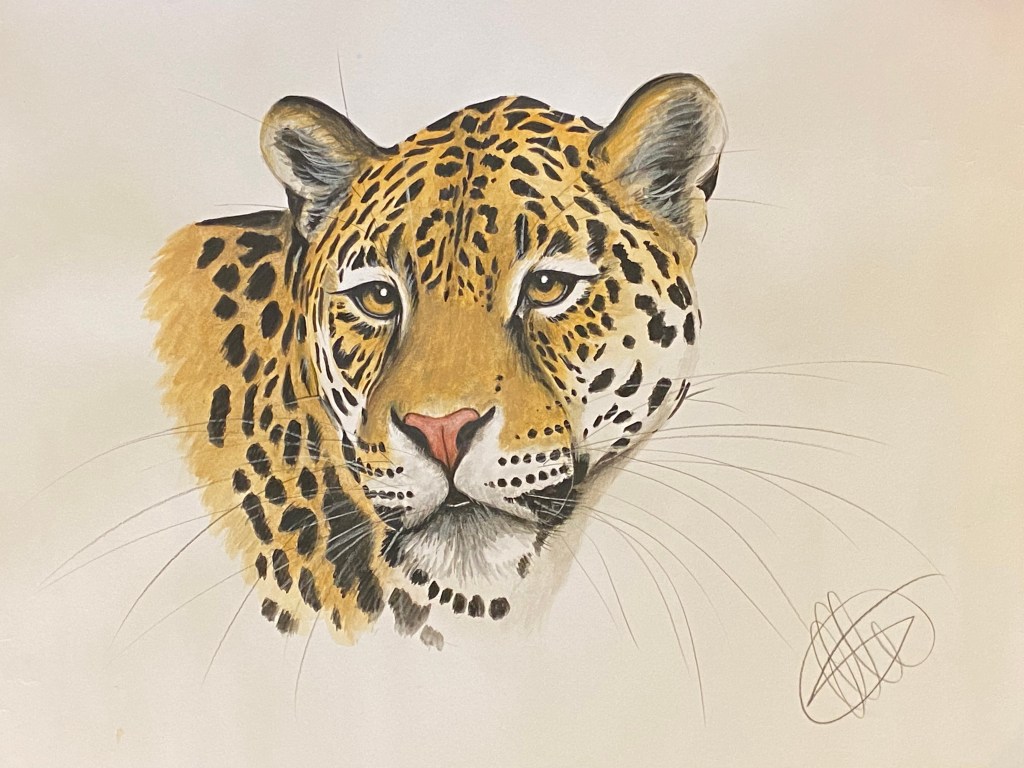
This is an ORIGINAL watercolour, pastel and pencil study of a Jaguar by wildlife artist Milo. This STUNNING piece is on high grade art paper measuring 57 x 42 cms. (#8
A Jaguar by Milo ~ 2020.
Lot 6
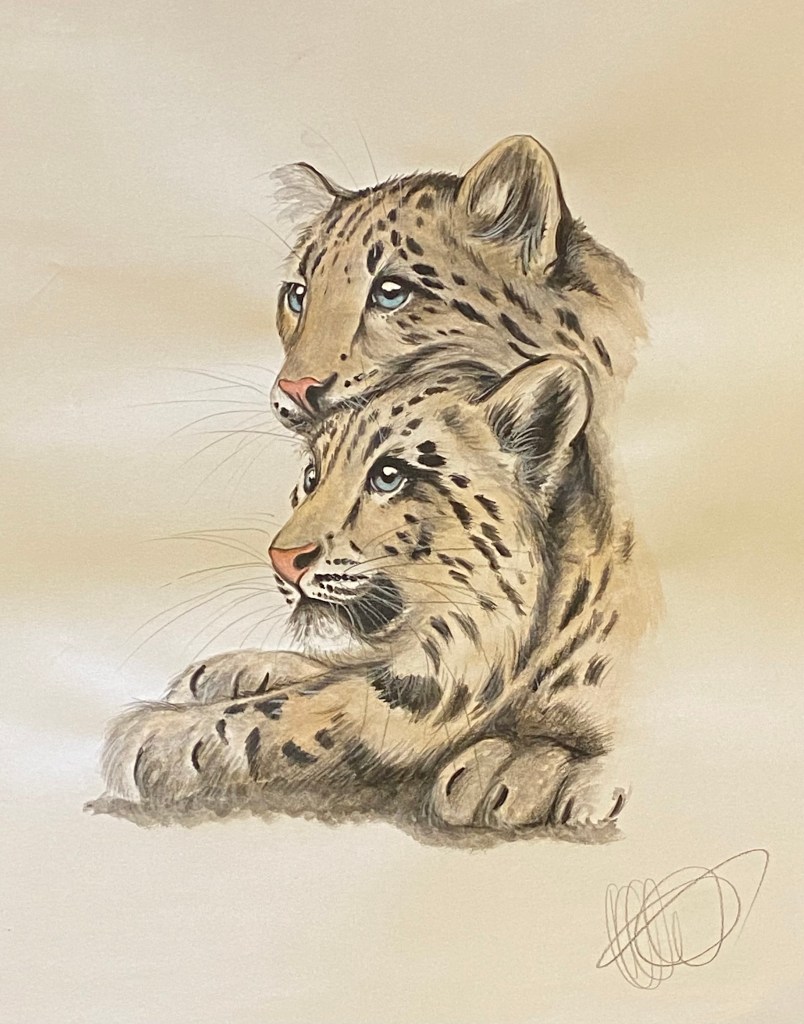
This is an ORIGINAL watercolour, pastel and pencil study of a pair of Snow leopard cubs by wildlife artist Milo. This STUNNING piece is on high grade art paper measuring 42 x 59cms. (#26).
A pair of Snow Leopard cubs by Milo ~ 2020.
Lot 7
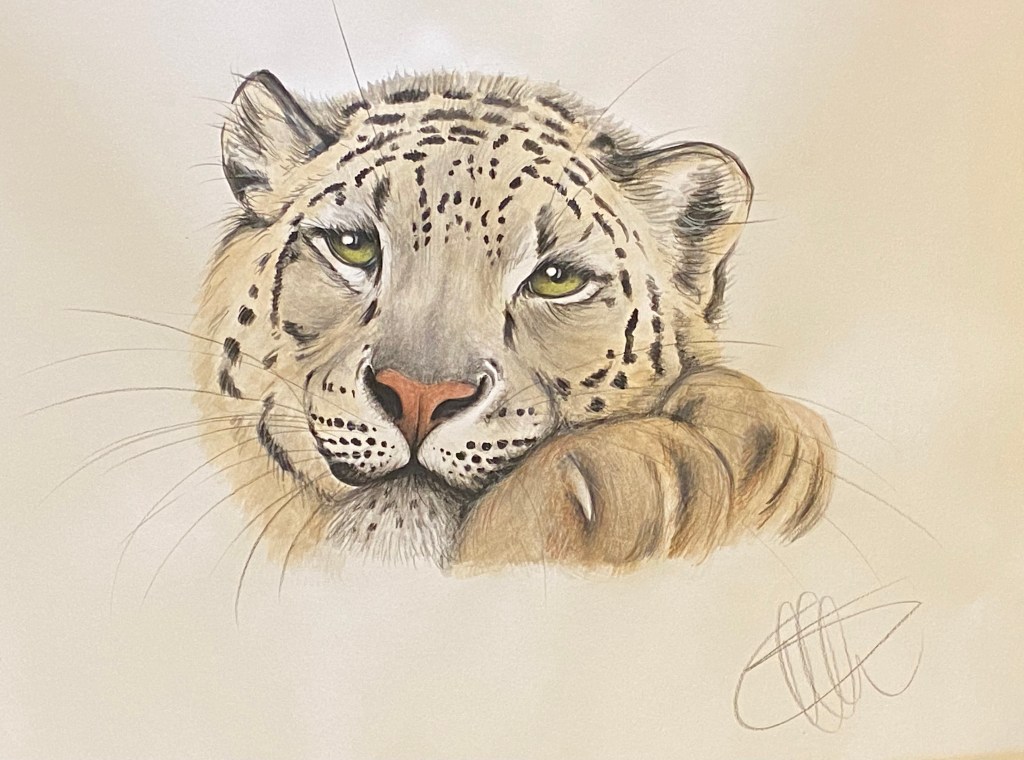
This is a stunning ORIGINAL watercolour, pastel and pencil study of a Snow Leopard by wildlife artist Milo. This STUNNING piece is on high grade art paper measuring 59×42 cms. (#7).
A Snow Leopard by Milo ~ 2020
Lot 8
This lot is ‘A Mother’s Love’, an adorable original watercolour, pastel and pencil of a Lioness and her cubs by wildlife artist Milo. This BEAUTIFUL piece is on high grade art paper measuring 30.5×27.6 cms. (#17).
A Mother’s Love by Milo ~ 2012
Lot 9
Who can resist ‘Those Eyes’? This delightful original watercolour, pastel and pencil study of a baby Orangutan is by Milo and is on high grade art paper measuring 59×42 cms. (#12).
‘Those Eyes’ by Milo ~ 2021.
Lot 10
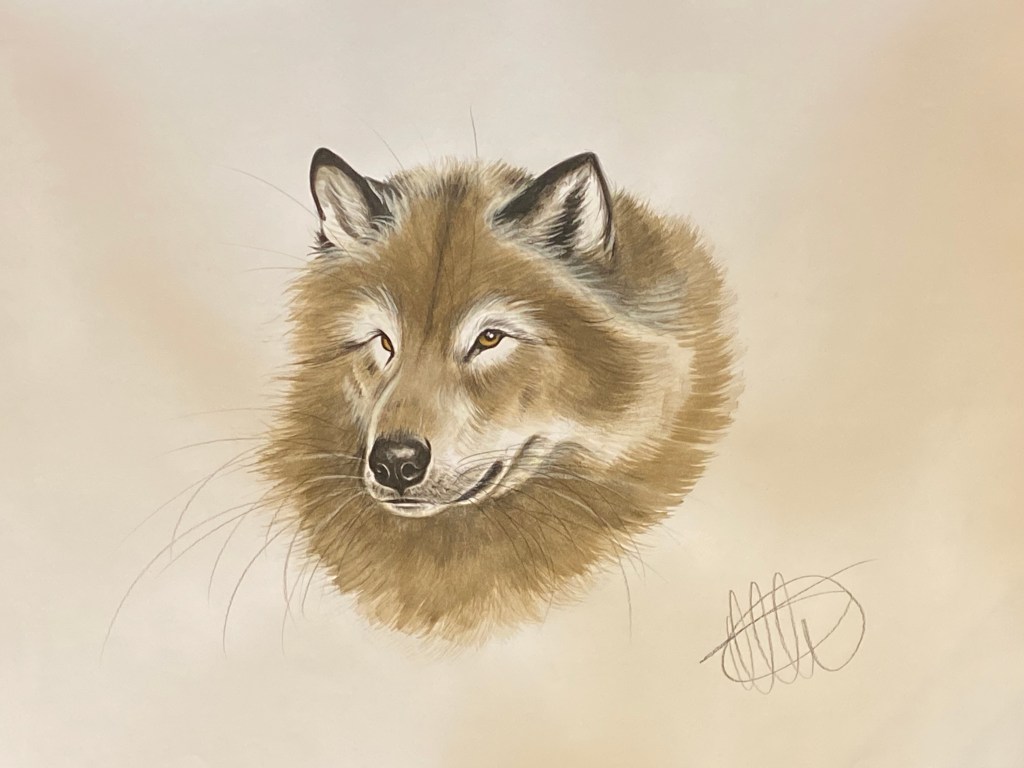
This is a stunning ORIGINAL watercolour, pastel and pencil study of a Wolf by wildlife artist Milo. This beautiful piece is on high grade art paper measuring 59×42 cms. (#13).
A Wolf by Milo ~ 2021.
Lot 11
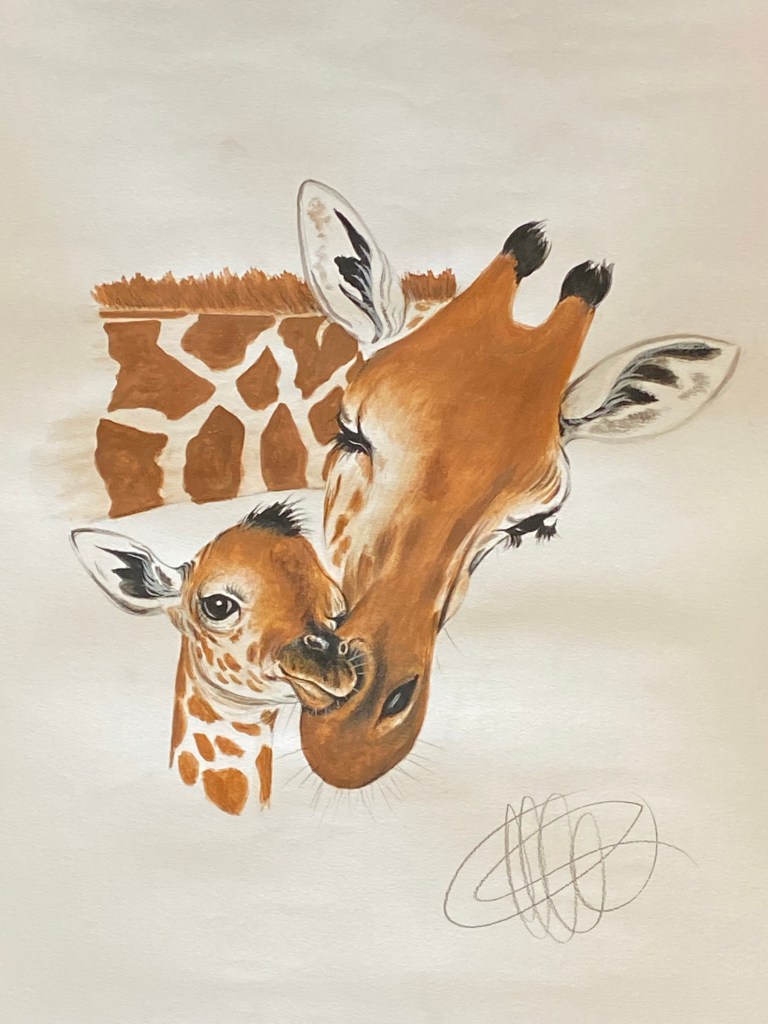
‘A Mother’s Love’ is an ORIGINAL watercolour, pastel and pencil study of a Giraffe and her baby by wildlife artist Milo. This STUNNING piece is on high grade art paper measuring 42 x 59 cms. (#18).
‘A Mother’s Love’ (Giraffe & Baby) by Milo ~ 2021.
Lot 12
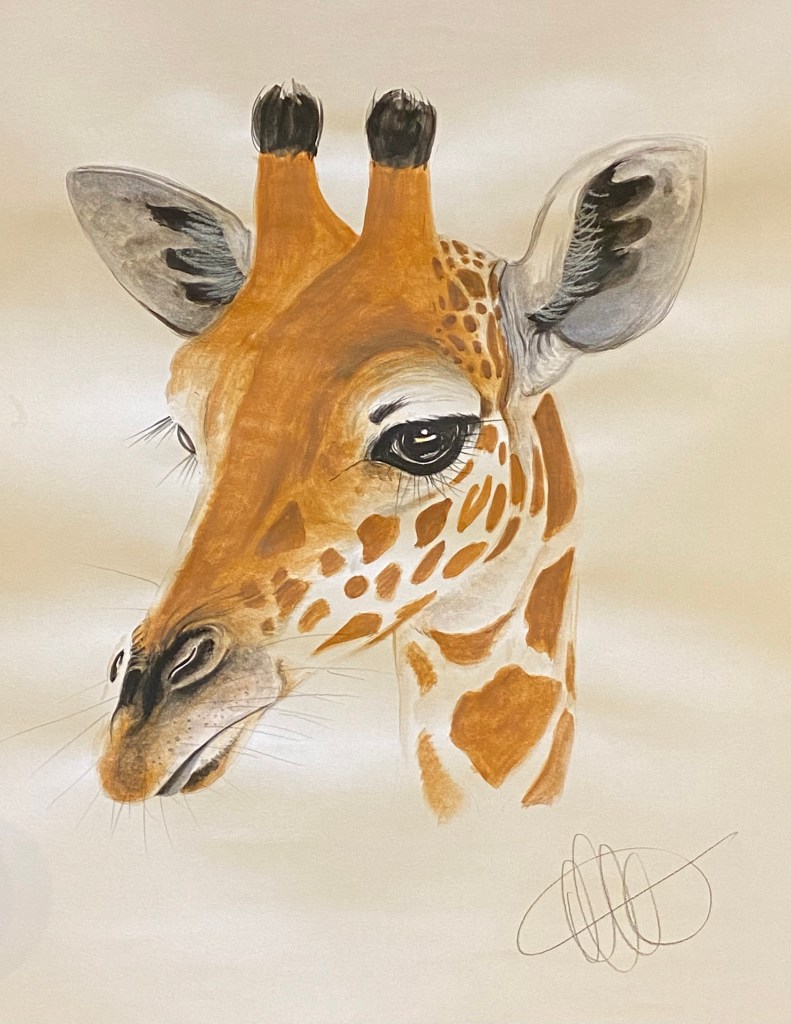
This is an ORIGINAL watercolour, pastel and pencil study of a Giraffe by wildlife artist Milo. This BEAUTIFUL piece is on high grade art paper measuring 42 x 59 cms. (#25).
A Giraffe by Mido ~ 2020.
Lot 13
This is an ORIGINAL watercolour, pastel and pencil study of an Amur Leopard by wildlife artist Milo. This BEAUTIFUL piece is on high grade art paper measuring 59 x 42 cms. (#27).
An Amur Leopard by Milo ~ 2021.
Lot 14
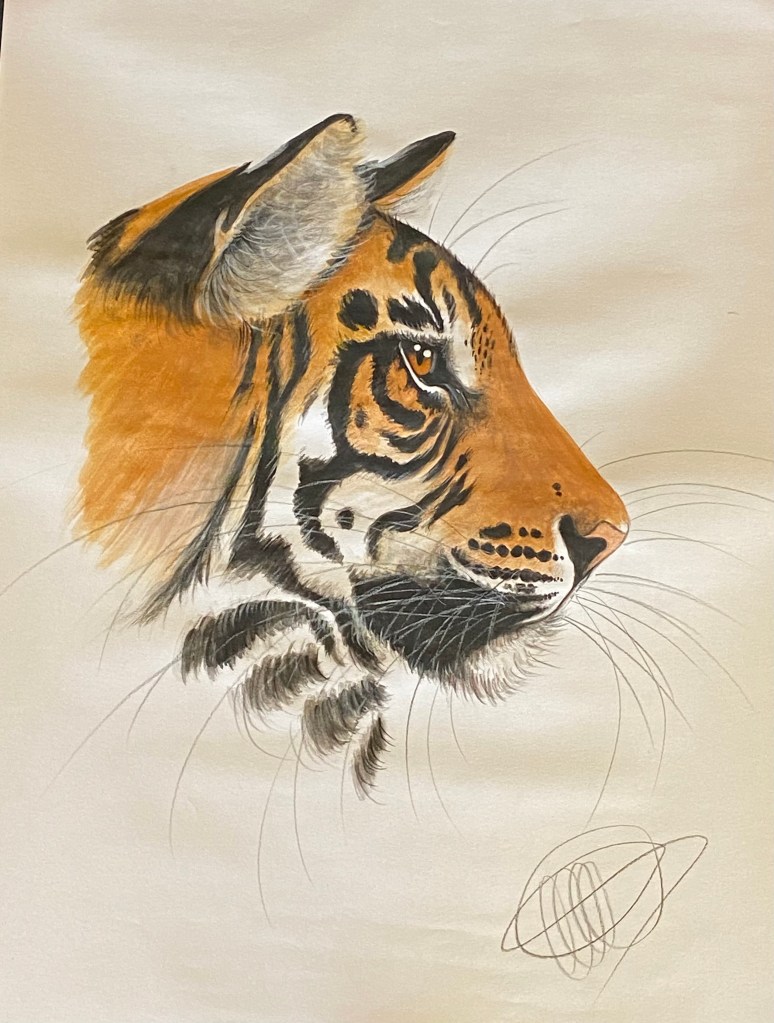
This is an ORIGINAL watercolour, pastel and pencil study of a Sumatran Tiger by wildlife artist Milo. This BEAUTIFUL piece is on high grade art paper measuring 59 x 42 cms. (#1).
A Sumatran Tiger by Milo ~ 2019.
Lot 15
This is an ORIGINAL watercolour, pastel and pencil study of a beautiful pair of Cheetah cubs by wildlife artist Milo. This BEAUTIFUL piece is on high grade art paper measuring 59 x 42 cms. (#16).
A pair of Cheetah cubs by Milo ~ 2020.
Lot 16
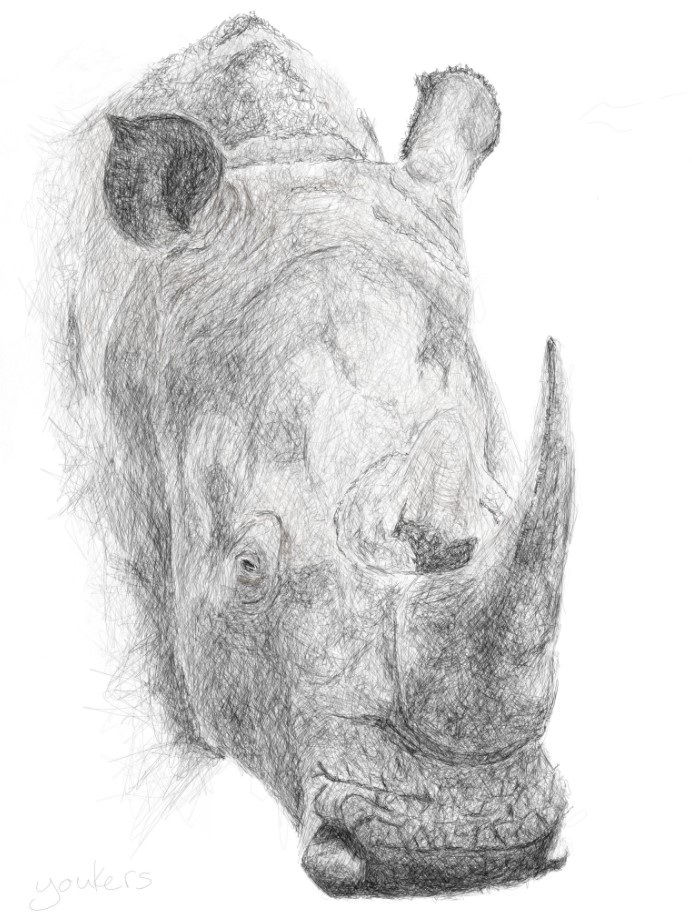
This is an ORIGINAL pencil study of a Rhino by Dane Youkers . This beautiful piece measures 28 x 36 cms .
A Rhino by Dane Youkers ~2022.
Lot 17
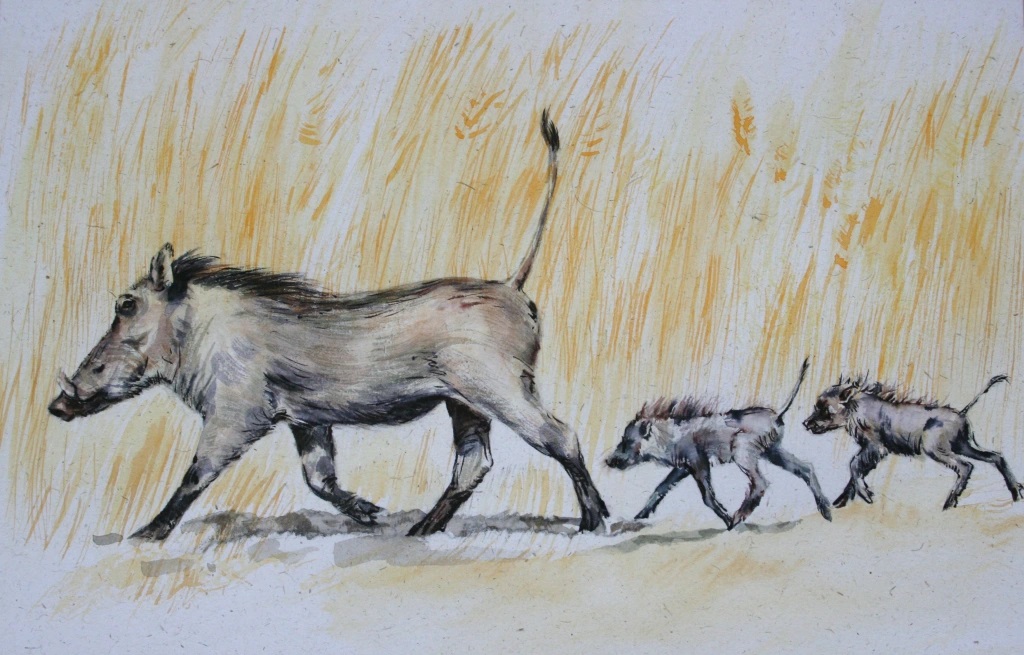
‘Tails Erect’ by Wildlife Artist Carol Barrett. This ORIGINAL study of Warthogs is in watercolour and ink and is on Rhino Dung Paper! It is mounted and measures 40 x 30 cm.
‘Tails Erect’ by Carol Barrett.
Lot 18
This is an ORIGINAL watercolour study of a Badger by Diane Antoine. This beautiful piece measures 30 x 21 cms .
‘The Badger’ by Diane Antoine ~2020.
Lot 19
This is an ORIGINAL pencil study of a Wolf (artist unknown). This beautiful piece measures 30 x 21 cms .
A Wolf In Thought
Lot 20
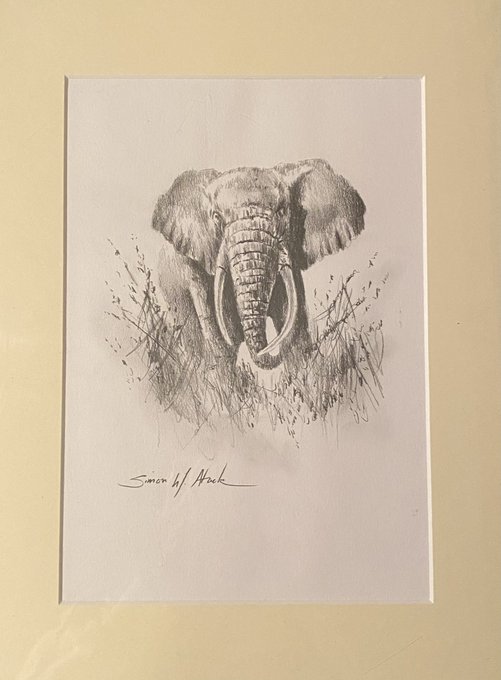
This is an ORIGINAL study of an Elephant in pencil by Simon W. Atack. This BEAUTIFUL piece measures 30 x 21 cms and is mounted.
The Leader Of The Herd by Simon W. Atack.
Lot 21
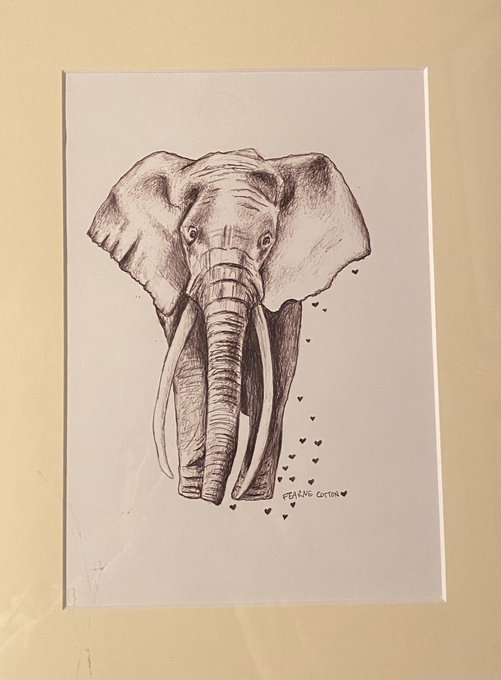
This is an ORIGINAL study of an Elephant in pencil by presenter and author Fearne Cotton. This BEAUTIFUL piece measures 30 x 21 cms and is mounted.
Super Tusker by Fearne Cotton.
Lot 22
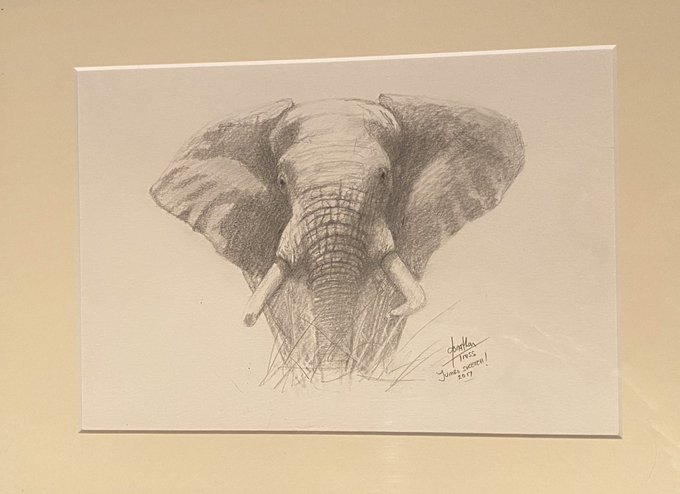
This is an ORIGINAL study of an Elephant in pencil by Jonathan Truss. This BEAUTIFUL piece measures 30 x 21 cms and is mounted.
Jumbo Sketch by Jonathan Truss.
Lot 23
‘Gentle Elephant’ is an ORIGINAL watercolour study by Anne Jolivet. This BEAUTIFUL piece measures 30 x 21 cms .
‘Gentle Elephant’ by Anne Jolivet ~ 2021.
Lot 24
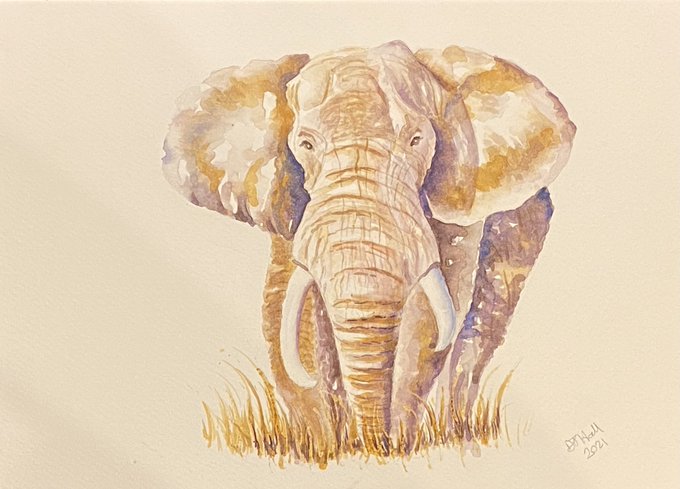
This is an ORIGINAL watercolour study of an Elephant by Debra J. Hall. This BEAUTIFUL piece measures 30 x 21 cms .
An Elephant by Debra J. Hall ~ 2021.
Lot 25
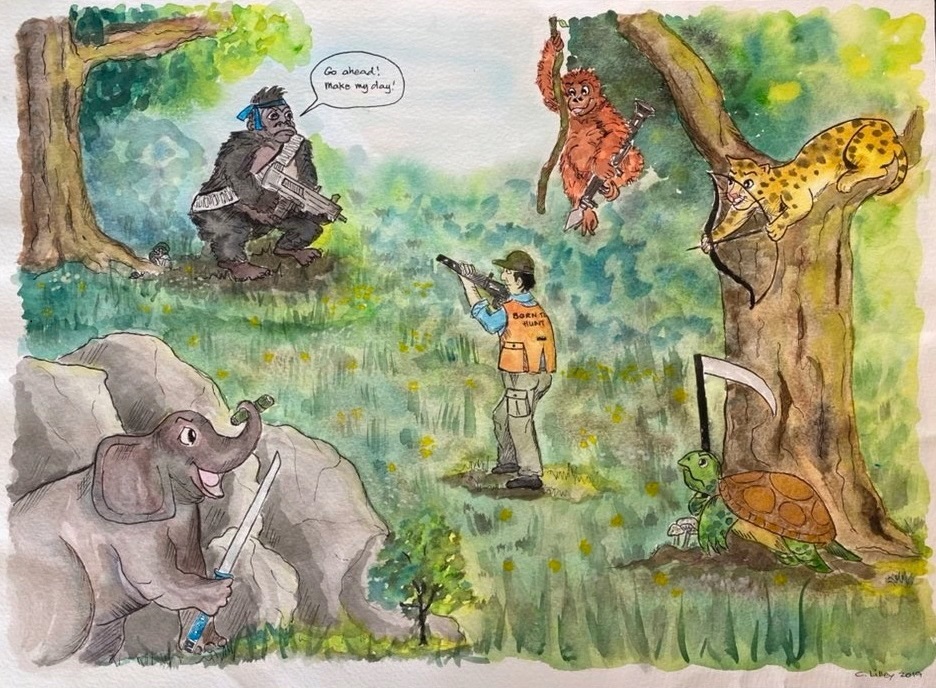
‘The Animals Fight Back’ ORIGINAL watercolour Charito Lilley. This thought-provoking piece measures 40 x 30 cms
‘The Animals Fight Back’ by Charito Lilley ~ 2019.
Lot 26
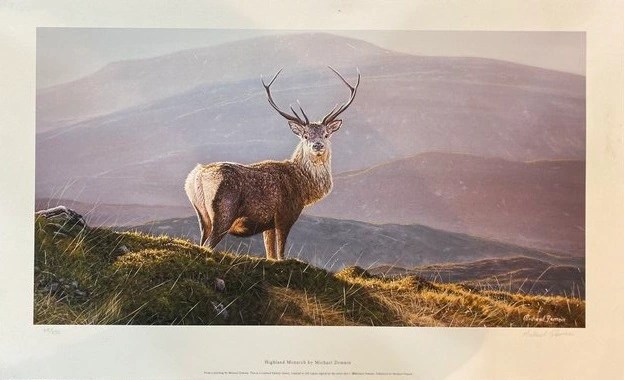
This is a Limited Edition (No. 46/250) print is ‘Highland Monarch’ by Michael Demain. This stunning print measures 56 x 34 cms.
‘Highland Monarch’ by Michael Demain.
Lot 27
A beautiful print of Tiger cubs by Jan Ferguson. This piece measures 41 x 31 cms.
‘Tiger Cubs’ by Jan Ferguson.
Lot 28
A stunning Limited Edition print (No. 7/100) titled ‘Endangered Nobility’ by Kim Thompson. This beautiful study of the noble Lion measures 60 x 42 cms.
‘Endangered Nobility’ by Kim Thompson ~ 2011.
Lot 29
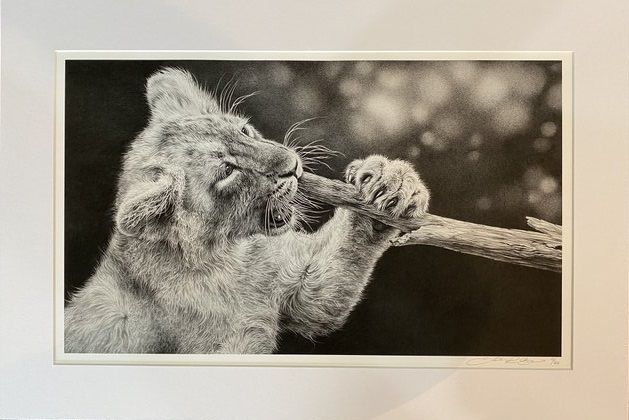
‘Mischief Maker’ is a beautiful Ltd Edition study of a playful Lion cub by Julie Rhodes. It is mounted and measures 56 x 38 cms.
‘Mischief Maker’ by Julie Rhodes.
Lot 30
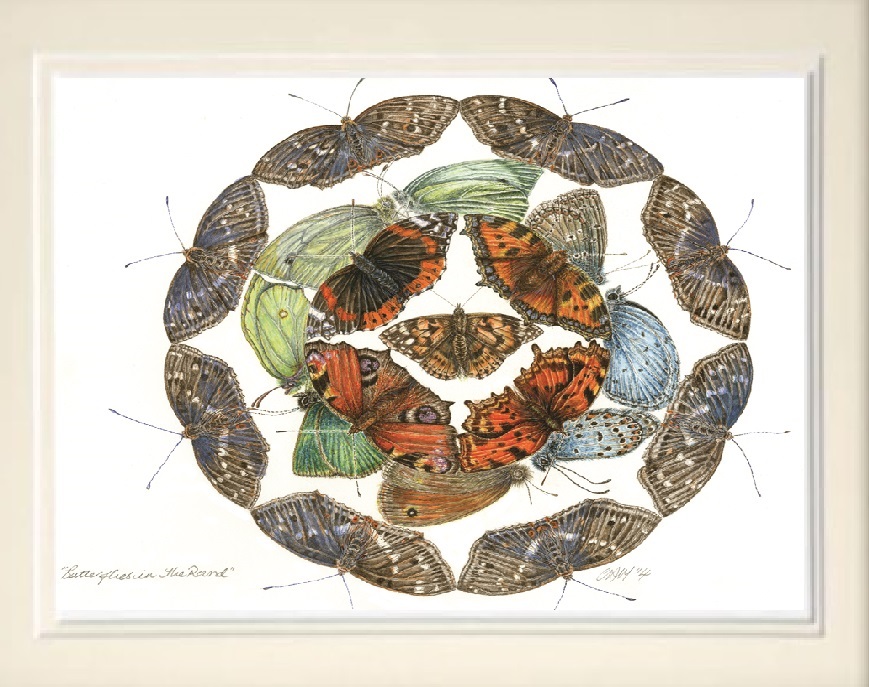
The beautiful Butterflies In The Round by Cath Hodsman. This Limited Edition print measures 51 x 41 cms.
‘Butterflies In The Round’ by Cath Hodsman.
Lot 31
Street artist Sonny Sundancer’s gigantic painting of an Amur Leopard overlooked the city of Vladivostok, Russia and was part of his worldwide ‘To The Bone’ project aimed at raising awareness about endangered species.
This STUNNING piece of his work is caught brilliantly in this VERY Limited Edition of only 45 prints (No. 29/45) and measures 50 x 35 cms.
Amur Leopard street art by Sunny Sundancer ~ 2017.
Lot 32
In a very Limited Edition of only 75 prints (No. 6/75), this beautiful study of a Sumatran Tiger is by Nick Day. It measures 38 x 41 cms.
A Sumatran Tiger by Nick Day ~ 2015.
Lot 33
This is a stunning Limited Edition print of a commission for The Miracle’s Mission Rehabilitation Centre. This beautiful piece measures 30 x 21 cms.
THE MIRACLE’S MISSION REHABILITATION CENTRE
Thank you for taking the time to look at our auction and happy bidding.
If you would like to make a donation to our fundraiser to help support our work you can do so at Fundraiser To Help Disabled Animals. Thank you.
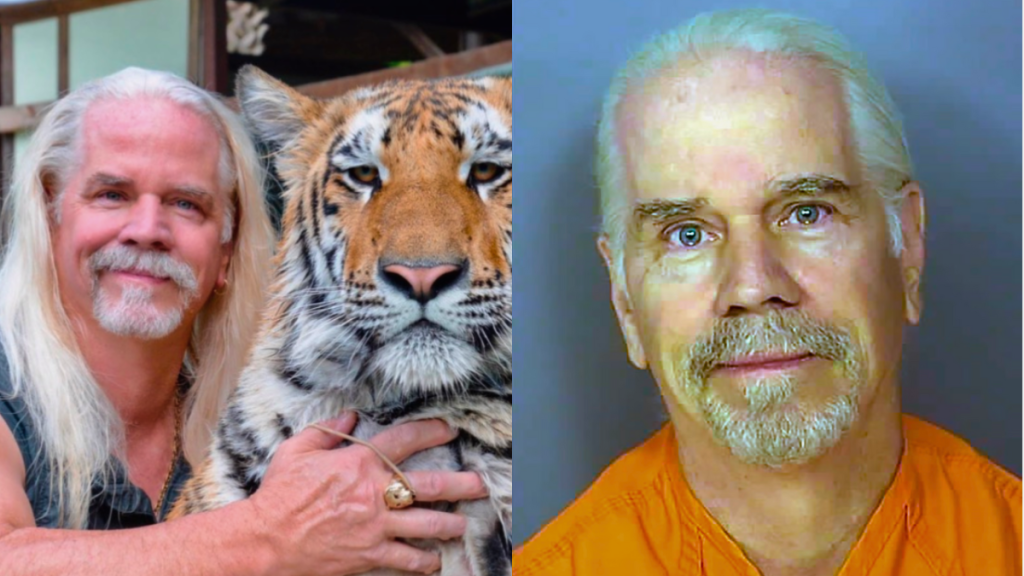
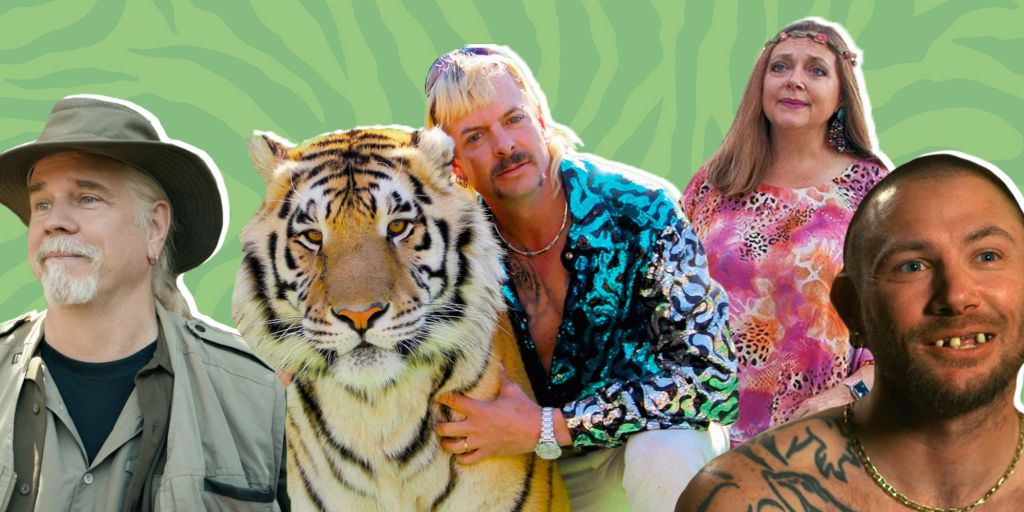
An exotic wildlife preserve owner who gained notoriety on the popular Netflix series “Tiger King” pled guilty on Monday to animal trafficking and money laundering, the U.S. Justice Department announced.
Bhagavan “Doc” Antle oversaw the sale or purchase of Cheetah cubs, Lion cubs, Tigers and a juvenile Chimpanzee that were all protected as endangered species, according to a Justice Department release. Officials said the 63-year-old man featured in a documentary mini-series about the Tiger trade tried to hide animal payments as “donations” to his nonprofit organization.
“The defendant held himself out as a conservationist, yet repeatedly violated laws protecting endangered animals and then tried to cover up those violations,” Assistant Attorney General Todd Kim of the Justice Department’s Environment and Natural Resources Division said in a statement.
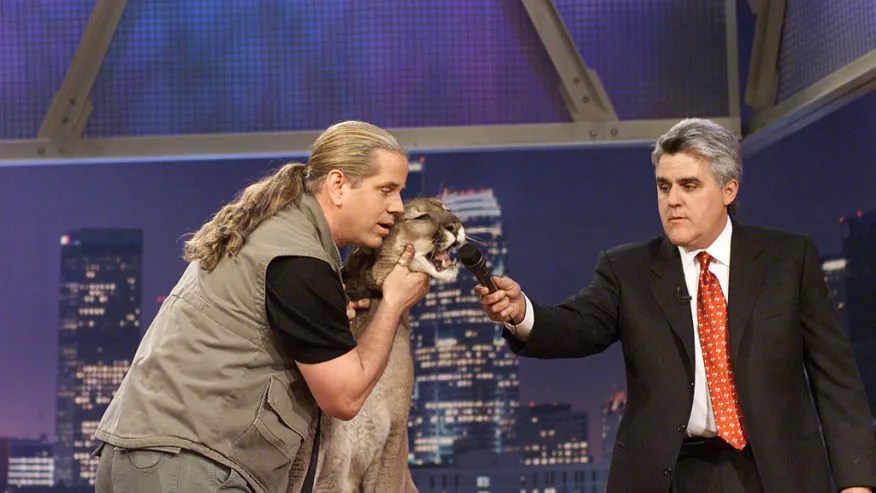
Antle On The Tonight Show Credit: Paul Drinkwater
Antle faces a maximum of five years’ imprisonment, fines up to $250,000 and three years of supervised release for each count. He is also the owner and operator of the Myrtle Beach Safari, which is also known as The Institute for Greatly Endangered and Rare Species, or T.I.G.E.R.S., prosecutors said. The safari is a 50-acre nature preserve that offers tours and the chance for private encounters with wildlife, prosecutors said.
Antle faces a maximum of five years’ imprisonment, fines up to $250,000 and three years of supervised release for each count.
Investigators found evidence that Antle and a coconspirator had also used cash acquired through the transportation and harboring of immigrants who illegally entered the country.
It’s the latest fallout for the subjects of “Tiger King: Murder, Mayhem and Madness.” Joe Exotic, the show’s star, is serving a 21-year prison sentence for trying to hire two different men to kill animal welfare activist Carol Baskin. The ongoing feud between Joe Exotic — whose real name is Joseph Maldonado-Passage — and Baskin featured prominently in the show. Maldonado-Passage had one year shaved off his penalty last year as he began treatment for early-stage cancer.
“Tiger King: Murder, Mayhem and Madness.”
WHAT YOU CAN DO TO HELP ANIMALS IN NEED
You can support our work by donating as little as £5 – It only takes a minute but it can last a lifetime for an animal in need.
Everyone who donates will receive a Certificate of Appreciation as a thank you for helping animals in need.
The Mission of Protect All Wildlife is to prevent cruelty and promote the welfare of ALL animals.
We believe EVERY animal should be treated with respect, empathy, and understanding. We raise awareness to protect and conserve wild, captive, companion and farm animals.
It is vital that we protect animals against acts of cruelty, abuse, and neglect by enforcing established animal welfare laws and, when necessary, take action to ensure that those who abuse animals are brought to justice.
Protect All Wildlife are involved in many projects to protect animals’ rights, welfare, and habitats. Money contributed to Protect All Wildlife supports ALL of our worthy programmes and gives us the flexibility to respond to emerging needs. Your donations make our work possible.
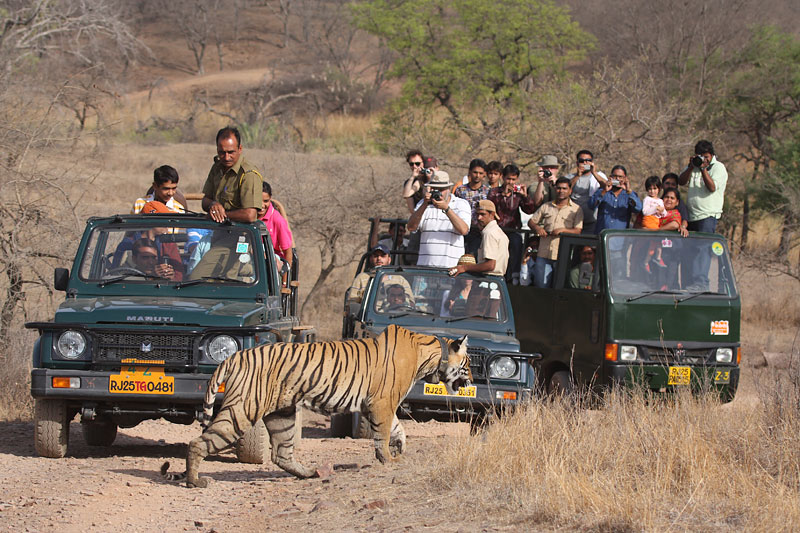
Tiger T42 – Fateh. A dominant tiger of Ranthambhore Tiger Reserve, he rules over Qualiji area. He is named after the legendary conservationist, synonymous with Ranthambhore, Fateh Singh Rathore-A tribute to a great man.
Wildlife Tourism in India has always been a controversial matter. In 2010, a Public Interest Litigation was filed by tiger activist Ajay Dubey, claiming that the industry was becoming unsustainable and exploitative. As per the 2006 Amendment of the Wildlife (Protection) Act of 1972, “critical Tiger and wildlife habitats” must be inviolate for the vital growth of tiger populations. Any form of human activity was deemed a threat to Tiger conservation. It was on this basis that, on the 24th of July 2012, the Supreme Court ordered a temporary ban on tourism in the core zone of Tiger reserves. The ban stirred significant debate amongst conservationists.
More about the wildlife tourism ban
The underlying principle of the order was questionable. Tiger populations grew remarkably in reserves such as Kahna, Bandhavgarh and Ranthambore, despite substantial amounts of wildlife tourism. Contrastingly, Tiger populations in less popular Protected Areas, such as Buxa and Palamu Tiger Reserve, have depleted immensely despite a lack of tourism. Associating wildlife tourism to the depletion of Tiger populations remains a baseless claim.
The Supreme Court hoped that the ban would instigate the establishment of buffer zones in Protect Areas for wildlife tourism, in accordance with the November 2011 NTCA guidelines. However, despite the Supreme Court mandate, numerous states were reluctant to comply with the guidelines. Tourism in buffer zones was not the most practical alternative. These regions are used extensively by bordering villages for cattle grazing and the collection of forest produce. Habitat degradation would lead to inferior wildlife sightings, hence attenuating the attractiveness of wildlife safaris.
Wildlife Tourism In India
Fortunately the MoEFCC and NTCA redrafted guidelines, allowing for wildlife tourism in up to 20% of the critical Tiger habitat of a reserve. The revised guidelines encouraged states to form their own ecotourism policies. Following this, on the 16th of October 2012, the Supreme Court allowed for the recommencement of tourism in core areas
Are there any benefits of wildlife tourism?
There are numerous benefits to wildlife tourism, particularly for the local communities. Following proper practices, ecotourism brings substantial economic benefits. With over 1 million people visiting tiger reserves annually, a lot of revenue is generated in the form of entry fees, guide salary, lodge bookings amongst others. This provides significant employment opportunities for the local communities and has ripple effects as locals will associate a monetary value with wildlife. This would increase the general acceptance of wildlife, hence reducing human-wildlife conflict. Furthermore, this would prevent locals from turning to game hunting for sustenance. Entry fees would also provide the Forest Department with much required funding for conservation works! It is estimated that in the Fiscal Year of 2019, wildlife tourism in Madhya Pradesh attracted nearly 2 million visitors, generating 27 crore rupees. An organization, TOFTigers, estimated that nearly a quarter of the state’s Forest Department Budget consists of park entry fees in 2017. Moreover, the industry generated an additional 2,500 full time jobs out of which 82% were given to locals. With the industry growing at a healthy 15% annually, local economies stand to benefit immensely, particularly in the North East where the wild wonders are relatively unexplored.
Tourism also has a plethora of benefits in the management of the reserve. With the Forest Departments heavily under resources and understaffed, patrolling Protected Areas is a daunting task. Parks certainly benefit from watchful tourists. Detection of forest fires, illegal activities and injured animals improves with the participation of tourists. In fact, with the development of citizen science software, tourists can contribute even further towards wildlife research. It is no surprise therefore, that within 6 weeks of wildlife tourism shutting down due to the pandemic in 2020, the cases of poaching increased by 151% across India.
Unethical Practices Cloud wildlife tourism
However, in the past, there have been concerns regarding whether the economic benefits of wildlife tourism actually reach local communities. Wildlife tourism may also lead to some atrocious practices. For example, both captive elephants, and dancing bears, undergo immense torture while being trained for tourist purposes. Similarly, Kopi Luwark, the world’s most expensive coffee, is a major attraction in Indonesia. However, most people are oblivious to the fact that it sponsors the illegal wildlife trade. Snake charming also is equally diastorous.
Unruly visitors are not avoidable
Enforcement of rules and regulation also remains a dark spot in the wildlife industry. I personally have witnessed numerous accounts of wildlife harassment. Unruly tourists littering, wearing excessively bright colours and making excessive noise has made a few safaris unpleasant. Furthermore, in the lure of tips, guides are often overly enthusiastic during a safari. A critical protocol which is frequently ignored during a direct sighting is the minimum distance requirement between two jeeps. Though legally, animals have the right of way in forest roads, this behaviour by jeeps often obstructs their paths and causes distress to the animals. I witnessed this with the dominant male Rudra in Tadoba Tiger Reserve in October 2020 and in my first visit to the park in 2017, where a jeep did some off-roading to show the guests tiger cubs feeding on a kill. Not only did the family flee, the jeeps shamelessly continued chasing them off-roading. Littering is also a prominent issue. On the same trip, I visited the Tipeshwar Tiger Reserve where visitors, despite being confronted by both forest staff and guests, continued to litter in the park. I can name plenty of such personal anecdotes from forests all over India! Seeing the popular tiger of the park overwhelms tourist and guide alike!
The impact of such behaviour has had an observed impact on wildlife. Tigers and other wildlife of popular parks are far more accustomed to jeeps than in the smaller reserves. Despite this, tigers do witness increased stress levels. This is proved by a study of 341 samples of tiger scats by the Centre for Cellular and Molecular Biology (CCMB) in Bandhavgarh and Kanha National Park. The study found that tigers had higher concentrations of the stress hormone, faecal glucocorticoid metabolite (fGCM), during the tourism season than prior.
This behaviour could be rectified by improved education. While an underlying purpose of ecotourism is education, only 30% of India’s Protected Areas have visitor orientation centres. Private lodges also are not very proactive in the field.
Wildlife tourism has to become more sustainable
Another issue with wildlife tourism is that lodges are not truly eco-friendly. A nationwide study of 10 of India’s major wildlife tourist destinations was alarming. 85% of tourist facilities were within 5km of the park. 93% of the lodges used local wood while the dependency on local borewells varied from 40% to 100%. Swimming pools in the lodges of Central India prove costly for local communities in the dry summer months. The fragile ecosystem of Ladakh is witnessing widespread decimation in recent years due to scores of tourists flocking to the state following the release of the movie “3 Idiots”.
The same study found that in the 10 parks, 95% of the revenue went to private operators. Only 4.5% and 0.5% went to the park and locals respectively. In fact, only 0.001% of the locals within a 10km buffer of PA were employed. This accentuates the fallacies of India’s wildlife industries!
Larger mammals steal the limelight
Although only 10% of India’s 500 Protected Areas are Tiger Reserves, they account for 32% of wildlife tourism. Spotting charismatic species such as Tigers, Elephants, Rhinos and Lions still remains the sole interest for most visitors. Much of India’s natural beauties are unheard of by the general public. This is in sharp contrast with countries such as Australia, US, South Africa and Europe. Unlike India, ecotourism is not limited to safaris solely. These countries offer a wide array of sustainable activities across their natural landscapes including bird watching, camping, adventure sports, and natural history museums. Although it is essential to not damage the natural ecosystem, the ecotourism industry in India could be further developed. In fact, developing more activities in the lesser known parks could help distribute tourism more evenly across the country. There is much scope to expand. India could also adopt a private-public partnership in a few regions, much like the Private Game Reserves of South Africa!
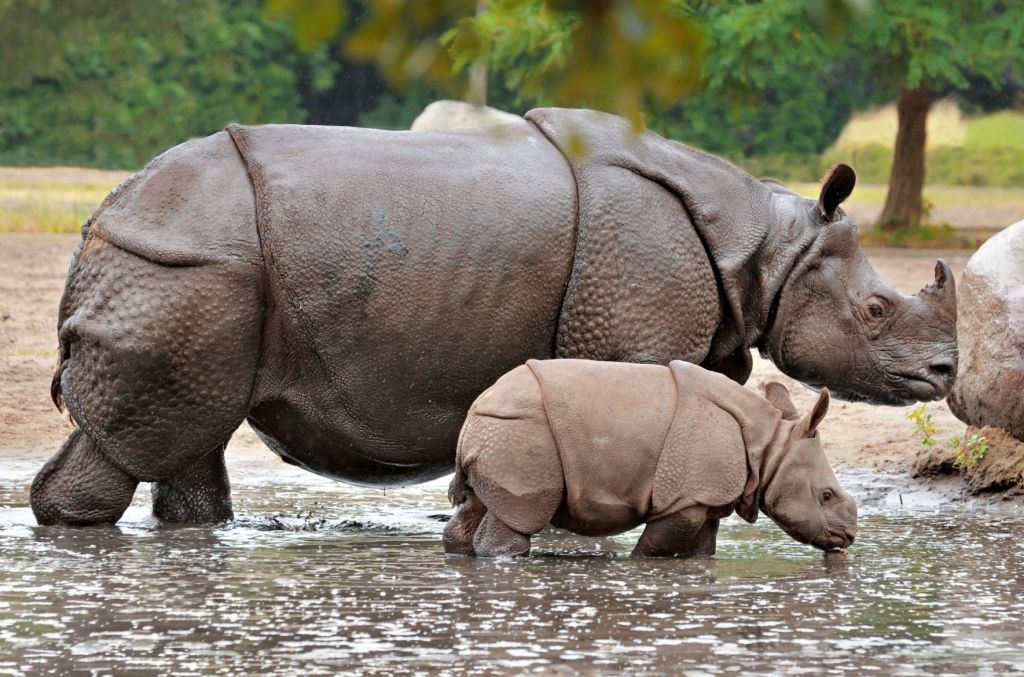
The Greater One-Horned Rhino
All in all, the wildlife tourism industry is still fairly young and has much growth left. It has various benefits to wildlife but there are many issues for India to iron out such that the industry can bolster conservation efforts.
This article was first published on Think Wildlife Foundation.
How you can help animals in need:
You can support animals in need by donating as little as £1 – It only takes a minute but it can last a lifetime for an animal in need.
Below, is the full testimony of an anonymous source, a former member of the Oxford University Wildlife Conservation Research Unit (WildCRU) team that radio-collared and studied Cecil prior to him being killed.
CECIL LIVED IN HWANGE NATIONAL PARK, IN ZIMBABWE. HE WAS LURED OUT OF THE PARK WITH AN ELEPHANT CARCASS BY AMERICAN TROPHY HUNTER WALTER PALMER
This anonymous source’s first-hand account of the killing of Cecil 7 years on is an appropriate testimony, not only to the callous way in which American trophy hunter Walter Palmer et al took this pride male Lion’s life for their own self-gratification and/or financial enrichment (the ethos of trophy hunters and the industry that panders to them in general), but also a testimony to why trophy hunting is a vacuous void, devoid of any moral or ethical compass that undermines Africa’s indigenous culture. That is why the long outdated, notion of a bygone era of colonial entitlement and the predominantly white foreigner’s self-proclaimed ‘right’ to kill African wildlife for sadistic entertainment as espoused by trophy hunting must end:
“The physical act of a white hunter coming in and going out on their exploratory adventure, to conquer and kill an animal – that act rehearses the history of colonialism. That point is not lost on people who live in local communities, and it should not be lost on those of us from the country sending trophy hunters” (page 146) – Dr Chelsea Batavia
Senior environmental scientist
“When I started reading the narratives of trophy hunters, I was struck more than anything by the similarity with the narratives of terrorists when they talk about what they do” (page 151) – Professor Geoff Beattie, Professor of Psychology, Edge Hill University. Author, ‘Trophy Hunting: A Psychological Perspective’
The economic forces that drive the trophy hunting industry can be replaced with a balanced approach that enriches Africa’s own cultural identity and interaction with its native wildlife, free from the imposition of the destructive, greed-based desire of the trophy hunting colonial mindset and its bloated lobby heavily financed by vested interests.
ANON – a former member of the Oxford University Wildlife Conservation Research Unit (WildCRU)
“I worked for close to a decade as a field researcher on the Hwange Lion research project in Hwange National Park, Zimbabwe. The initial focus of the work was the impact of trophy hunting outside the park on the Lions inside the park. There was a lot of darting, collaring and observational data to collect. I spent 7 days a week tracking Lions, catching and collaring them and getting to know them. Soon that developed into a study of the conflict between people and Lions, a subject I eventually specialised in.
Cecil was a very large mature Lion in Hwange. He was special because very few male Lions ever survive as long as he did, and thus a lot was made of his huge mane and the fact that it was black. The black mane is a genetic trait that is quite strong in Hwange Lions, but very few Lions survive long enough for it to present. Cecil was dominant over some of the best Lion real-estate in Hwange and this too was the area best for tourists. That is why he was so well-known. He had large prides and he was seen daily by tourists. Cecil was very much in his prime when he was shot, despite him being 12 years old or so. The hunters made a case that Cecil was old and therefore past his prime, but that was not true. He was still breeding and in perfect condition. He was considered old because most Lions are shot long before getting to that age. He was one of two males in a coalition. They were unrelated but had forged an alliance because together they were stronger.
On the night of the 1st of July 2015, a couple of professional hunters (PHs) and their client were sitting about 40 or 50 metres from a blind overlooking a dead elephant. Between 9 and 10pm Jericho, Cecil’s coalition partner, ran past the blind and started feeding on the elephant. Jericho was a very large Lion in his own right and was about a year younger than Cecil. His saving grace was that he was blonde. Walter Palmer – the trophy hunter who shot Cecil – has subsequently said that he didn’t know about Cecil and hadn’t come to hunt Cecil specifically. However, the fact that they didn’t shoot Jericho while watching him feed for over an hour meant that they knew that a larger and darker Lion – the traits a trophy hunter prefers – was still to come.
BROTHERS IN ARMS: THE LAST KNOWN PHOTOGRAPH OF CECIL (WITH BROTHER JERICHO STANDING BEHIND HIM)
Cecil arrived about an hour later. Walter Palmer let loose his arrow. Cecil ran off wounded. The hunters left to go back to camp for the night. Normally when a client is about to shoot a Lion from a blind, his professional hunter (PH) is ready too with his rifle. If the client’s shot doesn’t kill the Lion instantly, then the PH shoots the animal to “secure it”. This is common practice because a wounded Lion is dangerous to follow up and nobody wants to do it. The PH is professionally obliged to “back up” the client’s shot to avoid a wounded animal. In this case, however, Walter Palmer had told his PH not to back him up. The reason for this was that Walter Palmer was after Safari Club International’s bow-hunting record for a Lion. If a rifle was subsequently used, then the bow-hunting record would have been disallowed. So Cecil ran off wounded, and the hunters simply went back to camp.
In the morning, at around 9am, the hunters returned and tracked Cecil down. He was badly wounded and hadn’t gone far. Walter Palmer then finished him off with a second arrow. From statements made to police, we understand that when Palmer and the PH approached the Lion they saw the collar and panicked. The PH said that he took the collar off and placed it in a tree before following his client. When he returned he said the collar was gone. We know from the GPS data that the collar was collecting, however, that they then gave that collar to someone who carried it around for a couple of days to mimic a Lion’s movements in order to confuse us and presumably buy time to get the client out of the country. On the morning of July 4, the collar sent its last GPS point and was presumably destroyed. We never found it.
There was no permit for hunting a Lion in that area. The PH had purchased a Lion quota from another area. He was hoping to hunt Cecil and export it as one of the others shot elsewhere. Illegal practices such as those are relatively commonplace.
During my time as part of the Lion project, it happened maybe a dozen times that we know of. Usually the collar is destroyed and we only find it months later. In Cecil’s case he had a new satellite technology collar which meant all its data is sent to a server and even when the collar is destroyed the data is safe and accessible.
CECIL ENJOYS A MOMENT WITH A LIONESS. THE FAMOUS LION WAS KNOWN FOR BEING UNAFRAID OF HUMANS.
I became something of a pariah in Zimbabwe after the story died down. At first, when the story broke, I was the only person on the ground speaking to the press, and I was complimented by the authorities and WildCRU alike. However, when the hunting industry approached the government and told them that if they pressed for Walter Palmer’s extradition they would lose their industry, there was an about-turn.
Suddenly it was said everything was legal and no charges were pressed. I was left alone on the end of the plank, surrounded by sharks. I still had to go to meetings with the very landowners in the Gwaai Valley where Cecil had been shot where I was screamed at and accused of destroying the industry. I slept with a loaded rifle by my bed for many months, always waiting to hear a vehicle approaching our home at night. I have since been subjected to all sorts of abuse and character assassinations, including now having a file of everything I had ever posted on social media printed and given to Zimbabwe’s secret police, the CIO (Central Intelligence Organisation), the Parks authorities, local chiefs and so on. I was banned from entering the park for over a year and forced to delete my Facebook page. I have had to keep a very low profile since.
The situation of Lions today is difficult. There were 1.2 million wild Lions in the 1800s. Now there are around 20,000. They are doing well in protected areas. They are under threat from habitat loss, though, as well conflict with livestock owners which includes retaliatory killing and – worryingly – preventative killings before they kill any livestock. Lion conservation is all about boundaries. On park boundaries, where mortalities are man-related, that is where we lose Lions.
Much value is placed on the value of Lions in terms of economies, both for hunting and photographic safaris, and that is very important. However, to me these are the least important of their three values. The other two are cultural value and ecological value. The cultural value of Lions is all around for us to see. There was a premiership match a while ago between Manchester United and Chelsea. Three of the largest sports brands on earth and all three – the premier league being the third – have a Lion in their logo. That doesn’t even describe the value that the Lion represents to Africans which can hardly be quantified.
The most important aspect or value of Lions, though, is their ecological value. It is very much like the value of wolves which people are now understanding when they were lost and then reintroduced to Yellowstone National Park in the US. Lions keep landscapes healthy, rivers flowing and arid areas regenerating whilst avoiding desertification. Simply put, Lions keep browsing animals bunched in dense herds moving which avoids overgrazing. Savannahs are healthier with Lions. The loss of Lions would be a catastrophe for the people of Africa and for the globe to have lost the most iconic species on earth. Economies would suffer and ecosystems would have lost a key component that keeps millions of hectares of Africa from becoming desertified.
PALMER SHOT CECIL WITH A BOW AND ARROW ONCE THE LION LEFT THE SAFETY OF THE PARK, ONLY WOUNDING HIM. HOURS PASSED BEFORE THEY FINISHED HIM OFF
The 2015 IUCN Red Data analysis on Lions reported that trophy hunting was one of the main contributors “to an astonishing decline of 42% of the continent’s total Lion population.” Trophy hunting is detrimental because it targets the largest animals. With Lions, trophy hunters target the males with the darkest manes too. In nature, if a male has those two traits – in other words, he is the largest and darkest male in the area – then he is the pride male. Period. So hunters are targeting the very animal that is maintaining pride stability and holds all the best genes. The loss of that individual is felt for months after his death and over a large area for many species including ours. When a pride is stable and the male is in tenure undisturbed, his male offspring usually leave the pride at about 3.5 – 4.5 years old. They often leave in coalitions and have had plenty of hunting experience to allow them to fight for a territory and take one over for themselves. They are considered adults and will avoid humans and their livestock as a rule. The daughters will tend to stay with their mothers and that continuity is the maintenance of a pride and their territory.
CECIL’S PRIDE: CECIL’S CUBS IN 2015
If a pride male dies naturally, in a fight for instance, the new male is probably stronger with some genetic advantage. He will kill all the cubs from his predecessor and very quickly mate with all receptive females and get his genes into the system as soon as he can. And rightly so, as he is the strongest male around now. If the pride male is hunted, though – and we know that trophy hunters target the pride males by virtue of the fact they are after the largest, darkest males – then the weaker males that couldn’t beat the pride male move in after the hunter has left with his trophy, and the stronger male’s cubs are killed and replaced with weaker genes. We have seen a situation where a coalition of four males in a pride were trophy hunted and up to 16 cubs and sub-adults were killed by new males after the fact. So we don’t just lose 4 males – we lose 20 Lions altogether from that hunt.
Infanticide as I have described sounds all very clinical, but Lionesses if nothing else are the best mothers alive and they hardly just sit and allow their cubs to be killed.
They either fight, in which case they too can be killed, or they flee. Africa’s parks are large, but the Lionesses will flee to the only place that an adult male won’t follow her to kill the cubs, and that is often amongst people. When they leave the parks to avoid infanticide and find themselves amongst people, they rarely find wild prey to live off.
So they may start killing livestock. I noticed this pattern many years ago and I know that WildCRU has the data but they won’t publish it for fear of upsetting the people that give them their permits to study Lions – for example, the Parks department managers who receive money from Lion hunting.
As a result, we are told that trophy hunting is not the largest source of Lion mortality but that conflict with livestock is. This story shows that trophy hunting is in fact a major, if not the major, driver of that conflict. Ironically, the hunters that are responsible for the conflict spikes are often called in to deal with the “problem Lions” with no mention of the fact that they caused it. We have had prides of Lionesses birth 4 or 5 cohorts of cubs and not see a single one reach adulthood because they are caught in this cycle. No sooner have they moved out of the park and started killing livestock than they lose their cubs to snares and “problem animal” control. If the Lionesses survive they now move back to the park without cubs to protect and mate with the new males. Their own cubs are born when hunting season comes around and those males are killed too.
The Truth About Cecil’s Death and The Future of Africa’s Lions
And so the process repeats itself. All the time, Lions are getting the blame and hunters are seen as saving the day. Conflict work is the hardest work of all, especially if you are trying to be sensitive to people and protecting Lions. I have attended meetings where every man attending had an axe on his shoulder for me if the meeting went badly! Yet in Hwange, we know without a shadow of doubt that trophy hunting had the single most significant effect on Lion mortality. As Dr Andrew Loveridge of Oxford University WildCRU has written, levels of hunting mortality exceeded deaths of Lions in conflict with people or killed in wire snares set by poachers and also far outstripped natural levels of mortality. Other sources of mortality such as retaliatory and pre-emptive killing of conflict Lions are often driven by trophy hunting too. So the total impact of trophy hunting is enormous.
Lions breed quickly and their numbers can recover very swiftly once hunting is stopped. We saw Hwange’s Lion population nearly double in the 4 years that Lion hunting was stopped. By allowing the pride males to mature, their protection means that Lionesses lose fewer cubs to Hyaenas. The sub-adults leave later when they are more experienced and can get a territory, rather than get chased around by adult Lions until they too escape the park and predate on livestock – and end up being killed as a ‘problem’ animal.
What perhaps churns my stomach most are the prizes offered by groups such as Safari Club International. To win the highest Safari Club International award, it is estimated that a trophy hunter must kill more than 300 animals. This is one of the strongest arguments against trophy hunting. The hunting and killing of animals purely for ego is a colonial relic that has no place in modern humanity. Pro-hunters argue that if we stop hunting, then the lands that are set aside for it quickly turn to alternative, less Lion-friendly land uses. Slave owners and traders used a similar argument to counter the proposed abolition of slavery. If you ban slavery without finding an alternative source of labour then you won’t have sugar in your coffee, they might say. But that was not an excuse to keep an inhumane system going. It was banned, and people were forced to find an alternative, and so will conservationists when trophy hunting is banned.
MAJESTIC
If you wait, though, then there is no incentive to change. I actually advocate for traditional hunting in protected areas believing that people too are key components of healthy ecosystems, and traditional hunting is a disturbance activity that keeps animals moving and avoids overgrazing. Trophy hunting, though, has no place in African culture. If we are to strengthen Africa’s appreciation and protection of their natural heritage, we must look for links to their cultures. Currently, trophy hunting makes traditional African hunting illegal, and we call them poachers – while rich foreigners come and kill the wildlife with a red carpet rolled out for their arrival. It is vile and has to be consigned to history. These animals should not be sold and hunted as a commodity, but rather they should be part of a strong cultural and ecologically healthy system.
To ensure the survival of Lions, we need to get Africans to feel that the Lions are theirs and not only there for the privileged foreigners to shoot. Often I hear that there are people who have signed a letter saying that the world should leave Africa to manage its wildlife the way it sees fit. I agree with that in principle. However, when I read the list of names, especially from Zimbabwe, I see nobody who represents ordinary people. I see politicians with interests in the trophy hunting industry promoting hunting as “Africans managing their wildlife”. Trophy hunting has no place in African tradition. It is very easy to assemble corrupt people to sing the new song that the powerful trophy hunting lobby want to push, namely that trophy hunting is about promoting African self-determination.
I do believe Africans should decide how to manage their natural resources, but it is almost that they need to be allowed to re-learn what this means. All our park managers are trained by the colonial system under the “if it pays it stays” mantra. Let us instead promote a system change where self-confident Africans, who know what Lions and other wildlife mean to them culturally, and without outside influences, decide what to do with their rich resources. That is paramount. The rest will come easily after that.
I have advocated for the Lion to be declared the first World Heritage Species. This means not seeing it as a tax to ensure the survival of Lions, but rather as a celebration of an animal that means so much to all of humanity. Brands that use Lions for their marketing should come under pressure to pay into a fund that supports the types of work I describe above. Lions are important, but they are also the most efficient means of protecting large areas and a plethora of other species. If you give Lions what they need, their prey will be looked after and their landscapes as well as the people that have to live with them.
It is time to ban trophy hunting, set up Lion as the first World Heritage Species, and raise funds from businesses that use Lions in their marketing. That money should be used to protect Lion landscapes with less stick and more carrot, build up Africans in a way that they can explore what Lions and their wildlife resources mean to them both culturally and ecologically, and empower them to make those decisions.
BELOW ARE PHOTOS OF WALTER PALMER WHO KILLED CECIL IN THE PRIME OF HIS LIFE
US TROPHY HUNTER WALTER PALMER (LEFT) WITH ANOTHER LION HE KILLEDPALMER IS SNAPPED HERE WITH A RHINO THAT HE APPARENTLY PAID £13,000 TO KILL
PALMER WITH A LEOPARD FROM HIS NOW CLOSED FACEBOOK PAGE
We believe EVERY animal should be treated with respect, empathy, and understanding. We raise awareness to protect and conserve wild, captive, companion and farm animals.It is vital that we protect animals against acts of cruelty, abuse, and neglect by enforcing established animal welfare laws and, when necessary, take action to ensure that those who abuse animals are brought to justice.
Protect All Wildlife are involved in many projects to protect animals’ rights, welfare, and habitats. Money contributed to Protect All Wildlife supports ALL of our worthy programmes and gives us the flexibility to respond to emerging needs. Your donations make our work possible.
Mexican authorities have shut down the wild animal sanctuary Black Jaguar White Tiger in Mexico City on after accusations by former employees and activists of animal cruelty.
A POLICE OFFICER STANDS GUARD AT THE BLACK JAGUAR-WHITE TIGER SANCTUARYSHOCKING IMAGES OF EMACIATED LIONS
In this video, we can see the lack of attention and care to these felines. From malnutrition, scabies and many tailless felines, showing the terrible conditions of Black Jaguar White Tiger, which have affected the health of all these animals.
After this courageous denunciation, on July 5 the place was secured by PROFEPA, so that specialists and veterinarians of the AZCARM (Association of Zoos and Aquariums of Mexico A.C)can recover these animals, rehabilitate them and relocate them in several zoos in Mexico, where they will have the recovery and life they deserve.
In Fundación Comunal A.C. we join the efforts to help us all be part of this and be able to gather enough resources to give these animals a better life. A lot of support is needed to cover the expenses that this entails:
The resources obtained from this case will be delivered directly to the AZCARM and full transparency will be given to the handling of the same.
Black Jaguar-White Tiger is a well-known nonprofit that has provided a home to animals that are born or sold in Mexico, including animals from zoos or circuses and those that have been seized from breeders or collectors. In the past, it has received financial support from celebrities such as British race car driver Lewis Hamilton, Colombian singer Maluma and American actress Kristen Stewart, according to the newspaper El Universal.
LOTS OF ‘CELEBRITIES’ ENDORSED THE HELL BY POSING WITH THE ANIMALS
Eduardo Serio, the founder of Black Jaguar-White Tiger, denied that his animals were suffering mistreatment, and he contended that the photos and videos on social networks — which show animals that have infections and are exhausted, in addition to being malnourished — have been taken out of context.
EDUARDO SERIO, THE FOUNDER OF BLACK JAGUAR-WHITE TIGER WITH HIS ‘PLAYTHINGS’
Ernesto Zazueta, president of Azcarm, called for a harsh punishment for Serio, whom he categorized as one of the “pseudo-animalists and pseudo-activists” who is doing “so much damage to the wildlife” in Mexico. “This man, as well as the owners of other animal rights foundations, become very famous and rich through lies and deceit. They are not wildlife specialists. They are only very good at profiting from animals, and when they achieve their economic goals and feed their enormous ego, they simply forget about them and let them die.”
What you can do
Support ‘Protect All Wildlife’ by donating as little as £1 – It only takes a minute but it can last a lifetime for an animal in need. Thank you.
We believe EVERY animal should be treated with respect, empathy, and understanding. We raise awareness to protect and conserve wild, captive, companion and farm animals. It is vital that we protect animals against acts of cruelty, abuse, and neglect by enforcing established animal welfare laws and, when necessary, take action to ensure that those who abuse animals are brought to justice
Protect All Wildlife are involved in many projects to protect animals’ rights, welfare, and habitats. Money contributed to Protect All Wildlife supports ALL of our worthy programmes and gives us the flexibility to respond to emerging needs. Your donations make our work possible. Thank you for your support.
The Elephant was a major attraction for tourists at the Kabini backwaters. The 60-year-old Elephant was found dead in the Gundre range of Karnataka’s Bandipur Tiger Reserve.
The Elephant was named Bhogeshwar by the forest department officers and tribals after he was often sighted near Bhogeshwar camp, where a temple and an anti-poaching camp are located. “Many tourists would be delighted and pleased on catching a glimpse of him, even if they were not able to sight a Tiger in Kabini. The tusker has also featured in several wildlife documentaries and films made by the department and some private organizations,” said a forest department official.
Bhogeshwara, reportedly the Elephant with the longest tusks in Asia, died of natural causes at the age of 60, according to officials. The wild Elephant, also known as Mr Kabini, was found dead in the Gundre range of Karnataka’s Bandipur Tiger Reserve on Saturday. The officials believe that he died three or four days ago.
According to forest department officials, Bhogeshwar’s tusks were 2.54 meters and 2.34 meters long.
Known for his gentle temperament, the Elephant frequented the Kabini backwaters for the last three decades. Wildlife enthusiasts who observed Bhogeshwara say that his calmness and long tusks used to attract the tourists at Kabini.
The director of the Bandipur Tiger Reserve, Ramesh Kumar, said: “The field staff found the carcass. We did not find any injury marks and the tusks were intact. Usually as they age, Elephants cannot eat properly due to the wearing of their teeth. The tusks were removed and carcass was left for the natural decomposition and scavengers to feed on,” he said.
FIELD STAFF WITH THE BODY OF BHOGESHWARA
The forest department in April came out with a notification that the carcass of the wild animals will not be incinerated or buried since they are an important source of energy and nutrients for predators and scavengers. The new rule, however, does not apply to tigers.
Meanwhile, tributes poured on social media for Bhogeshwara .
Bhogeshwara, the 58-year-old elephant of Kabini, Reserve forest. who has the longest core tooth in Asia is no more Om Shanthi pic.twitter.com/2bYJ6AWxuC
The Mission of Protect All Wildlife is to prevent cruelty and promote the welfare of ALL animals.
We believe EVERY animal should be treated with respect, empathy, and understanding. We raise awareness to protect and conserve wild, captive, companion and farm animals.
It is vital that we protect animals against acts of cruelty, abuse, and neglect by enforcing established animal welfare laws and, when necessary, take action to ensure that those who abuse animals are brought to justice.
Protect All Wildlife are involved in many projects to protect animals’ rights, welfare, and habitats. Money contributed to Protect All Wildlife supports ALL of our worthy programmes and gives us the flexibility to respond to emerging needs. Your donations make our work possible.
Please support our work by donating ANY amount, large or small. It only takes a minute and your donations make it all possible. Thank you for your support.
“Animals are not here for us to do as we please with. We are not their superiors. We are their equals. We are their family. Be kind to them.” ~ Ricky Gervais.
Cruelty to animals, also called animal abuse, animal neglect or animal cruelty, is the infliction by omission (neglect) or by commission by humans of suffering or harm upon any animal. More narrowly, it can be the causing of harm or suffering for specific achievement, such as killing animals for entertainment; cruelty to animals sometimes encompasses inflicting harm or suffering as an end in itself, defined as zoosadism.
Animal cruelty can be broken down into two main categories: active and passive. Passive cruelty is typified by cases of neglect, in which the cruelty is a lack of action rather than the action itself. Oftentimes passive animal cruelty is accidental, born of ignorance. In many cases of neglect in which an investigator believes that the cruelty occurred out of ignorance, the investigator may attempt to educate the pet owner, then revisit the situation. In more severe cases, exigent circumstances may require that the animal be removed for veterinary care.
Whether it is Elephants killed for their tusks or beaten so they comply in the Asian tourism ‘industry’, Rhino slaughtered for their horns for ‘traditional Chinese medicine (TCM), animals skinned alive for the fur trade etc, animal activists need to stand together to fight for their rights.
At many elephant ‘sanctuaries’ across Thailand and in other countries, the elephants are taught to fear humans. This is so that they will act with compliancy. From babies they are tied up, starved and beaten in what is known as a ‘crush’. This is the act of breaking a young elephant’s spirit. And it’s mostly true what they say: an elephant never forgets. This means that, with their long memories, elephants remember this period of abuse for the rest of their lives. It ensures that the elephants will do what the trainers (also known as mahouts) say, and are more easily trained.
They are also commonly beaten with hooks and sticks that have nails poking out of them – this is when they are seen to be misbehaving or not following orders, or being too slow to respond. The mahouts want the animals to be constantly putting on a performance for those tourists who are there for elephant riding in Thailand.
UNDERCOVER FOOTAGE SHOWS CRUEL TRAINING USED ON BABY ELEPHANTS TO BOOST THAILAND TOURISM
As poaching and habitat loss ravage rhinoceros and elephant populations, protections for these species are vitally important. Today, all five rhino species and both elephant species are threatened with extinction. Efforts are underway across the globe to save these iconic animals.
Elephants and rhinos often experience painful deaths when poached. Rhinos may have their horns cut off while they are still alive and contrary to belief, elephants do not lose their tusks; they are hacked out by poachers.
More than a thousand rhinos and tens of thousands of elephants are killed each year to feed demand for ivory and rhino horn. The international trade in elephants, rhinos, and other species is the second-largest threat to wildlife after habitat loss. If the market continues to drive poaching, both rhinos and elephants could vanish from the wild as early as 2034.
HORRIFIC IMAGES OF ELEPHANTS POACHED FOR THEIR TUSKS AND A RHINO FOR ITS HORN
Every year, hundreds of badgers meet a horrific death in the name of ‘sport’ in the UK at the hands of terriermen. Many of those who have been caught digging into badger setts have used the excuse that they were after foxes – and many have escaped prosecution by so doing.
The Lychee and Dog Meat Festival, commonly referred to as the Yulin Dog Meat Festival is an annual event starting on 20th of June where an estimated 10,000 – 15,000 dogs and cats are slaughtered for their meat.
The ‘festival’ began in 2010 to celebrate summer solstice. Advocates and restaurant owners say that eating dog is traditional in the summertime. Around 10-20 million dogs are killed for their meat each year in China. However, critics argue there is no cultural value in the festival and it was mainly devised as a way of making money.
While slaughtering dogs is common in China, the festival is seen as representative of the cruelty and lack of hygiene associated with the largely unregulated industry. In addition, many of the animals killed are stolen pets some of which have been seen still wearing their collars.
Some are sent to the festival in small cages without food or water on trucks that can travel hundreds of miles.
Slaughtering takes place in front of the live animals, usually with a club or with a blow-torch to induce the pain and fear that some restaurant owners claim makes their adrenaline-rich meat tastier.
“Psychologically and mentally, they have already died many times,” said Peter Li, a China policy specialist with the Humane Society International.
DOGS ARE TORTURED TO DEATH IN THE BELIEF THAT IT MAKES THE MEAT TASTIER
Trophy hunters pay large sums of money, often tens of thousands of dollars, to travel around the world to kill wild animals. Who can forget the killing of Cecil the Lion in 2015 in Zimbabwe? He was hunted over many hours with a bow and arrow, before being skinned and beheaded by Dentist Walter Palmer.
More often than not animals in their prime and in breeding age are targeted by trophy hunting because of their specific characteristics; their black mane, their long tusks, the size of their antlers, in fact Safari Club International offers prizes for the largest animals killed. Where older males are targeted this can have extreme negative consequences for the herd or pride; older males offer protection to groups and keep juvenile males in line, when they are killed less experienced animals move in, increasing the risk of human wildlife conflict and killing the cubs of the older male. When the elephants with the largest tusks are killed, we have seen the size of elephant tusks in the population decrease over time, making it harder to find food and defend themselves.
CECIL THE LION WAS SHOT BY DENTIST WALTER PALMER IN JULY 2015 AND CAUSED INTERNATIONAL OUTRAGE
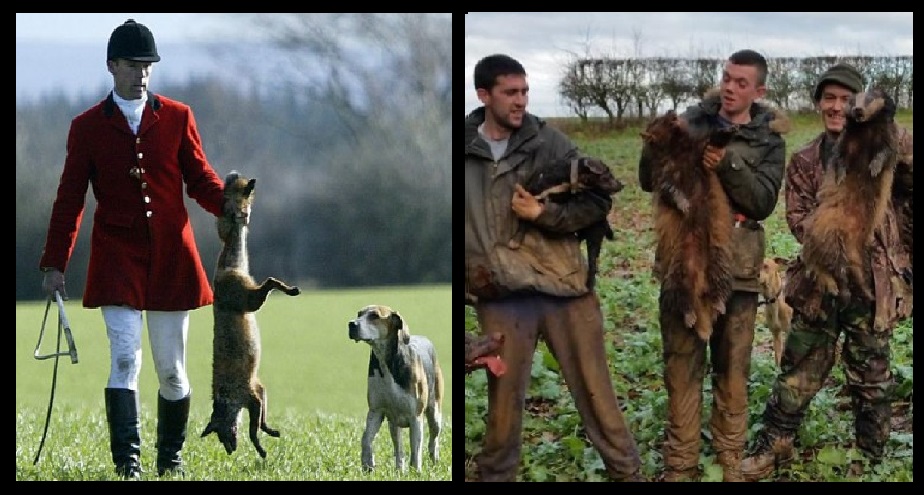
More than 10,000 are caught, tortured and killed in the UK each year by huntsmen with terriers – with almost a third of these illegal acts being carried out in Wales. Alarmingly, this figure is rising constantly. Terry Spamer, a former RSPCA inspector, believes that there are around 2,000 people involved in badger baiting currently. However, only around three people are caught and convicted of badger baiting each year, while the majority carry on breaking the law.
Traditional fox hunting was banned in England and Wales under the Hunting Act 2004. In spite of existing legislation, there has been 500 successful prosecutions under the Act. However, many incidents of illegal hunting have gone unpunished.
FOX HUNTING AND BADGER BAITING IS ILLEGAL IN THE UK BUT CARRIES ON WITH WITH APPARENT IMPUNITY
Dogfighting is an inhumane ‘bloodsport’ where dogs who have been bred, conditioned and trained to fight are placed in a pit to fight each other for spectator ‘entertainment’ and profit. Fights average one to two hours, ending when one of the dogs cannot continue.
Dog fights usually take part in quiet, private locations, such as in an industrial unit or farm building. Participants will spend months training their dogs in preparation, much like boxing, the fighters will have to hit a target weight to take part. Organisers will create a fighting ‘pit’ for the dogs to fight within.
Dogs who have been used in fighting often have serious injuries to their head, ears, front legs and chest that are caused as they go head-to-head in a pit. They will also have injuries of different ages, some old scars and some fresh wounds.
IT IS BELIEVED OVER 16000 DOGS DIE EACH YEAR IN ORGANIZED DOG FIGHTS
Each year, thousands of bulls are barbarically slaughtered in bullrings around the world. Over the centuries, bullfighters have found countless ways to rig the “fight” in their favor. Bulls are often weakened with drugs or by having sandbags dropped on their backs. Their horns have been shaved to keep them off balance, or petroleum jelly has been rubbed into their eyes to impair their vision.
Every year, approximately 250,000 bulls are killed in bullfights. Bullfighting is already banned by law in many countries including Argentina, Canada, Cuba, Denmark, Italy and the United Kingdom. Although legal in Spain, some Spanish cities, such as Calonge, Tossa de Mar, Vilamacolum and La Vajol, have outlawed the practice of bullfighting. There are only a few countries throughout the world where this practice still takes place (Spain, France, Portugal, Mexico, Colombia, Venezuela, Peru, and Ecuador). ~ HSI.
BULLS ARE TORTURED IN THE NAME OF CULTURE AND TRADITION
Each year from approximately September 1 to March 1, a large-scale hunt of dolphins takes place in the small village of Taiji, Japan, as featured in the 2010 Academy Award-winning documentary The Cove. During this six month season, dolphin hunters utilize drive hunt techniques to herd large numbers of dolphins to shore, resulting in their capture or death.
The captured dolphins may be selected for live trade to aquariums and marine parks for display, while others are slaughtered for their meat. The price for live captures is many times higher than those killed.
THE ANNUAL TAIJI DOLPHIN SLAUGHTER
What you can do to help end animal abuse
We believe EVERY animal should be treated with respect, empathy, and understanding. We raise awareness to protect and conserve wild, captive, companion and farm animals.
It is vital that we protect animals against acts of cruelty, abuse, and neglect by enforcing established animal welfare laws and, when necessary, taking action to ensure that those who abuse animals are brought to justice.
The Mission of Protect All Wildlife is to prevent cruelty, promote the welfare of ALL animals EVERYWHERE, and help END animal abuse.
Please support our work by donating ANY amount, large or small. It only takes a minute and your donations make it all possible. Thank you for your support.
What else you can do to help
Please SHARE to raise awareness to wildlife and environmental issues from around the world.






























 PROTECT ALL WILDLIFE