
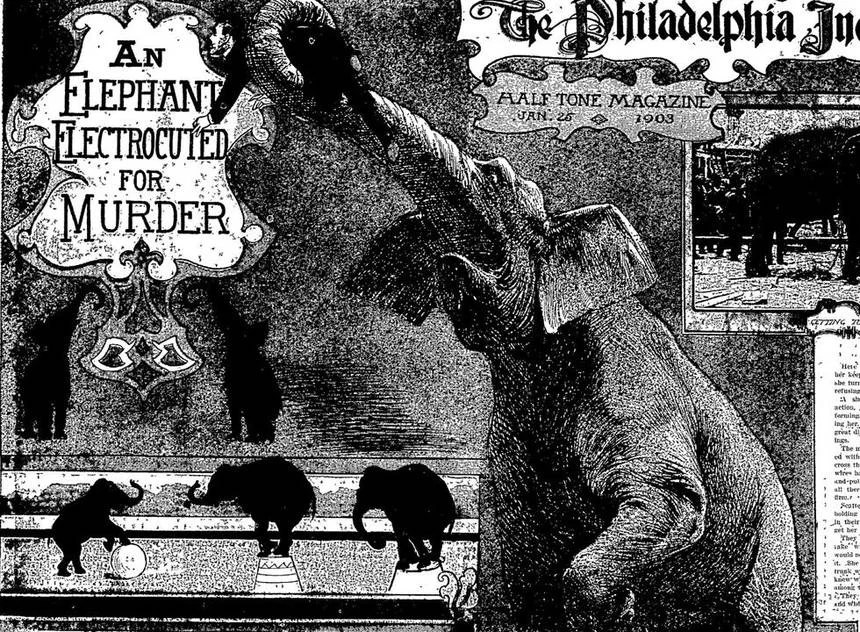
Much has been written about the controversial movie Blackfish, the 2013 film that vilified SeaWorld for use of captive orcas. Many in the theme park community have attacked the movie as a hit piece, while others in the anti-animal captivity community used it as a call to arms. But for all the discussion and passion that the movie generated, history tells us that this issue is as old as the industry itself. If told completely, this story shines a different kind of light on the culture of the times, and also on an iconic figure in American history. Once upon a time, a 110 years before Blackfish and Tilikum there was another movie, and an Elephant named Topsy.
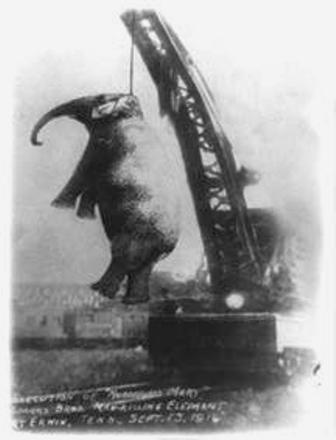
Sometime around 1875, Topsy was smuggled as a baby out of Asia and brought into America to perform in the Forepaugh circus. Billed as the first “American born elephant,” she became the star of the show. Like many circus performers at the time, she was subject to harsh treatment during training sessions. Trainers of the time were vicious towards the animals in their attempts to control them, prodding the elephants with sharp hooks between the eyes and in the head. Beatings, hot pokers, and even guns were also common methods of training. By most accounts, Topsy was one of the fan favorites. Behind the scenes though, she endured years of harsh treatment. Her crooked tail was a point of emphasis with promoters. In reality, it was the result of a particularly severe beating. Over the years, her temper became shorter and shorter, and she attacked several handlers and was reportedly responsible for the deaths of three of them. In 1902, one particular (alcoholic) trainer named James Fielding Blount foolishly met his end. After a night of heavy drinking, Blount went into the elephant tent and offered Topsy a drink of whiskey. Her refusal angered Blount, who reportedly then stuck a lit cigar on the tip of her trunk. He was then promptly thrown down and crushed.
After this highly-publicized incident, Topsy was then sold to Coney Island amusement operator Paul Boynton. When Boynton sold his operation to the founders of Luna Park, Topsy and her trainer were part of the sale. Luna Park was under construction at the time, so for a brief time she was put to work hauling loads of building material. After a new site for the “Trip to the Moon” attraction was cleared, the workers tried, but simply couldn’t move the massive structure to its new location. Topsy was called upon to do the job. With the help of a few horses, she pushed the building nearly a mile to its new location. Police arrested one of her handlers that day after observing “excessive” use of a sharp object to prod the elephant. Her trainers reportedly kept a pitchfork handy. He was tried for animal cruelty but later was acquitted because the amount of prodding was deemed acceptable. Subsequent incidents and moments of aggression occurred, all under the watchful eye of the press. The final straw came when trainer Whitey Ault got drunk and decided to ride Topsy down Surf Avenue. When Whitey was arrested and taken to the station, Topsy followed them down the street and then tried to go into the police station behind them. Whitey was fired for this incident, leaving nobody on the staff that could handle Topsy. With costs of her care high and no one to take care of the elephant, Luna Park owners Thompson and Dundy tried to get rid of her. However, all the bad press over the past year had tarnished the elephant’s reputation. No zoo would take her, no show would have her. They tried to raffle her off, then to give her away for free, but had no success. After exhausting many options, the decision was then made to euthanize Topsy.

Killing a 10-foot tall, three-ton elephant in 1903 wasn’t a simple proposition, let alone doing so in a quick and humane way. They didn’t have a gun big enough to quickly do the job, and even though it had been done to other elephants before, the idea of hanging her was thrown out.
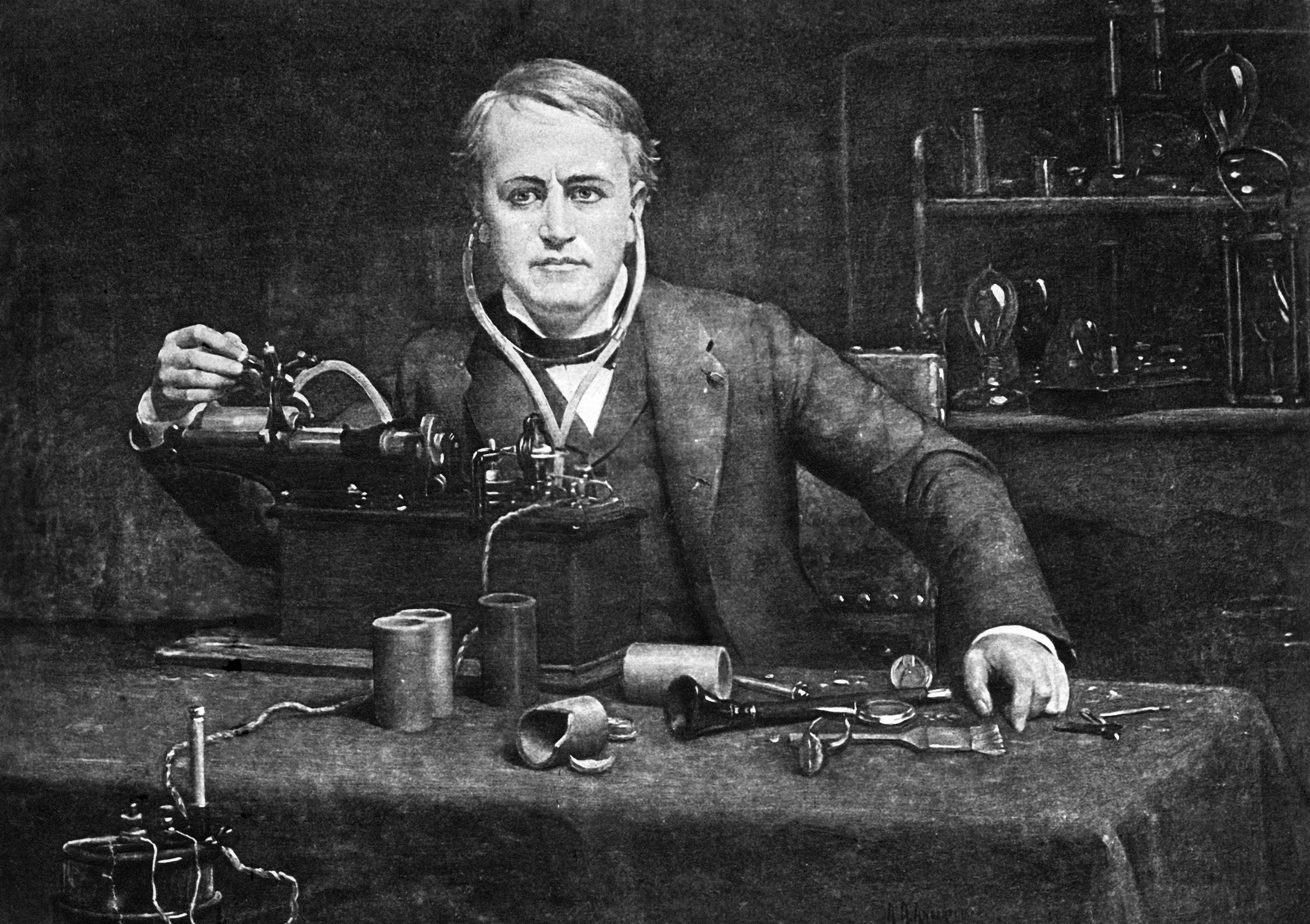
The owners of Luna Park turned to inventor Thomas Edison, who by 1903 had fought and lost the “battle of the currents” for the electricity standard to be used in the United States. Edison’s direct current (DC) methods had been used extensively at first, but the more efficient alternating current (AC) method, invented by Nikola Tesla and backed by industrial giant George Westinghouse, had gained traction and was becoming the standard for distribution. Trying to keep his standard intact (and preservation of the royalties), Edison had engaged in a propaganda war, discouraging the use of AC by lobbying Congress, spreading false rumors and misinformation, and staging public demonstrations of its danger by electrocuting stray and unwanted animals. For a time his technicians were regularly dispatched for this matter, killing dogs and cats, and in some cases horses and cows. He commissioned a partner to develop the electric chair for the state of New York with AC current, even though he himself was reportedly an opponent of capital punishment.
Edison’s “experience” with the matter and his standing as an authority on electricity prompted Thompson and Dundy to call. Even though the current war was over, he apparently for one reason or another couldn’t resist the opportunity to demonstrate the “dangers” of AC one more time…this time on the largest land animal in the world. Some say he was still fighting the war in his own mind, others say Edison still harbored a grudge from the loss and participated out of vindictiveness. Whichever the case, he signed on to do it, and he would document the whole thing with another one of his inventions, the movie camera.
In another sign of the times, the ever-enterprising owners of Luna Park knew the attention the story had gotten, and they initially intended to charge admission for the public execution. The press coverage though had also attracted the attention of the SPCA, who flatly refused to allow that to happen. In turn, the admission fee idea was thrown out, but the public would still be allowed to watch. By this time, Topsy had been characterized in the press like a convicted killer condemned to death, and so the people came to watch.

The ‘execution’ of Topsy the Elephant
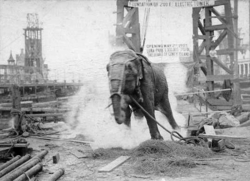
The execution date was set for January 4, 1903. A crowd of about thousand gathered in the courtyard of the half-finished Luna Park to witness the spectacle. Topsy’s old trainer Whitey Ault was offered a then handsome sum of $25 to help bring the Elephant to her demise, but the saddened trainer turned it down, saying he wouldn’t do it for a thousand. With no qualified people to handle her, leading a very docile Topsy to the platform proved difficult. She wouldn’t cross the bridge to the middle of the lagoon. After technicians moved the wood and metal platform to her, she wouldn’t stand in place, then she shook off the electrodes that were hooked to her, and then refused to eat the cyanide laced carrots that were offered to her…almost as if she knew what was going on. After some coaxing, Topsy finally ate the carrots and the switch was thrown.
She died almost instantly, and almost took one of the Edison technicians with her. He was also electrocuted when he threw the switch. Even though she had already been pronounced dead, workers tightened a noose around her neck for ten minutes to make sure. SPCA doctors on hand pronounced it as the most humane way to kill an animal they had ever seen, and Edison had his documentary. The film “Electrocuting An Elephant” depicted the first actual death on screen, and was seen by audiences across the country. A part of it remains intact online [warning: disturbing images] for the curious to view. Ultimately, the film did nothing to either advance his agenda or raise any kind of awareness for animal cruelty. Audiences of the time were simply more interested in the novelty of the motion picture, the spectacle, and being entertained. Perhaps some things haven’t really changed after all.
Ultimately, Topsy’s story provides a bit of perspective on today’s state of affairs. Her story of a systematic life of abuse in the circus and the spectacle surrounding her death is the true epitome of animal cruelty. Topsy was not the only circus animal of the time to endure this kind of treatment, to be killed, or to kill a human being, but she was the most well known and well documented. Her brief role in the early theme park industry as well as American history makes the story worth telling, however horrible it may be. As for today, the debate continues. People may or may not agree with the use of marine animals in a theme park, but SeaWorld’s animal treatment methods, and its practices of conservation, animal rescue and rehabilitation, research, and education stand in stark contrast to the brutality of the Forepaugh circus and its contemporaries.
For years there were reports of ghost sightings, but the story of Topsy largely disappeared for a long time. In recent years Topsy has reappeared in pop culture, namely the television show Bob’s Burgers and the 2009 video game Assassin’s Creed II. A book about Topsy and the early American circus written by Michael Daly was published in 2013. A memorial dedicated to her sits in the Coney Island museum.


WHAT YOU CAN DO TO HELP ANIMALS IN NEED
You can support our work by donating as little as £5 – It only takes a minute but it can last a lifetime for an animal in need.
PLEASE CLICK HERE TO DONATE TO HELP ANIMALS IN NEED
Everyone who donates will receive a Certificate of Appreciation as a thank you for helping animals in need.

The Mission of Protect All Wildlife is to prevent cruelty and promote the welfare of ALL animals.
We believe EVERY animal should be treated with respect, empathy, and understanding. We raise awareness to protect and conserve wild, captive, companion and farm animals.
It is vital that we protect animals against acts of cruelty, abuse, and neglect by enforcing established animal welfare laws and, when necessary, take action to ensure that those who abuse animals are brought to justice.
Protect All Wildlife are involved in many projects to protect animals’ rights, welfare, and habitats. Money contributed to Protect All Wildlife supports ALL of our worthy programmes and gives us the flexibility to respond to emerging needs. Your donations make our work possible.

 PROTECT ALL WILDLIFE