A Tragic Wolf Called ‘Romeo’ Was Loved Too Much And Deserved Better.

On a twilit night in Juneau, Alaska, in December 2003, Nick and Sherrie Jans were walking with Dakotah, their yellow Lab, in the Mendenhall Glacier Recreation Area not far from their house. Suddenly, a young black wolf appeared on the ice—and began running in their direction. Awestruck but scared, the couple watched as Dakotah broke loose and charged the predator, which was twice the size of the dog. The animals stopped yards apart and gazed at each other “as if each were glimpsing an almost-forgotten face and trying to remember,” recalled Jans. After a few moments, Dakotah ran back to her owners, and the three hurried home, listening to the wolf howl

The locals named him Romeo, and soon his presence was noted by the entire town. Most found it fascinating that Romeo was so friendly, while others assumed that this naturally predatory animal would give into his natural instincts at any moment, potentially attacking their pets and children.

During this time Nick Jans started documenting Romeo. When he did, he uncovered an emotional story, the heart of which describes the tenuous relationships between wild animals and the humans around them.

“The first thing I saw was tracks out on the lake in front of our house on the outskirts of Juneau,” Jans said in an interview with National Geographic. “A few days later, I looked out from my house and there was this wolf out on the ice. I’d had 20 years of experience around wolves up in the Arctic and immediately knew it was a wolf, not a dog. I threw on my skis and found him.”

ROMEO

According to Jans, Romeo seemed totally relaxed and friendly.

And it wasn’t just one interaction, either: Romeo remained his curious, friendly self for the better part of six years.

“For want of a better word,” Jans said, “The only thing I can say from a human perspective is that it amounted to friendship. If you wanted to be scientifically correct, it would be “social mutual tolerance.” But it was more than that. The wolf would come trotting over to say hi, and give a little bow and a relaxed yawn, and go trotting after us when we went skiing. There was no survival benefit. He obviously just enjoyed our company.”

Romeo’s behavior was definitely unusual, as many wolves tend to assert dominance by attacking dogs and other animals.

The wolf got his name because Jans and his family noticed how Romeo was kind of a flirt — particularly with their “Juliet,” a dog named Dakotah. Here, they’re standing nose-to-nose in what seems to be an all-too-perfect photo moment.

Romeo survived for years despite many mortal threats: scented traps, busy roads, illegal hunting, and even a poisoning attempt. He also had to contend with the natural dangers of starvation, injury, and attack by another pack of wolves. By almost any standard, his prolonged proximity to humans and dogs constituted incredibly rare behaviour. There was no obvious survival benefit to his socializing, yet the wolf lingered persistently, a late echo of the original process that must have initiated the domestication of dogs.

“When you get down to the genetic difference between a wolf and a domestic dog, whether it is a Chihuahua or a Great Dane, all dogs are 99.98 percent genetically a wolf. That 0.02 percent obviously looms huge, because if you raise a wolf cub from the time it opens its eyes, it may make a wonderfully bonded animal, but it will not be a dog, no matter what you do. It will act like a wolf and be a wolf. It takes generations to shape the soul of a wolf and its physical shape into man’s best friend.”

Romeo stayed in the area for as long as he lived — and he lived three times longer than most wild wolves do.

“Romeo was the single most transformative event of my life,” Jans said. “The amazing thing was Romeo’s understanding. It wasn’t just our understanding and tolerance. It was the combination of his and ours and the dogs’. We were these three species working out how to get along harmoniously. And we did.”

What happened to Romeo?                                                                                                   Romeo disappeared in late September 2009. After some sleuthing, a supporter found he had been shot and killed by Juneau resident Park Myers III and his Pennsylvanian friend Jeff Peacock. Both men were arrested and ended up paying fines, serving a few years on probation, and losing hunting and fishing privileges for a limited time. In late November 2010, a memorial service was held for Romeo and this plaque was laid along a path where he once roamed.

“Nothing can take away the miracle that was Romeo and the years we spent in his company,” writes Jans. “Love, not hate, is the burden we carry.”

Nick Jans’ beautiful account of his unusual relationship is now in a book called A Wolf Called Romeo.

WHAT YOU CAN DO TO HELP WILDLIFE

You can support ‘Protect All Wildlife’ by donating as little as £1 – It only takes a minute but it can last a lifetime for an animal in need. Please donate below.

PLEASE CLICK HERE TO HELP ANIMALS IN NEED

Everyone who donates will receive a Certificate of Appreciation as a thank you for helping animals in need.

The Mission of Protect All Wildlife is to prevent cruelty and promote the welfare of ALL animals.

We believe EVERY animal should be treated with respect, empathy, and understanding. We raise awareness to protect and conserve wild, captive, companion and farm animals.

It is vital that we protect animals against acts of cruelty, abuse, and neglect by enforcing established animal welfare laws and, when necessary, take action to ensure that those who abuse animals are brought to justice.

Protect All Wildlife are involved in many projects to protect animals’ rights, welfare, and habitats. Money contributed to Protect All Wildlife supports ALL of our worthy programmes and gives us the flexibility to respond to emerging needs. Your donations
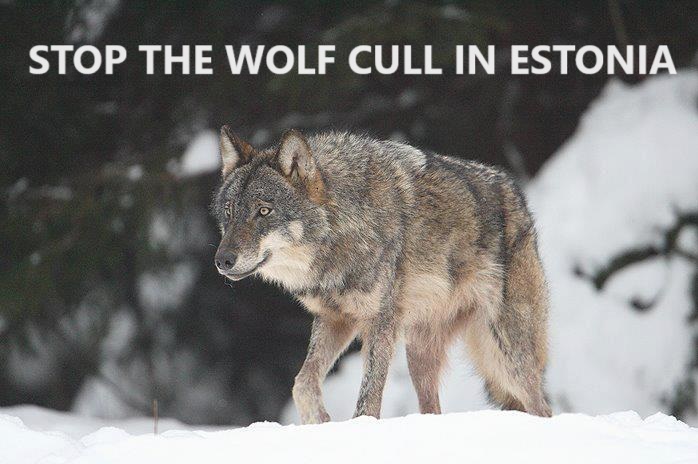
Wolf Cull Begins In Estonia: Conservationists Fear It Could Wipe Out 50% Of The Population

Concerns have been raised that the science behind the killing is untenable, and that killing Wolves could lead to harmful behavior against humans.

Estonia has once again begun culling its Wolf population.

A certain number of Wolves are killed every year in the Baltic country, although this time conservationists are worried.

Estonia’s environment agency has set the killing quota at 144, claiming there are more wolves in the country than conservation plans allow.

However, Wolf researcher Maris Hindrikson at the University of Tartu told Euronews that he and fellow scientists are “not convinced” about their data.

She claims that Wolf populations are being counted based on “old-fashioned” and “messy” techniques – such as hunter observations – that may not accurately reflect their numbers.

This means that the killing quota may be much higher, given the already threatened species under even more strain.

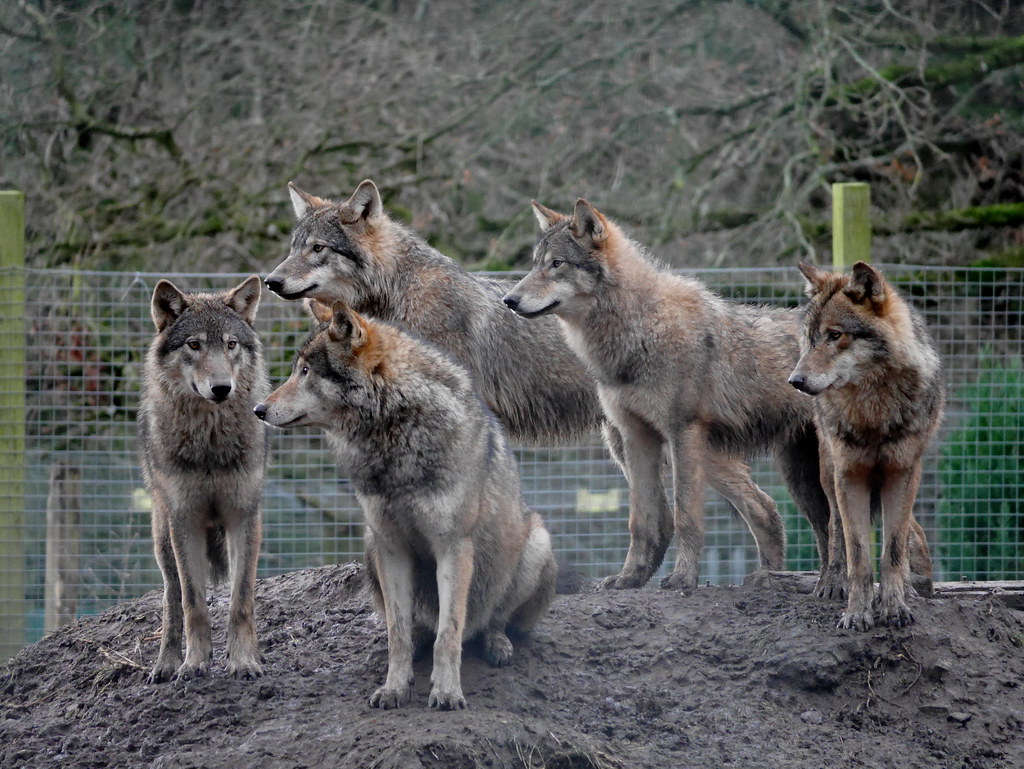
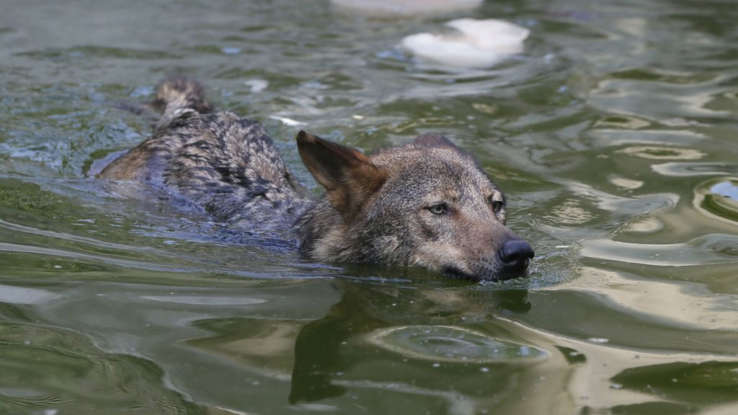
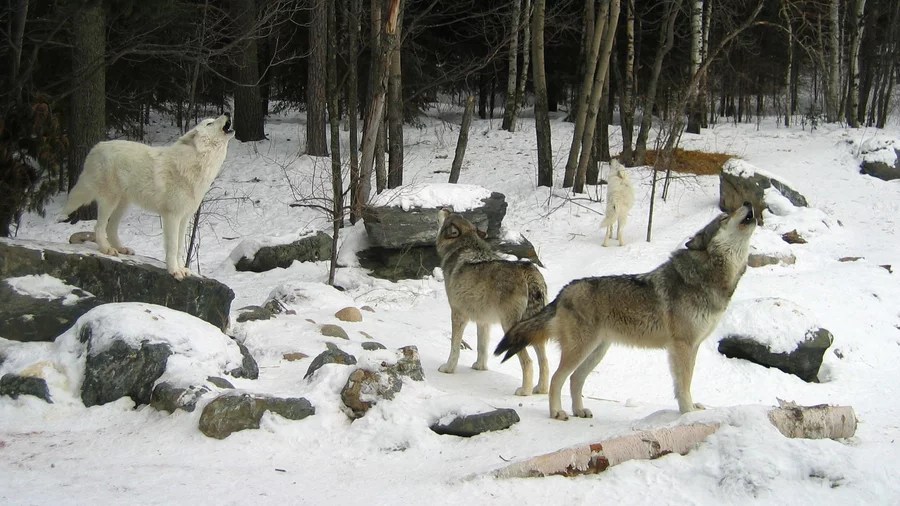
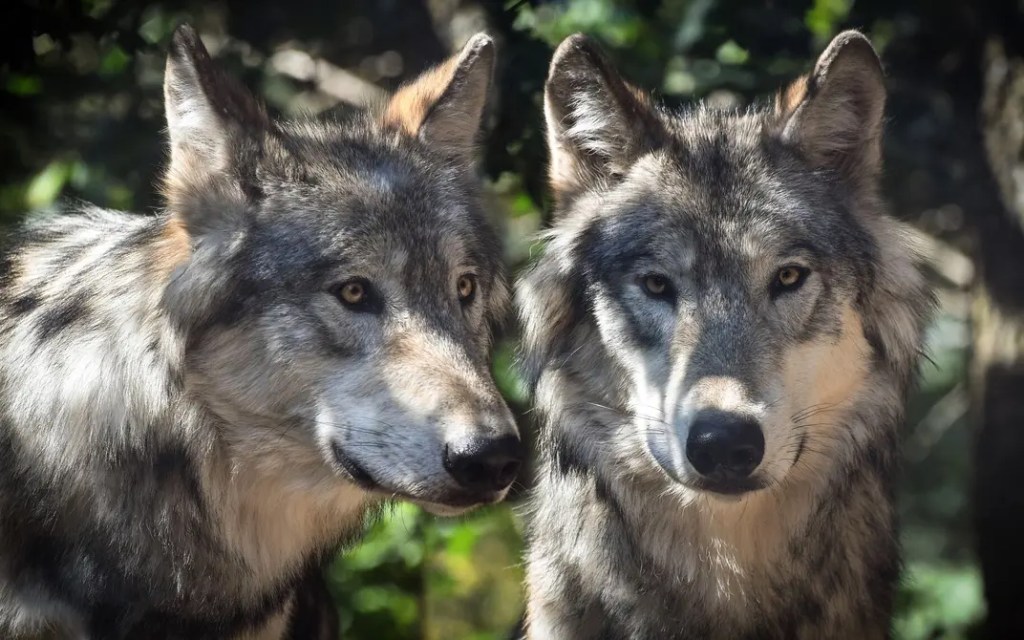
A pair of Estonian Gray Wolves

“The problem is we don’t know how many Wolves there are,” Hindrickson says, estimating that the cull could wipe out 30 percent to 50 percent of the country’s entire Wolf population.

In a statement sent to Euronews, the Estonian Environment Agency said its “method was in use in Nordic countries such as Sweden, Finland and Norway.”

“We find the current methodology comprehensive, objective and reasonable,” he said.

Even though Wolf numbers have recovered in recent years, their total number is considered “stable/decreasing” by the International Wolf Centre. Estimates put their total population at between 150 – 300 in Estonia. 

Officials claim their culling is necessary because Wolves attack livestock, especially sheep, causing economic losses to the country’s farmers.

According to the Environmental Board of Estonia (Keskonamet), a total of 946 sheep were killed by predatory Wolves in 2022.

It said the figure has crossed 1,100 this year, with several weeks left for 2023.

One particularly grizzly attack at a farm in southeastern Tartu County killed an entire breeding flock of more than a dozen ewes in October, with farmer Rein Mirka telling Estonian Public Broadcasting (ERR) the incident had cost him between €15,000 to €20,000.

Hindrickson still questions whether killing is the best approach to the problem. “Science has always shown that culling doesn’t actually help reduce sheep deaths”.

As habitats are destroyed – limiting available food resources – Hindrickson claims lethal solutions could be counterproductive, driving Wolves to prey on livestock in the first place.

Killing is a really big problem because it destroys herds. Wolves are very social animals and we know that large packs hunt larger animals such as deer. But generally, small herds seek out smaller prey because they cannot develop cooperative methods of hunting,” she explains.

The researcher says another problem is that when older Wolves are killed younger Wolves do not experience and learn more complex hunting strategies, meaning they resort to eating livestock. . Hindrickson likens it to “fast food” for wolves.

“What I’m against is killing that kills a lot of wolves. We don’t really know how many wolves we have and what impact actually killing them has. It seems like they create a pattern Where we kill so many wolves, they affect how the herds are structured, they go after the sheep, then sheep attacks increase. So then people say yes, sheep are in danger. Please more wolves. kill.

“It’s a continuous cycle,” she adds.

A Wolf killed in a previous cull.

Better alternatives Hindrikson proposes are “ensuring adequate numbers of natural prey in the wild”, such as Deer and Wild Boar, and taking steps to deter Wolves.

“Farmers should build more fences and get guard dogs to scare off Wolves. This is something that has worked all over Europe. We get news of a sheep attack, but often farmers haven’t prevented a thing. We always blame the Wolves, it is easy, but actually, people do everything.

“Prevention and making society understand where this problem comes from and how to mitigate it are very important,” she continues.

Bizarrely, in 2018 Estonia chose the Wolf as their national animal and symbol of Estonian nature and culture.

WHAT YOU CAN DO TO HELP ANIMALS IN NEED

You can support our work by donating as little as £5 – It only takes a minute but it can last a lifetime for an animal in need.

PLEASE CLICK HERE TO HELP ANIMALS IN NEED

Everyone who donates will receive a Certificate of Appreciation as a thank you for helping animals in need.

The Mission of Protect All Wildlife is to prevent cruelty and promote the welfare of ALL animals. We believe EVERY animal should be treated with respect, empathy, and understanding. We raise awareness to protect and conserve wild, captive, companion and farm animals.

It is vital that we protect animals against acts of cruelty, abuse, and neglect by enforcing established animal welfare laws and, when necessary, take action to ensure that those who abuse animals are brought to justice.

Protect All Wildlife are involved in many projects to protect animals’ rights, welfare, and habitats. Money contributed to Protect All Wildlife supports ALL of our worthy programmes and gives us the flexibility to respond to emerging needs. Your donations make our work possible.

UK Wildlife Park Sparks Fury After Putting Down An Entire Pack Of Wolves After Alpha Male Died

The entire pack was euthanised due to ‘abnormal behaviour’ after Alpha male Loki died.

The pack at Camperdown Wildlife Centre in Dundee started displaying ‘abnormal behaviour’ when alpha Loki was put down after he underwent an operation and suffered complications leaving the team “absolutely heartbroken”.

The full statement read: “We are devastated to announce that our alpha male Wolf, Loki, has been humanely euthanised today.

Loki had to be euthanised after complications following an operation. Pic: Camperdown Wildlife Centre

“Despite an initially successful operation, there have been subsequent complications, and the difficult decision was reached to save the animal from further pain.

“The other four Wolves in the pack have been exhibiting unusually anxious and abnormal behaviour since the operation, and it is with great sadness that these wolves have also been euthanised as a result.

The entire pack was euthanised due to ‘abnormal behaviour’ after Alpha male Loki died.

“This course of action was a last resort, and our team is absolutely heartbroken. We ask you for your kind consideration at this time.

The wildlife centre went on to thank the public and confirmed it’s closure on Wednesday as the team “processed recent events”.

The statement added: “We thank members of the public who have sent messages of support and for their kind consideration during this painful time for our team.

“We can assure everyone that this difficult decision was taken following expert advice and consultation with the relevant professional bodies.

“Camperdown Wildlife Centre will be closed to the public on Wednesday to allow our colleagues to process recent events. We thank-you for your patience and understanding.”

In a similar incident in 2006, a pack of Wolves was culled at Highland Wildlife Park by operator Royal Zoological Society of Scotland – after the animals stopped displaying “normal behaviour”.

While many expressed sympathy for the park and its employees, others were outraged. The move has sparked an outcry from members of the public with some left angry and branded the mass euthanising as “extreme”.

One local resident has now started a petition demanding an inquiry into why the entire pack was put down.

Online, one visitor wrote: “I’m so sorry to read this news and my thoughts are with all involved but if you wouldn’t mind could more of an explanation be given into why the 4 others were destroyed?

LOKI

“This is heartbreaking to read and I can’t help but think the public should be given more information to help with understanding this dreadful news.”

“Very disappointed you euthanized all 5,” a comment said. “It seems like the animals weren’t even given time to grieve or acclimatise to the death of their family member. What a tragic loss of life.”

Another added: “I think the Wolves should have been given some time before euthanasia for the whole pack. That seems a bit extreme. Can you please explain just anxiety and abnormal behaviour in a more direct way.”

“We can assure everyone that this difficult decision was taken following expert advice and consultation with the relevant professional bodies,” the park commented.

The way Wolves behave in captivity is very different from what researchers see in the wild, according to the Scientific American.

The “Alpha Wolf” concept is at best misunderstood by the public and is a phenomenon far more common among captive packs than those roaming free, wolf expert L. David Mech told the publication.

——–((((((()))))))——–

WHAT YOU CAN DO TO HELP WILDLIFE:

You can support ‘Protect All Wildlife’ by donating as little as £1 – It only takes a minute but it can last a lifetime for an animal in need. Please donate below.

Everyone who donates will receive a Certificate of Appreciation as a thank you for helping animals in need.

The Mission of Protect All Wildlife is to prevent cruelty and promote the welfare of ALL animals.

We believe EVERY animal should be treated with respect, empathy, and understanding. We raise awareness to protect and conserve wild, captive, companion and farm animals.

It is vital that we protect animals against acts of cruelty, abuse, and neglect by enforcing established animal welfare laws and, when necessary, take action to ensure that those who abuse animals are brought to justice.

Protect All Wildlife are involved in many projects to protect animals’ rights, welfare, and habitats. Money contributed to Protect All Wildlife supports ALL of our worthy programmes and gives us the flexibility to respond to emerging needs. Your donations make our work possible.
Firefighters In Verona Rescue A Wolf That Fell Into A Stream

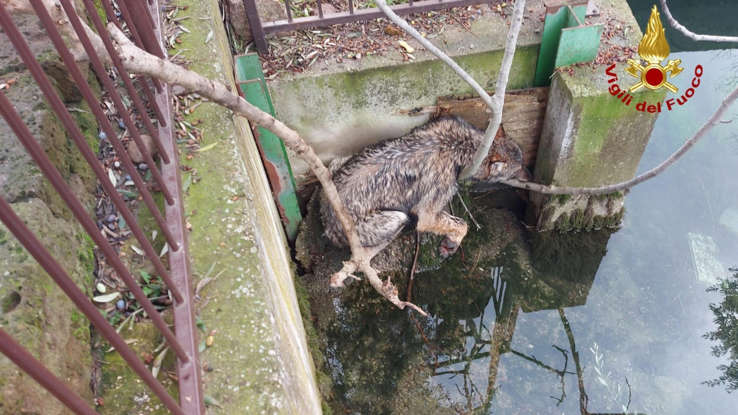
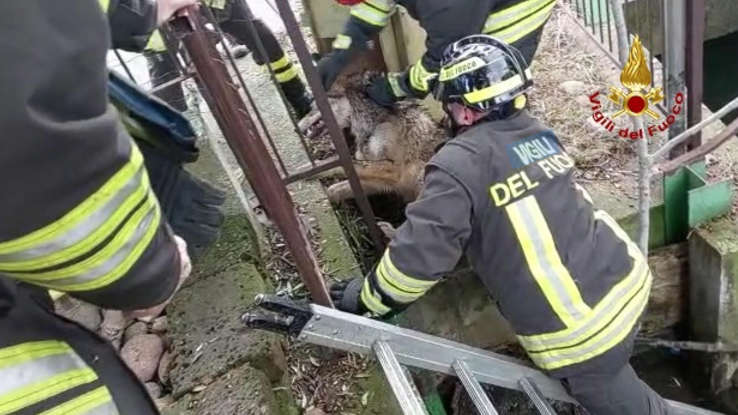
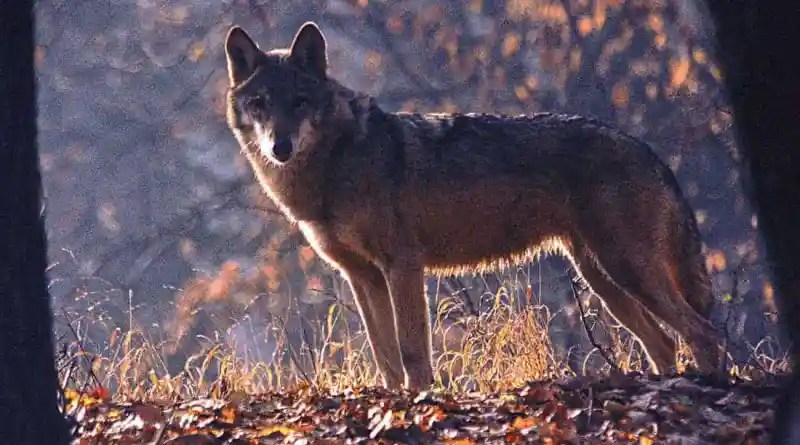
Firefighters from Verona (Italy) rescued a Wolf that ended up in a stream, in the city centre. Initially mistaken for a Dog, the Wolf, exhausted, had stopped on the branches of a fig tree and then ended up in the ditch.

he firefighters, who intervened to save the animal that could no longer free itself and get back on the street, took it and put it, in total safety, inside a cage.

The Wolf rescued by firefighters will now be released on the mountains of Lessina, from where it is thought to have reached the centre of Verona.

The fire brigade of the city of Verona often intervene to rescue animals. During 2022, a total of 242 rescues were carried out, about 4% of the rescue operations performed.

It is no longer so anomalous to see wolves trespassing in some Italian cities, as well as other types of animals (in Rome it is now usual to see wild boars). A problem that should certainly be tackled intelligently, to protect citizens and animals.

A Collared Wolf From Michigan’s U.P. Roamed More Than 4,000 Miles Before A Hunter Killed It

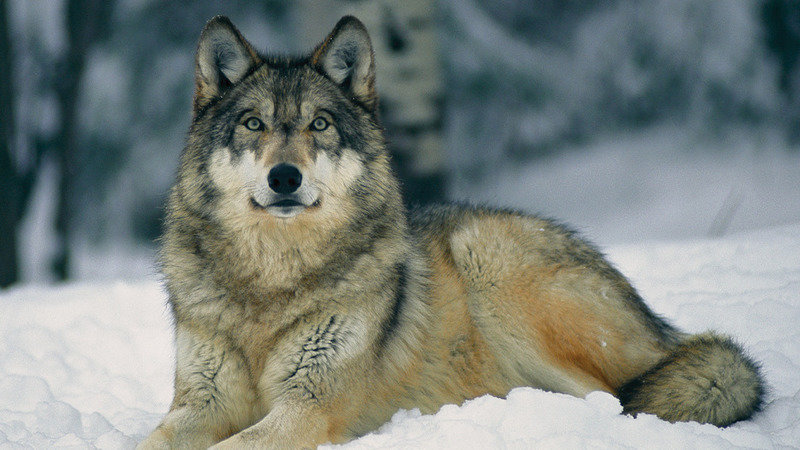
A Gray Wolf (Canis Lupus)

When a hunter in Manitoba, Canada legally shot and killed a Gray Wolf in early December 2022, a radio collar found around its neck was the first clue to the incredible journey this animal had been on. The Wolf had been collared in Michigan’s Upper Peninsula in the summer of 2021, and its GPS data since then showed this Wolf’s multi-state and two-country trek was one for the record books.

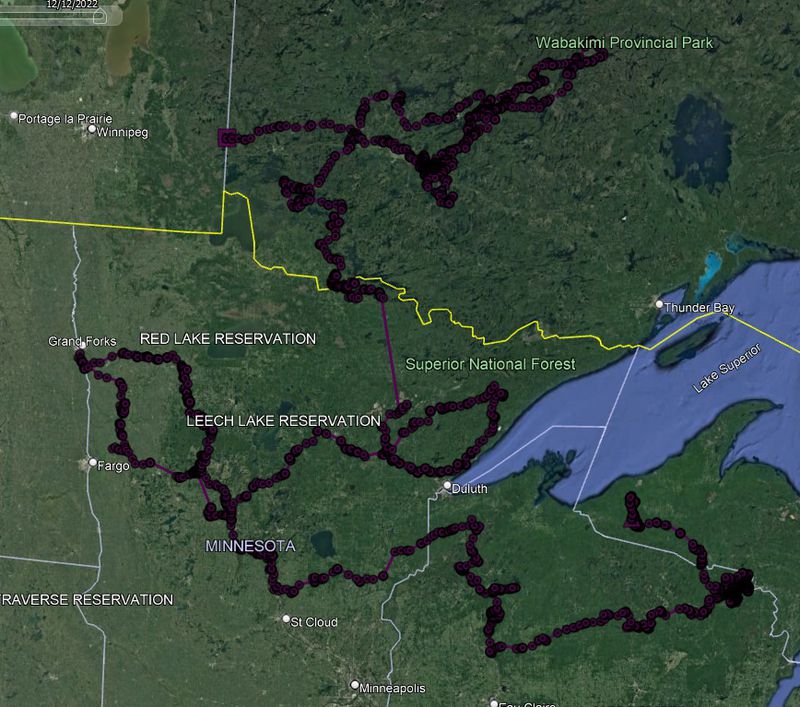
A map plotted by Michigan Department of Natural Resources researchers showed this male Wolf travelled through Wisconsin, then Minnesota, made a short stop in North Dakota, crossed the Canadian border into Ontario, then swung up into the Whiteshell area of Manitoba, where the hunter’s bullet found him. In all, this Wolf had travelled 4,200 miles in about 18 months.

This map from Michigan DNR shows the lengthy trek of a collared Gray Wolf from the Upper Peninsula, through other northern states and into Canada.

“The use of GPS collars will certainly add more insight to the movement of these amazing animals and likely show that others may make similar movements over time, but I suspect this will stand as a record for some time for Michigan,” said Brian Roell, a wildlife biologist with Michigan’s DNR.

Use of Wolf Collars

Michigan’s Wolf population has been stable for the last several years, with anywhere from 600 to 700 Wolves spread out across every county in the state’s Upper Peninsula. There’s been evidence a few Wolves have crossed the Straits of Mackinac to enter the Lower Peninsula, but there’s no documented population there so far, the DNR says.

State biologists have run a Wolf-collaring program since 1992. Currently, about 30 of the U.P.’s Wolves are wearing collars. Researchers can typically get about three years of data from a Wolf before the newer GPS collars stop working. Each spring, the DNR catches and collars new Wolves. They try to target Wolves from specific packs they want more information about – packs that might have overlapping territories, where researchers want to get a better handle on the pack boundaries. Or packs that are reportedly getting too close to livestock farms. By tracking any troublemaking packs, the DNR can use hazing methods to try to push them away from specific areas.

Beyond just population measurements, Roell said the collaring effort has given biologists lots of important information on Michigan’s 130 to 140 Wolf packs. “It also gives us insight into biological information on Michigan Wolves, their movement, their territory sizes.”

A Well-Travelled Wolf

But this lone Wolf making the 4,200-mile trip was unusual in the breadth of his roaming, researchers agree. The 92-pound male was collared in the summer of 2021 near Lake Gogebic. This is in the Ottawa National Forest in the north-western part of the U.P.

“It did not stay in Michigan very long after that,” Roell said the GPS data showed. “So it really never settled down.”

The DNR has documented other Michigan Wolves that have taken long trips. One showed up in Missouri. Others have been found in closer locales like Wisconsin or Minnesota. Some have crossed into Canada.

“The new technology that we have been using … has really given us some insight into these long-distance movements,” Roell said. “Often it seems like some of these animals are destined to stay loners.”

As for this particular Wolf, “we know this animal had been going for a while,” before it was legally harvested, he said.

Great Lakes Wolves: One Big Population?

Another group that was interested in this Michigan Wolf’s long trek was the Voyageurs Wolf Project, researchers who study Wolves and their prey in and around Voyageurs National Park in northern Minnesota. This Michigan Wolf walked though part of Voyageurs – and through at least two Wolf pack territories in that park – on its way north to Canada. When the group recently shared this information and the Michigan DNR’s maps on social media, the post amassed thousands of likes and shares.

A Pack Of Wolves On The Ice At Voyageurs National Park

But beyond just sharing the information, the Voyageurs group said this Michigan Wolf’s trek helps expand people’s understanding of the “Lone Wolf” concept. And it shows how Wolves in the Great Lakes region are more connected than some people might think. After all, Wolves don’t know when they’re crossing state lines, or stepping into another country.

“The travels of this Michigan Wolf, along with many others that our project and other researchers have documented, show how Wolves across the Midwest states and Canadian provinces are connected,” their social media post reads.

“Although we tend to think of Wolf populations based on geopolitical boundaries (e.g. the Wolf population in a given state or province), which are useful for management and conservation decisions, there isn’t much to indicate that these boundaries actually denote the boundaries between Wolf populations.

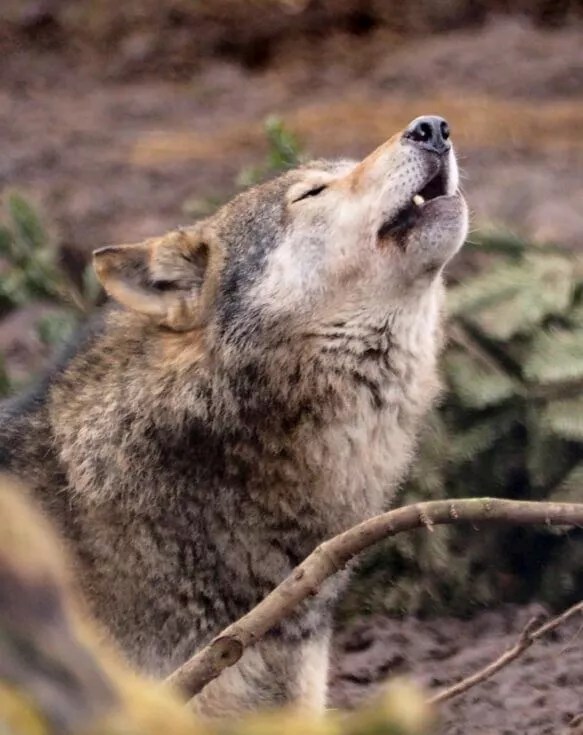
Four Of The Great Lakes Gray Wolves Population Howling

“Instead, probably the best way to think of Wolf populations in the western Great Lakes area is to think of them as one large, connected population with dispersing Wolves moving between provinces and states all the time.”

Originally posted by Michigan Live.

What you can do to help wildlife:

You can support ‘Protect All Wildlife’ by donating as little as £1 – It only takes a minute but it can last a lifetime for an animal in need.

Please Help End Animal Abuse And Cruelty.

Animal Rights Activist Ricky Gervais

 “Animals are not here for us to do as we please with. We are not their superiors. We are their equals. We are their family. Be kind to them.” ~ Ricky Gervais.

Cruelty to animals, also called animal abuseanimal neglect or animal cruelty, is the infliction by omission (neglect) or by commission by humans of suffering or harm upon any animal. More narrowly, it can be the causing of harm or suffering for specific achievement, such as killing animals for entertainment; cruelty to animals sometimes encompasses inflicting harm or suffering as an end in itself, defined as zoosadism.

Animal cruelty can be broken down into two main categories: active and passive. Passive cruelty is typified by cases of neglect, in which the cruelty is a lack of action rather than the action itself. Oftentimes passive animal cruelty is accidental, born of ignorance. In many cases of neglect in which an investigator believes that the cruelty occurred out of ignorance, the investigator may attempt to educate the pet owner, then revisit the situation. In more severe cases, exigent circumstances may require that the animal be removed for veterinary care.

Whether it is Elephants killed for their tusks or beaten so they comply in the Asian tourism ‘industry’, Rhino slaughtered for their horns for ‘traditional Chinese medicine (TCM), animals skinned alive for the fur trade etc, animal activists need to stand together to fight for their rights.

At many elephant ‘sanctuaries’ across Thailand and in other countries, the elephants are taught to fear humans. This is so that they will act with compliancy. From babies they are tied up, starved and beaten in what is known as a ‘crush’. This is the act of breaking a young elephant’s spirit. And it’s mostly true what they say: an elephant never forgets. This means that, with their long memories, elephants remember this period of abuse for the rest of their lives. It ensures that the elephants will do what the trainers (also known as mahouts) say, and are more easily trained.

They are also commonly beaten with hooks and sticks that have nails poking out of them – this is when they are seen to be misbehaving or not following orders, or being too slow to respond. The mahouts want the animals to be constantly putting on a performance for those tourists who are there for elephant riding in Thailand.

UNDERCOVER FOOTAGE SHOWS CRUEL TRAINING USED ON BABY ELEPHANTS TO BOOST THAILAND TOURISM

As poaching and habitat loss ravage rhinoceros and elephant populations, protections for these species are vitally important. Today, all five rhino species and both elephant species are threatened with extinction. Efforts are underway across the globe to save these iconic animals.

Elephants and rhinos often experience painful deaths when poached. Rhinos may have their horns cut off while they are still alive and contrary to belief, elephants do not lose their tusks; they are hacked out by poachers.

More than a thousand rhinos and tens of thousands of elephants are killed each year to feed demand for ivory and rhino horn. The international trade in elephants, rhinos, and other species is the second-largest threat to wildlife after habitat loss. If the market continues to drive poaching, both rhinos and elephants could vanish from the wild as early as 2034.

HORRIFIC IMAGES OF ELEPHANTS POACHED FOR THEIR TUSKS AND A RHINO FOR ITS HORN

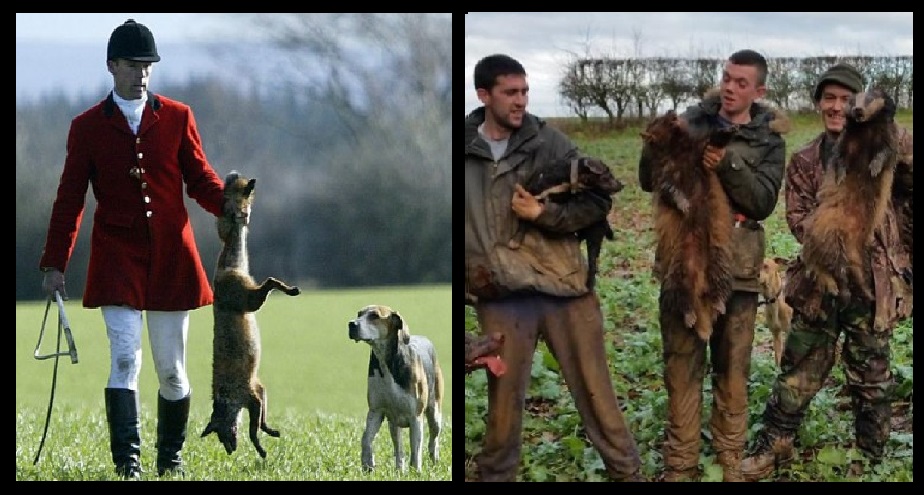
Every year, hundreds of badgers meet a horrific death in the name of ‘sport’ in the UK at the hands of terriermen. Many of those who have been caught digging into badger setts have used the excuse that they were after foxes – and many have escaped prosecution by so doing.

The Lychee and Dog Meat Festival, commonly referred to as the Yulin Dog Meat Festival is an annual event starting on 20th of June where an estimated 10,000 – 15,000 dogs and cats are slaughtered for their meat.

The ‘festival’ began in 2010 to celebrate summer solstice. Advocates and restaurant owners say that eating dog is traditional in the summertime. Around 10-20 million dogs are killed for their meat each year in China. However, critics argue there is no cultural value in the festival and it was mainly devised as a way of making money.

While slaughtering dogs is common in China, the festival is seen as representative of the cruelty and lack of hygiene associated with the largely unregulated industry. In addition, many of the animals killed are stolen pets some of which have been seen still wearing their collars.

Some are sent to the festival in small cages without food or water on trucks that can travel hundreds of miles.

Slaughtering takes place in front of the live animals, usually with a club or with a blow-torch to induce the pain and fear that some restaurant owners claim makes their adrenaline-rich meat tastier.

“Psychologically and mentally, they have already died many times,” said Peter Li, a China policy specialist with the Humane Society International.

DOGS ARE TORTURED TO DEATH IN THE BELIEF THAT IT MAKES THE MEAT TASTIER

Trophy hunters pay large sums of money, often tens of thousands of dollars, to travel around the world to kill wild animals. Who can forget the killing of Cecil the Lion in 2015 in Zimbabwe? He was hunted over many hours with a bow and arrow, before being skinned and beheaded by Dentist Walter Palmer.

More often than not animals in their prime and in breeding age are targeted by trophy hunting because of their specific characteristics; their black mane, their long tusks, the size of their antlers, in fact Safari Club International offers prizes for the largest animals killed. Where older males are targeted this can have extreme negative consequences for the herd or pride; older males offer protection to groups and keep juvenile males in line, when they are killed less experienced animals move in, increasing the risk of human wildlife conflict and killing the cubs of the older male. When the elephants with the largest tusks are killed, we have seen the size of elephant tusks in the population decrease over time, making it harder to find food and defend themselves.

CECIL THE LION WAS SHOT BY DENTIST WALTER PALMER IN JULY 2015 AND CAUSED INTERNATIONAL OUTRAGE

More than 10,000 are caught, tortured and killed in the UK each year by huntsmen with terriers – with almost a third of these illegal acts being carried out in Wales. Alarmingly, this figure is rising constantly. Terry Spamer, a former RSPCA inspector, believes that there are around 2,000 people involved in badger baiting currently. However, only around three people are caught and convicted of badger baiting each year, while the majority carry on breaking the law.

Traditional fox hunting was banned in England and Wales under the Hunting Act 2004. In spite of existing legislation, there has been 500 successful prosecutions under the Act. However, many incidents of illegal hunting have gone unpunished.

FOX HUNTING AND BADGER BAITING IS ILLEGAL IN THE UK BUT CARRIES ON WITH WITH APPARENT IMPUNITY

Dogfighting is an inhumane ‘bloodsport’ where dogs who have been bred, conditioned and trained to fight are placed in a pit to fight each other for spectator ‘entertainment’ and profit. Fights average one to two hours, ending when one of the dogs cannot continue.

Dog fights usually take part in quiet, private locations, such as in an industrial unit or farm building. Participants will spend months training their dogs in preparation, much like boxing, the fighters will have to hit a target weight to take part. Organisers will create a fighting ‘pit’ for the dogs to fight within.

Dogs who have been used in fighting often have serious injuries to their head, ears, front legs and chest that are caused as they go head-to-head in a pit. They will also have injuries of different ages, some old scars and some fresh wounds.

IT IS BELIEVED OVER 16000 DOGS DIE EACH YEAR IN ORGANIZED DOG FIGHTS

Each year, thousands of bulls are barbarically slaughtered in bullrings around the world. Over the centuries, bullfighters have found countless ways to rig the “fight” in their favor. Bulls are often weakened with drugs or by having sandbags dropped on their backs. Their horns have been shaved to keep them off balance, or petroleum jelly has been rubbed into their eyes to impair their vision.

Every year, approximately 250,000 bulls are killed in bullfights. Bullfighting is already banned by law in many countries including Argentina, Canada, Cuba, Denmark, Italy and the United Kingdom. Although legal in Spain, some Spanish cities, such as Calonge, Tossa de Mar, Vilamacolum and La Vajol, have outlawed the practice of bullfighting. There are only a few countries throughout the world where this practice still takes place (Spain, France, Portugal, Mexico, Colombia, Venezuela, Peru, and Ecuador). ~ HSI.

BULLS ARE TORTURED IN THE NAME OF CULTURE AND TRADITION

Each year from approximately September 1 to March 1, a large-scale hunt of dolphins takes place in the small village of Taiji, Japan, as featured in the 2010 Academy Award-winning documentary The Cove. During this six month season, dolphin hunters utilize drive hunt techniques to herd large numbers of dolphins to shore, resulting in their capture or death.

The captured dolphins may be selected for live trade to aquariums and marine parks for display, while others are slaughtered for their meat. The price for live captures is many times higher than those killed.

THE ANNUAL TAIJI DOLPHIN SLAUGHTER

What you can do to help end animal abuse

We believe EVERY animal should be treated with respect, empathy, and understanding. We raise awareness to protect and conserve wild, captive, companion and farm animals.

It is vital that we protect animals against acts of cruelty, abuse, and neglect by enforcing established animal welfare laws and, when necessary, taking action to ensure that those who abuse animals are brought to justice.

The Mission of Protect All Wildlife is to prevent cruelty, promote the welfare of ALL animals EVERYWHERE, and help END animal abuse.

Please support our work by donating ANY amount, large or small. It only takes a minute and your donations make it all possible. Thank you for your support.

What else you can do to help

Please SHARE to raise awareness to wildlife and environmental issues from around the world.

Go back

Your message has been sent

Warning
Warning
Warning
Warning
Warning
Warning.

A Yellowstone Grizzly Bear Is Surrounded & Run Off By A Pack Of Wolves In “Once In A Lifetime” Footage

Every year, millions and millions of people visit Yellowstone National Park, but not everybody gets a show like this.

The Bear Is Chased Off By The Wolves

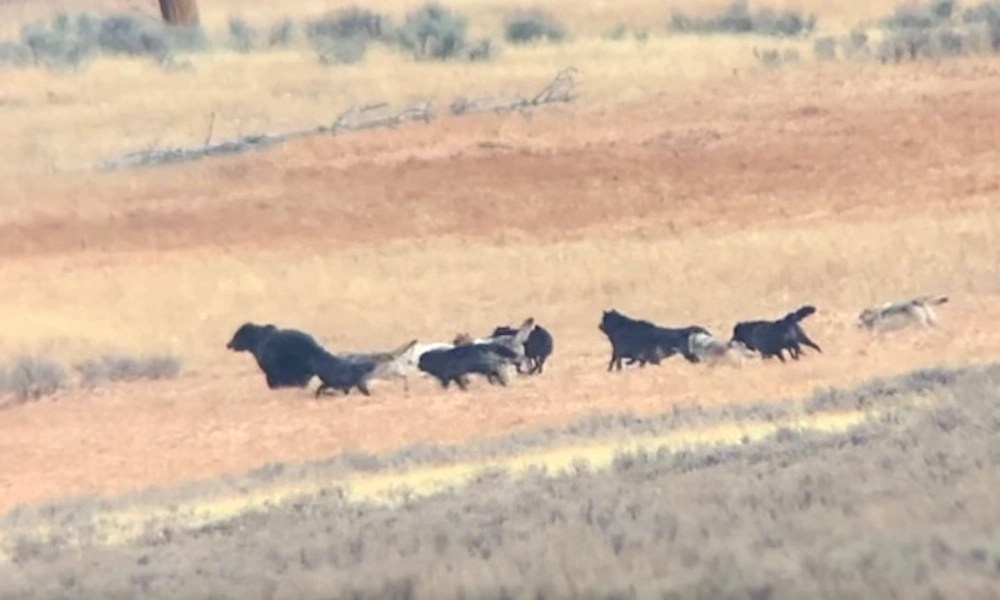
Captured by Yellowstone Adam Brubaker of Tied to Nature, the video picks up in the Hayden Valley area of Yellowstone with a couple of Wolves from Wapiti Lake Pack and a curious Grizzly bear.

You’d think that a bear would want to run away when he’s outnumbered by a few Wolves, but nope, this fella charges forward to get a better look.

A group of tourists have witnessed a scene straight out of a Sir David Attenborough documentary, when a pack of wild Wolves decided to take on a giant Grizzly bear.

In a stunning video shot by Tied to Nature tour operator Adam Brubaker, tourists witnessed a pack of 10 Wolves surround a bear which Mr Brubaker believes was eyeing off their kill.

The encounter, which happened at Hayden Valley in the famed Yellowstone National Park, was described as a “once in a lifetime” sighting by the qualified naturalist.

“I had the awesome opportunity to share this once in a lifetime Wolf and Grizzly sighting while on tour in Yellowstone today.” he wrote on his Facebook page alongside the video.

“This Grizzly was foraging in the far end of the valley when the Wolves started to cross his path. The Grizzly started standing up on his hind legs to get a better view of what was going on and then started to approach the Wolves.

At one point, the bear reared up on its hind legs to get a better look over the tall grass.

“Soon the rest of the Wolf pack appears and escorts the bear into the trees.”

Some thought that the Wolves might have been trying to protect their cubs, but Mr Brubaker believes they had dinner nearby – and didn’t want a hungry bear to snack on any leftovers.

“From what I could see the pups were not with them,” he told USA Today.

“The white Wolf has blood on her face and neck, so there could have been a carcass, but while I watched them they were not feeding on one.”

While grizzlies and Wolves typically avoid each other, encounters have happened before.

“Bears may benefit from the presence of Wolves by taking carcasses that Wolves have killed, making carcasses more available to Bears throughout the year,” National Park Service told Newsweek .

“If a bear wants a Wolf-killed animal, the Wolves will try to defend it; Wolves usually fail to chase the bear away, although female grizzlies with cubs are seldom successful in taking a Wolf kill.”

“I could see that the two species were probably going to cross paths but I did not expect what was going to happen.

“For many people, this would be a once-in-a-lifetime encounter. Neither the Wolves nor Bears were injured. I believe I saw the same bear yesterday out in the same place this time with no Wolves around.

“I have been a guide in Yellowstone for seven years and visiting the park for 20 and every day can offer something new or different.”

Please SHARE to raise awareness to wildlife and environmental issues from around the world. You can also receive NEWS and UPDATES by signing up in the top right of this page.

What you can do to help end animal abuse

The Mission of Protect All Wildlife is to prevent cruelty, promote the welfare of ALL animals EVERYWHERE, and help END animal abuse.

Please support our work by donating ANY amount, large or small. It only takes a minute and your donations make it all possible. Thank you for your support.