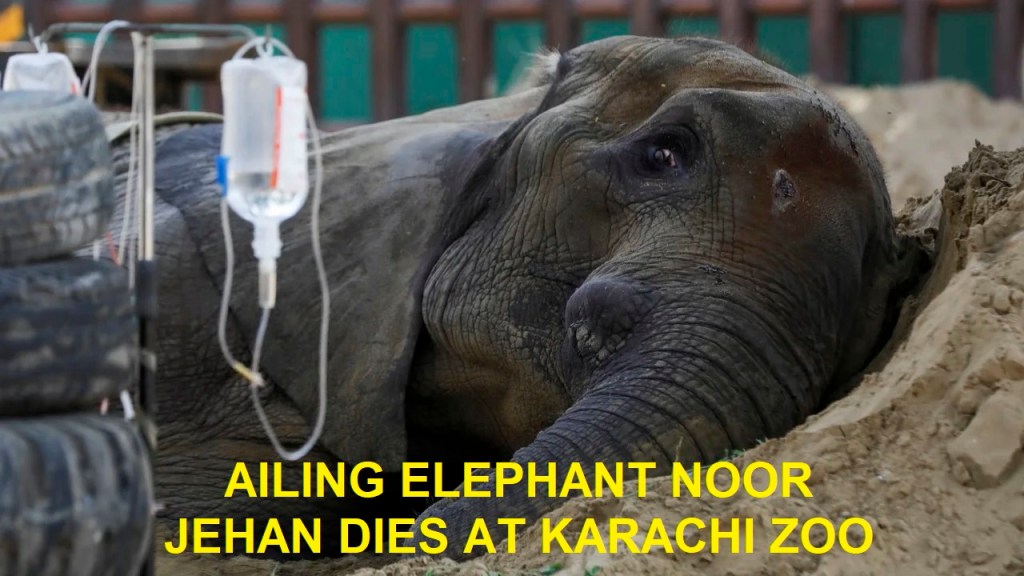
The ailing Elephant died on Saturday, vets said, calling on the ill-equipped menagerie to evacuate her “mourning” partner to avert a second tragedy.
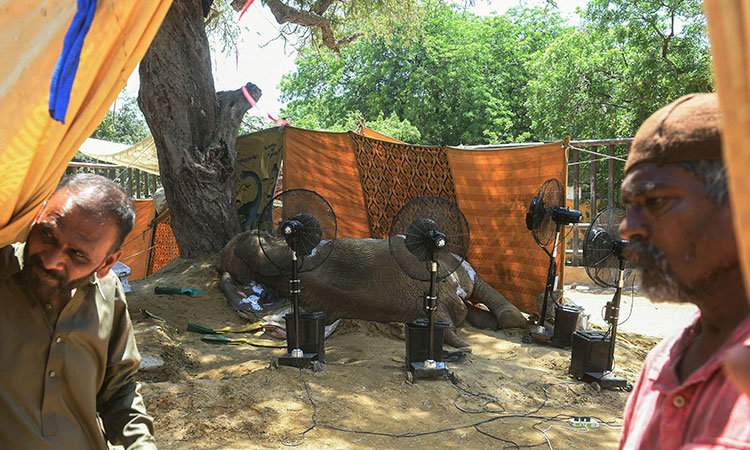
Zoo staff stand near the dead body of Noor Jehan at an enclosure in Karachi Zoological Gardens on Saturday. AFP
Pakistan’s zoos are frequently accused of being blasé about animal welfare, and the plight of Noor Jehan was cited by animal rights activists campaigning to shut the wildlife exhibition in southern Karachi city.
This month the 17-year-old African Elephant underwent emergency treatment for a tumour, which had crippled her back legs, but while in recovery she became trapped in her enclosure’s pool.
Zoo workers hauled out the 3.5-tonne pachyderm but she was unable to stand and lay stricken for nine days, “a life-threatening situation for Elephants”, said animal charity Four Paws International.
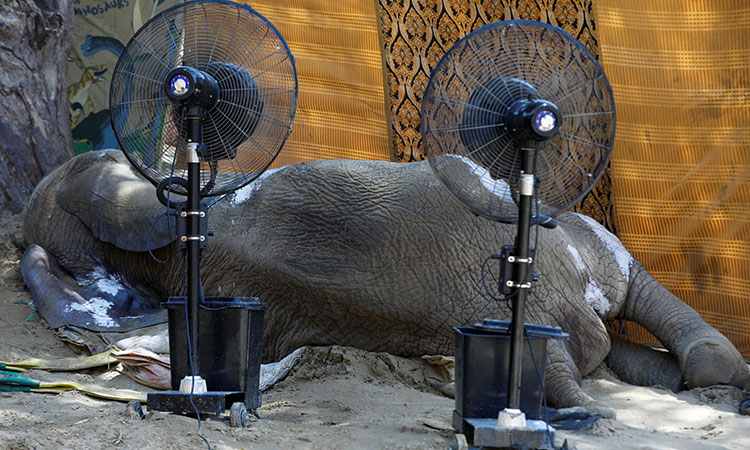
Misting fans are placed beside the body of Noor Jehan at Karachi Zoo. AP
Experts were considering euthanasia but before a decision was taken “she succumbed to her critical condition,” said a statement from the charity, which organised last-ditch medical efforts to save her.
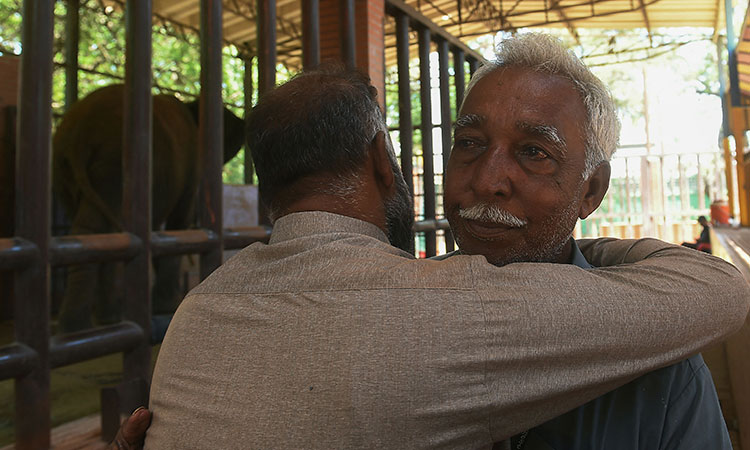
Karachi Zoo director Kanwar Ayub confirmed Noor Jehan’s death on Saturday and an AFP reporter saw her caretaker openly weeping outside her enclosure. “It’s very sad,” said Four Paws International’s Austria-based chief vet Amir Khalil. “Noor Jehan deserved a chance.”
But the deceased Elephant’s pen pal Madhubala “should not have the same future”, he told AFP, saying he plans to arrive in Pakistan on Sunday to assess her health and organise her evacuation.
“Karachi Zoo does not fulfil international standards and is not equipped to take appropriate care of Elephants,” the Four Paws International statement said, expressing support for a forced closure.
Caretaker Yusuf Masseih (R) mourns following the death of Noor Jehan at Karachi Zoological Gardens. AFP
“It is now more urgent than ever that the remaining Elephant, who is mourning her long-time companion, is transferred to a more species-appropriate location as soon as possible, to prevent another potential tragedy.”
In April 2020, a court ordered the only zoo in Pakistan’s capital Islamabad to shut after poor facilities and mistreatment of the animals there were revealed.
The facility had drawn international condemnation for its treatment of an Asian Elephant named Kaavan, who was later airlifted to retirement in Cambodia in a project spearheaded by US popstar and actor Cher, and carried out by Four Paws.
Agence France-Presse
~~~~~(((())))~~~~~
WHAT YOU CAN DO TO HELP WILDLIFE
You can support Protect All Wildlife by donating as little as £1 – It only takes a minute but it can last a lifetime for an animal in need. Please donate below.
The Mission of Protect All Wildlife is to prevent cruelty and promote the welfare of ALL animals.
We believe EVERY animal should be treated with respect, empathy, and understanding. We raise awareness to protect and conserve wild, captive, companion and farm animals.
It is vital that we protect animals against acts of cruelty, abuse, and neglect by enforcing established animal welfare laws and, when necessary, take action to ensure that those who abuse animals are brought to justice.
Protect All Wildlife are involved in many projects to protect animals’ rights, welfare, and habitats. Money contributed to Protect All Wildlife supports ALL of our worthy programmes and gives us the flexibility to respond to emerging needs. Your donations make our work possible.
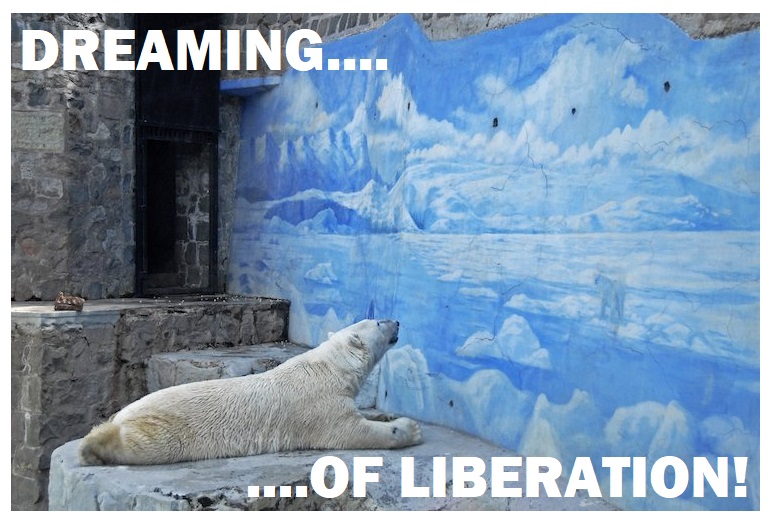
Sadly, unhealthy and dreary polar bear enclosures such as this still exist. Chile’s only polar bear “Taco” died in 2015 at the age of 18 at the National Zoo in Santiago. For years, activists protested its captivity, sometimes with blockades and burning barricades. [Photo by Aldo Fontana]
In urban areas of the western hemisphere, polar bears have lived in our midst since the Middle Ages—a result of our fascination with these charismatic carnivores. As early as 1252, Henry III of England kept a muzzled and chained polar bear, which was allowed to catch fish and frolic about in the Thames. The first undisputed documentation of polar bears in Europe shows that the bears arrived by way of Greenlandic Norse traders and from Iceland, where sea currents still sometimes maroon them. Viking entrepreneurs distributed them to royalty throughout Europe, who kept them in ostentatious menageries or passed them on as gifts to grease diplomatic gears and careers.
Beginning in 1693, the first King of Prussia, Frederick I, kept a polar bear and other large mammals for public amusement in a baroque-style hunting enclosure inspired by Roman arenas. These rare animals were too valuable to be killed but, defanged and de-clawed, were pitted against each other in faux fights. During medieval times in England, entertainers displayed all sorts of animals at carnivals and fairs. The traveling menagerie, which derived from the processions of Europe’s ambulatory monarchs and their entourages, first took to the roads at the turn of the eighteenth century. In a bid for respectability, the owner of one bragged he was doing “more to familiarize the minds of the masses of our people with the denizens of the forest than all the books of natural history ever printed.”
Around this same period of time, a burgeoning middle class and expeditions to the Americas, Asia, and Africa, as well as new developments in science and philosophy, brought about changes in how polar bears were displayed. Animal collections in Europe—until then largely a privilege of nobility—increasingly welcomed the public. Featured in these publicly accessible collections, polar bears drew a good deal of attention, just as they did in medieval wildlife collections or “menageries” (such as the one in the Tower of London).
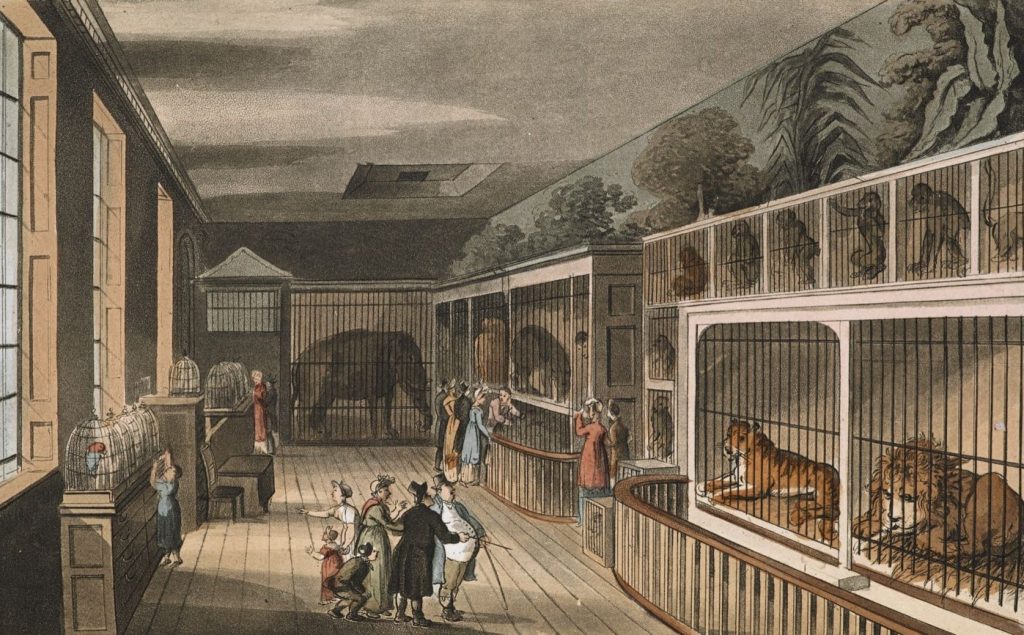
The Royal Menagerie: An illustration of how the zoo within the Tower looked in 1816
Nobody contributed more to the popularity of captive polar bears or the looks of modern zoos than Carl Hagenbeck. In 1848, Carl Hagenbeck Sr., a Hamburg fishmonger, exhibited six seals he’d received as bycatch from fishermen before selling the seals at a handsome profit. At age fifteen, Carl Hagenbeck Jr. took over what would become Europe’s most famous animal-trade business. He soon supplied zoos, menageries, and wealthy individuals, including the Kaiser. In his early twenties, Hagenbeck already ranked among Europe’s top dealers in exotics. With a nose for opportunity, he branched out into the budding entertainment industry, mounting “ethnological” and large carnivore shows as well as a circus.
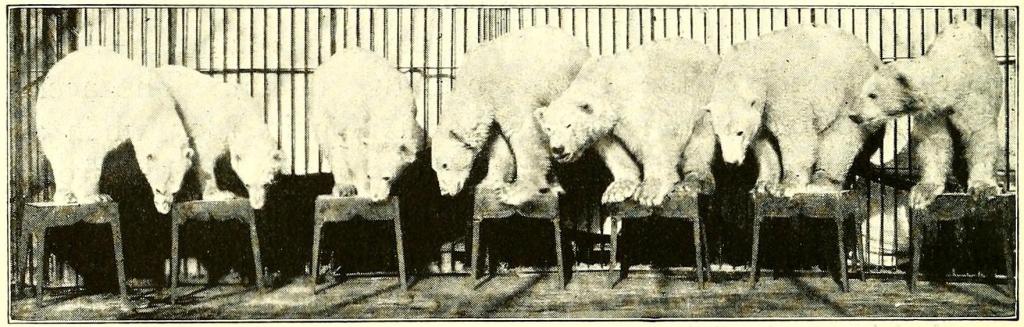
Some of the Polar Bears abducted by the Hagenbecks faced a fate worse than zoo captivity. These seven polar bears were forced to become performers by Carl’s relative Wilhelm Hagenbeck.
From their very beginnings as cultural institutions, zoos have tried to balance entertainment and education. Today, with climate change and habitat loss from development threatening the polar bear’s natural habitat, many zoos have added conservation to their mission, contributing to captive breeding programs and scientific research.
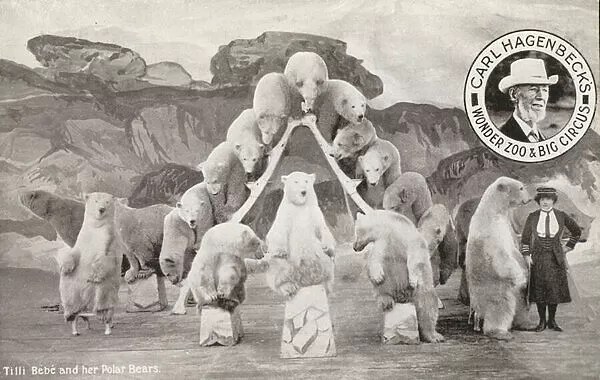
Austrian circus performer Mathilde Rupp (stage name Tilly Bébé) and her Polar Bears at Carl Hagenbeck’s Wonder Zoo in 1918.
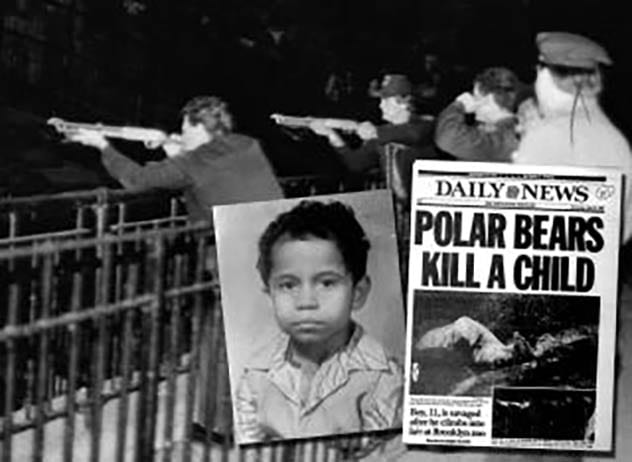
The urge to be close to the wildness (fettered as it may be) that cannot be bred out of zoo polar bears, or perhaps a desire to better get to know these ursine celebrities, has caused numerous incidents at zoos. Such trespassing is not a recent phenomenon. In 1891, a female servant from Bavaria, Karoline Wolf, climbed down a rope into the Frankfurt Zoo’s bear pit—after undressing and neatly folding her clothes—in order to be “eaten alive by a white bear.” People will forever seek operatic ways to end their lives, but accidental zoo maulings are telling because of what these incidents reveal about attitudes toward the animal. In 1987, two polar bears at the Brooklyn Zoo dragged into their den and then killed eleven-year-old Juan Perez, who had entered the enclosure after hours on a dare. The boy thought the bears were slow and afraid of people and water. After invading their space, he provoked the female, throwing bottles and sticks. Police, who suspected that more kids were in danger, riddled both bears with shotgun slugs and pistol bullets.
On May 19, 1987, 11-year-old Juan Perez and two of his friends were visiting the Prospect Park Zoo in Brooklyn, New York, after the zoo had closed for the day.
The old animal magic, that attraction of people to bears, remains strong. Drawn like foxes to a bear kill, we take risks to breach barriers that once, long ago, did not exist. Juan Perez’s death and similar cases recall an Inuit boy’s test of courage and coming-of-age rite: his first polar bear kill. The crucial difference, of course, is the cultural context. Whereas Inuit children grew up listening to their elders, respecting the animal, observing bear habits and how bears are hunted, young Juan had never been inducted into the White Bear’s ways.
A Polar Bear riding a motorcycle circa 1960. (Photo by John Cuneo)
——–((((((()))))))——–
WHAT YOU CAN DO TO HELP WILDLIFE:
You can support ‘Protect All Wildlife’ by donating as little as £1 – It only takes a minute but it can last a lifetime for an animal in need. Please donate below.
Everyone who donates will receive a Certificate of Appreciation as a thank you for helping animals in need.
The Mission of Protect All Wildlife is to prevent cruelty and promote the welfare of ALL animals.
We believe EVERY animal should be treated with respect, empathy, and understanding. We raise awareness to protect and conserve wild, captive, companion and farm animals.
It is vital that we protect animals against acts of cruelty, abuse, and neglect by enforcing established animal welfare laws and, when necessary, take action to ensure that those who abuse animals are brought to justice.
Protect All Wildlife are involved in many projects to protect animals’ rights, welfare, and habitats. Money contributed to Protect All Wildlife supports ALL of our worthy programmes and gives us the flexibility to respond to emerging needs. Your donations make our work possible.
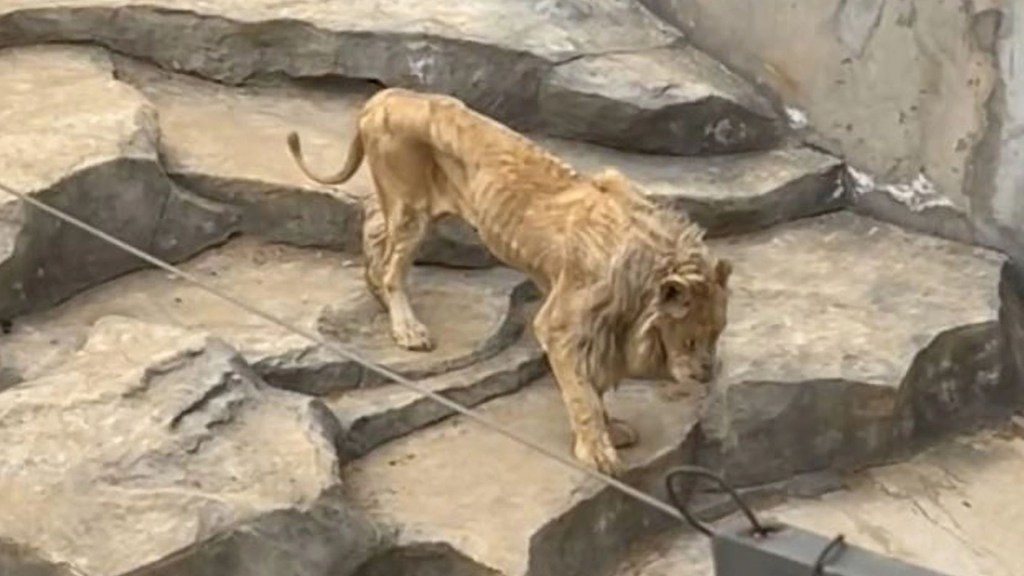
A frail Lion that looks like a walking skeleton has become too weak to chew.
Shocking footage showed the skinny lion walking through its enclosed cage
The Lion, called Ala, is so emaciated he can barely walk through his enclosure at the Jinniu Lake Safari Park in Nanjing, China with outraged social media users accusing the zoo of inflicting suffering on the lion and starving their animals.
Shocking footage has emerged of a starving lion which is barely more than skin and bones at a Chinese zoo.
Many have been left furious and disturbed by the sight of the big cat who looks so malnourished it is struggling to carry out basic functions such as walking.
In the horrifying video viewers can see the Lion’s ribs because it is so thin.
The clip – shared later on Douyin, China’s version of TikTok – shows the ultra-skinny Lion wobbling down a walkway.
The lion is so frail he can barely walk
It caused outrage among viewers who accused the zoo of not taking proper care of the feeble feline.
One user said: ‘This is too much suffering. If you can’t afford to feed it, send it to a different zoo that can.
‘Why let him suffer? It should have been left living in nature.’
Meanwhile, another added: ‘This zoo is too much, starving the lions like this.’
Officials at the zoo later attributed the lion’s shocking appearance to its old age because he can no longer chew his food.
They claimed that the 25-year-old big cat would be 80 if he was a human.
Officials say he is fed a special diet of liquid protein and small cuts of meat and is watched over by specially trained vets and keepers in a private cage.
The zoo added: ‘Usually, we let it out for a walk in the morning or evening.’
Despite the concerning footage, Jinniu Lake Safari Park is ranked in the top five family-friendly things to do in Nanjing on Trip.com.
It has an overall rating of 4.2 out of 5 but there are also hundreds of negative reviews, with some visitors citing the zoo’s ‘poor management’ and others complaining of the huge costs.
What you can do to help wildlife:
You can support ‘Protect All Wildlife’ by donating as little as £1 – It only takes a minute but it can last a lifetime for an animal in need. Please donate below.
Everyone who donates will receive a Certificate of Appreciation as a thank you for helping animals in need.
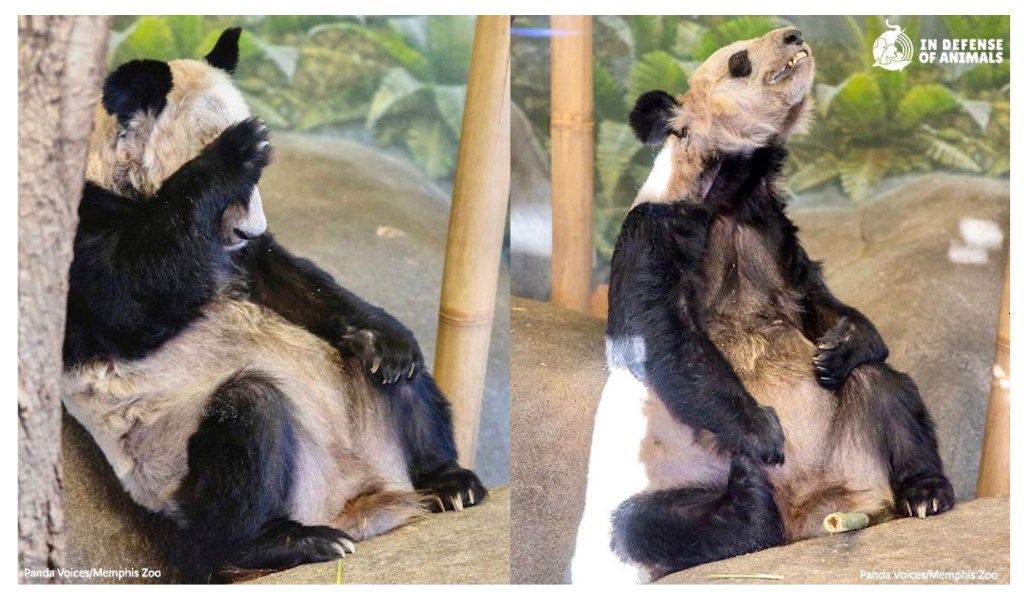
Suffering: Giant Pandas YaYa And LeLe At Memphis Zoo Credit: Panda Voices
UPDATE! A huge victory for Giant Pandas YaYa, 22, and LeLe, 24, who will be sent back to their homeland of China, according to a statement from the Memphis Zoo. In Defense of Animals and Panda Voices, who have been lobbying for the pandas’ release for nearly two years, announced the news today.
“After far too many years of suffering in a grossly inappropriate zoo exhibit, YaYa and LeLe will finally get improved care at a specialized panda refuge in their homeland,” said Brittany Michelson, Captive Animals Campaigner for In Defense of Animals.
“We applaud the Memphis Zoo and Chinese authorities for making the ethical decision to return the pandas to China once the loan contract ends in April 2023. We thank Billie Eilish and our many thousands of supporters worldwide for helping us encourage the zoo to do the right thing,” continued Michelson. “We are delighted to celebrate this momentous victory. Animals suffer tremendously in zoos, and we hope this will prompt all zoos to put animals’ needs first and release them to accredited sanctuaries.”
YaYa and LeLe have been suffering at the Memphis Zoo since 2003. The pandas are visibly distressed and malnourished and spend their days pacing or sleeping, clearly bored in their dirty, small enclosure. YaYa has a chronic skin condition and LeLe has significant teeth issues resulting in broken molars.
“We are overwhelmed with joy at the news of YaYa and LeLe returning home to China!” said Taciana Santiago of Panda Voices.
“We thank the Memphis Zoo for allowing this to happen and hope they provide the pandas the conditions they need to be fit to endure the long travel. We will continue to monitor their situation until we are sure they are in a suitable environment,” continued Santiago. “We look forward to seeing them live a life of retirement and peace in China. Big thanks to In Defense of Animals and all of our supporters who stayed vigilant on this journey! King LeLe and Queen YaYa will soon be home!”
The campaign to free YaYa and LeLe was supported by singer Billie Eilish.
I want my money back I came to see an Elephant I paid to see a conservation ambassador Inspire me to help conserve the species Especially her kind
I saw an empty shell
She looks like an Elephant But what is there to see, not Happy She is a poor teacher of Elephant lessons She is no solitary animal, but kept confined Like all captives, neurones scrambled, brain denied Stereotypy is not a dance – no, a pathetic trance A sign she can’t be happy in mind She’s not right in the head.
She is an empty shell
They have broken personalities All the Elephants with names, captive They are poor Elephant facsimiles They have the stature, the thick skin and bones They are devoid of Elephant spirit, truncated They are subjected to Floydian ‘Brain Damage’ They are all caught on the dark side (“‘As a matter of fact, it’s all dark’*) Cut off from the herd
They are empty shells
We pay the price to see: see the price they pay We fall for the old ‘conservation /education’ story We fail to see the oppression and the damage done We should be able to see for ourselves We could accept they are Sentients like us We could see them better in a sanctuary We could do the right thing Will we?
Collect all the empty shells
Put them back where they can refill Regain their freedom and society Be Elephants again, herd mentality That would be something to see Is it just a Zoological fantasy?
I find myself unhappy for Happy, again
If I find myself outside her enclosure (But I wouldn’t pay to go in anyway) Watching her sway song, groundhog days One day closer to her end of days Inspired to write yet another Happy poem Adding to ‘Not Happy’ ‘Personable’ ‘Elephant Stomp’ After the first setback of her legal person court case What would I do if I were you?
Might just as well go to a museum Pay to see a stuffed Elephant This one already is
I want my money back I came to see an Elephant Largest land animal, majestic Social fellow-sentient being Exemplary, salutary
I got an empty shell
*From ‘Brain Damage’ on the Pink Floyd album ‘Dark Side of the Moon’
**From ‘The Needle and the Damage Done’ by Neil Young
For all captive Elephants – Happy, Lucy, Shankar, The Fresno Elephants and so many more.
Written By Anthony Lovell.
What you can do to help wildlife:
Please Sign The Petition To Free Happy From Her Imprisonment At The Bronx Zoo HERE!
Support ‘Protect All Wildlife’ by donating as little as £1 – It only takes a minute but it can last a lifetime for an animal in need. Thank you.
We believe EVERY animal should be treated with respect, empathy, and understanding. We raise awareness to protect and conserve wild, captive, companion and farm animals. It is vital that we protect animals against acts of cruelty, abuse, and neglect by enforcing established animal welfare laws and, when necessary, take action to ensure that those who abuse animals are brought to justice.
Protect All Wildlife are involved in many projects to protect animals’ rights, welfare, and habitats. Money contributed to Protect All Wildlife supports ALL of our worthy programmes and gives us the flexibility to respond to emerging needs. Your donations make our work possible. Thank you for your support.
Everyone who donates will receive a Certificate of Appreciation as a thank you for supporting wildlife.








 PROTECT ALL WILDLIFE