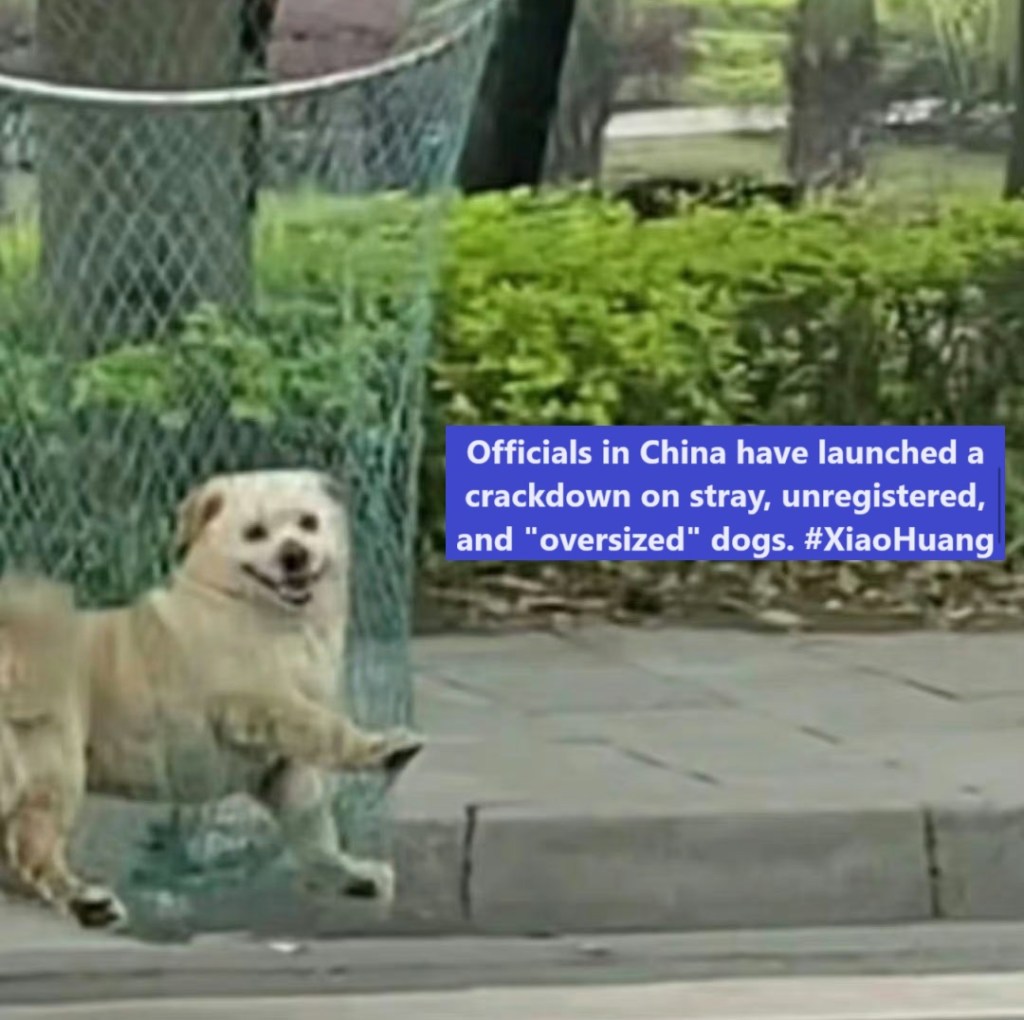
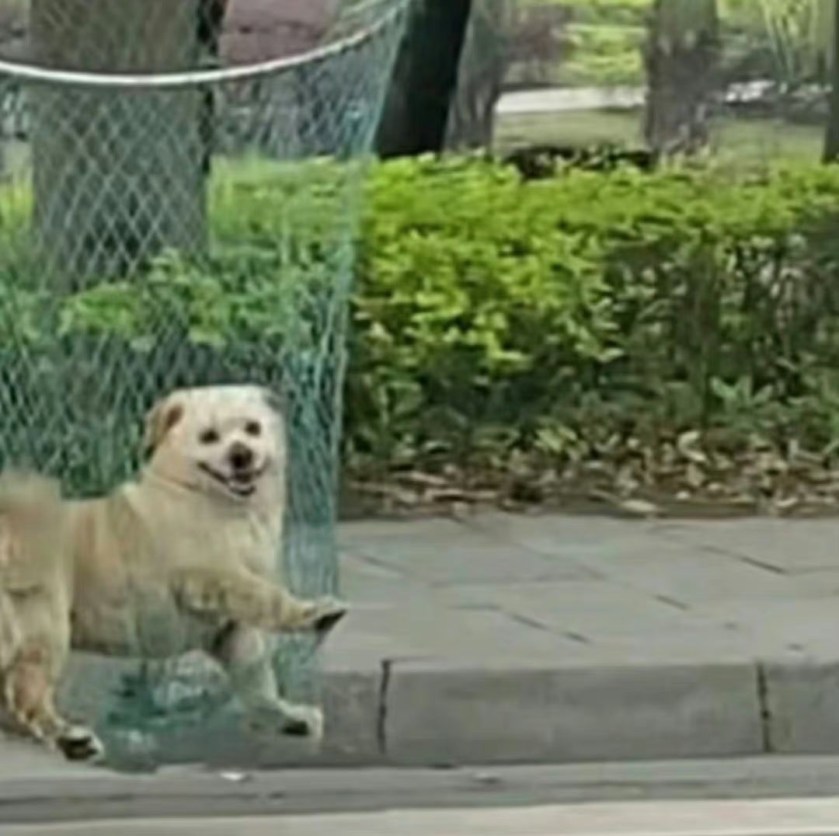
A small, stray dog on a university campus in Chongqing was filmed being grabbed in a net by a dog catcher, prior to being killed. The “smiling” appearance of the dog has prompted a social media hashtag using the name it was given #XiaoHuang.
Officials in China have launched a crackdown on stray, unregistered, and “oversized” dogs.
But the move has been widely criticised after reports that dogs without owners are being rounded up and sometimes euthanised.
It comes after a vicious attack on a two-year-old girl by a Rottweiler last week that shocked the country.
The Rottweiler that attacked the child in Chongzhou, Sichuan Province, WAS NOT A STRAY. It was unleashed and approached the mother who was walking her child to preschool inside their housing compound.
The toddler suffered a ruptured kidney, fractured ribs and lacerations across her body. She is reportedly stable.
The crackdown prompted by the mauling has however, been questioned on social media and by pet owners after several shocking stories came to light.
Community workers in Leshan broke into a house to hunt and kill pet dogs
In one case, security guards and a landlord entered an office without the permission of the tenant and killed both of their dogs.
In another case – which has drawn considerable attention online – a small, stray dog on a university campus in Chongqing was filmed being grabbed in a net by a dog catcher, prior to being killed. The “smiling” appearance of the dog has prompted a social media hashtag using the name it was given #XiaoHuang. University officials said the dog had chased a student.
A small, stray dog on a university campus in Chongqing was filmed being grabbed in a net by a dog catcher, prior to being killed. The “smiling” appearance of the dog prompted a social media hashtag using the name it was given #XiaoHuang.
Some users of Chinese microblogging site Weibo posted pictures claiming security personnel in their residential compounds had started killing strays and dumping their bodies in the trash. Their posts sparked an online outcry, with many calling for more humane measures, including adoption and neutering.
Chinese celebrities have also joined the social media discussion, saying the crackdown across the country was not warranted by the initial attack, terrible though it was.
Chinese actress Cya Liu Ya-se posted on Weibo on Friday, stating that “not all stray dogs are bad dogs” and called for “an end to the killing of animals.”
Celebrity Yang Di also posted a video on short video platform Douyin the same day, saying that people don’t have to all love dogs, but “please do not harm them.” Both accounts were banned shortly after the posts.
Xiao Feng calls for the killing of stray cats and dogs to stop.
However, the Rottweiler that attacked the child in Chongzhou, Sichuan Province, was not a stray. It was unleashed and approached the mother who was walking her child to preschool inside their housing compound.
Statements issued from officials in Shandong, Jiangxi and Hubei Provinces have said that captured stray dogs would be put down if an owner cannot be found for them.
In another instance, a security guard at a university in Liaoning Province was suspended after beating a beloved on-campus stray to death.
Chen Minjie, a staffer from the Cat and Dog Welfare Program with the Animals Asia Foundation, told the Global Times on Monday that the heated debate surrounding uncivilized incidents reflects the expanded pet ownership in the country and the varying quality of pet owners. Attention should be focused on addressing the behavior of uncivilized dog owners, rather than a widespread antagonism between dog owners and non-dog owners.
Internet users also called on the public to go to the State Council website and leave a message asking the government to stop abusing and killing stray animals, to reasonably disclose the way stray cats and dogs are handled, and to call on the state to legislate for the protection of animals.
Editor’s Note: Whilst it is agreed that attacks by dogs should be dealt with severely, in this case the dog(s) involved were not strays. They were pets that were not on leads. No stray dogs were anywhere in the vicinity of the awful attack. Why persecute strays for something they had nothing to do with?
WHAT YOU CAN DO TO HELP RESCUE ANIMALS
You can support our work by donating as little as £5 – It only takes a minute but it can last a lifetime for an animal in need.
Everyone who donates will receive a Certificate of Appreciation as a thank you for helping rescue animals in need.
OUR MISSION STATEMENT
‘Animals that use wheels and prosthetics can live as good a quality of life as fully able-bodied animals and this is what we want to show people’ ~ Victoria Bryceson, founder of Miracle’s Mission.
We do not receive financial support from the government or other institutions. We rely solely on donations from generous animal lovers.
Animal rescues cost a lot of money to run. While we get donations and funding through events like charity runs etc, the costs are EXTREMELY high. We need to pay for food, heating and other bills, as well as any staff costs and expenses like petrol for home visits.
The average cost to feed a dog for one month typically costs somewhere from £16 to £50, depending on the breed. Microchipping costs about £10 to £15. The average cost of essential vaccinations is £64. A routine vet appointment costs between £40-£60, surgery can cost anywhere over £1000. Physiotherapy, Hydrotherapy – the average cost is £50 for a 30-minute session. Prosthetics and dog wheels etc can cost up to £500.
Please help Miracle’s Mission continue to rescue, rehabilitate and rehome MANY MORE sick, injured and disabled animals by kindly donating ANY amount, large or small, today. Thank you.
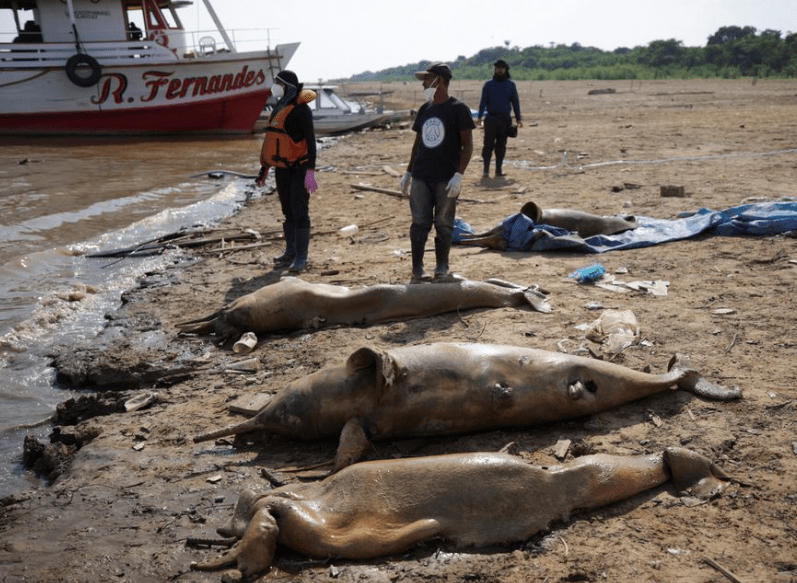
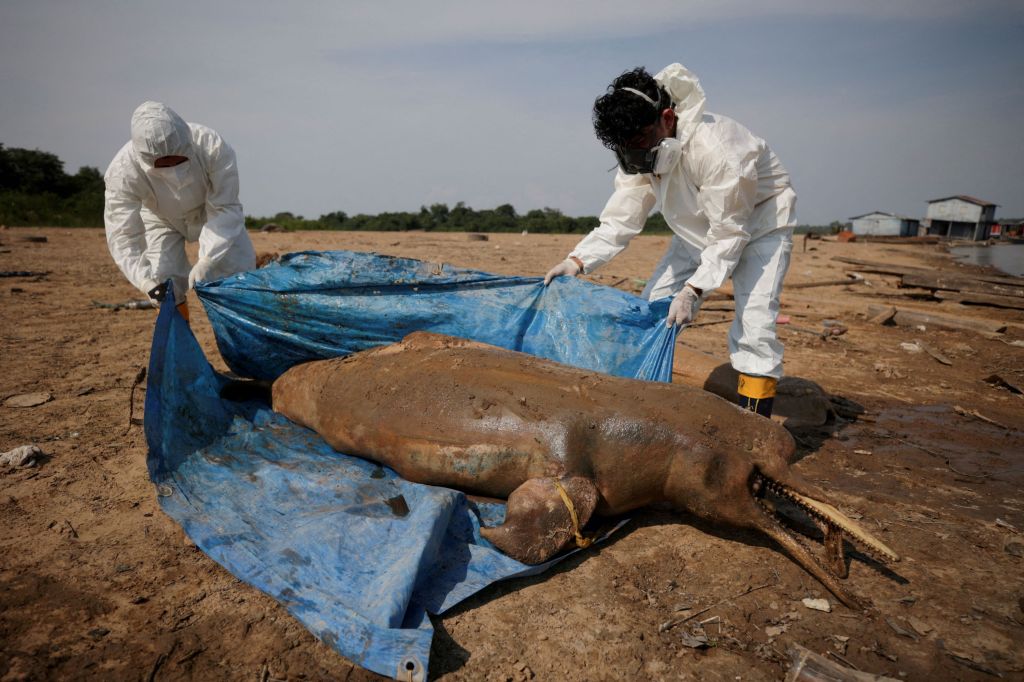
Researchers from the Mamiraua Institute for Sustainable Development retrieve dead dolphins from Tefe lake, which flows into the Solimoes river, that has been affected by the High temperatures and drought in Tefe, Amazonas state, Brazil, October 2, 2023. Credit: Bruno Kelly
Since September 23, as the drought has worsened and water temperatures have risen, 153 River Dolphins have been found dead in the region: 130 Pink River Dolphins and 23 Tucuxi. In one week, the loss was around 10% of the local river Dolphins population. On the 28th of September alone, when the water temperature exceeded 39ºC, 70 River Dolphin carcasses were recorded, in addition to hundreds of fish.
The crisis, however, goes far beyond the loss of River Dolphins. There is an increase in mortality of fish species in the region, which are essential for the food security and livelihoods of local communities. The drought is also impacted water supplies and transportation, isolating some communities. Overall, 500,000 people have already been impacted.
Researchers are still trying to confirm the cause of death, but they suspect the high water temperatures are to blame. Image Credit: Bruno Kelly
“What is happening at Lake Tefé is terrifying. The impact of the loss of these animals is enormous and affects the entire local ecosystem”, warns Mariana Paschoalini Frias, Conservation analyst at WWF-Brazil. “River Dolphins are considered ‘sentinels’. In other words: they are indicative of the health of the environment where they live. What happens to them is reflected in the other species that live around them, including humans.”
“In our studies on Amazonian Dolphins, we found that they suffer from several pressures, such as fishing, mercury contamination and the impact of hydropower plants. But these events in Tefé show that more research needs to be carried out on how they will be affected by worsening climate change,” she added.
The deaths highlight the urgent need to scale up efforts to conserve the world’s River Dolphins – and the importance of the Global Declaration for River Dolphins, which will be signed by South American and Asian range states in Colombia on October 24th.
The operation was divided into different fronts. One of them, called Alive Operation Sector, monitors groups of Pink and Tucuxi River Dolphins along Lake Tefé, an isolated environment that is home to a large population of these two endangered species. When the team finds an individual with signs of abnormality, they are able to rescue them and take them to the Rehabilitation Float. The Operation Dead Sector, in turn, aims to identify and search for carcasses in the region and perform necropsies to collect samples for laboratory analysis. And the Environmental Operation Sector works to monitor water, fish and phytoplankton, organisms composed of microalgae and photosynthetic bacteria.
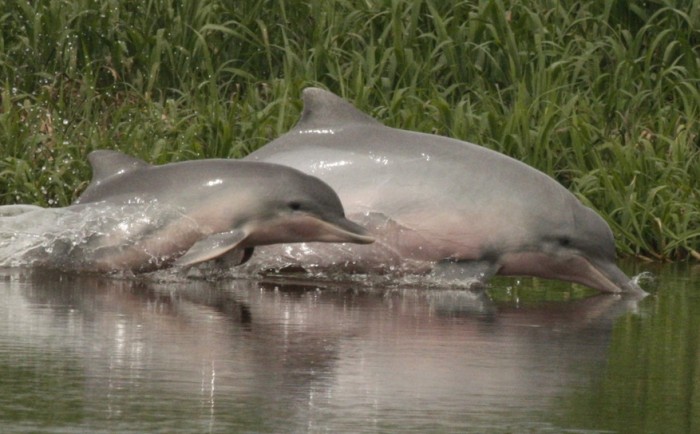
Tucuxi Amazon river dolphins (Sotalia fluviatilis). Image Credit: Projeto Boto
Of all the variables analysed so far by experts, the one that has shown discrepant changes is water temperature, reinforcing that River Dolphins mortality is related to climate change, the effects of El Niño and extreme drought. The water temperature of Lake Tefé reached close to 40°C, says oceanographer Miriam Marmontel, leader of the Amazon Aquatic Mammals research group at IDSM, when the maximum average over time has been 32 degrees, a fact that certainly generated thermal stress in animals.
Members of the environmental consultancy Aqua Viridi also identified in one of the lake’s points an unusual number of alga Euglena sanguinea, which produces a toxin that can cause mortality in fish. The assessment carried out on the river Dolphins, however, did not confirm that the animals have been affected by possible toxins produced by these organisms. Other analyses are underway to help understand the algae’s possible role in the current environmental and health emergency.
Since the beginning of the crisis, 104 River Dolphins have been necropsied and tissue and organ samples have been sent to specialised laboratories. Seventeen individuals have already been assessed and, to date, there is no evidence of an infectious agent as the primary cause of deaths. Molecular diagnostics of 18 individuals also tested negative for infectious agents, such as viruses and bacteria, associated with mass deaths.
In Lake Tefé, there is a stretch called Enseada do Papucu, which has been critical for animals due to the water temperature. Even so, many Dolphins continue to frequent the area due to the abundance of fish, their basic diet. To prevent further deaths, the area is being isolated with a physical barrier called “pari”, which is made of wooden stakes and is based on traditional riverside knowledge. Subsequently, the species will be moved to deeper, less hot areas.
The International Union for Conservation of Nature lists the species as endangered and reports that its numbers are shrinking. The Dolphins are susceptible to numerous threats, ranging from industrial and agricultural pollution to drilling for oil and gas.
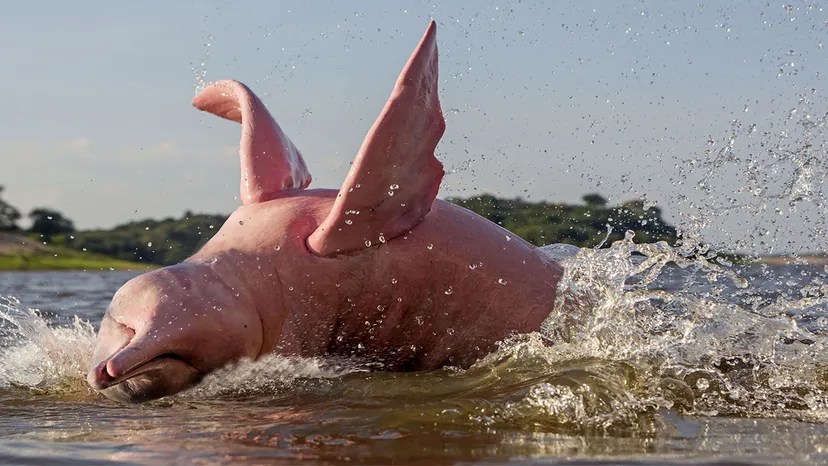
The Amazon River Dolphin (Inia geoffrensis), or boto, acquires its pink hue from repeated abrasion of the skin surface. Males are typically pinker than females because of more frequent trauma due to aggression. Image Credit: Sylvain Cordier
Pink River Dolphins are a source of tourism income for some local communities, which call them “boto” or “bufeo,” per the New York Times. They are part of Amazonian legends and stories, including one in which the Dolphins turn into handsome men to seduce young women. The animals’ well-being is thought to be an indicator of the health of the river ecosystem.
“The past month in Tefé has seemed like a science-fiction climate change scenario,” says Daniel Tregidgo, a British researcher who lives in the region, to the Guardian’s Jonathan Watts. “To know that one [Dolphin] has died is sad, but to see piles of carcasses, knowing that this drought has killed over 100, is a tragedy.”
WHAT YOU CAN DO TO HELP ANIMALS IN NEED
You can support our work by donating as little as £5 – It only takes a minute but it can last a lifetime for an animal in need.
Everyone who donates will receive a Certificate of Appreciation as a thank you for helping animals in need.
The Mission of Protect All Wildlife is to prevent cruelty and promote the welfare of ALL animals.
We believe EVERY animal should be treated with respect, empathy, and understanding. We raise awareness to protect and conserve wild, captive, companion and farm animals.
It is vital that we protect animals against acts of cruelty, abuse, and neglect by enforcing established animal welfare laws and, when necessary, take action to ensure that those who abuse animals are brought to justice.
Protect All Wildlife are involved in many projects to protect animals’ rights, welfare, and habitats. Money contributed to Protect All Wildlife supports ALL of our worthy programmes and gives us the flexibility to respond to emerging needs. Your donations make our work possible.
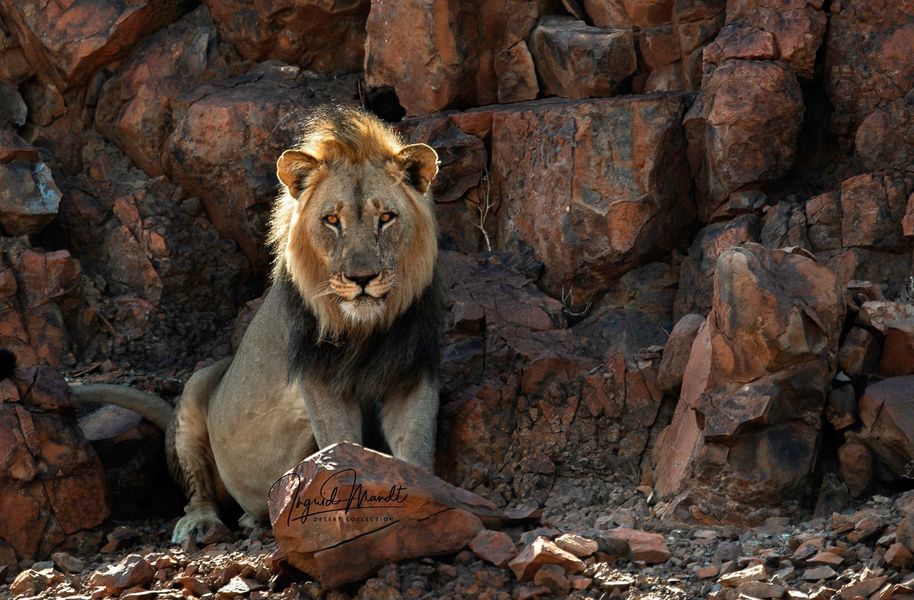
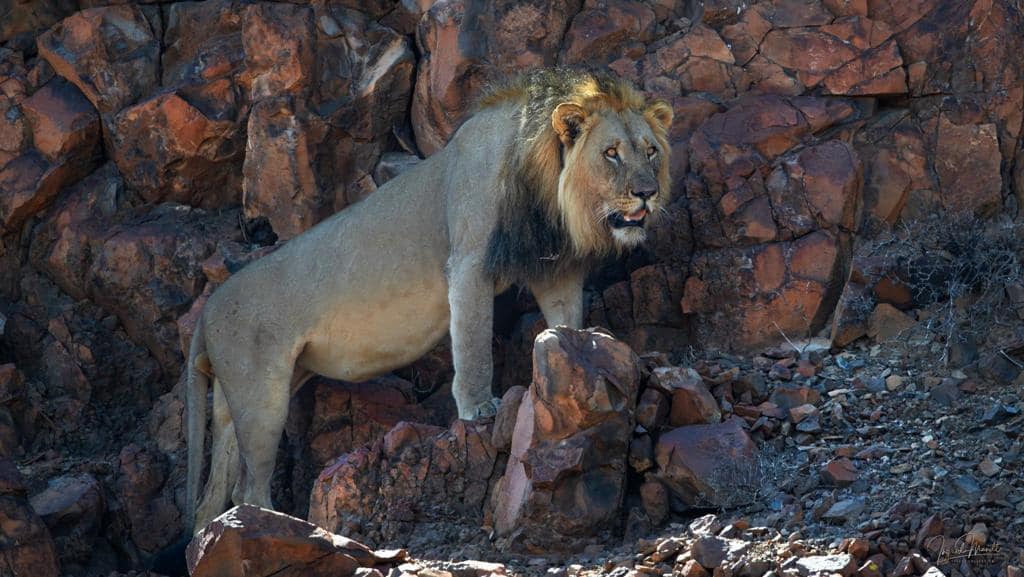
Black Maned Desert Lion Mwezi (XPL 107) Image Credit: Ingrid Mandt
According to the Desert Lion conservation organization DELHRA (Desert Lions Human Relations Aid), it can be assumed that one of the last black-maned male desert lions, “Mwezi” or “XPL 107”, was ‘harvested’ as a trophy on Wednesday, October 11.
In a letter to the Ministry of Environment, Forestry and Tourism (MEFT), DELHRA writes: “Having learned from reliable sources and informants that the male Lion, known as ‘Mwezi’, was allegedly shot, we would like to contact the ministry to know the circumstances and justification for such an alleged killing.”
According to the report, the tracking system of the satellite collar (which is supposed to protect her) was abused to locate the Lion in a protected area. “That is, in the Palmwag concession or, more likely, in the adjacent Skeleton Coast Park, by trophy hunters who were allegedly accompanied by MEFT officials.”
The Desert Lion Conservation Organization further states: “On October 12, we received a report from our informant in Khowarib that the Lion Rangers had received a warning SMS (this happens when a collared lion breaks through a geo-fence) indicating a Lion near the Wild Veld Safaris hunting camp in Khowarib village.” The investigation revealed that it was a dead Lion that had allegedly been kept in the hunting camp since the early evening of October 11.
Black Maned Desert Lion Mwezi (XPL 107) Image Credit: Desert Lion Conservation
According to Desert Lion Conservation, “Mwezi” was still observed and photographed on Sept. 27 when he mated with a lone Lioness, XPL 108, the last survivor of the Obab pride, and followed her into the Skeleton Coast Park, the tracks suggested.
According to DELAHRA, the investigation revealed that two vehicles – one from the MEFT and the other allegedly a hunting vehicle – had entered the Palmwag concession area, with the crew citing “police action” as the reason for the entry. “This coincided with the report coming out of Khowarib later that day, and we learned from a source that the dead lion in the Khowarib hunting camp was the beautiful black-maned desert Lion Mwezi, which had been sought as a trophy for some time.”
DELHRA is of the opinion that a criminal investigation that compels the release of the information will clear up this case and that the parties involved, if warranted, should be prosecuted, as a permit to hunt in the Palmwag concession or in the Skeleton Coast Park cannot have been lawfully granted, and that if it is granted for a hunt in a concession area, but is hunted in the Palmwag or Skeleton Coast Protected Areas, such a permit would be considered null and void.
Black Maned Desert Lion Mwezi (XPL 107) Image Credit: Ingrid Mandt
The letter to MEFT further states: “Based on our information, we would welcome answers to our questions or even a joint and transparent investigation. We ask you to inform us of the following: Has the MEFT issued a trophy permit for hunting XPL 107? If so, could the MEFT please justify this? We ask for a copy of the hunting permit and a copy of the report of the MEFT officer who accompanied the hunting party. We also ask for a copy of the protocol of the website concerning the downloads of the positions of this Lion between September 1 and now by all users. Finally, we are asking for copies of reports of incidents in which XPL 107 may have been involved.”
It goes on to say: “We intend to file a complaint and contact the Information Access Officer and the Ombudsman, as the destruction of natural resources falls within the remit of these bodies in the event that the MEFT does not respond. In such a case, those who have access to the relevant information may be summoned as witnesses.”
The Ministry of the Environment had not responded to questions at the time of going to press.
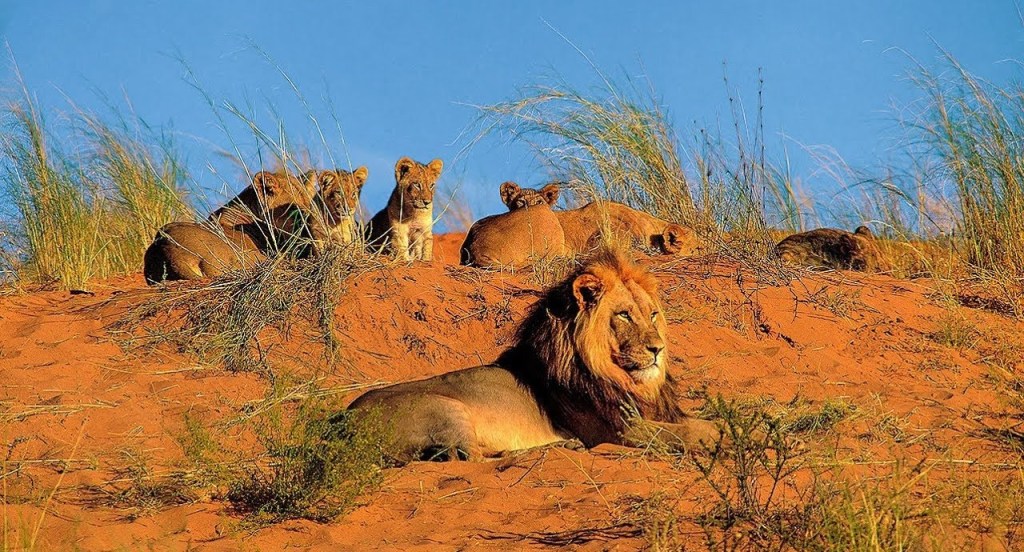
The Desert Lions Of Namibia Image Credit: Wilderness Travel
WHAT YOU CAN DO TO HELP ANIMALS IN NEED
You can support our work by donating as little as £5 – It only takes a minute but it can last a lifetime for an animal in need.
Everyone who donates will receive a Certificate of Appreciation as a thank you for helping animals in need.
The Mission of Protect All Wildlife is to prevent cruelty and promote the welfare of ALL animals.
We believe EVERY animal should be treated with respect, empathy, and understanding. We raise awareness to protect and conserve wild, captive, companion and farm animals.
It is vital that we protect animals against acts of cruelty, abuse, and neglect by enforcing established animal welfare laws and, when necessary, take action to ensure that those who abuse animals are brought to justice.
Protect All Wildlife are involved in many projects to protect animals’ rights, welfare, and habitats. Money contributed to Protect All Wildlife supports ALL of our worthy programmes and gives us the flexibility to respond to emerging needs. Your donations make our work possible.
This rescue dog story will completely change your perspective on animal adoption. Please take the time to read ALL of this poignant story.
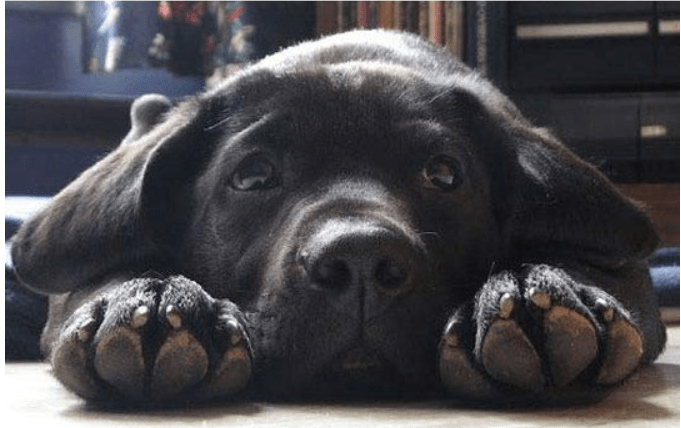
They told me the big black Lab’s name was Reggie as I looked at him lying in his pen. The shelter was clean, no-kill, and the people really friendly. I’d only been in the area for six months, but everywhere I went in the small college town, people were welcoming and open. Everyone waves when you pass them on the street.
But something was still missing as I attempted to settle into my new life here, and I thought a dog couldn’t hurt. Give me someone to talk to. And I had just seen Reggie’s advertisement on the local news. The shelter said they had received numerous calls right after, but they said the people who had come down to see him just didn’t look like “Lab people,” whatever that meant. They must’ve thought I did.
But at first, I thought the shelter had misjudged me in giving me Reggie and his things, which consisted of a dog pad, bag of toys almost all of which were brand new tennis balls, his dishes, and a sealed letter from his previous owner. See, Reggie and I didn’t really hit it off when we got home. We struggled for two weeks (which is how long the shelter told me to give him to adjust to his new home). Maybe it was the fact that I was trying to adjust, too. Maybe we were too much alike.
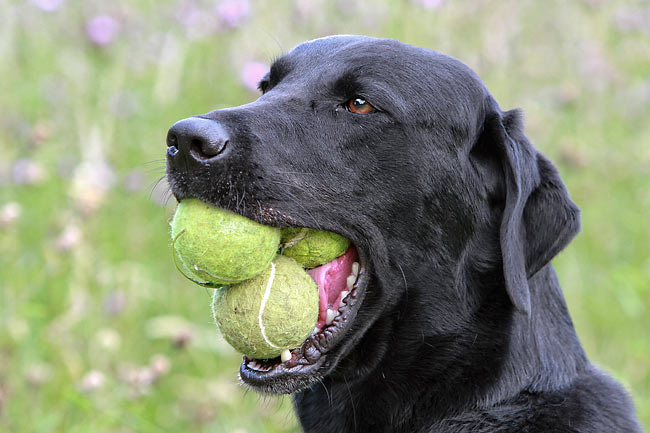
For some reason, his stuff (except for the tennis balls — he wouldn’t go anywhere without two stuffed in his mouth) got tossed in with all of my other unpacked boxes. I guess I didn’t really think he’d need all his old stuff, that I’d get him new things once he settled in. but it became pretty clear pretty soon that he wasn’t going to.
I tried the normal commands the shelter told me he knew, ones like “sit” and “stay” and “come” and “heel,” and he’d follow them — when he felt like it. He never really seemed to listen when I called his name — sure, he’d look in my direction after the fourth or fifth time I said it, but then he’d just go back to doing whatever. When I’d ask again, you could almost see him sigh and then grudgingly obey.
This just wasn’t going to work. He chewed a couple shoes and some unpacked boxes. I was a little too stern with him and he resented it, I could tell. The friction got so bad that I couldn’t wait for the two weeks to be up, and when it was, I was in full-on search mode for my cell phone amid all of my unpacked stuff. I remembered leaving it on the stack of boxes for the guest room, but I also mumbled, rather cynically, that the “darn dog probably hid it on me.”
Finally I found it, but before I could punch up the shelter’s number, I also found his pad and other toys from the shelter. I tossed the pad in Reggie’s direction and he snuffed it and wagged, some of the most enthusiasm I’d seen since bringing him home. But then I called, “Hey, Reggie, you like that? Come here and I’ll give you a treat.” Instead, he sort of glanced in my direction — maybe “glared” is more accurate — and then gave a discontented sigh and flopped down. With his back to me.
Well, that’s not going to do it either, I thought. And I punched the shelter phone number.
But I hung up when I saw the sealed envelope. I had completely forgotten about that, too. “Okay, Reggie,” I said out loud, “let’s see if your previous owner has any advice.”
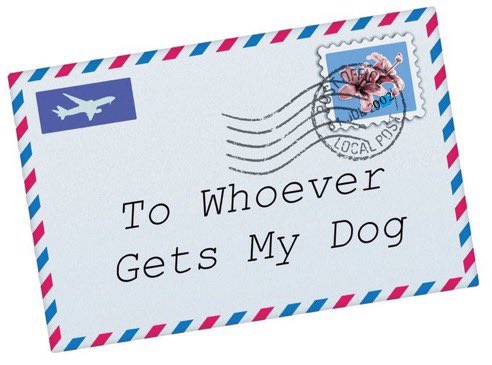
To Whoever Gets My Dog
Well, I can’t say that I’m happy you’re reading this, a letter I told the shelter could only be opened by Reggie’s new owner. I’m not even happy writing it. If you’re reading this, it means I just got back from my last car ride with my Lab after dropping him off at the shelter. He knew something was different. I have packed up his pad and toys before and set them by the back door before a trip, but this time … it’s like he knew something was wrong. And something is wrong … which is why I have to go to try to make it right.
So let me tell you about my Lab in the hopes that it will help you bond with him and he with you.
First, he loves tennis balls. the more the merrier. Sometimes I think he’s part squirrel, the way he hoards them. He usually always has two in his mouth, and he tries to get a third in there. Hasn’t done it yet. Doesn’t matter where you throw them, he’ll bound after it, so be careful — really don’t do it by any roads. I made that mistake once, and it almost cost him dearly.
Next, commands. Maybe the shelter staff already told you, but I’ll go over them again: Reggie knows the obvious ones — “sit,” “stay,” “come,” “heel.” He knows hand signals: “back” to turn around and go back when you put your hand straight up; and “over” if you put your hand out right or left. “Shake” for shaking water off, and “paw” for a high-five. He does “down” when he feels like lying down — I bet you could work on that with him some more. He knows “ball” and “food” and “bone” and “treat” like nobody’s business. I trained Reggie with small food treats. Nothing opens his ears like little pieces of hot dog.
Feeding schedule: twice a day, once about seven in the morning, and again at six in the evening. Regular store-bought stuff; the shelter has the brand.
He’s up on his shots. Call the clinic on 9th Street and update his info with yours; they’ll make sure to send you reminders for when he’s due. Be forewarned: Reggie hates the vet. Good luck getting him in the car — I don’t know how he knows when it’s time to go to the vet, but he knows.
Finally, give him some time. I’ve never been married, so it’s only been Reggie and me for his whole life. He’s gone everywhere with me, so please include him on your daily car rides if you can. He sits well in the backseat, and he doesn’t bark or complain. He just loves to be around people, and me most especially. Which means that this transition is going to be hard, with him going to live with someone new.
And that’s why I need to share one more bit of info with you …
His name’s not Reggie.
I don’t know what made me do it, but when I dropped him off at the shelter, I told them his name was Reggie. He’s a smart dog, he’ll get used to it and will respond to it, of that I have no doubt. but I just couldn’t bear to give them his real name. For me to do that, it seemed so final, that handing him over to the shelter was as good as me admitting that I’d never see him again. And if I end up coming back, getting him, and tearing up this letter, it means everything’s fine. But if someone else is reading it, well… well it means that his new owner should know his real name. It’ll help you bond with him. Who knows, maybe you’ll even notice a change in his demeanour if he’s been giving you problems.
His real name is Tank. Because that is what I drive.
Again, if you’re reading this and you’re from the area, maybe my name has been on the news. I told the shelter that they couldn’t make “Reggie” available for adoption until they received word from my company commander. See, my parents are gone, I have no siblings, no one I could’ve left Tank with … and it was my only real request of the Army upon my deployment to Iraq, that they make one phone call to the shelter … in the “event”… to tell them that Tank could be put up for adoption. Luckily, my colonel is a dog guy, too, and he knew where my platoon was headed. He said he’d do it personally. And if you’re reading this, then he made good on his word.
Well, this letter is getting to downright depressing, even though, frankly, I’m just writing it for my dog. I couldn’t imagine if I was writing it for a wife and kids and family. but still, Tank has been my family for the last six years, almost as long as the Army has been my family.
And now I hope and pray that you make him part of your family and that he will adjust and come to love you the same way he loved me.
That unconditional love from a dog is what I took with me to Iraq as an inspiration to do something selfless, to protect innocent people from those who would do terrible things … and to keep those terrible people from coming over here. If I had to give up Tank in order to do it, I am glad to have done so. He was my example of service and of love. I hope I honoured him by my service to my country and comrades.
All right, that’s enough. I deploy this evening and have to drop this letter off at the shelter. I don’t think I’ll say another good-bye to Tank, though. I cried too much the first time. Maybe I’ll peek in on him and see if he finally got that third tennis ball in his mouth.
Good luck with Tank. Give him a good home and give him an extra kiss goodnight — every night — from me.
Thank you, Paul Mallory.
I folded the letter and slipped it back in the envelope. Sure, I had heard of Paul Mallory, everyone in town knew him, even new people like me. Local kid, killed in Iraq a few months ago and posthumously earning the Silver Star when he gave his life to save three buddies. Flags had been at half-mast all summer.
I leaned forward in my chair and rested my elbows on my knees, staring at the dog.
“Hey, Tank,” I said quietly. The dog’s head whipped up, his ears cocked and his eyes bright.
C’mere boy.” He was instantly on his feet, his nails clicking on the hardwood floor. He sat in front of me, his head tilted, searching for the name he hadn’t heard in months.
“Tank,” I whispered. His tail swished.
I kept whispering his name, over and over, and each time, his ears lowered, his eyes softened, and his posture relaxed as a wave of contentment just seemed to flood him. I stroked his ears, rubbed his shoulders, buried my face into his scruff and hugged him.
“It’s me now, Tank, just you and me. Your old pal gave you to me.” Tank reached up and licked my cheek. “So whatdaya say we play some ball? His ears perked again. “Yeah? Ball? You like that? Ball?” Tank tore from my hands and disappeared in the next room.
And when he came back, he had three tennis balls in his mouth.
WHAT YOU CAN DO TO HELP ANIMALS IN NEED
You can support our work by donating as little as £5 – It only takes a minute but it can last a lifetime for an animal in need.
Everyone who donates will receive a Certificate of Appreciation as a thank you for helping animals in need.
The Mission of Protect All Wildlife is to prevent cruelty and promote the welfare of ALL animals.
We believe EVERY animal should be treated with respect, empathy, and understanding. We raise awareness to protect and conserve wild, captive, companion and farm animals.
It is vital that we protect animals against acts of cruelty, abuse, and neglect by enforcing established animal welfare laws and, when necessary, take action to ensure that those who abuse animals are brought to justice.
Protect All Wildlife are involved in many projects to protect animals’ rights, welfare, and habitats. Money contributed to Protect All Wildlife supports ALL of our worthy programmes and gives us the flexibility to respond to emerging needs. Your donations make our work possible.
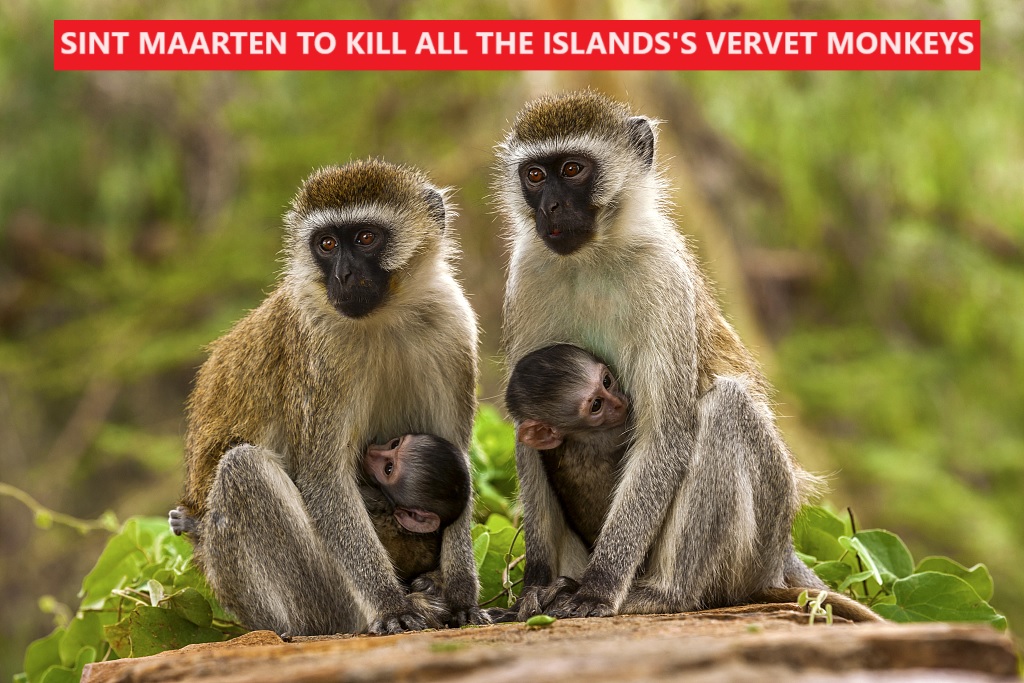
SINT MAARTEN PLAN TO CULL ALL THE ISLAND’S VERVET MONKEYS
Seventy-five animal welfare organisations and experts have called on the government of Sint Maarten in the Caribbean to immediately stop its attempt to cull the territory’s entire population of Vervet monkeys.
The international protest comes after the Guardian revealed in January that the Dutch territory is funding a non-profit organisation to eradicate the “nuisance” species over the next three years.
The animal advocacy non-profit Born Free USA, which coordinated the protest, says experts are ready and willing to support the government with a more humane sterilisation programme. But they say they have not received a reply to their offer.
However, the Nature Foundation Sint Maarten, which is carrying out the cull, has said that while the project is “painful and controversial”, it remains a necessity.
“Given the current significant but manageable size of the vervet monkey population, there is a window of opportunity to ensure that the issue does not worsen in coming decades,” it said in a statement.
Vervet monkeys were introduced to the region from Africa sometime around the 17th century and the first sightings on Sint Maarten date back to the early 1970s.
Research carried out by the Nature Foundation St Maarten found in 2020 that about 450 were living on the Dutch side of the island. By 2022, that number had increased to about 2,000.
“Given the current significant but manageable size of the vervet monkey population, there is a window of opportunity to ensure that the issue does not worsen in coming decades,” it said.
The monkeys have been blamed for eating crops, destroying gardens, entering schools and acting aggressively.
Last December, the territory’s ministry of tourism, economic affairs, transportation and telecommunication approved 100,000 Netherlands Antillean guilders (US$55,000) funding to control the species.
The foundation said this was enough to pay for a single full-time ranger to carry out the cull along with equipment, but not for a sterilisation programme.
Born Free USA says the information on which the cull is based is “fundamentally flawed”.
The group offered its “expertise, including voluntary veterinary services” for alternative humane species management, and said it will also provide training to neighbouring territories.
“In this way, Sint Maarten could lead the way on humane primate population management in the Caribbean region,” the group wrote in a letter to the Sint Maarten government.
“We would be grateful if you would consider postponing plans to cull the animals and working with us to explore truly humane alternatives.”
In its statement, Nature Foundation Sint Maarten said local law prevents anyone from releasing non-native species – so setting monkeys free after sterilisation would be a violation of the law.
It added: “In the face of substantial monkey overpopulation, neighbouring islands have turned to more desperate means of population control.”
The foundation said that among those are consumption, poisoning, hunting and shipping monkeys away for biomedical research.
“These are all invasive species management strategies that St Maarten would like to avoid by preventing the situation here from reaching that point at all,” it concluded.
The cull is projected to end in 2026, at which point the foundation says it plans to thoroughly assess its impact and review alternative, long-term management options within local law.
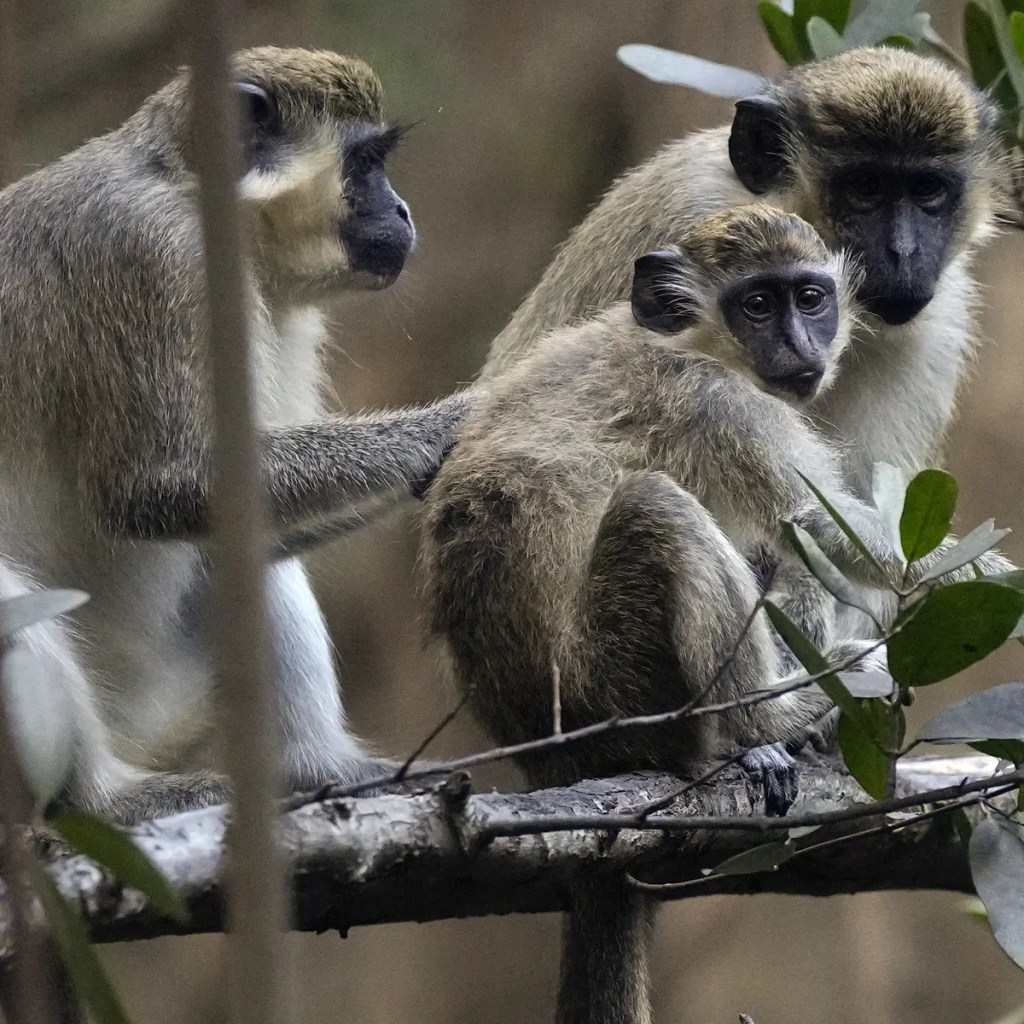
Some of the island’s Vervet Monkeys
Born Free USA has also launched a public petition asking for non-lethal measures to control the invasive primate population which you can sign here: STOP THE MONKEY CULL!
WHAT YOU CAN DO TO HELP ANIMALS IN NEED
You can support our work by donating as little as £5 – It only takes a minute but it can last a lifetime for an animal in need.
Everyone who donates will receive a Certificate of Appreciation as a thank you for helping animals in need.
The Mission of Protect All Wildlife is to prevent cruelty and promote the welfare of ALL animals.
We believe EVERY animal should be treated with respect, empathy, and understanding. We raise awareness to protect and conserve wild, captive, companion and farm animals.
It is vital that we protect animals against acts of cruelty, abuse, and neglect by enforcing established animal welfare laws and, when necessary, take action to ensure that those who abuse animals are brought to justice.
Protect All Wildlife are involved in many projects to protect animals’ rights, welfare, and habitats. Money contributed to Protect All Wildlife supports ALL of our worthy programmes and gives us the flexibility to respond to emerging needs. Your donations make our work possible.
Hachikō, The Japanese Dog Who Waited For His Owner At The Railway Station For Ten Years
Hachikō is a national hero to the Japanese! A dog so famous there have been several movies made about him.
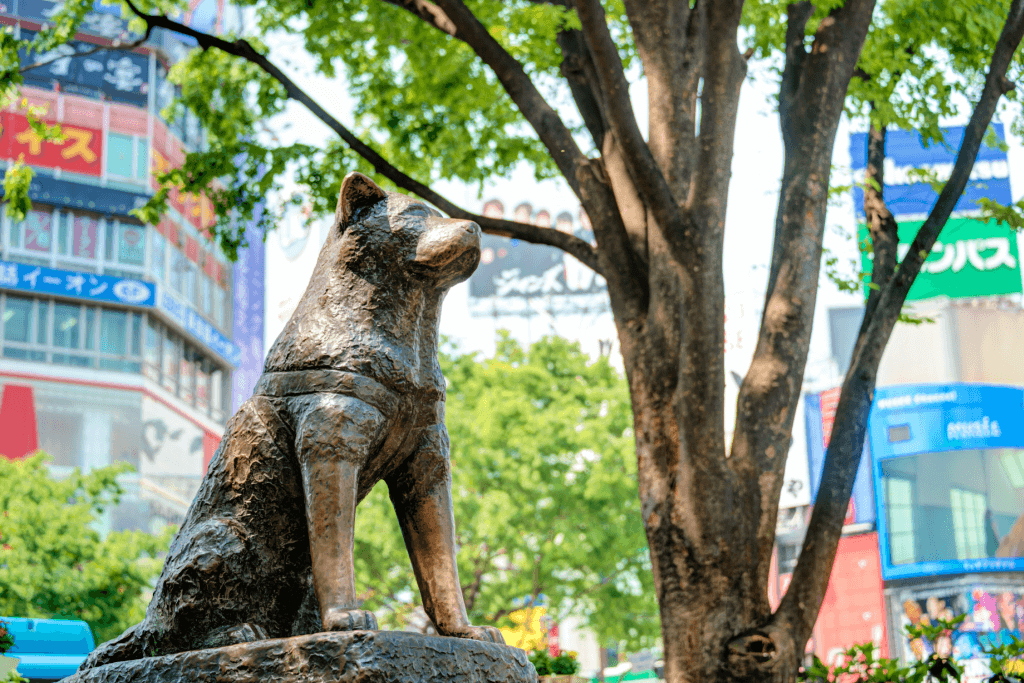
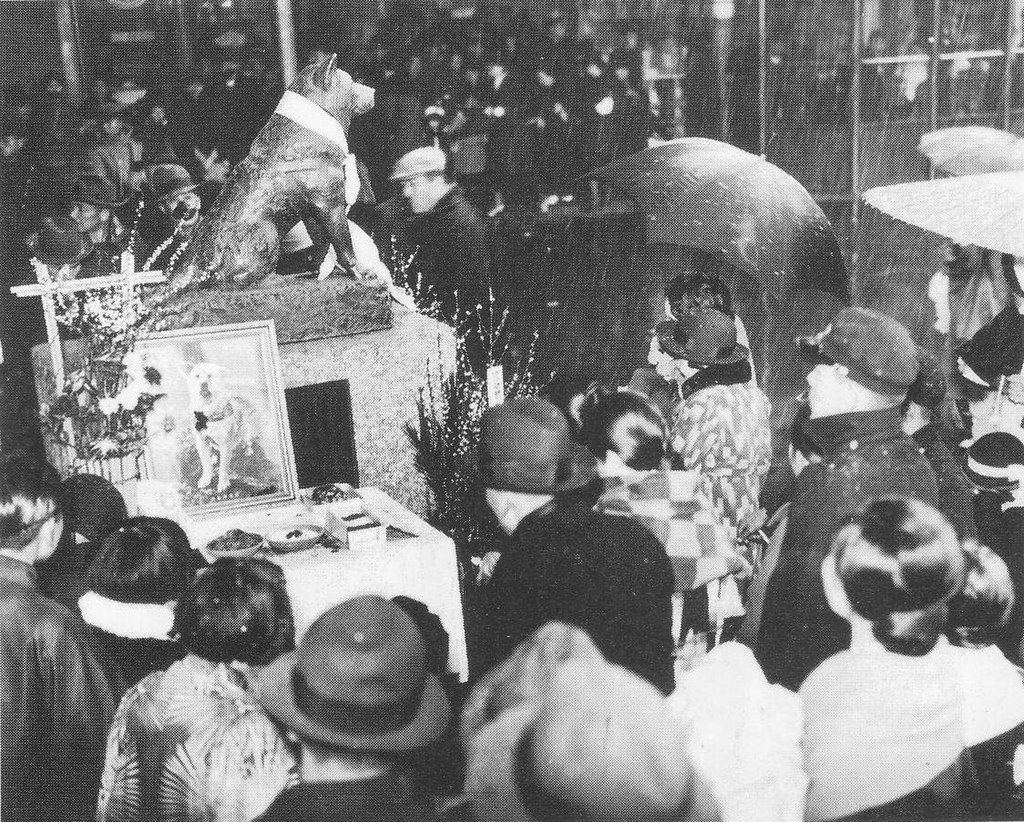
He has his own bronze statue next to Shibuya Train Station in Tokyo, where every day hundreds of people have their photograph taken with him.
The bronze statue of Hachikō next to Shibuya Train Station in Tokyo
Even Hollywood has made a movie about Hachiko! There is a statue of him at Rhode Island in the USA where the American version of the film was made.
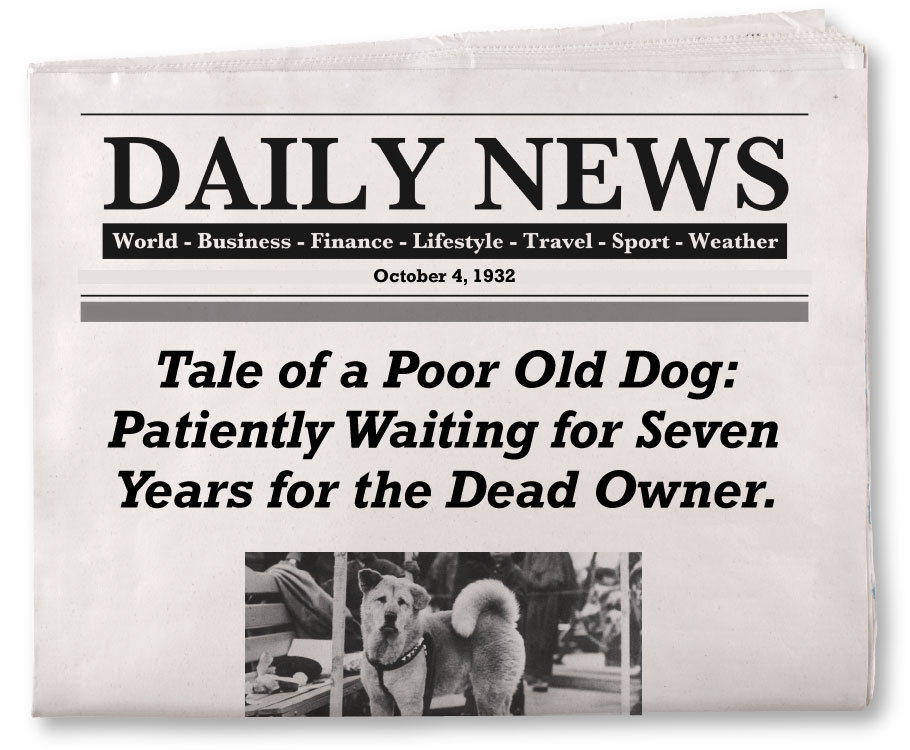
The story of Hachikō made the news worldwide
So why is the Hachiko story so famous? Here is the amazing, real and very sad story about Hachiko the dog. ♥
Once Upon A Time, There Was A Dog Named Hachiko
Eizaburo Ueno, a professor in agriculture science at Tokyo University in Japan, had long wanted a purebred Japanese Akita dog. He had looked for the perfect Akita puppy for a long time, until one of his students encouraged him to adopt Hachiko, from the Odate city in the Akita prefecture of Japan.
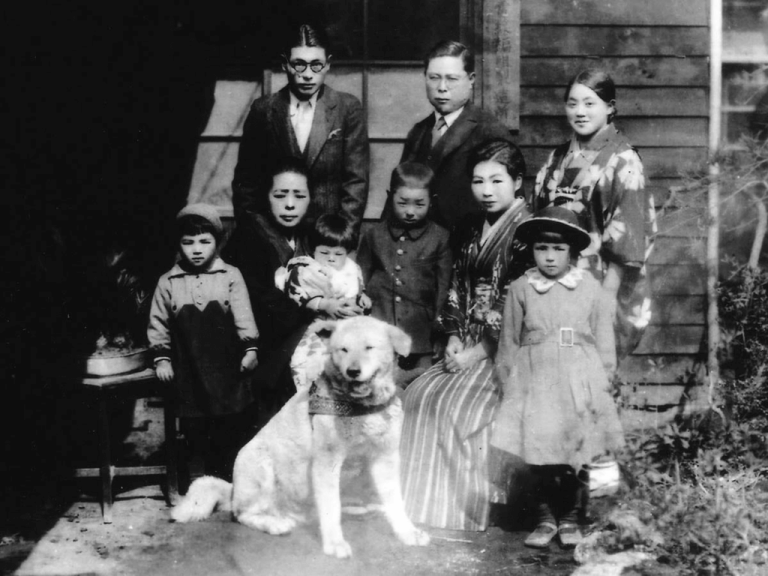
Hachiko, or Hachi which became his nickname, and his new owner soon became best friends. Eizaburo loved his dear dog above all and treated him as his son. The two of them were inseparable.
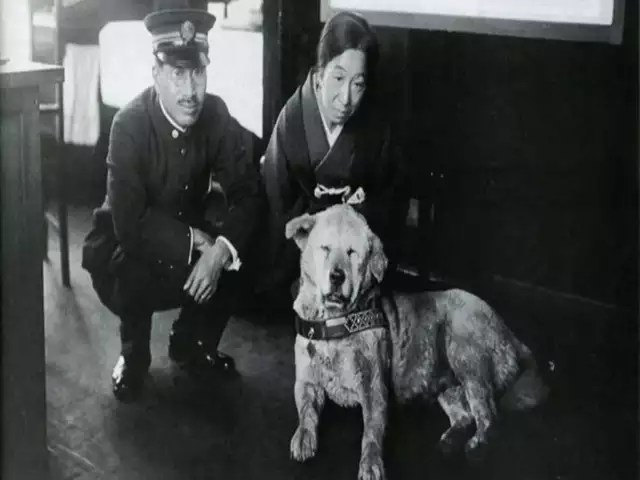
Hachikō with the Ueno family
As Hachiko grew older, he started to see his owner off to work in the morning at the Shibuya Train Station, in central Tokyo and went to pick him up at the station in the afternoon when he returned from work.
On May 21, 1925, only two years after Hachiko was born, Hachiko was as usual sitting by the exit at Shibuya train station waiting for his dear Eizaburo. But his owner never showed up…..It turned out that Eizaburo had suffered from a cerebral haemorrhage and died suddenly and unexpectedly while at work.
Hachiko crawled under the coffin of his master and refused to move. The dog was handed over to another family outside Shibuya.
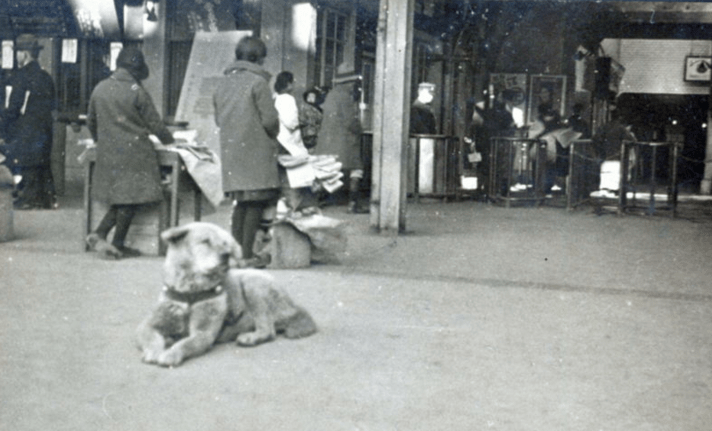
According to Hachiko’s biographer Prof Mayumi Itoh, in the summer of 1925, the loyal dog ended up at Ueno’s gardener Kikusaburo Kobayashi’s place. Hachiko then started going to the Shibuya station daily to wait for his master Ueno. He would look at each passenger to search for his master.He sat there for hours, patiently waiting in vain for the return of his beloved owner who sadly never came back.
Every day, Hachikō would sit at the entrance to Shibuya station to look at each passenger to search for his master.
A major Japanese newspaper reporter picked up the story of Hachiko in 1932 and published it, which led to Hachiko becoming a celebrity all over Japan.
People started calling him “Chuken-Hachiko“, which means “Hachiko – the faithful dog“.
The story of the dog that never gave up gained a lot of attention also in national media, inspiring many people from all over the world to visit Hachiko at Shibuya Train Station to offer him treats. He touched the hearts of the Japanese people and soon became their hero.
Hachikō with the station master and his wife
The station started receiving donations of food for Hachiko, and visitors came to have a glimpse of the cute canine. It led to poems, haikus, and fundraisers to make a statue of him.
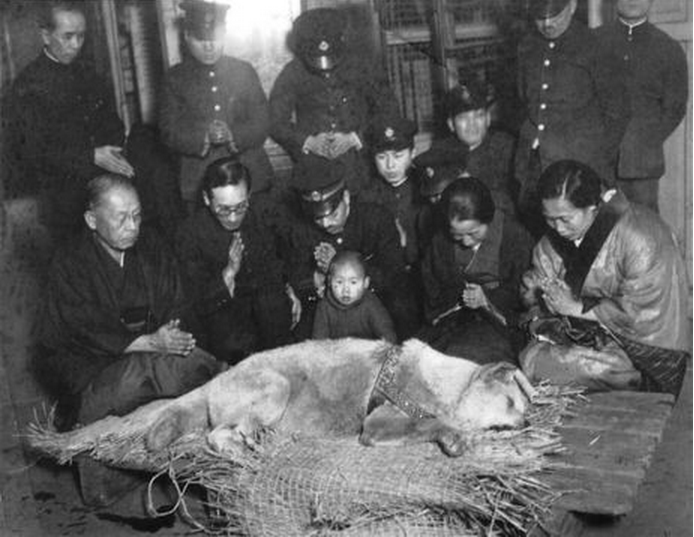
Hachiko died on March 8, 1935, making front page headlines of newspapers. Buddhist monks offered prayers for him and dignitaries read eulogies at his funeral.
Mourning the death of Hachikō
Hachiko Reunites With His Master
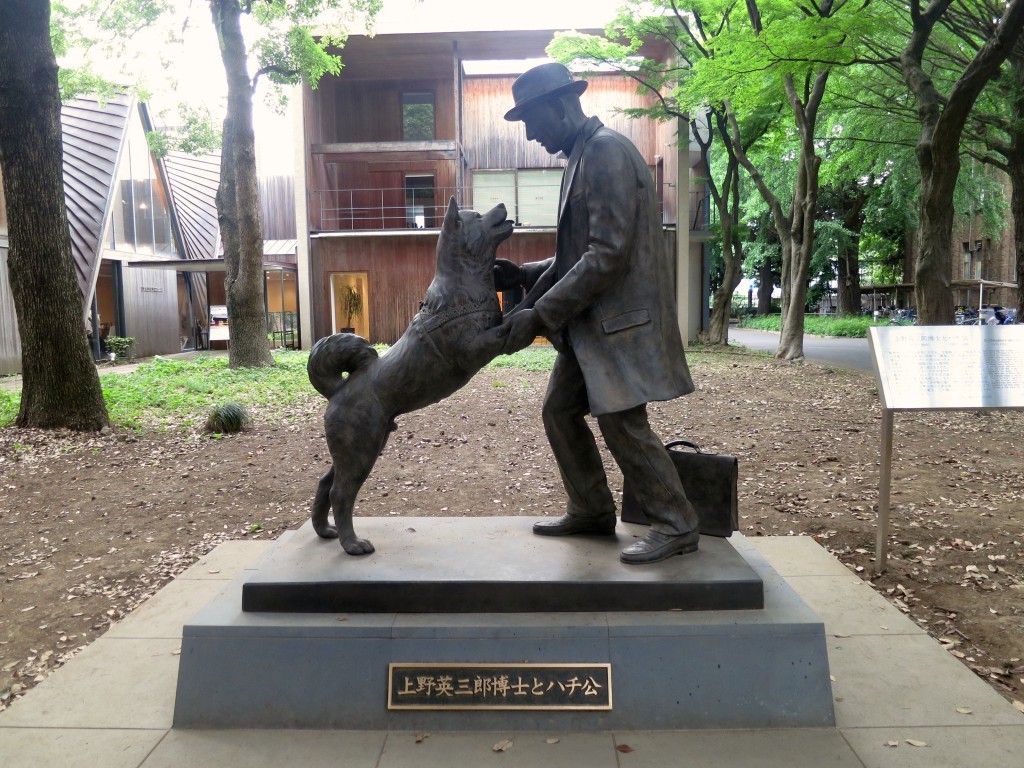
On March 8, 2015, Tokyo University’s Faculty of Agriculture unveiled a statue that portrays Professor Ueno reuniting with Hachiko to commemorate the 80th anniversary of Hachiko’s passing.
The statue’s creation was made possible by collaborating with the Faculty of Agriculture and an online charity. It was sculpted by Tsutomu Ueda, an artist from Nagoya.
The beautiful statue of Hachikō greeting Eizaburo as he arrives at the station
It portrays Hachiko enthusiastically greeting his master, Eizaburo, who is depicted wearing a long trench coat and hat with a briefcase placed on the ground. The sculpture beautifully captures the heart-warming moment of their reunion, with Ueno embracing his loyal dog with open arms.
Every year on April 8, a memorial service for Hachiko is held outside Shibuya station, where his statue still stands.
A memorial service for Hachikō is held outside Shibuya station every year.
WHAT YOU CAN DO TO HELP ANIMALS IN NEED
You can support our work by donating as little as £5 – It only takes a minute but it can last a lifetime for an animal in need.
Everyone who donates will receive a Certificate of Appreciation as a thank you for helping animals in need.
The Mission of Protect All Wildlife is to prevent cruelty and promote the welfare of ALL animals.
We believe EVERY animal should be treated with respect, empathy, and understanding. We raise awareness to protect and conserve wild, captive, companion and farm animals.
It is vital that we protect animals against acts of cruelty, abuse, and neglect by enforcing established animal welfare laws and, when necessary, take action to ensure that those who abuse animals are brought to justice.
Protect All Wildlife are involved in many projects to protect animals’ rights, welfare, and habitats. Money contributed to Protect All Wildlife supports ALL of our worthy programmes and gives us the flexibility to respond to emerging needs. Your donations make our work possible.
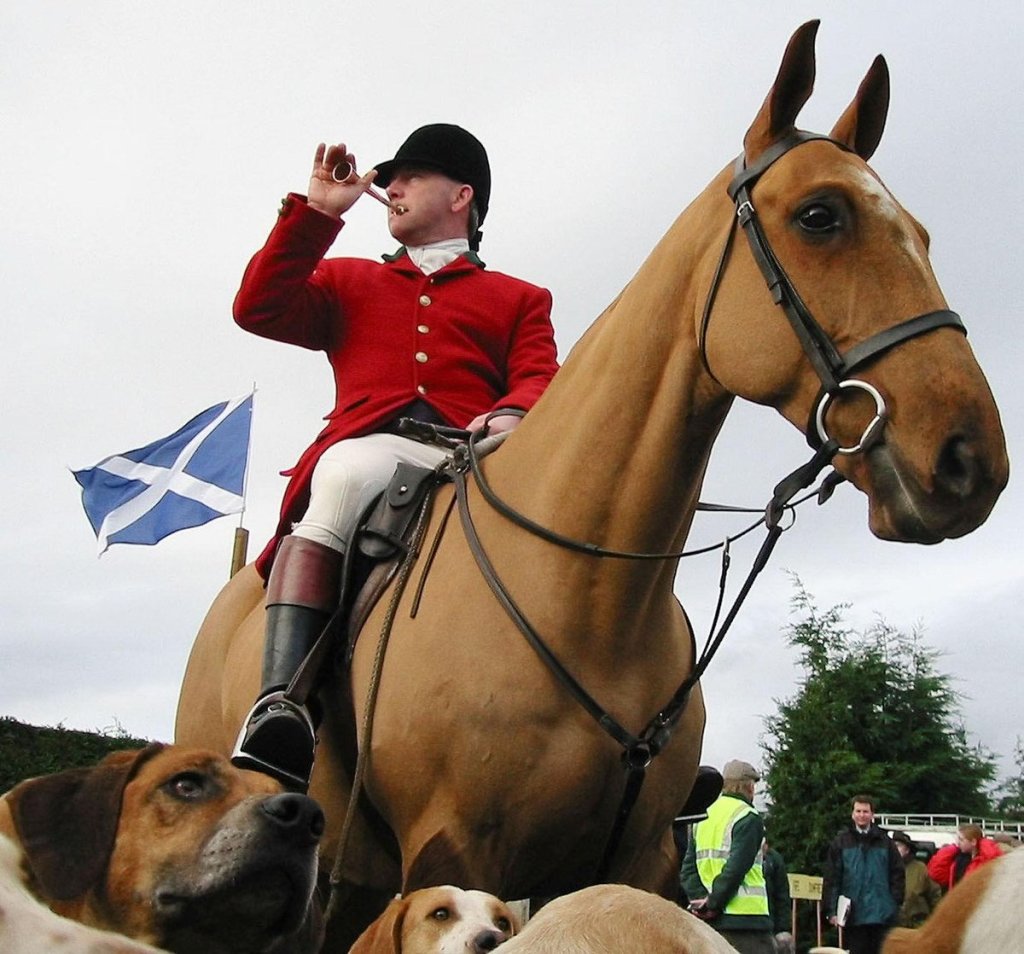
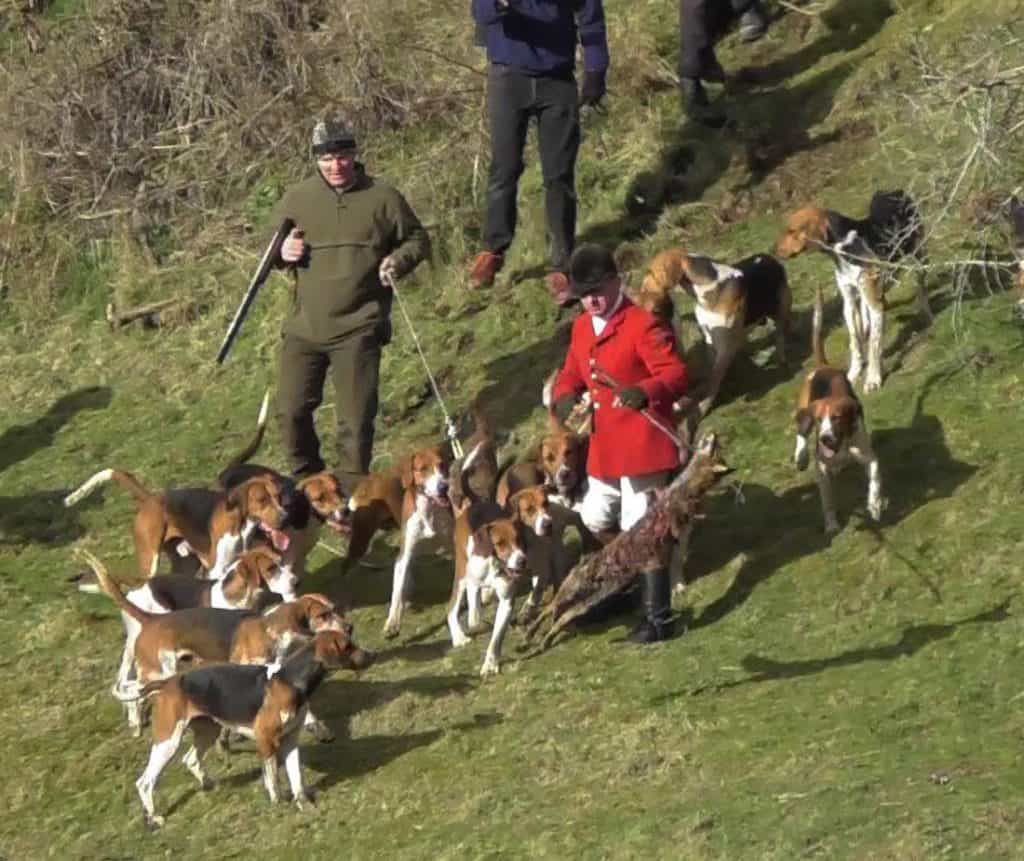
A new law banning the hunting with packs of dogs and “flushing out” wild mammals came into force across Scotland on Tuesday after MSPs passed a Bill back in January.
This will replace the Protection of Wild Mammals Act, which was passed in 2002. The Scottish Government says that legislation had a loophole that allowed illegal hunts to continue.
The original Act allowed hunters to use dogs to flush out foxes from under cover as long as the foxes were then shot, and providing the hunt was to protect livestock or ground-nesting birds, or to prevent the spread of disease.
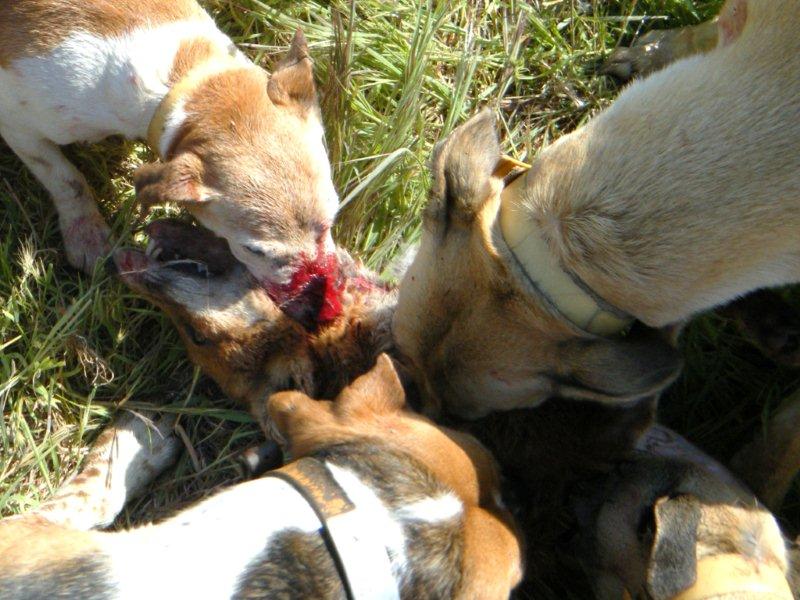
A fox being fed to the hounds at the Fife Hunt, Lindores
The Scottish Greens say this is a historic moment in Scotland’s progress as a nation that respects and values wildlife.
Ariane Burgess MSP, the party’s rural affairs spokeswoman, said: “This is a historic day. We finally have a real hunting ban after decades of campaigning.
“Hunting with dogs is brutal, cruel and outdated. It has no place in a modern or progressive Scotland, and we should all take pride in this new law.
Barbaric: Hounds Ripping A Live Fox Apart
“Loopholes in the original hunting ban were ruthlessly exploited by those who were determined to continue hunting. This law is much more robust, but we will be watching carefully to ensure it is effective and abided by.”
Environment minister Gillian Martin agreed it was a “truly historic milestone” in Scotland.
She said: “This law finally closes the loophole that has allowed the archaic practice of hunting wild animals with packs of dogs to persist in our country for over 20 years. It has taken us almost a decade to get to this point.
“In that time the sheer volume of responses to our consultations have shown us just how concerned people still are about fox hunting in Scotland.
“We have listened and we have delivered. We have succeeded in crafting a law that strikes a balance – one which rightly bans barbaric hunting methods, but which still allows farmers and land managers to undertake legitimate wildlife management.”
WHAT YOU CAN DO TO HELP ANIMALS IN NEED
You can support our work by donating as little as £5 – It only takes a minute but it can last a lifetime for an animal in need.
Everyone who donates will receive a Certificate of Appreciation as a thank you for helping animals in need.
The Mission of Protect All Wildlife is to prevent cruelty and promote the welfare of ALL animals.
We believe EVERY animal should be treated with respect, empathy, and understanding. We raise awareness to protect and conserve wild, captive, companion and farm animals.
It is vital that we protect animals against acts of cruelty, abuse, and neglect by enforcing established animal welfare laws and, when necessary, take action to ensure that those who abuse animals are brought to justice.
Protect All Wildlife are involved in many projects to protect animals’ rights, welfare, and habitats. Money contributed to Protect All Wildlife supports ALL of our worthy programmes and gives us the flexibility to respond to emerging needs. Your donations make our work possible.
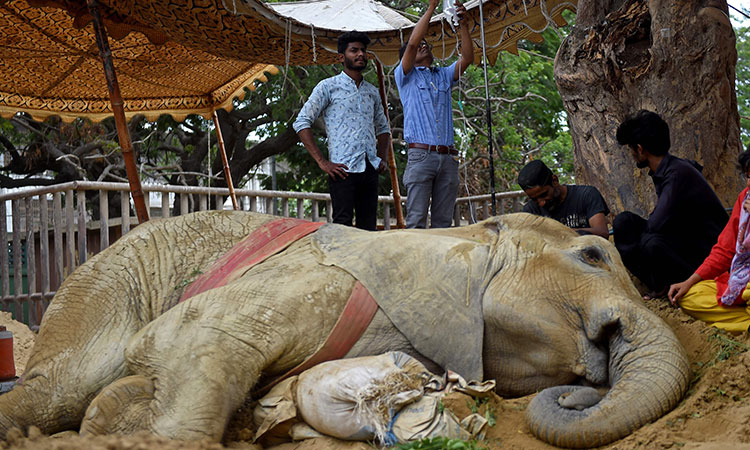
The three remaining African Elephants in Karachi, Pakistan continue to be subjected to poor care and living conditions despite these factors playing a significant role in the premature death of the fourth Karachi Elephant ‘Noor Jehan’ in April 2023.
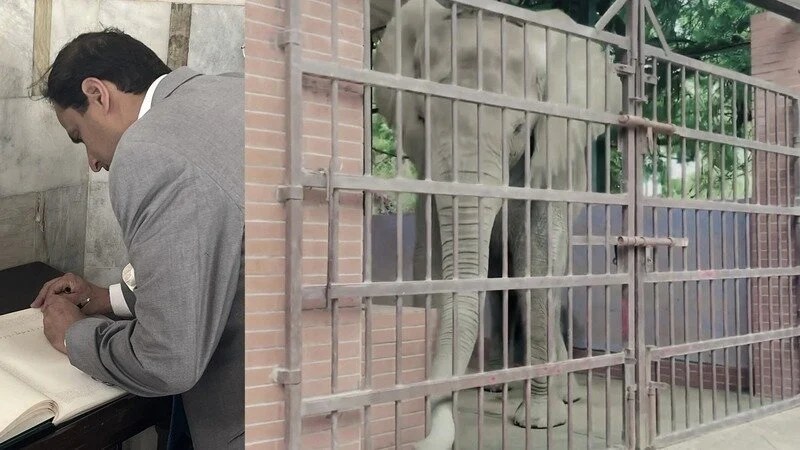
Madhubalaat Karachi Zoo is now alone despite Elephants being herd animals, her solitary status has been documented to be causing her severe angst. In addition, she resides in a small barren environment that fails to meet her species-specific needs. Questions also remain around her diet & general care.
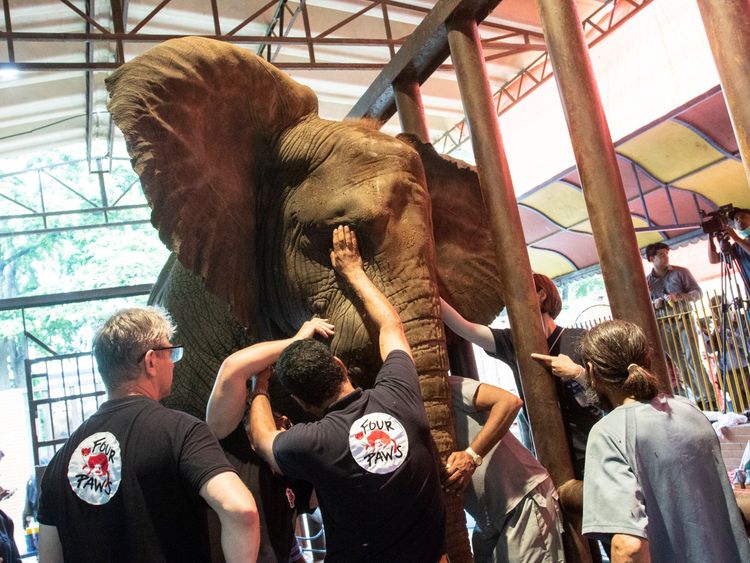
Four Paws Vets perform dental treatment on Madhubala at Karachi Zoo.
Sonia & Malikaat Karachi Safari Park fare slightly better having a green pasture to reside in during the day (in recent months the Elephants have been afforded greater access to the pasture & this must continue) although the cages in which they are incarcerated at night remain abhorrent and entirely unsuitable for Elephants (a third cage of the same type has been constructed in anticipation of Madhubala’s arrival)
Noor Jehan Shortly Before Her Death In April2023
Following the death of Noor Jehan and recognising that the three remaining Karachi Elephants are suffering, Karachi Metropolitan Corporation struck a verbal agreement with animal welfare organisation Four Paws International to upgrade the Elephant enclosure at the Safari Park to create a more species-specific environment as well as training caretakers to afford the Elephants’ better ongoing care. In line with these improvements Four Paws also agreed to complete the move of Madhubala to the Safari Park to be with other Elephants in what would become a more appropriate setting.
In June 2023 Barrister Murtaza Wahab Siddiqui was elected Mayor of Karachi and since then the agreement has stalled with no further progress and no signed MOU (Memorandum of Understanding)
Mayor Murtaza Wahab in dragging his feet to sign the MOU is prolonging the suffering of all three Elephants and particularly Madhubala.
So as not to cause further suffering to the elephants Mayor Murtaza Wahab must sign the MOU without further delay or relinquish all three Elephants to a recognised Elephant sanctuary outside Pakistan
Everyone who donates will receive a Certificate of Appreciation as a thank you for helping animals in need.
The Mission of Protect All Wildlife is to prevent cruelty and promote the welfare of ALL animals.
We believe EVERY animal should be treated with respect, empathy, and understanding. We raise awareness to protect and conserve wild, captive, companion and farm animals.
It is vital that we protect animals against acts of cruelty, abuse, and neglect by enforcing established animal welfare laws and, when necessary, take action to ensure that those who abuse animals are brought to justice.
Protect All Wildlife are involved in many projects to protect animals’ rights, welfare, and habitats. Money contributed to Protect All Wildlife supports ALL of our worthy programmes and gives us the flexibility to respond to emerging needs. Your donations make our work possible.
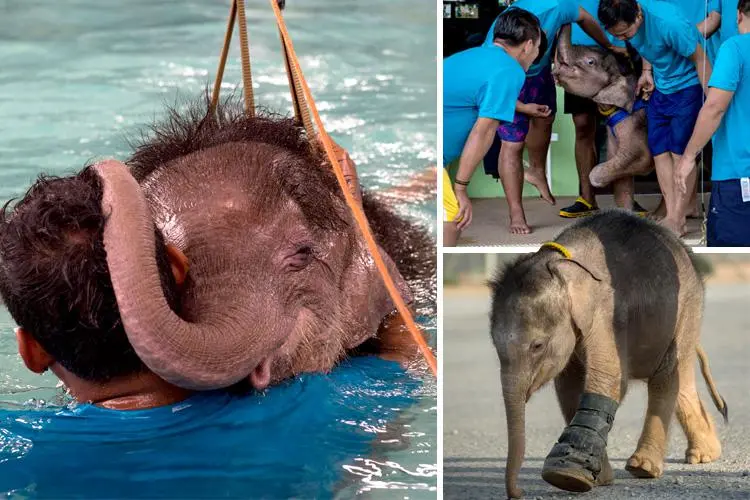
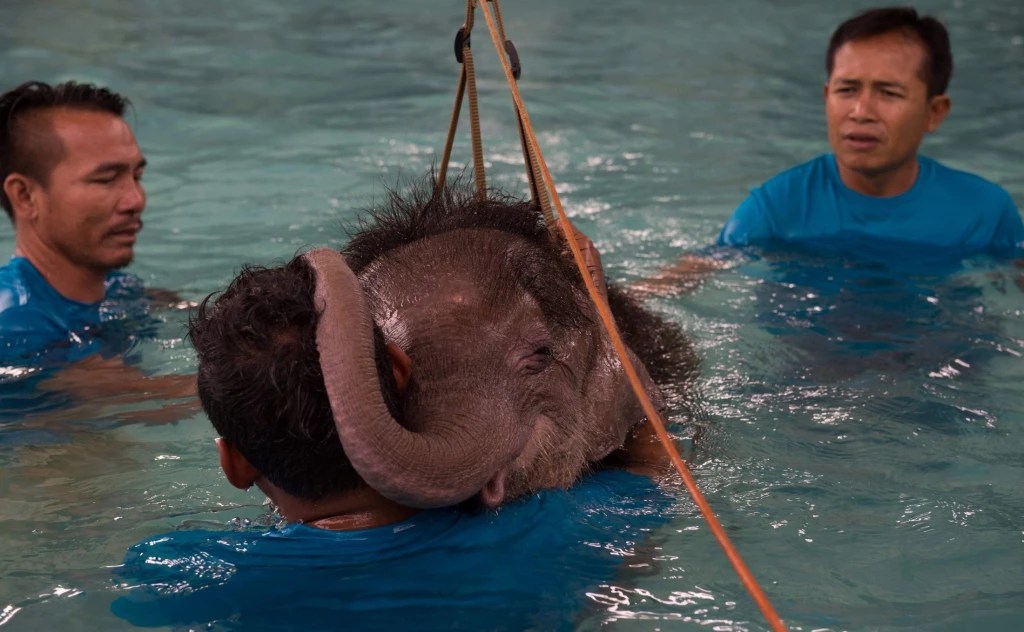
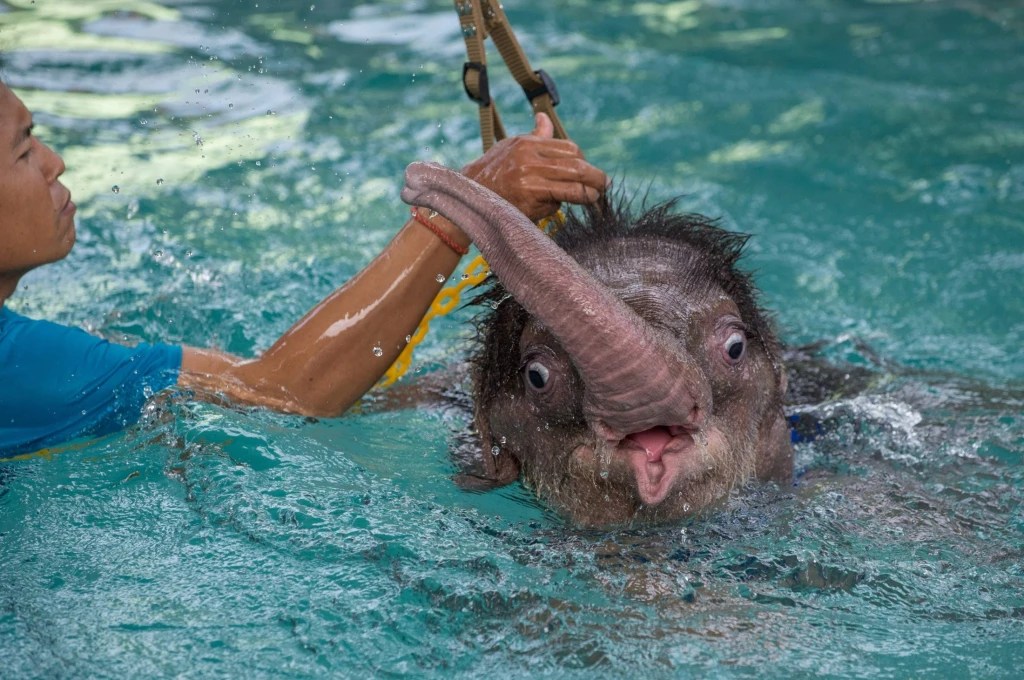
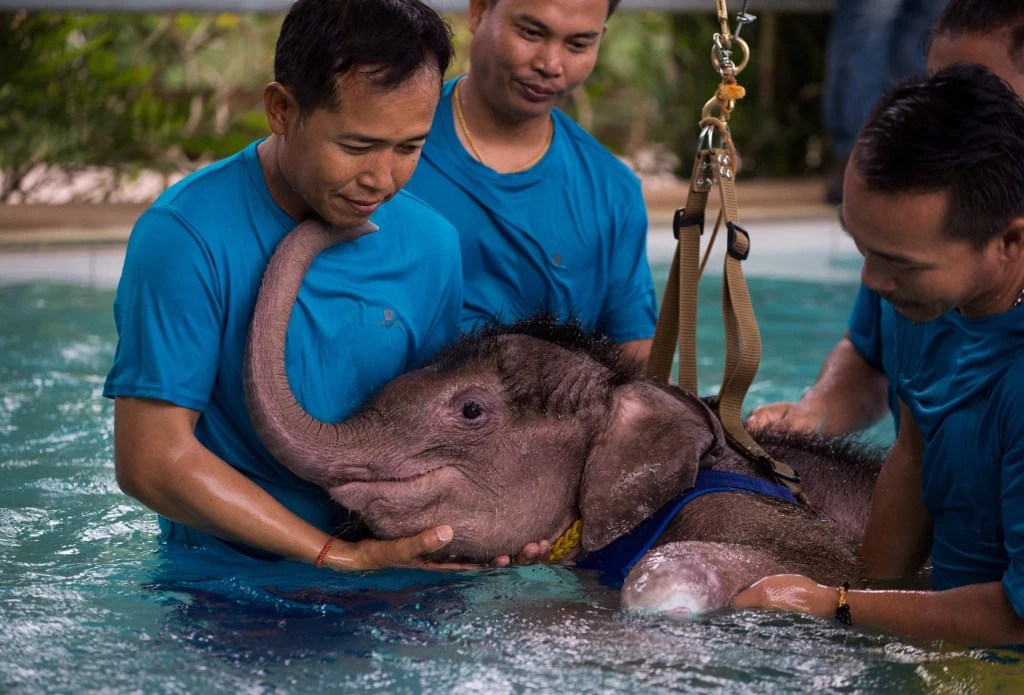
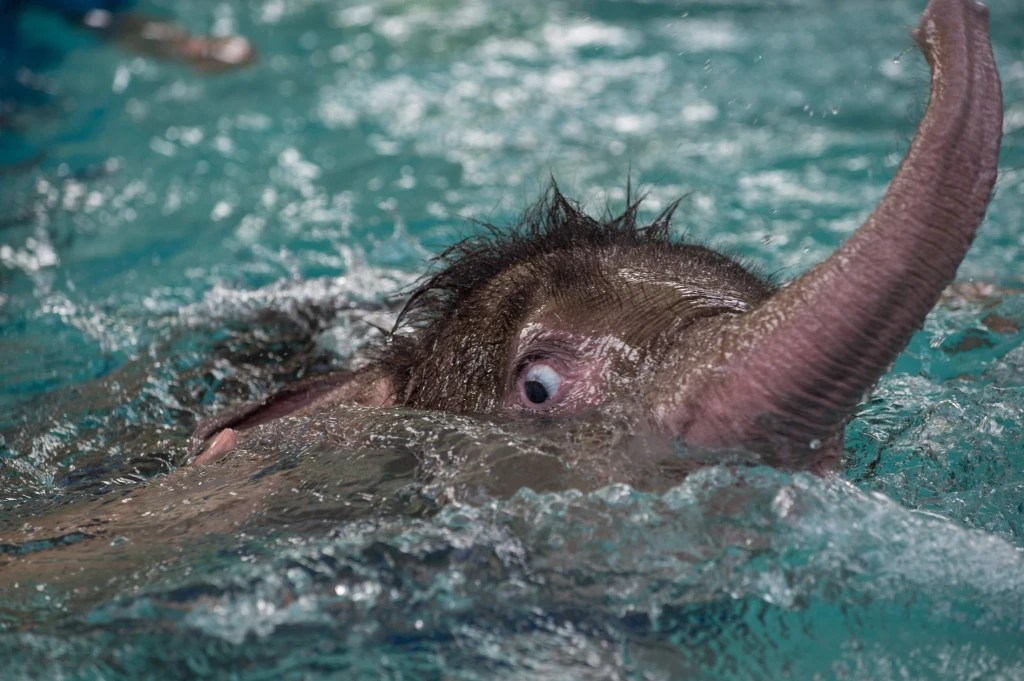
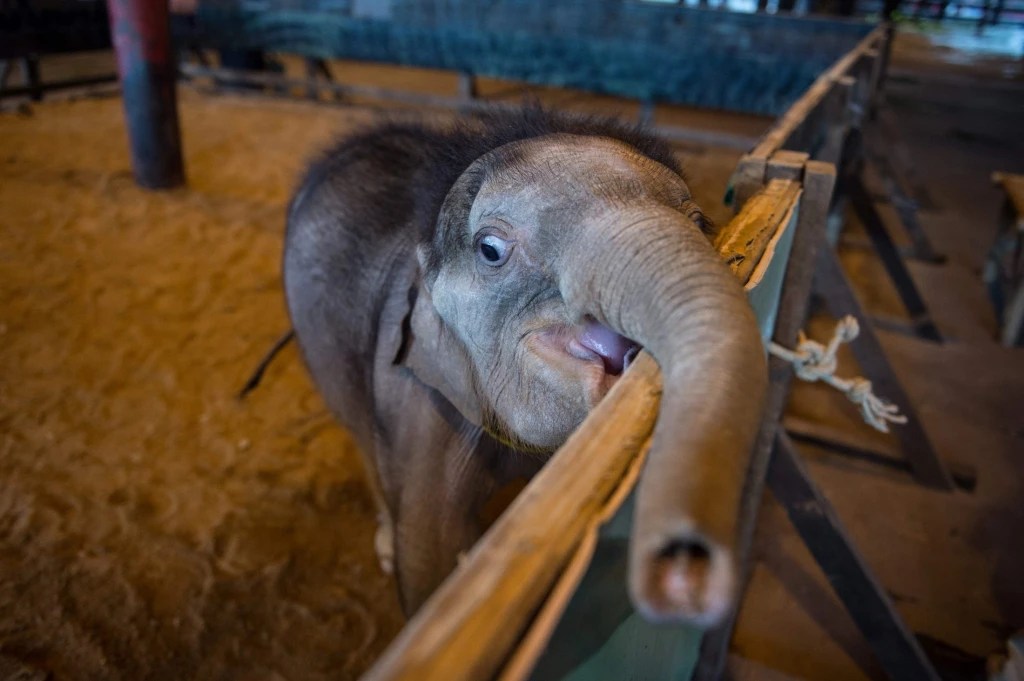
Staff at a Thai animal hospital take six-month-old orphan Clear Sky swimming to strengthen her leg muscles.
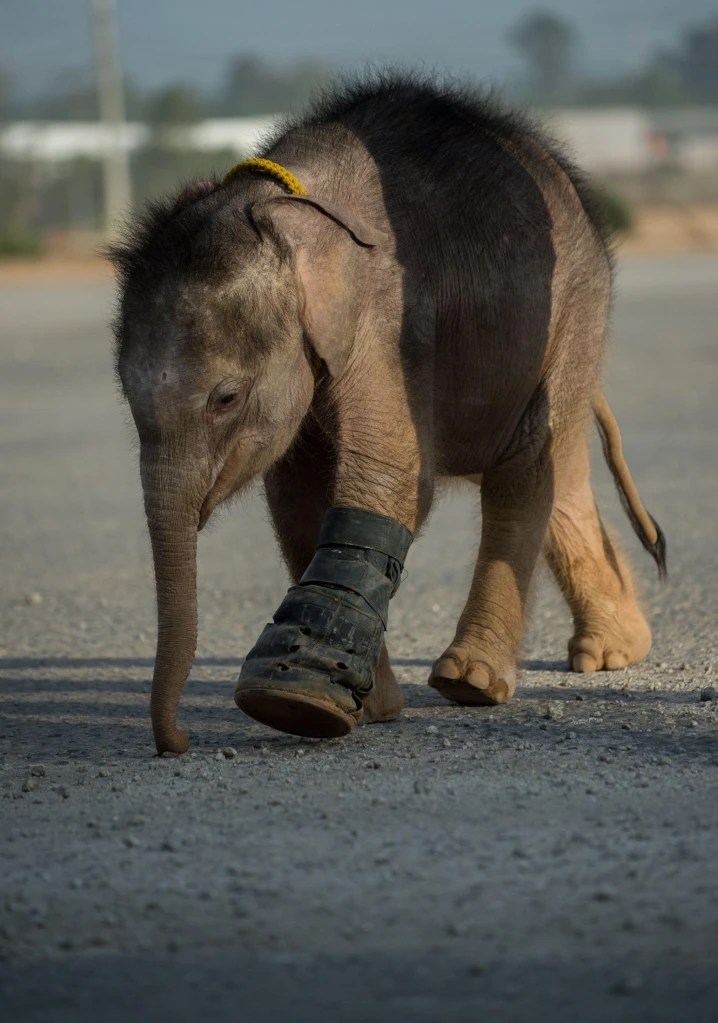
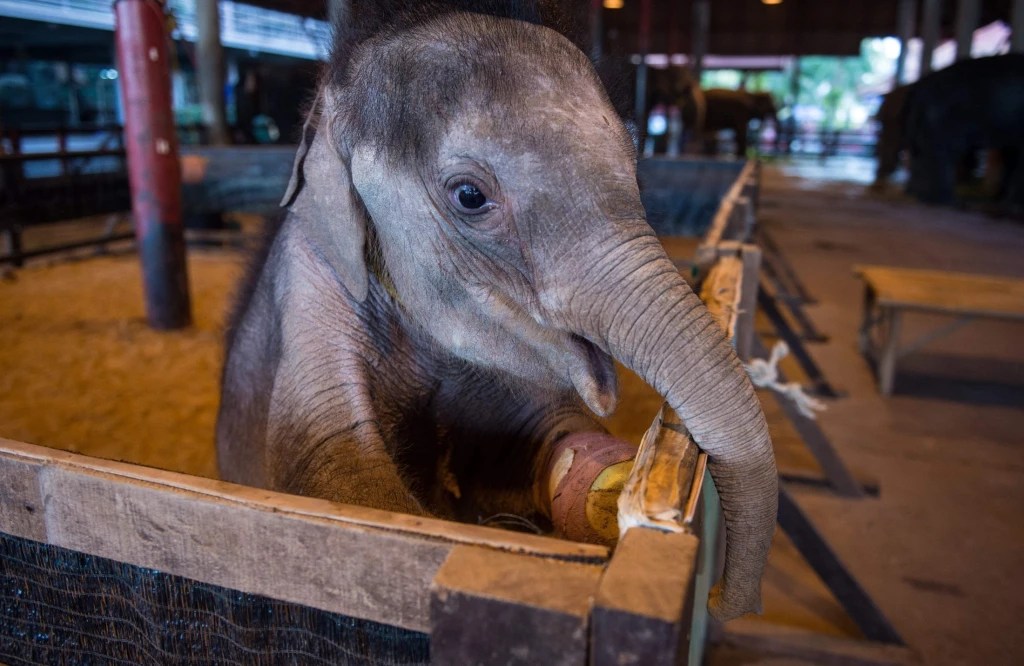
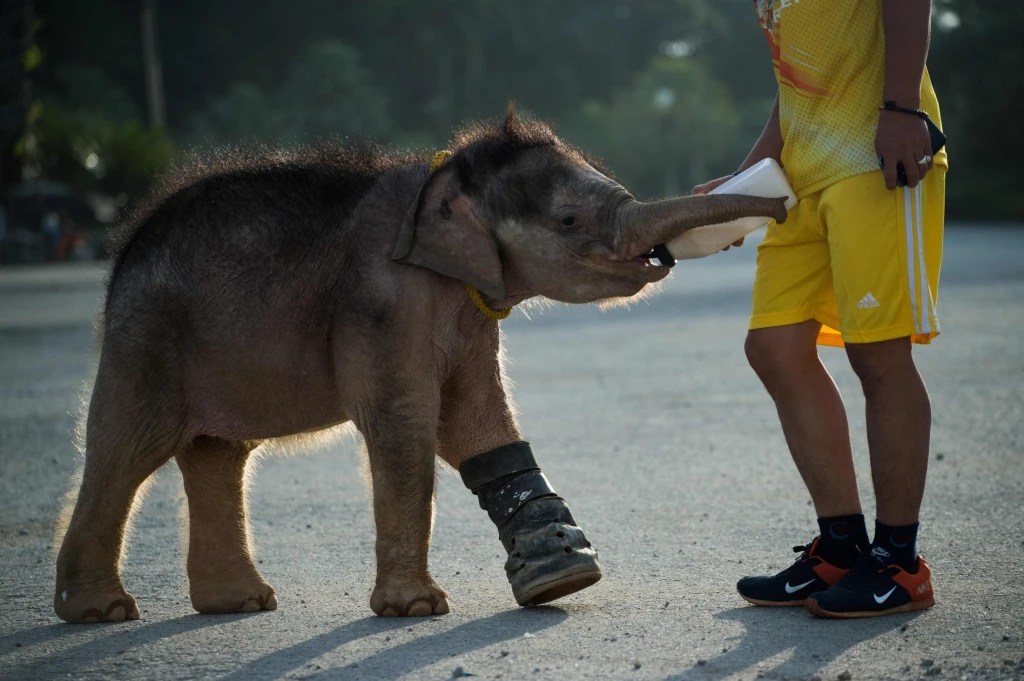
This baby Elephant is trying to forget her fear of water as she learns to walk again after losing part of her foot.
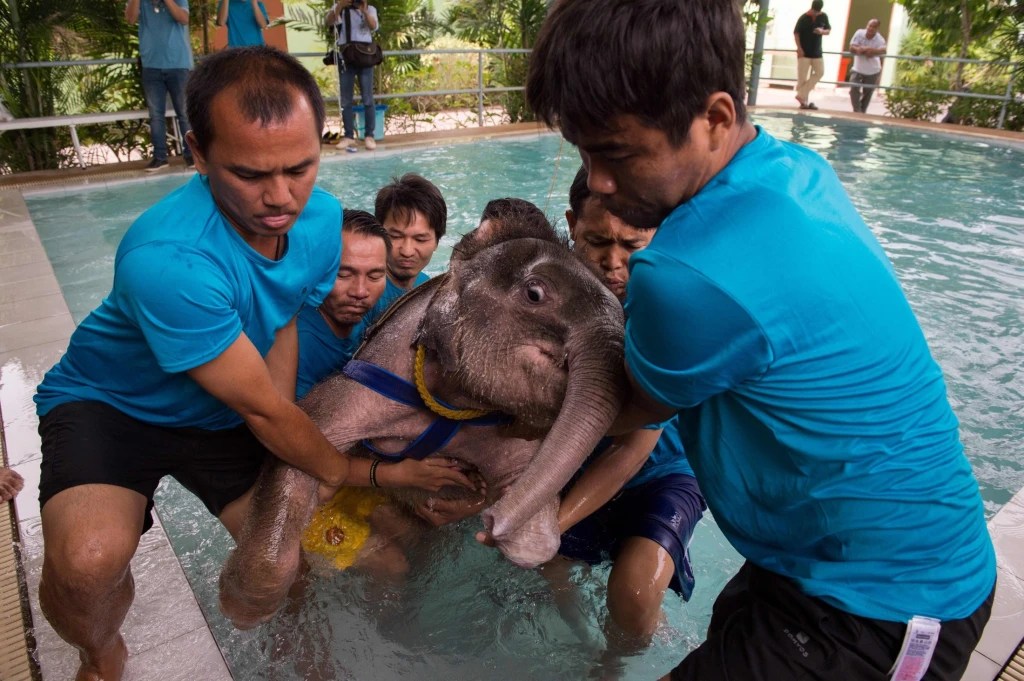
The nervous six-month-old grabbed a keeper for support as she was lowered into the pool at an animal hospital in Chonburi, Thailand.
CLEAR SKY IS LEARNING TO WALK AGAIN IN A SWIMMING POOL AFTER SHE INJURED HER FOOT.
The six-month-old is the first elephant to receive hydrotherapy at the Nong Nooch Tropical Garden animal hospital in Thailand
Clear Sky caught her leg in an animal trap laid by villagers to protect their crops.
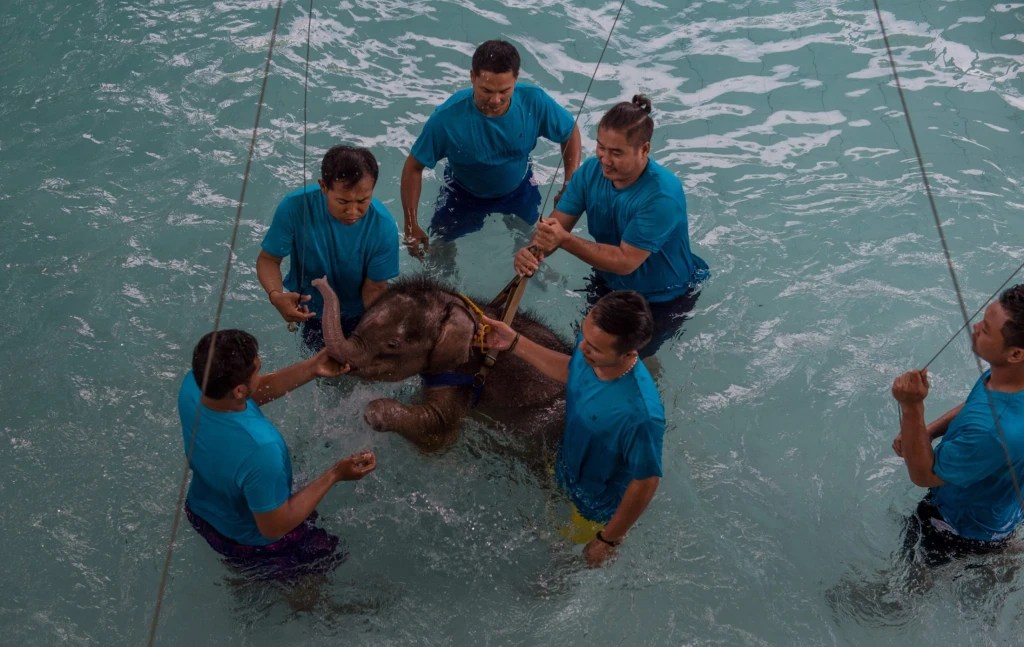
Staff at the animal hospital are trying to help her strengthen her withered leg muscles.
After surgery she is now having treatment to strengthen her leg muscles.
STAFFERS USE A HARNESS TO HELP CLEAR SKY INTO THE WATER AND KEEP HER AFLOAT
THIS WAS HER SECOND TIME GETTING WATER THERAPY
Baby Elephants usually love water, but Clear Sky was ‘a bit nervous and scared’, said a vet.
However she appeared to relax by the end of the hour-long session.
Vet Padet Siridumrong said: “She is still a bit nervous and scared of the water.
“Usually baby Elephants love the water.
“If she can do this regularly she will have fun.”
Villagers had found Clear Sky hungry and hobbling, after being separated from her mother in the wild.
Vets hope with more swimming, she won’t need an artificial leg.
The orphaned Elephant was in bad shape when she arrived at the hospital.
She was hobbling, in pain and in dire need of milk.
‘Kampon Tansacha, the director of the zoo that’s now her home, said: “We named her Clear Sky Up Ahead, because that is what she will need while she is with us.”
Elephants are a revered national symbol in Thailand, but their population in the wild has plummeted to an estimated 2,500 in the last century, a result of rabid development, habitat destruction and the ivory trade.
WHAT YOU CAN DO TO HELP ANIMALS IN NEED
You can support our work by donating as little as £5 – It only takes a minute but it can last a lifetime for an animal in need.
Everyone who donates will receive a Certificate of Appreciation as a thank you for helping animals in need.
The Mission of Protect All Wildlife is to prevent cruelty and promote the welfare of ALL animals.
We believe EVERY animal should be treated with respect, empathy, and understanding. We raise awareness to protect and conserve wild, captive, companion and farm animals.
It is vital that we protect animals against acts of cruelty, abuse, and neglect by enforcing established animal welfare laws and, when necessary, take action to ensure that those who abuse animals are brought to justice.
Protect All Wildlife are involved in many projects to protect animals’ rights, welfare, and habitats. Money contributed to Protect All Wildlife supports ALL of our worthy programmes and gives us the flexibility to respond to emerging needs. Your donations make our work possible.
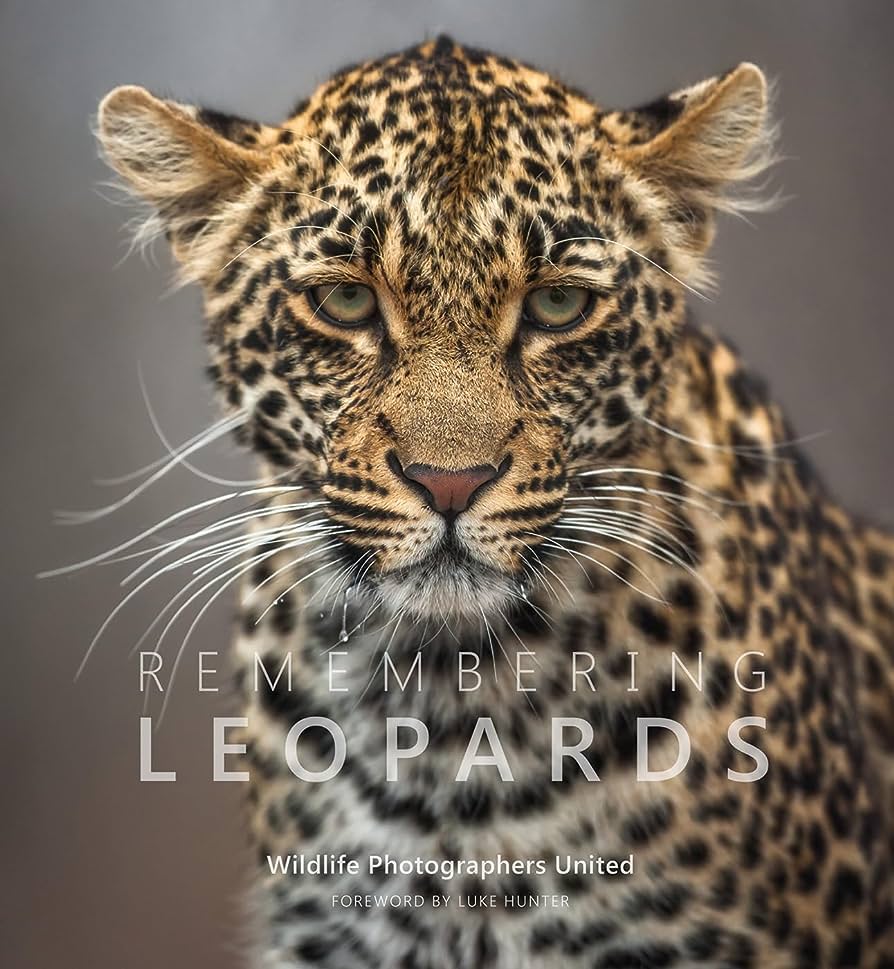
Front Cover: African Leopard by Mark Dumbleton in Sabi Sands Game Reserve, South Africa.
Remembering Wildlife has launched several charity photo books over the years that highlight endangered species and act to raise funds for the protection of the animals featured with the help of famous supporters and talented photographers around the world. Remembering Elephants, Remembering Rhinos, Remembering Great Apes, Remembering Lions, Remembering Cheetahs, and Remembering African Wild Dogs have already been produced, and Remembering Bears was funded and delivered last year. Remembering Leopards is the latest release in the series and will bring attention to Leopard species that are threatened around the world with the help of beautiful images of Leopards generously donated by many of the world’s top wildlife photographers
A mesmerising Leopard study by Roy Toft
This year the attention is turned to the eight species of Leopard: African, Amur, Arabian, Indian, Indochinese, Javan, Sri Lankan and Persian. Despite their adaptability, the global population and distribution is sadly in decline. They are now believed extinct in 23 of their 85 original range countries. As well as each of the sub-species, Remembering Leopards have also included images of Snow and Clouded Leopards too.
The International Union for Conservation of Nature (IUCN) classifies the Leopard as a Vulnerable species, and three of its subspecies are ranked as Critically Endangered. In addition, the Peer paper recommends that the status of another two subspecies be uplisted to the status of Critically Endangered and Endangered.
Margot Raggett, founder and producer of Remembering Wildlife, said: “Despite their adaptability, the global population and distribution of leopards is sadly in decline. “They are now believed to be extinct in 23 of their 85 original range countries.
Habitat loss and fragmentation, the legal and illegal wildlife trades, traps, trophy hunting and human-wildlife conflict are among the leading threats to Leopards. Although found across Africa and Asia, they are now extinct across large swathes of their previous habitat.
The Making Of The Book
A crowdfunding appeal to produce the latest edition of a wildlife book series has broken previous records for this very popular project. The campaign launched on April 1 2023 and smashed its minimum target of £20,000 in just four minutes when it launched on 1 April. Remembering Wildlife says that within the first day, supporters had pledged more than £100,000, making Remembering Leopards the fastest funded of all the books in the series so far.
More than £1 million has been donated by the photobook series to protect endangered species since its launch in 2016, attracting famous supporters including Russell Crowe, Ricky Gervais and Michelle Pfeiffer.
“I’m blown away by the support our Kickstarter has had already and I promise everyone who has pledged their support that this will be the most beautiful book on Leopards the world has ever seen.”
Margot Raggett, founder and producer of Remembering Wildlife
“There is no greater friend to the animals than Ricky and we are deeply grateful for his on-going support and championing of the series!” ~ Margot Raggett/Remembering Wildlife
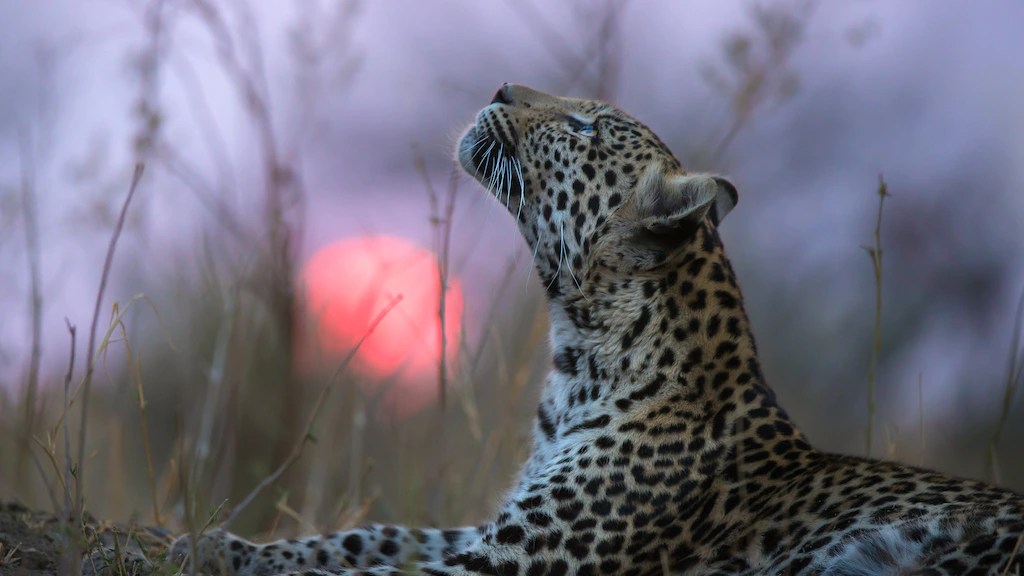
In Chobe National Park, Botswana, Hannes Lochner captured this Leopard looking skyward, as a flock of marabou storks flew overhead. Behind him, on the horizon, the sun sets over a swelteringly hot (50°C) day.
The photographers who have donated their images for this edition are:
Jane Addey, Oriol Alamany, Neil Aldridge, Theo Allofs, Matt Armstrong-Ford, Daryl & Sharna Balfour, Adam Bannister, Volodymyr Burdiak, Will Burrard-Lucas, Vladimir Cech Jr., Paras Chandaria, Chad Cocking, Marius J Coetzee, Shem Compion, Keith Connelly, Ben Cranke, Brendon Cremer, M & C Denis-Huot, Anja Denker, Tristan Dicks, Kevin Dooley, Greg du Toit, Marlon du Toit, Mark Dumbleton, Kairav Engineer, Morkel Erasmus, Amit Eshel, Suzi Eszterhas, Sascha Fonseca, James Gifford, Paul Goldstein, Sergey Gorshkov, Owen Gröbler, Richard Guijt, Todd Gustafson, Thorsten Hanewald, Hilary Hann, Trish Hennessy, Roger Hooper, Arnfinn Johansen, Lakshitha Karunarathna, Sebastian Kennerknecht, Agung Ganthar Kusumanto, Tim Laman, Frans Lanting, Behzad J Larry, Chien Lee, Hannes Lochner, Michael Lorentz, Piper Mackay, Russell MacLaughlin, Shivang Mehta, Garry Mills, Marc Mol, Yashas Narayan, Latika Nath, Heinrich Neumeyer, Pete Oxford, Parinya Padungtin, Richard Peters, Mevan Piyasena, Michael Poliza, Isak Pretorius, Margot Raggett, Abdul Rashid, Matthew Roper, Andy Rouse, Jonathan & Angela Scott, Pasan Senevirathne, Ismail Shariff, Anjali Singh, Harman Singh Heer, Andy Skinner, Sarah Skinner, James Suter, Tom Svensson, Roy Toft, Ann & Steve Toon, Paolo Torchio, Lance van de Vyver, Jan van der Greef, Marsel van Oosten, Christophe Vasselin, Federico Veronesi, Francesco Veronesi, Thomas Vijayan, Marion Vollborn, James Warwick, Marcus Westberg, Shannon Wild, Steve Winter, Art Wolfe and Nelis Wolmarans
Two Leopard brothers play fighting at Samburu National Reserve, Kenya. The shot was taken by photographer Trish Hennessy. The pair were initially playing in a bush before they climbed on top of the rocks on a hill to put on the show.
All profits from the sales of Remembering Leopards will be donated to projects protecting Leopards.
I fell in love with wildlife and safaris many years before picking up a camera! In the 2000s, I worked in PR in London and used all my spare cash to book safaris to Africa, as I had become totally addicted to being in nature. It was when I inadvertently signed up to a photography-based safari in 2010 that everything changed for me. It was a trip to see Kenya’s ‘Great Migration’ led by Jonathan & Angela Scott and it was only a few days before I went, that I realised I was supposed to bring a camera. I bought a cheap kit camera & lens and headed to Kenya. It turned out that camera was no good at all for wildlife (it was a very short lens) but nonetheless, I was totally inspired by Jonathan & Angela’s photography. When I got home, I immediately upgraded my gear and signed up for a course at the London School of Photography to learn the basics and I’ve never looked back. For a few years I went on as many photographer-led trips as I could, to learn from the best and then in 2012, agreed a deal to work as a Photographer in Residence at a camp in the Maasai Mara called Entim Camp. At that point I started selling my photos and attracting followers on social media.
It was in 2014 that everything changed for me once again. I had been working as a resident photographer in Kenya at that point for about three months a year, for three years, and it was at the end of one of those stays that I travelled to Laikipia to visit a friend. We were woken very early in camp by the sound of hyenas going crazy and at first light, went to investigate. What I saw changed my life, It was an elephant who has died from a poisoned arrow, likely poachers had shot him but he’d got away, only to die a slow, painful death over the next few days. The hyenas had started to eat his body and the sight – and the smell – was so shocking. I came to realise that poaching and the many other threats that wildlife faces are often hidden away from tourists and as a result, many like me at that point, had any idea how bad things really are. I was incredibly angry and upset and resolved to channel those emotions into something positive. That was the trigger for me to start work on what I thought would be a one-off book on elephants, to raise awareness about poaching and funds for projects working to protect elephants. I started to approach wildlife photographers I’d met in the field and invited them to donate an image each and it took off from there. 18 months later, Remembering Elephants was published. It sold out in 2 months and raised more than £100,000 and without me knowing it, a series was born. We’ve published five more books since (Remembering Rhinos, Remembering Great Apes, Remembering Lions, Remembering Cheetahs and Remembering African Wild Dogs) and the 7th in the series, Remembering Bears, will be published in October 2022. More than $1.2m USD has been raised by the series for conservation so far. Over 200 photographers have now contributed to the series and producing and steering it, has become my life’s work. Nowadays I spend far less time in the field taking traditional wildlife pictures like before but rather, I spend more time visiting the projects we are able to support with our funds, so I can see how our money is making a difference.
Source: Heroes of the extreme An interview with Margot Raggett. Gizmo, 2022.
Margot was awarded an MBE in the The King’s Birthday Honours 2023 for services to International Wildlife Conservation.


















 PROTECT ALL WILDLIFE