Asian Elephants Seen Mourning And Burying Their Dead For The First Time

Five Elephant calves have been found buried in drainage ditches on tea-growing estates in India in a rare example of burial behaviour in non-human animals.
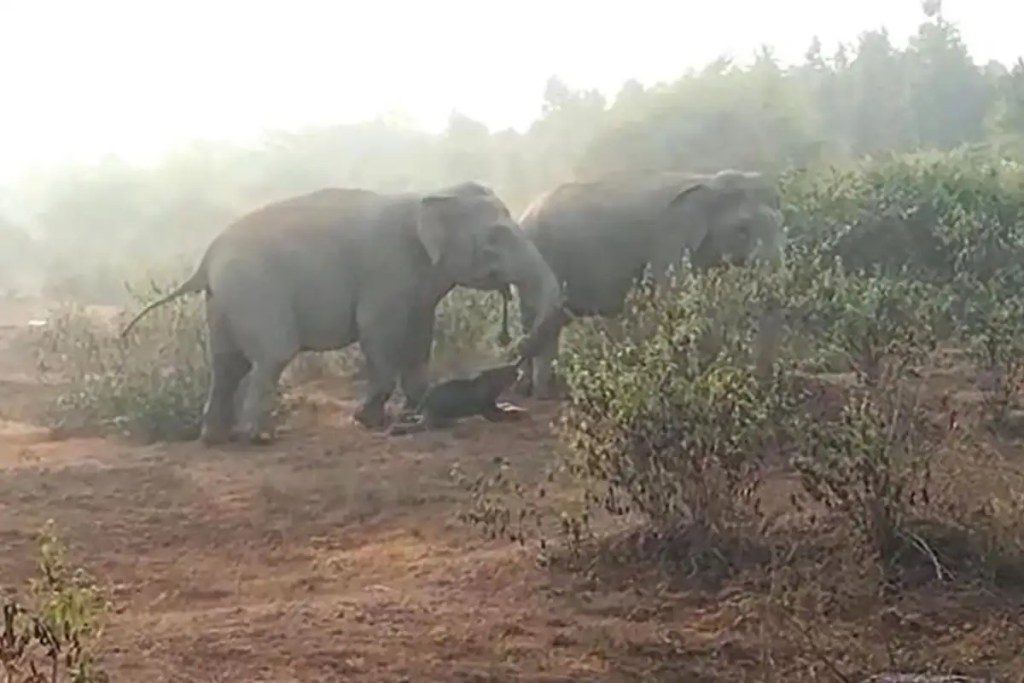
An Elephant pulling a dead calf on a tea estate in North Bengal, India
Credit: Parveen Kaswan and Akashdeep Roy.

Asian Elephant herd members in north Bengal have been documented burying premature calves in irrigation trenches inside tea gardens. The behavior is unique to this species and has been observed in cases in Debpara, Chunabhati, Bharnabari, Majherdabri, and the New Dooars tea gardens near Gorumara and Buxa. In five case studies in north Bengal, herd members dragged the calves away from human settlements before burying them in “leg-upright position” in irrigation trenches inside tea gardens.

Footprints and dung of various sizes indicate that herd members of all ages contributed to each burial. Night guards at the estates reported loud Elephant vocalisations, sometimes lasting as long as 30 to 40 minutes, before the herd left the area.

Akashdeep Roy at the Indian Institute of Science Education and Research in Pune and Parveen Kaswan at the Indian Forest Service suggest that these trumpeting sounds may signify mourning and that the herds showed “helping and compassionate behaviour” during the burials.

“Calf burials are extremely rare events in nature,” says Roy.

An Elephant calf buried on a tea estate, with its feet protruding from the ground. Credit: Parveen Kaswan and Akashdeep Roy

They were surprised that the calves were buried feet up, but if the herd collectively buried each calf, this is the most accessible position to place the carcass into the drainage ditch, says Roy. As social animals, it may be most important to the elephants to bury the calf’s head, he says.

The calves’ bodies were later exhumed and examined. They ranged in age from 3 months to a year old, and a number of them were malnourished and had infections. Bruising along each calf’s back suggests they were dragged or carried long distances to the burial sites.

African bush Elephants (Loxodonta africana) have been observed covering dead bodies with vegetation and returning to these locations later. However, the Asian Elephants (Elephas maximus) in this study generally avoided returning to the burial sites, instead using alternative pathways.

“These observations offer impressive evidence of the social complexities of Elephants,” says Chase LaDue at the Oklahoma City Zoo and Botanical Garden. “Others have noted that Elephants appear to behave in unique ways towards their deceased relatives, [but] this paper is the first to describe what appears to be methodical and deliberate burial of Elephant calves after they have been carried to the burial site.”

The land in which Elephants once roamed freely is shrinking as humans expand – especially in India, the world’s most populous country. Only about 22 per cent of the land that Elephants use is within protected areas.

“Understanding how Elephants behave and respond to rapid changes in human-dominated landscapes may help us develop conservation strategies that promote the coexistence of people and Elephants,” says LaDue.

Research Study: Unearthing Calf Burials Among Asian Elephants In Northern Bengal, India.

Asian Elephants are recognised as endangered by the International Union for Conservation of Nature.

An estimated 26,000 of them live in the wild, mostly in India with some in South-East Asia, surviving for an average of 60-70 years outside captivity.

WHAT YOU CAN DO TO HELP WILDLIFE

You can support ‘Protect All Wildlife’ many projects by donating as little as £5 – It only takes a minute but it can last a lifetime for an animal in need. Please donate below.

Donate Here: Please Help Animals In Need

Everyone who donates will receive a Certificate of Appreciation as a thank you for helping animals in need.

The Mission of Protect All Wildlife is to prevent cruelty and promote the welfare of ALL animals.

We believe EVERY animal should be treated with respect, empathy, and understanding. We raise awareness to protect and conserve wild, captive, companion and farm animals.

It is vital that we protect animals against acts of cruelty, abuse, and neglect by enforcing established animal welfare laws and, when necessary, take action to ensure that those who abuse animals are brought to justice.

Protect All Wildlife are involved in many projects to protect animals’ rights, welfare, and habitats. Money contributed to Protect All Wildlife supports ALL of our worthy programmes and gives us the flexibility to respond to emerging needs. Your donations make our work possible.
Donate Here: Please Help Animals In Need

Watch: Rescuers Frantically Perform CPR On Mother Elephant As She Faints During Baby’s Rescue From High Drain.

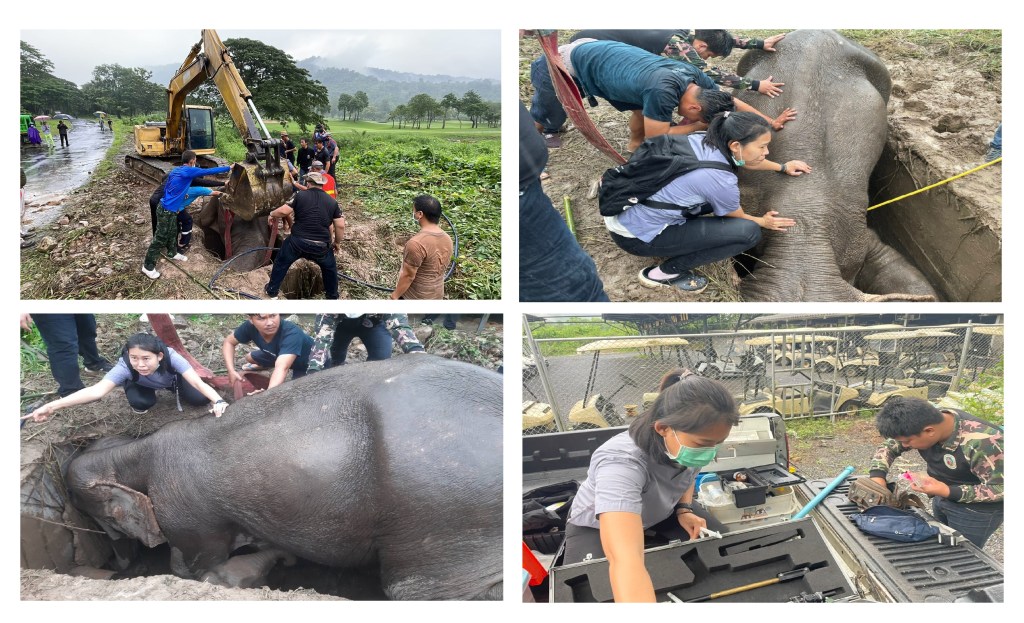
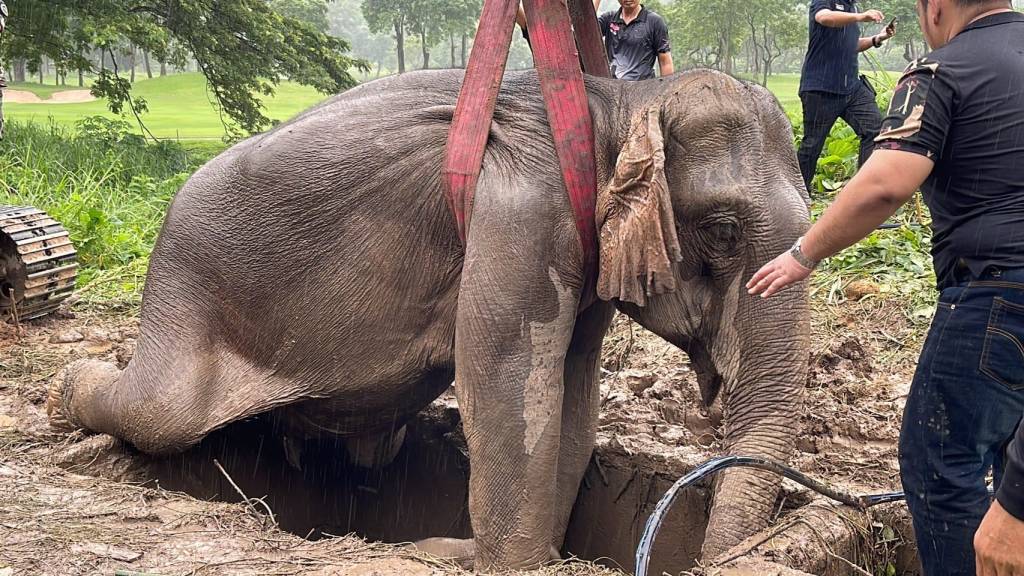
When the rescue team arrived in Thailand’s Nakhon Nayok province, they used anaesthetic shots to subdue the mother elephant, it resulted in her halfway falling into the hole.

The Mother Elephant Being Lifted By A Crane (Source: Thailand Wildlife Conservation Division/ Facebook)

Heavy rains and muddy roads are not just dangerous for humans but also for wild animals travelling in the wild during the monsoon. A case in point is a baby elephant that slipped and fell into a high drain in Thailand. Things took a dramatic turn when rescuers attempted to save the baby with its mother fainting in stress.

The Rescue Tean Find Mother Elephant Stuck Whilst Trying To Rescue Her Baby. (Source: Thailand Wildlife Conservation Division/ Facebook)

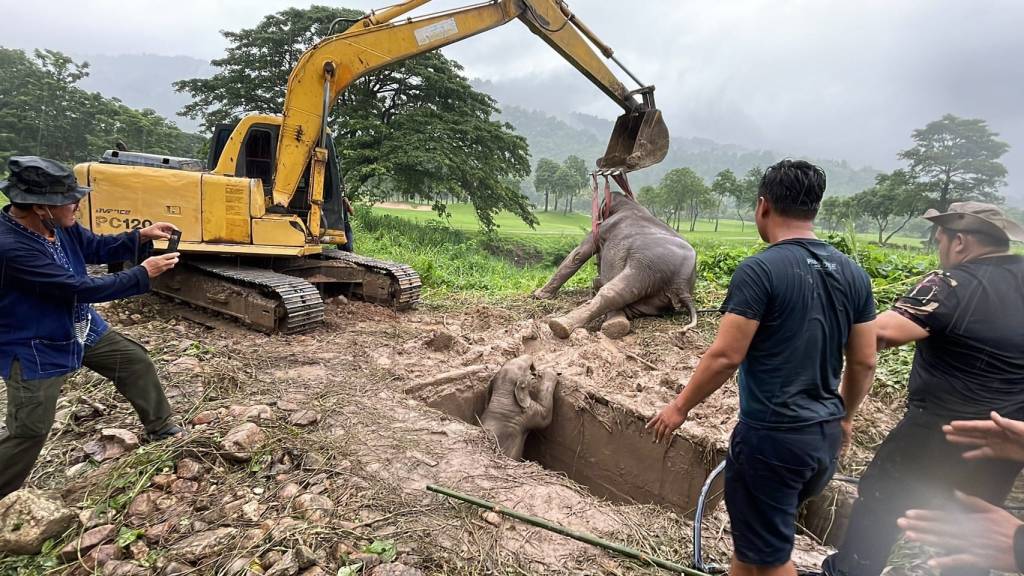
After the one-year-old calf fell into the manhole in the area of Royal Hill Golf Course, Khao Yai National Park in Nakhon Nayok province, its mother tried her best to help the baby walk out. However, continuous showers and slippery muddy terrain made all attempts go in vain. When wildlife rescuers arrived at the scene to help the infant, the anxious mother proved to be a hindrance in the operation. Things went awry when the rescue team used a shot to subdue the frantic elephant and she partly fell in as well.

The Trapped Baby Watches On Frantically. (Source: Thailand Wildlife Conservation Division/ Facebook)

Videos showed the rescuers racing against time to not just help the baby but the mother as well. Rescuers used a truck-mounted crane to pull the mother out before climbing on top of her to perform cardiopulmonary resuscitation (CPR), while an excavator was seen in action clearing the way to help the calf climb out of the drain.

“It was impossible to get near the baby while the mother was nearby so we gave her three doses of tranquillisers but she moved towards her baby before passing out and hit her head,” Dr Chananya Kanchanasarak, a vet involved in the operation explained to Sky News.

The Baby Snuggles Up To Mum Whilst A Rescuer Performs CPR (Source: Thailand Wildlife Conservation Division/ Facebook)

Dr Chananya said, “Despite the obstacles, the mother did not leave her baby’s side”. He added that the experience will be “one of the most memorable rescues” they have done.

(Source: Thailand Wildlife Conservation Division/ Facebook)

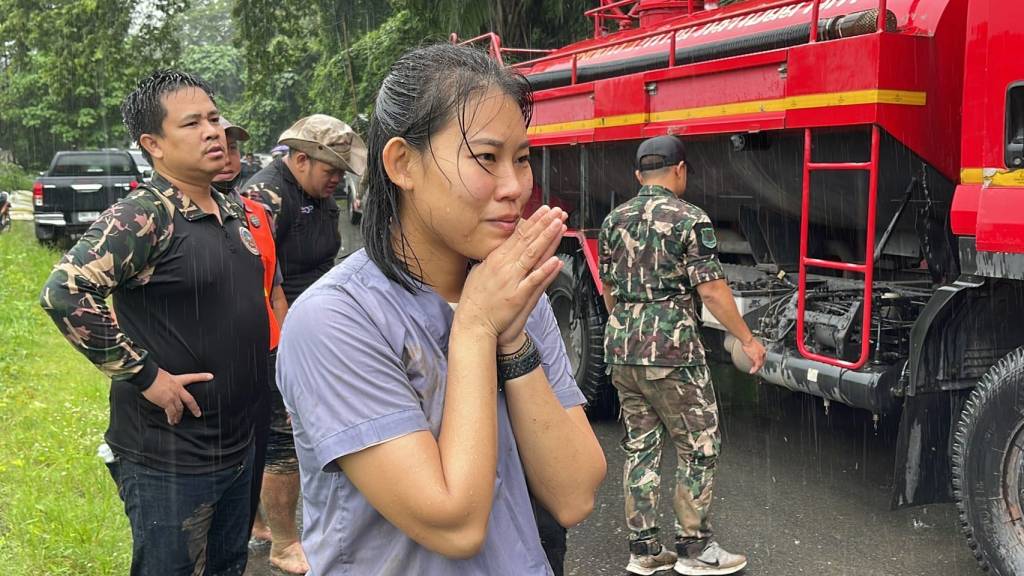
Eventually, the calf was able to climb out of the hole and the mother elephant too regained consciousness. Video showed the calf suckling its mother as soon as it got out and helped the mother too sooth her nerves. After an exhaustive and tense operation that lasted over three hours, both returned to the wild. 

After Three Hours The Mother And Calf Were Rescued And They Returned To The Wild. (Source: Thailand Wildlife Conservation Division/ Facebook)
The Rescuers Watch On As The Elephant Return To The Wild (Source: Thailand Wildlife Conservation Division/ Facebook)

For or more info on the Wildlife Conservation Division

What you can do to help animals in need:

Support ‘Protect All Wildlife’ by donating as little as £1 – It only takes a minute but it can last a lifetime for an animal in need. Thank you.

We believe EVERY animal should be treated with respect, empathy, and understanding. We raise awareness to protect and conserve wild, captive, companion and farm animals. It is vital that we protect animals against acts of cruelty, abuse, and neglect by enforcing established animal welfare laws and, when necessary, take action to ensure that those who abuse animals are brought to justice.

Protect All Wildlife are involved in many projects to protect animals’ rights, welfare, and habitats. Money contributed to Protect All Wildlife supports ALL of our worthy programmes and gives us the flexibility to respond to emerging needs. Your donations make our work possible. Thank you for your support.
Go back

Your message has been sent

Warning
Warning
Warning
Warning
Warning
Warning.

Watch Forest Officials Rescue A Baby Elephant Stuck In A Muddy Ditch With The Help Of A JCB: Video

THE BABY ELEPHANT GETS A HELPING PUSH UP FROM A JCB

One lucky little Elephant has captured the hearts of people across the internet after it was rescued from a mud pit in the Southern India state of Karnataka.

A video of the rescue operation staged by state forest officials has charmed netizens, as it also shows what some people say was an appreciative gesture from the Elephant, who turned to address the crane that helped to dig it out.

THE BABY ELEPHANT BEING RESCUED FROM A DEEP PIT BY A JCB

The incident took place in Siddapura Village in Coorg district of Karnataka, reported Indian Express.

A good Samaritan recorded and shared the clip, which has been viewed over one million times on Twitter alone. The beginning of the video shows the Elephant struggling to climb up and out of a slippery mud put. Each time it tries, it slips back down the hole’s steep walls. Eventually, an excavator machine pulls in and begins to dig mud out from around the Elephant.

THE ELEPHANT KEPT SLIDING BACK INTO THE PIT

Bystanders can be heard cheering as the arm of the JBC crane reaches behind the Elephant and gives it a gentle push, giving it the boost it needs to finally get its feet back on solid ground.

The lumbering animal then turns back around to face its rescuers, bumping its head and tusk to the machine’s bucket in what some are viewing as a sign of appreciation. Onlookers can be heard cheering loudly as it does, then officials set off a small firecracker to encourage the Elephant to leave the area and return to the forest.

Sudha Ramen, Deputy Conservator of Forests, Tamilnadu Forest Department shared the video from her Twitter account. She told Newsweek, “Elephants are mostly human-friendly until they get aggressive stimulated by human behaviour or have some hormonal imbalances. They are known to recognize the aid received when they are in need.”

Even though this behaviour can be observed in subadult and adult Elephants, young ones are not as human-friendly or expressive.

She added that when such rescues happen in a crowded environment, the animal is usually in panic mode and may get aggressive because of human presence or too much noise.

“But in this situation not many outsiders were present. Still, I do not say that the animal returned a gesture in this case. It may be an exhibit of stress too,” Ramen told Newsweek, addressing the belief shared by many that the head bump was ‘thank you’ in the Elephant language.

Her tweet with the video has been viewed more than a million times. She credited the video to Indian actor Satish Shah who initially shared it on his Twitter page.

SUDHA RAMEN, DEPUTY CONSERVATOR OF FORESTS, TAMILNADU FOREST DEPARTMENT SHARED THE VIDEO FROM HER TWITTER ACCOUNT.

The usage of machinery such as a JBC depends upon the terrain, the animal involved in the rescue, and other safety factors, according to Ramen. The vehicle often comes in handy as many of its features make it able to handle slushy, slippery ground, and many rescue operations are carried out in the forest or nearby in areas that are usually non-motorable larger vehicles.

“Such operations are done only in the presence of the forest officials and vet doctors, so the driver gets guided by them,” Ramen told Newsweek.

“This made my day 1,000 times. Kudos to the construction crew and operator. And Mr. Elephant is the classiest mammal I’ve ever seen,” commented one user.

While many appreciated the machine operator’s work, some also questioned the use of smoke crackers in the end.

“It seems the Elephant was actually very grateful to the JCB for helping her/him by doing a head bump with it. Instead of busting smoke to scare it away, we could be gentler next time by keeping some food nearby so that they can replenish and get busy without charging at anyone,” wrote another.

THE RESCUED ELEPHANT APPEARS TO THANK THE JCB

However, the rescue team is always advised to carry the smokers along for safety reasons, Ramen told Newsweek, saying it is not necessarily standard practice to use them but they are commonly deployed when herds venture into villages or human habitations.

“It is used on occasions to direct the animal back into the forest and also to protect the nearby people if the animal tries to attack them,” she said.

What you can do to help

Please SHARE to raise awareness to wildlife and environmental issues from around the world.

About Protect All Wildlife

The Mission of Protect All Wildlife is to prevent cruelty and promote the welfare of ALL animals.We believe EVERY animal should be treated with respect, empathy, and understanding. We raise awareness to protect and conserve wild, captive, companion and farm animals.

It is vital that we protect animals against acts of cruelty, abuse, and neglect by enforcing established animal welfare laws and, when necessary, take action to ensure that those who abuse animals are brought to justice.

Protect All Wildlife are involved in many projects to protect animals’ rights, welfare, and habitats. Money contributed to Protect All Wildlife supports ALL of our worthy programmes and gives us the flexibility to respond to emerging needs. Your donations make our work possible.

Thank you for your support and consideration.

Go back

Your message has been sent

Warning
Warning
Warning
Warning
Warning
Warning.

THE ELEPHANT THAT WAS IN THE ROOM

Save The Asian Elephants (STAE) and all the animal welfare sector are aghast at the weekend’s media reports that the Government has abandoned the Animals Abroad Bill despite all its commitments otherwise, received regularly by STAE’s team as pledges, promises, “it’s been cleared in Cabinet” and “you’re pushing at an open door” in over 20 meetings with No 10 and Defra since lockdown.

THE ANIMALS ABROAD BILL WOULD HELP STOP CRUELTY LIKE THIS

STAE is working to bring the entire sector together to ensure all is done to see this decision, if confirmed, reversed. Indeed with public support for a ban to protect elephants from the most extreme violence largely driven by the UK market running at over 90%, STAE’s petition now touching 1.1 million, and extreme emotions evoked in the electorate by torture of baby elephants, any such decision seems extraordinary as a General Election looms before late 2024.

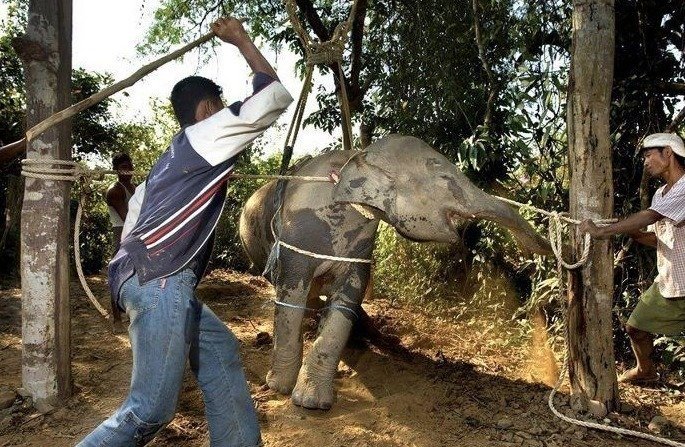
PHAJAAN OR ‘CRUSHING’ IS THE TRADITIONAL ASIAN TORTURE OF YOUNG ELEPHANTS TO BREAK THEIR SPIRIT. IT IS DONE SO THAT THEY ARE SUBMISSIVE TO HUMANS.

Why on earth would Government be committed to these cruel acts? It must surely be in its own interests to take a principled lead over other parties (who will support it) and other nations, by pursuing the Bill. They are important measures now expanded in the Action Plan for Animal Welfare to all species abused in overseas tourism (including big cats, apes, bears, equines, dolphins) and not particularly controversial or difficult. On the contrary they are welcomed across the political divide. None of the measures to ban ads for “low welfare venues” impinge on Tory peers’ shooting weekends or even pigging out on foie gras, if that’s their tragic choice.

STAE CEO Duncan McNair speaking to Protect All Wildlife said “If confirmed, its sickening and foreshadowed in STAE’s communications with Govt and officials over the past year and my US TV interview on Unchained TV, despite every reassurance from Govt (including a letter signed by the Minister a week ago) all was on track.” 

Muted claims that the Russian war on Ukraine has stolen all available Parliamentary time are unconvincing. STAE traces the evidence of wavering elements in Govt much further back. As they say, the first casualty of war is the truth. We hope the Defra Ministers at the helm will turn this round, publish the Bill, consult and bring it into Parliament soon.

Thank you to Duncan McNair CEO, Save The Asian Elephants  for speaking to us.

WILD AND FREE, HOW THEY SHOULD BE

Please SHARE to raise awareness to this issue. You can also REGISTER to receive news and updates direct to your inbox.