South Korea’s Dog Farmers Protest At Proposed Ban On Dog Meat

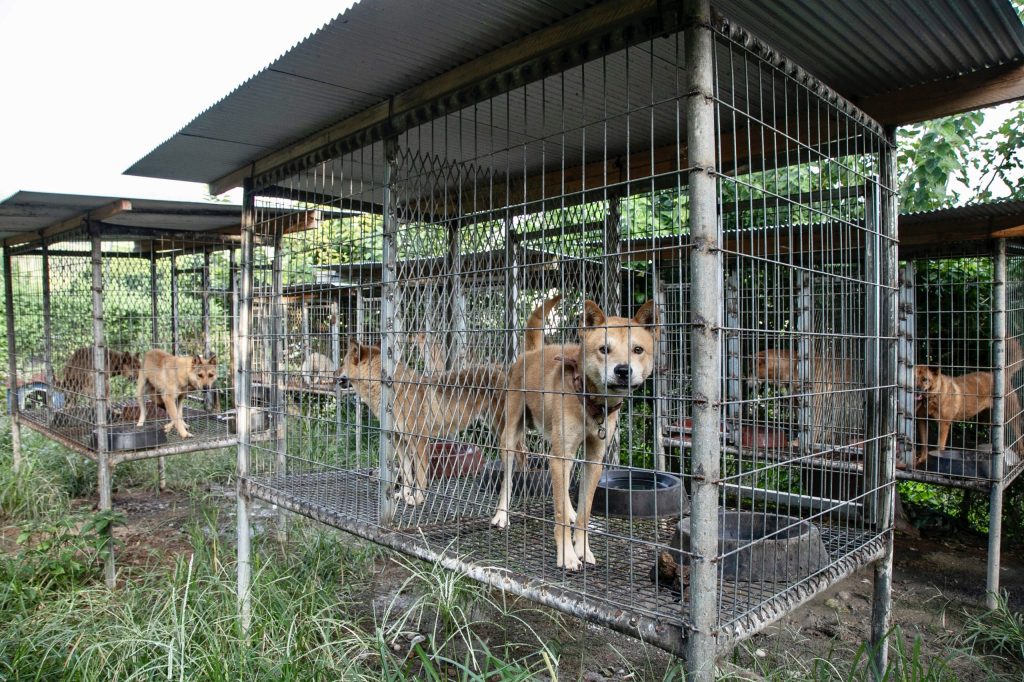
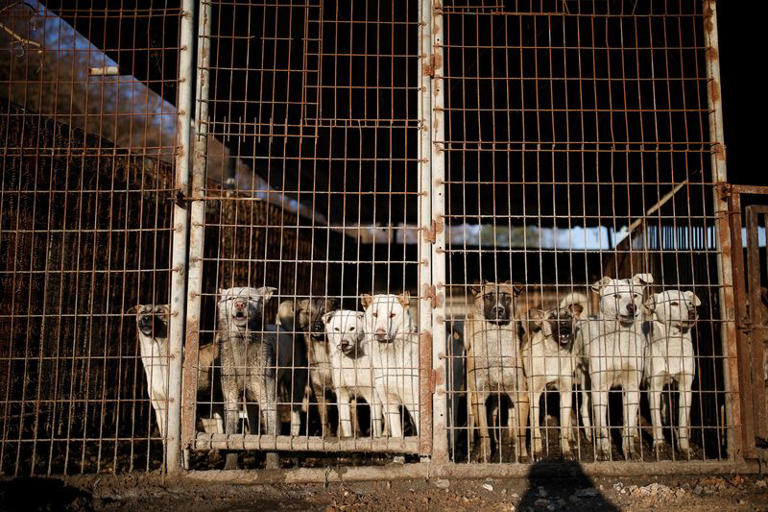
Dogs pictured in cages at a dog meat farm in Wonju, South Korea. Credit: REUTERS/Kim Hong-Ji

HWASEONG, South Korea (Reuters) – As South Korea moves to ban eating dog meat, many of those involved in the centuries-old controversial practice are fighting to keep it legal.

The farmers who breed the dogs, and the owners of eateries that serve the meat, have held protests in front of parliament to demand the government and ruling People Power Party scrap plans to pass a bill this year to enforce a ban.
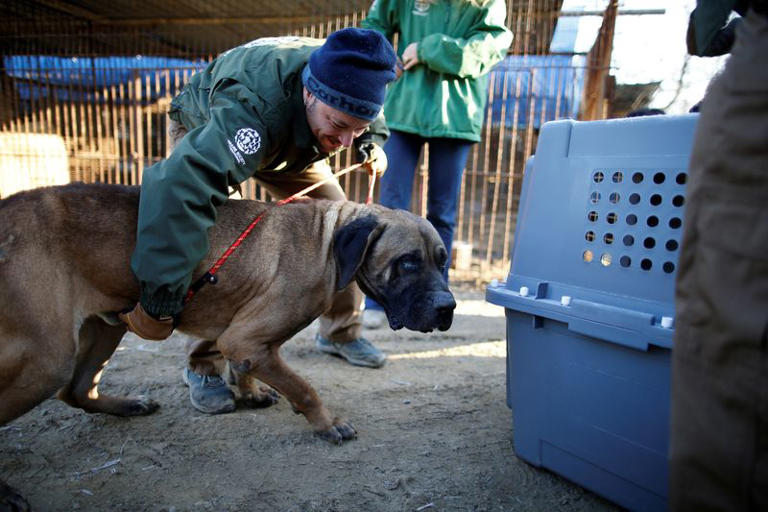
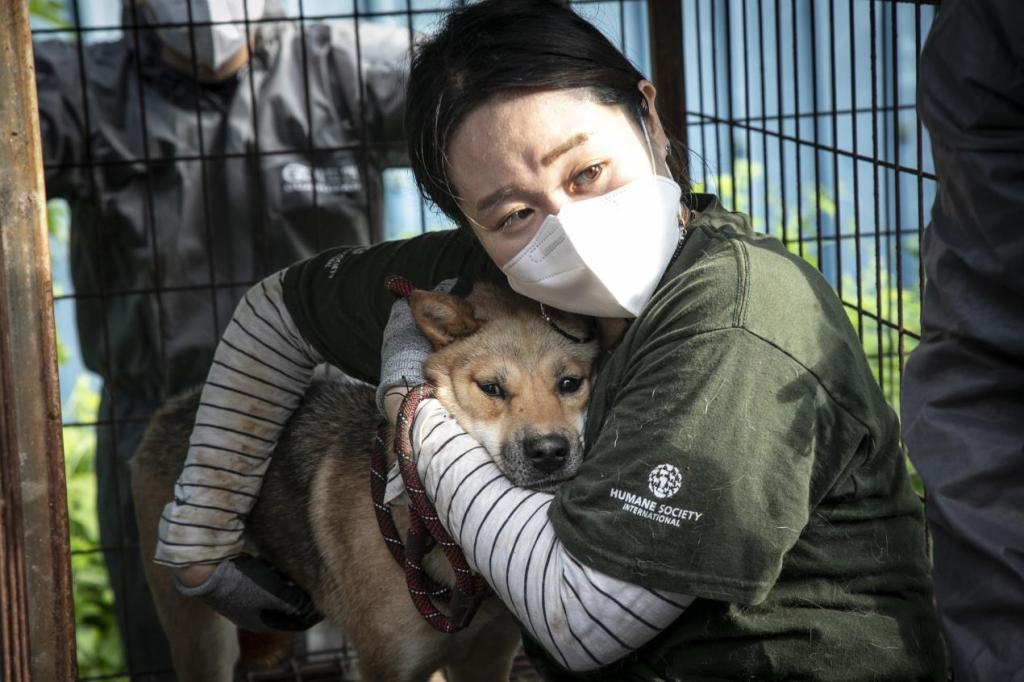
Rescue workers from Humane Society International rescue a dog at a dog meat farm in Wonju, South Korea. Credit: REUTERS/Kim Hong-Ji

They say banning dog meat would decimate their livelihoods, and also limit the options available to diners by taking off the menu a dish that in the Korean peninsula has traditionally been consumed to beat the summer heat, but which today is only eaten by some older people.

“If I have to close down, with the financial condition I’m in, there really is no answer to what I can do,” said Lee Kyeong-sig, who runs a farm outside Seoul raising up to 1,100 dogs. “I’ve been in this for 12 years and it is so sudden.”

A Gallup Korea poll last year showed almost two-thirds of respondents opposed eating dog meat, with only 8% saying they had eaten dog within the past year, down from 27% in 2015.
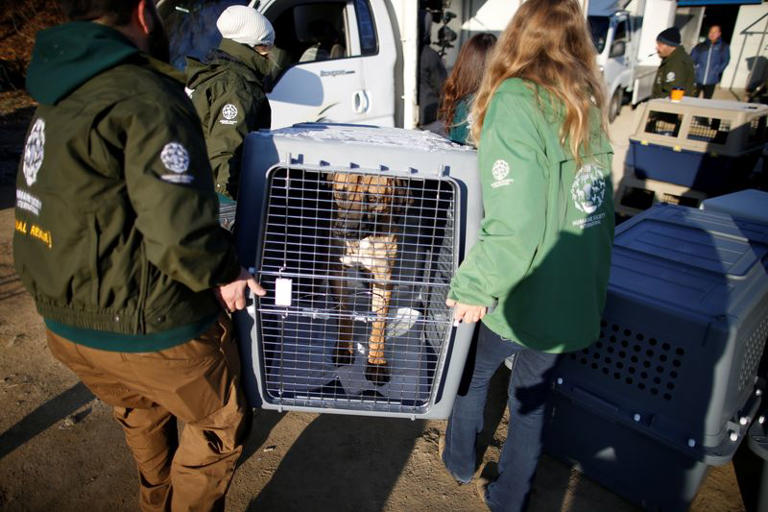
Rescue workers from Humane Society International rescue a dog at a dog meat farm in Wonju, South Korea. Credit: REUTERS/Kim Hong-Ji

Despite its declining popularity and opposition from animal rights activists, previous attempts to ban dog meat have failed because of industry protests.
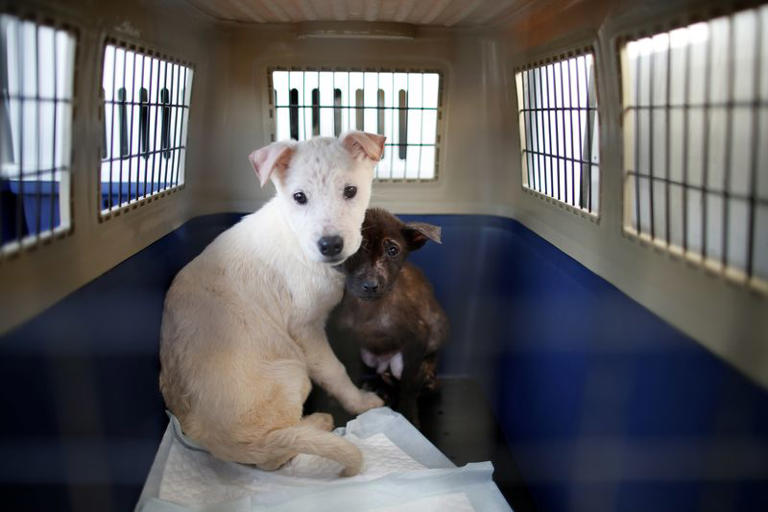
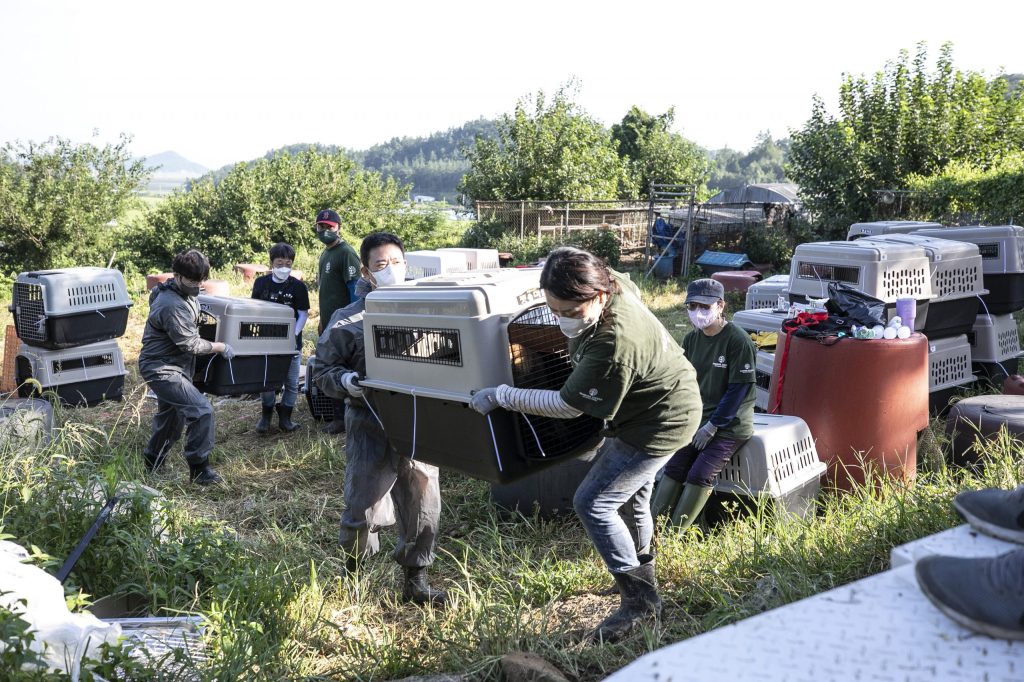
Rescued dogs are seen as they wait for transport, at a dog meat farm in Wonju, South Korea. credit: REUTERS/Kim Hong-Ji

This time, the government has said the proposed ban would give the industry a three-year grace period to transition out of the trade, as well as provide the maximum possible financial support for those affected.

With the backing of the public, and bipartisan support in parliament, there are signs that the ban could soon become law.

TIME FOR CHANGE

The agriculture ministry declined to give details about the size of the industry, but the Korean Association of Edible Dogs, says far more farms and restaurants than those cited by the government will be affected.

The association said 3,500 farms raising 1.5 million dogs and 3,000 restaurants will have to shut down, almost twice the numbers stated by officials.

Nam Sung-gue who has run a restaurant selling dog meat boshintang, or “restoring” soup, for the past 30 years, said the ban was unfair, even though his business is fast declining.

“If they try to ban the food that people have eaten for a long time, that is a wrong kind of law, a law that takes away the freedom to choose what we eat,” he said.

Many opponents of the ban blame it on First Lady Kim Keon Hee, a vocal critic of dog meat consumption who along with her husband President Yoon Suk Yeol has six dogs.

South Korea President Yoon Suk-yeol and first lady Kim Keon-hee invite the newest member of the presidential family Saeromi, a retired guide dog, after adopting her from the Samsung Guide Dog School in Yongin, Gyeonggi. [PRESIDENTIAL OFFICE]

Asked about Kim’s influence, an official at the president’s office said: “Both in the country and abroad there is support and consensus, as well as from the opposition party.”

An Byung-gil, member of parliament for the ruling party who is the main sponsor of the bill, also said the time was ripe for change. “Even though something may be part of tradition, what needs to be changed has to be changed,” he said.

WHAT YOU CAN DO TO HELP ANIMALS IN NEED

You can support our work by donating as little as £5 – It only takes a minute but it can last a lifetime for an animal in need.

PLEASE CLICK HERE TO HELP ANIMALS IN NEED

Everyone who donates will receive a Certificate of Appreciation as a thank you for helping animals in need.

The Mission of Protect All Wildlife is to prevent cruelty and promote the welfare of ALL animals. We believe EVERY animal should be treated with respect, empathy, and understanding. We raise awareness to protect and conserve wild, captive, companion and farm animals.

It is vital that we protect animals against acts of cruelty, abuse, and neglect by enforcing established animal welfare laws and, when necessary, take action to ensure that those who abuse animals are brought to justice.

Protect All Wildlife are involved in many projects to protect animals’ rights, welfare, and habitats. Money contributed to Protect All Wildlife supports ALL of our worthy programmes and gives us the flexibility to respond to emerging needs. Your donations make our work possible.

South Korea Plans To BAN Eating Dogs By 2027: Animal Groups Praise ‘Historic Announcement’ As ‘A Dream Come True’.

South Korea aims to ban eating dog meat and put an end to the controversy over the ancient custom amid growing awareness of animal rights, a ruling party policy chief said on Friday.

The Korean practice of eating dog meat has drawn criticism from overseas for its cruelty but there has also been increasing opposition at home, particularly from the younger generation.

“It is time to put an end to social conflicts and controversies around dog meat consumption through the enactment of a special act to end it,” Yu Eui-dong, policy chief of the ruling People Power Party, said at a meeting with government officials and animal rights activists.

The government and ruling party would introduce a bill this year to enforce a ban, Yu said, adding that with expected bipartisan support, the bill should sail through parliament.

Agriculture Minister Chung Hwang-keun told the meeting the government would implement a ban quickly and provide the maximum possible support for those in the dog meat industry to close their businesses.

Rescue workers from Humane Society International rescue a dog at a dog meat farm in Wonju, South Korea. Credit: REUTERS/Kim Hong-Ji

First lady Kim Keon Hee has been a vocal critic of dog meat consumption and, along with her husband, President Yoon Suk Yeol, has adopted stray dogs.

Anti-dog meat bills have failed in the past because of protests by those involved in the industry, and worry about the livelihoods of farmers and restaurant owners.

The proposed ban will include a three-year grace period and financial support for businesses to transition out of the trade.

Eating dog meat has been an age-old practice on the Korean peninsula and is seen as a way to beat the summer heat.

But it is much less common than it used to be in South Korea, though it is still eaten by some older people and served in certain restaurants.

Animal rights groups welcomed the prospect of a ban. “A dream come true for all of us who have campaigned so hard to end this cruelty,” Humane Society International said in a statement.

There are about dog 1,150 breeding farms, 34 slaughter houses, 219 distribution companies, and some 1,600 restaurants serving dog, according to government data.

A Gallup Korea poll last year showed 64% opposed dog meat consumption. The survey found only 8% of respondents had eaten dog within the past year, down from 27% in 2015.

Reporting by Ju-min Park (Reuters).

WHAT YOU CAN DO TO HELP ANIMALS IN NEED

You can support our work by donating as little as £5 – It only takes a minute but it can last a lifetime for an animal in need.

PLEASE CLICK HERE TO HELP ANIMALS IN NEED

Everyone who donates will receive a Certificate of Appreciation as a thank you for helping animals in need.

The Mission of Protect All Wildlife is to prevent cruelty and promote the welfare of ALL animals. We believe EVERY animal should be treated with respect, empathy, and understanding. We raise awareness to protect and conserve wild, captive, companion and farm animals.

It is vital that we protect animals against acts of cruelty, abuse, and neglect by enforcing established animal welfare laws and, when necessary, take action to ensure that those who abuse animals are brought to justice.

Protect All Wildlife are involved in many projects to protect animals’ rights, welfare, and habitats. Money contributed to Protect All Wildlife supports ALL of our worthy programmes and gives us the flexibility to respond to emerging needs. Your donations make our work possible.

126 Dogs With Pet Collars Rescued From Dog Meat Slaughterhouse In China

SOME OF THE DOGS RESCUED FROM THE DOG MEAT SLAUGHTERHOUSE

As the Chinese dog meat festival in Yulin came to an end last month, 126 dogs, believed to once be pets, were rescued from an illegal slaughterhouse 1,000 miles away.

Thanks to animal advocates from Vshine, local Xi’an activists, the Baoji Small Animal Protection Association, and a group of police, law enforcement officers, and the mayor from Fufeng County, the animals escaped the brutal death that was awaiting them. The team worked to close down an illegal dog slaughterhouse.

The Rescue Carried Out By Humane Society International

When they arrived, they found a gruesome scene with dead dogs on the floor, pools of blood, de-hairing machines, and knives. They also found processed dog meat and a pile of pet collars in the corner of the facility. This is just more proof that all too often pets are stolen from the streets, their homes, and farms and taken to be killed for meat.

Vshine, an organization that campaigns across Asia for the end of the dog meat trade, released a video and photos of the horrific scene. Many of the dogs found alive at the scene were German shepherds, Labradors, Huskies, Golden Retrievers, and other scared and emaciated pups. They huddled together in the filthy slaughterhouse but despite what they had been through, many were eager to receive comfort from the activists. They believe that most of the dogs were once pets.

MOST OF THE DOGS HAD COLLARS

Ziyang Huang from Vshine told the Humane Society International, “This was a horrendous slaughterhouse and we are so grateful to the tip-off by the Xi’an activists so that we could rally together and get this place shut down before any more dogs suffered and died there. The dogs we found alive were whimpering and distressed but very happy to see us. They were standing in their own filth with blood and dog fur all around, and slaughter equipment just nearby. They will likely have witnessed dogs killed and butchered right in front of them. The amount of pet collars we found was really shocking, and the gentle, friendly nature of these dogs tells us probably most of them were once part of a home and somehow ended up at that terrible place. That’s just one of the reasons why we campaign to end this cruel dog meat trade.”

Animal campaigners from Vshine recently teamed up with police from the city of Shaanxi to help rescue nearly 400 dogs from a truck that was headed to the Yulin festival.

Although dog meat is still a huge problem in China, most people there don’t eat dog meat and oppose the industry. It is not a part of China’s mainstream culinary culture and the country’s concern for animal welfare is growing. In 2020, China’s Ministry of Agriculture and Rural Affairs made a statement saying that dogs are companion animals, not “livestock” for eating. That same year, two cities in mainland China banned the consumption of dog and cat meat, a decision that was supported by nearly 75 percent of Chinese citizens. However, an estimated 30 million dogs are killed a year for meat in other parts of Asia.

Sign this petition to urge the government of South Korea to create programs to transition dog meat farmers into more ethical industries and protect all dogs! 

What you can do

Support ‘Protect All Wildlife’ by donating as little as £1 – It only takes a minute but it can last a lifetime for an animal in need. Thank you.

We believe EVERY animal should be treated with respect, empathy, and understanding. We raise awareness to protect and conserve wild, captive, companion and farm animals. It is vital that we protect animals against acts of cruelty, abuse, and neglect by enforcing established animal welfare laws and, when necessary, take action to ensure that those who abuse animals are brought to justice.

Protect All Wildlife are involved in many projects to protect animals’ rights, welfare, and habitats. Money contributed to Protect All Wildlife supports ALL of our worthy programmes and gives us the flexibility to respond to emerging needs. Your donations make our work possible.

Go back

Your message has been sent

Warning
Warning
Warning
Warning
Warning
Warning.

65 Jindo Dogs And Puppies Are Rescued By The Humane Society International After Notorious South Korean Dog Meat Farm Closes For Good

A dog meat farm on South Korea’s famous Jindo Island, which for more than 20 years bred and slaughtered Jindo dogs for human consumption despite them being the country’s national dog breed, has closed its doors for good after coming to an agreement with Humane Society International/Korea and Korean animal protection group LIFE. The 66 year-old dog farmer Mr Kim, who also runs a local restaurant where his dogs were on the menu, was found by local authorities to have breached the Animal Protection Act by killing dogs in front of each other, after concerned residents reported hearing dogs vocalising in terror on the farm. Instead of setting up business elsewhere, the farmer signed a contract with LIFE to give up dog farming forever and agreed to remove dog meat from the menu at his restaurant.

Being Korea’s national dog breed didn’t save countless Jindo dogs from slaughter, but at least for some of them the nightmare is now over. A dog meat farm on South Korea’s Jindo Island has closed its doors after 20 years of breeding and slaughtering dogs for consumptions – including the iconic Jindo.

After coming to an agreement with Humane Society International/Korea (HSI/Korea) and Korean animal protection group LIFE, the farmer signed a contract to give up dog farming forever and agreed to remove dog meat from the menu at his restaurant.

LIFE and HSI/Korea saved all 65 Jindo dogs and puppies found languishing in small, wire battery cages on the farm. A statement reads, “The South Korean government designated the Jindo the country’s 53rd Natural Monument in 1962, nominally affording them protection under the Cultural Heritage Protection Act, meaning the farmer could face additional charges.”

Nara Kim, HSI/Korea’s campaign manager, said, “All the dogs on this meat farm are Jindos which is supposed to be Korea’s national dog breed.  But instead, these poor dogs have been locked away in filthy wire cages, fed on restaurant waste, denied even the most basic care and any level of human kindness.

“As a proud Korean I always find it upsetting to see the cruelty of dog meat farms, but it felt especially shocking to see our country’s national dog breed being exploited like this on Jindo Island. I shed tears when I saw the killing area where I know dogs were killed in front of each other. There was a big pile of collars where they were electrocuted.”

She added, “Thankfully, together with our friends at LIFE, we have been able to get these dogs out of that horrible place and ensure that no animals will ever suffer again in those cages. The authorities will also pursue cruelty charges against the farmer.

“As the Animal Protection Act currently offers little protection for dogs on dog meat farms, it’s encouraging to see law enforcement officials making use of those few regulations at their disposal.

“But in order to fully crack down on this brutal industry, we will continue to campaign for a ban on the breeding, slaughter and sale of dogs for meat.”

While only a small minority of South Koreans consumes dog meat, with more and more dog meat farmers retiring from an industry “without a future”, dog meat farms and vendors are still active in the country.

In-Seob Sim, president of LIFE, said, “I feel anger beyond misery. We boast about Jindo dogs being our national dog, but at the same time they are on someone’s dinner table. This is a direct example of the duality of humans, but also of the contradiction in Korean society.

“Is there really a difference between a treasure Jindo dog and an edible Jindo dog as the dog meat traders encourage us to think? The answer is a definite NO! They are both just Jindo dogs, almost perfect pets for companionship with people.”

The Korean jindo

Please SHARE to raise awareness to the issues of the dog meat trade. You can also sign up to receive NEWS & UPDATES straight to your inbox.