
Five Elephant calves have been found buried in drainage ditches on tea-growing estates in India in a rare example of burial behaviour in non-human animals.
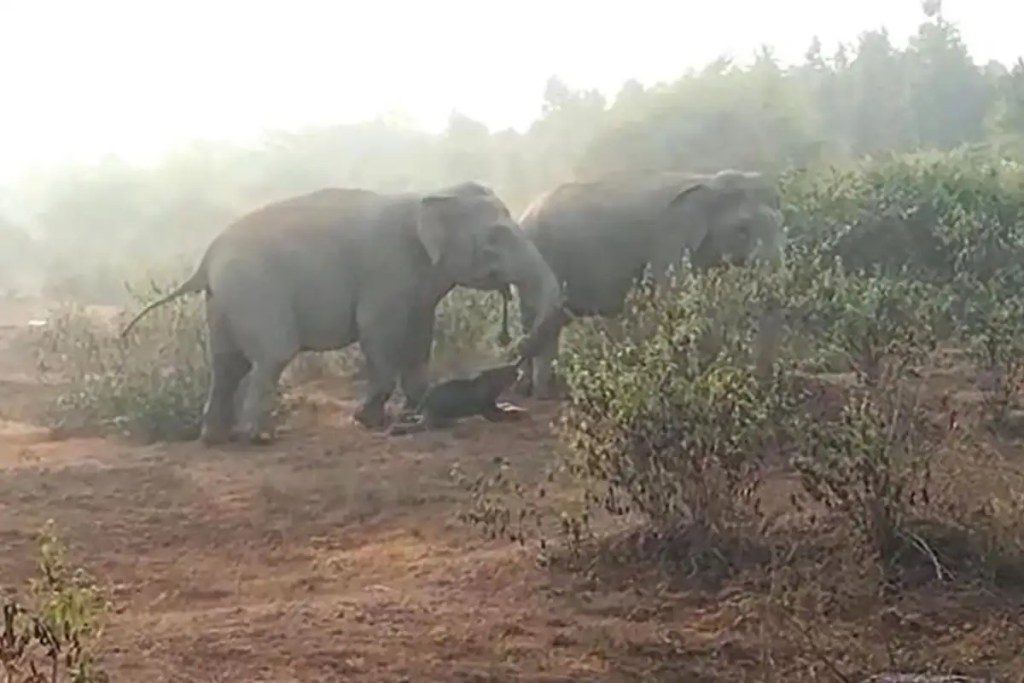
Credit: Parveen Kaswan and Akashdeep Roy.
Asian Elephant herd members in north Bengal have been documented burying premature calves in irrigation trenches inside tea gardens. The behavior is unique to this species and has been observed in cases in Debpara, Chunabhati, Bharnabari, Majherdabri, and the New Dooars tea gardens near Gorumara and Buxa. In five case studies in north Bengal, herd members dragged the calves away from human settlements before burying them in “leg-upright position” in irrigation trenches inside tea gardens.
Footprints and dung of various sizes indicate that herd members of all ages contributed to each burial. Night guards at the estates reported loud Elephant vocalisations, sometimes lasting as long as 30 to 40 minutes, before the herd left the area.
Akashdeep Roy at the Indian Institute of Science Education and Research in Pune and Parveen Kaswan at the Indian Forest Service suggest that these trumpeting sounds may signify mourning and that the herds showed “helping and compassionate behaviour” during the burials.
“Calf burials are extremely rare events in nature,” says Roy.

They were surprised that the calves were buried feet up, but if the herd collectively buried each calf, this is the most accessible position to place the carcass into the drainage ditch, says Roy. As social animals, it may be most important to the elephants to bury the calf’s head, he says.
The calves’ bodies were later exhumed and examined. They ranged in age from 3 months to a year old, and a number of them were malnourished and had infections. Bruising along each calf’s back suggests they were dragged or carried long distances to the burial sites.
African bush Elephants (Loxodonta africana) have been observed covering dead bodies with vegetation and returning to these locations later. However, the Asian Elephants (Elephas maximus) in this study generally avoided returning to the burial sites, instead using alternative pathways.
“These observations offer impressive evidence of the social complexities of Elephants,” says Chase LaDue at the Oklahoma City Zoo and Botanical Garden. “Others have noted that Elephants appear to behave in unique ways towards their deceased relatives, [but] this paper is the first to describe what appears to be methodical and deliberate burial of Elephant calves after they have been carried to the burial site.”
The land in which Elephants once roamed freely is shrinking as humans expand – especially in India, the world’s most populous country. Only about 22 per cent of the land that Elephants use is within protected areas.
“Understanding how Elephants behave and respond to rapid changes in human-dominated landscapes may help us develop conservation strategies that promote the coexistence of people and Elephants,” says LaDue.
Research Study: Unearthing Calf Burials Among Asian Elephants In Northern Bengal, India.
Asian Elephants are recognised as endangered by the International Union for Conservation of Nature.
An estimated 26,000 of them live in the wild, mostly in India with some in South-East Asia, surviving for an average of 60-70 years outside captivity.

WHAT YOU CAN DO TO HELP WILDLIFE
You can support ‘Protect All Wildlife’ many projects by donating as little as £5 – It only takes a minute but it can last a lifetime for an animal in need. Please donate below.
Donate Here: Please Help Animals In Need
Everyone who donates will receive a Certificate of Appreciation as a thank you for helping animals in need.

The Mission of Protect All Wildlife is to prevent cruelty and promote the welfare of ALL animals.
We believe EVERY animal should be treated with respect, empathy, and understanding. We raise awareness to protect and conserve wild, captive, companion and farm animals.
It is vital that we protect animals against acts of cruelty, abuse, and neglect by enforcing established animal welfare laws and, when necessary, take action to ensure that those who abuse animals are brought to justice.
Protect All Wildlife are involved in many projects to protect animals’ rights, welfare, and habitats. Money contributed to Protect All Wildlife supports ALL of our worthy programmes and gives us the flexibility to respond to emerging needs. Your donations make our work possible.
 PROTECT ALL WILDLIFE