After Whales and Dolphins, Ottawa intends to ban keeping Elephants and great Apes in captivity in the country “because of the cruelty they represent”.
A new bill, calledThe Jane Goodall Act, was introduced in the Senate on Tuesday to ban anyone from taking an Elephant or a great Ape, a term that includes Chimpanzees, Gorillas and Orangutans.
Canadian zoos won’t be able to bring in new elephants or apes under new federal legislation introduced this week, except under specific circumstances. Bill S-15 looks to ban all new captivity of the species except where a licence is granted for conservation, research or an animal’s best interest.
“The recapture of any Elephant or great Ape in Canada must meet very strict criteria demonstrating that the activity is for animal welfare, conservation or science,” commented the Minister of Environment and Climate Change, Steven Guilbeault.
Senator Marky Klyne of Saskatchewan sponsored the bill that was introduced on Tuesday. “It is upsetting to know that according to current standards, a person does not need to hold a permit to own a chimpanzee in some regions of Canada,” he lamented to explain the interest of his fee.
Elephants, for their part, are very intelligent animals that suffer when kept in captivity or presented to the public in an unnatural environment, added the senator in the second reading of the law on Thursday.
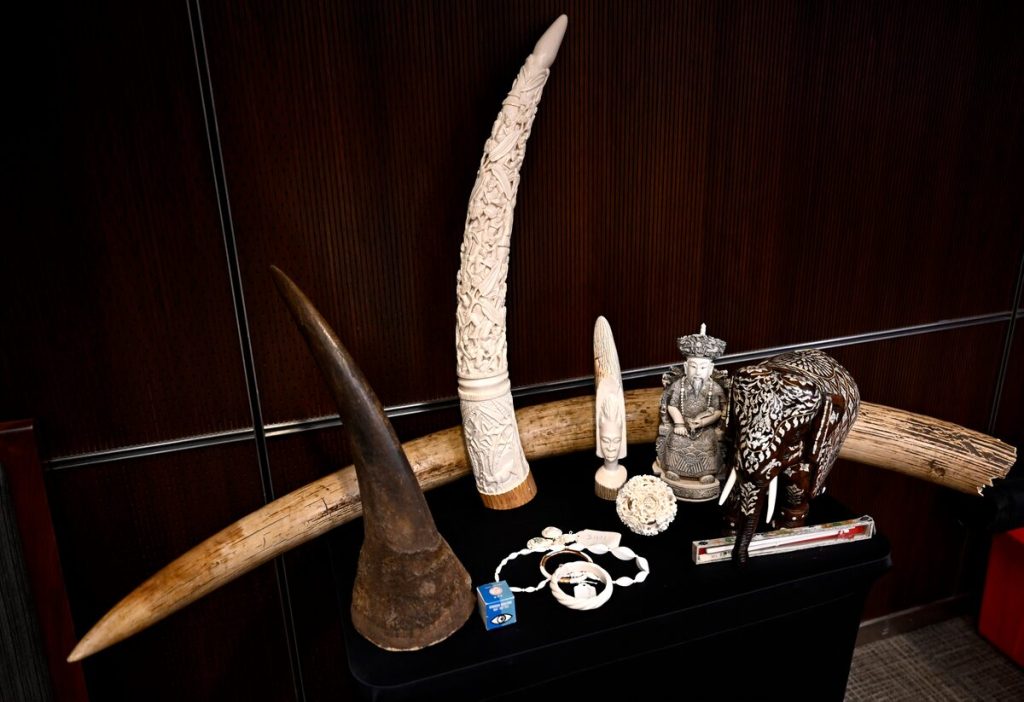
Minister Guilbeault announced the ban on the import of ivory from Elephant tusks and Rhino horns, including hunting trophies and articles carved from ivory, for which it is necessary to obtain a permit. Few exceptions are planned for museums and scientific research.
Elephant ivory and rhino horn imports have been banned by Ottawa
Tightening the laws
The law banning the captivity of great Apes and Elephants is part of a series of laws adopted to better protect animals in Canada and elsewhere in the world.
In 2019, Canada also banned the keeping of Whales and Dolphins in captivity.
WHAT YOU CAN DO TO HELP ANIMALS IN NEED
You can support our work by donating as little as £5 – It only takes a minute but it can last a lifetime for an animal in need.
Everyone who donates will receive a Certificate of Appreciation as a thank you for helping animals in need.
The Mission of Protect All Wildlife is to prevent cruelty and promote the welfare of ALL animals. We believe EVERY animal should be treated with respect, empathy, and understanding. We raise awareness to protect and conserve wild, captive, companion and farm animals.
It is vital that we protect animals against acts of cruelty, abuse, and neglect by enforcing established animal welfare laws and, when necessary, take action to ensure that those who abuse animals are brought to justice.
Protect All Wildlife are involved in many projects to protect animals’ rights, welfare, and habitats. Money contributed to Protect All Wildlife supports ALL of our worthy programmes and gives us the flexibility to respond to emerging needs. Your donations make our work possible.
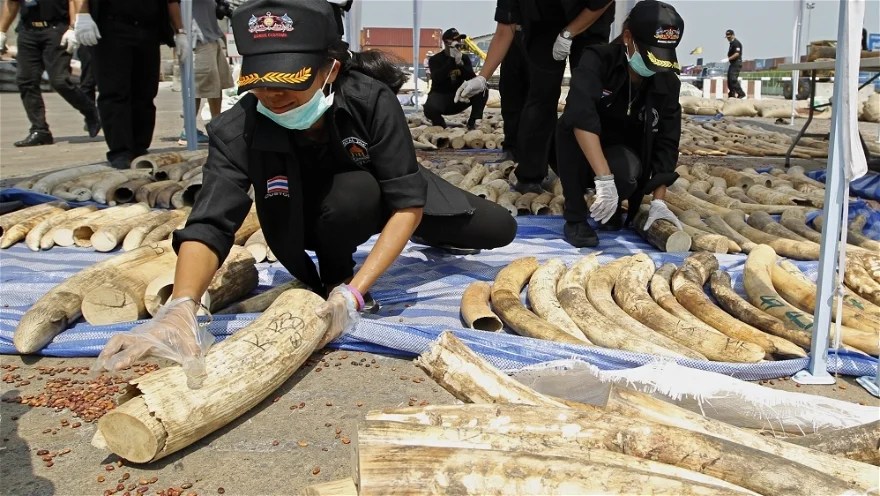
A three-year investigation has led authorities in the Democratic Republic of Congo to 2 metric tons of ivory hidden in a stash house in the southern city of Lubumbashi.
The tusks are valued at $6 million on the international market and estimated to have come from more than 150 elephants.
The three people arrested in the May 14 raid are allegedly members of a major wildlife trafficking ring in the Southern African region.
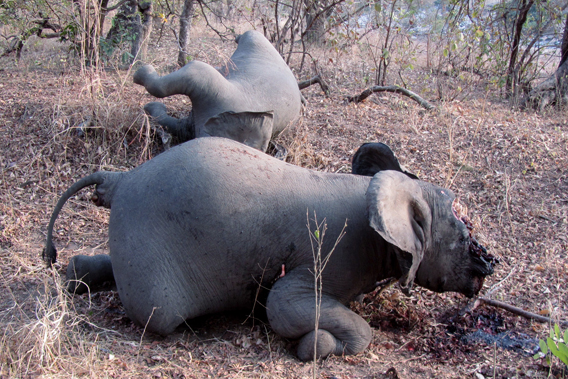
POACHED ELEPHANT ON ITS KNEES WITH ANOTHER LYING DEAD BEHIND IT
Authorities in the Democratic Republic of Congo have seized 2 metric tons of ivory in the city of Lubumbashi, a hub for ivory trafficking.
The May 14 seizure is one of the largest in recent years, according to Adams Cassinga, who heads Conserv Congo, an NGO that fights wildlife trafficking and which took part in the operation. The seized ivory is estimated to be worth $6 million.
Authorities arrested three people, believed to be members of one of the major wildlife trafficking rings in the region. The network is linked to the smuggling of 20 metric tons of ivory in the past five years alone.
The latest seizure represents more than 150 elephants killed for their tusks, Cassinga said. The tusks originated from countries in Southern Africa, which has seen a surge in ivory trafficking in the 2000s, fueled by demand from Asia, particularly China.
Ivory found in a stash house in Lubumbashi, the Democratic Republic of Congo. Image courtesy of Adams Cassinga/Conserv Congo
At the height of the crisis, 30,000 elephants were being killed every year, an average of 80 a day. African elephant populations have shrunk by 80% in the past 100 years, according to an analysis by WWF. The African savanna elephant (Loxodonta africana) is considered endangered on the IUCN Red List, while the forest elephant (Loxodonta cyclotis) is critically endangered, only a step away from being extinct in the wild.
Poaching has declined in recent years, a 2021 report by Geneva-based nonprofit Global Initiative Against Transnational Organized Crime (GI-TOC) found. One of the factors cited for the dip is the weakening of criminal networks because of raids and arrests.
DR CONGO AUTHORITIES SEIZE 1.5 TONNES OF ELEPHANT IVORY
“The reduced poaching seems to be the result of the dismembering through arrests and prosecutions of a large number of transnational organized criminal networks involved in ivory poaching and trafficking in East and southern Africa between 2014 and 2020,” the GI-TOC report said.
The Lubumbashi raid was led by the DRC’s top conservation authority, known by its French acronym, the ICCN. It included members of the national police force, court officials and the NGO Conserv Congo.
The team recovered the ivory from a stash house in Lubumbashi in the southern DRC. Traffickers brought the poached parts into the DRC from Zambia, which lies on the country’s southern border. Lubumbashi has emerged as a major hub from where poached wildlife parts are funneled out of Africa. The items originate primarily in Southern African countries like South Africa, Zimbabwe and Zambia.
“We are sure it will bring a great deal of deterrence in a place where previously wildlife laws were neglected and not applied,” Cassinga said in a tweet.
Weak enforcement of laws, armed conflict and corruption have allowed international gangs to operate with impunity in western and Central Africa. The DRC, which shares borders with nine countries, serves as an important transit point for the movement of trafficked parts. The Central African nation, which hosts the largest swath of Congo Basin rainforest, is also a source country for illegal wildlife goods.
Yet, from 2000 to 2014, when elephant poaching was rampant, the DRC recovered only around 8 metric tons of ivory in seizures. Then, between 2015 and 2019, authorities there confiscated 20 metric tons, according to data collected by the Environmental Investigation Agency, an NGO based in the U.K.
“We are making strong efforts to take down all the illegal trade networks. With time, we have bigger impacts on the illegal networks,” Olivier Mushiete, head of the ICCN, said in a phone interview with Mongabay.
The Lubumbashi raid follows a series of raids in the DRC capital, Kinshasa, last year. Mushiete told Reuters at that time that they expect to recover more than 60 metric tons in future seizures. The current operation was a result of three years of investigation.
“The relationship between the government and the civil society is improving. You can see that it is yielding results,” Cassinga said. He added that support from partners like Zambia-based Wildlife Crime Prevention and international donors like the Rhino Recovery Fund is helping them combat wildlife trafficking.
The skull of an elephant recently killed by poachers who ripped out its tusks in Province Orientale, DRC. Image by Matchbox Media Collective via Flickr (CC BY-NC-SA 2.0).
Ivory poaching is one of the most lucrative illicit trades, valued at around $23 billion a year, according to Bloomberg.
CITES, the global convention on the wildlife trade, banned the international commercial trade in ivory in 1989. However, some countries continue to allow domestic trade and international trade, subject to varying degrees of regulation.
In the past decade, efforts to curb ivory demand have gathered pace, with the U.S. imposing a near-complete ban on elephant ivory trade in 2016 and China banning the domestic trade in 2017. The EU tightened its rules on the ivory trade in 2021. Narrower exemptions limit the legal ivory trade, which conservationists say often serves as a cover for unlawful transactions.
The three suspected traffickers from the Lubumbashi raid are due to appear in court this week.
Even if seizures and arrests increase, the impact on poaching could be limited by countries’ failure to prosecute alleged traffickers. Coordinating cross-border investigations and amassing the necessary evidence is tricky. Wildlife crimes are often not prioritized by law enforcement agencies or judicial authorities.
The arrest of two Vietnamese nationals during the seizure of 3.3 metric tons of ivory from Uganda’s capital, Kampala, in 2019 did not result in convictions because both suspects skipped bail.
Raids also tend to net intermediaries but rarely lead to the capture of those who organize, fund and benefit the most from this illegal trade. “As far as dismantling the network, that is unlikely. It may be slowed down,” said Chris Morris, who works with the Kenya-based organization Saving Elephants through Education and Justice (SEEJ). “These cartels are a business. They are prepared for losses from seizures and arrests.”
What you can do to help
Please support Protect All Wildlife‘s work by donating as little as £1 – it only takes a minute. Please donate ANY amount, large or small,at HELP PROTECT ALL WILDLIFE. Thank you.
What else you can do to help
Please SHARE to raise awareness to wildlife and environmental issues from around the world. You can also receive NEWS and UPDATES by signing up in the top right of this page.








 PROTECT ALL WILDLIFE