
A LONELY orca has been filmed swimming by itself in captivity – barely able to move in a tiny pool.

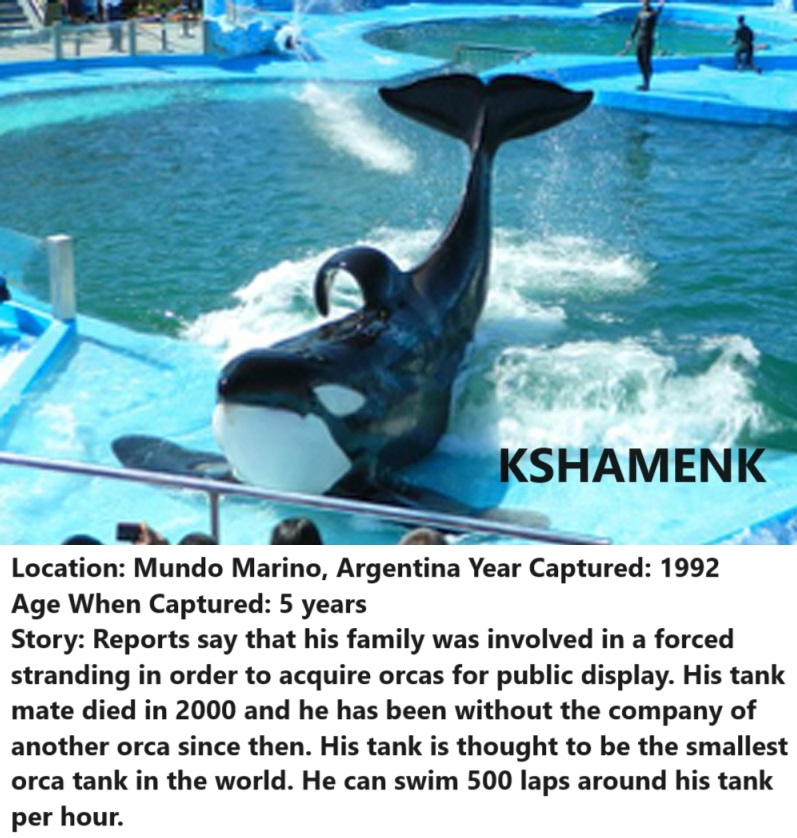
The 35-year-old whale, known as Kshamenk, has lived in captivity at Mundo Marino since 1992 when he was caught in the wild. He had a mate, known as Belen, but she died in 2000, leaving the lonely orca alone. Now a new video shared online shows the orca in a tiny pool at the marine site.
The devastating video shared to social media has gone viral 20 years after the heartbroken orca’s partner died.
He appears very still, floating in the middle of the pool, as a Dolphin swims around him. In the wild, Kshamenk would swim anywhere up to 140 miles in a single day as they swim huge distances over the course of a year.
Animal activist and co-founder of UrgentSeas, Phil Demers, visited the park where he filmed the footage to share knowledge of the lonely Orca’s troubling existence. Phil from Canada, said: “Kshamenk was captured from the wild and brought to the park to accompany another Orca, Belen Sadly, Belen died in 2000 after pregnancy complications, leaving Kshamenk to live with only two Dolphins.
“His sperm has been sold several times to SeaWorld to impregnate orcas. The Argentina government refuses to release Kshamenk or export him out of the country. He appears to be losing weight and is more lethargic in recent videos causing growing concerns for his well-being. Unless Kshamenk is rescued soon, he too will die tragically and senselessly. We must fight for Kshamenk!”
Phil put the video up on his Instagram page. The post has had more than 13,135 likes, as well as 1,290 comments from shocked users.
One said: “This is horrifying. No animal should live like this.”
As another commented: “Imagine being locked in a white padded room for 50 years since you were a baby.
“No education. This is a jail. Solitary confinement.”
Other posts called the treatment “so awful”, as he can’t even move around while some called it “so sad and heartbreaking”.
A final man went on a passionate cry for help on behalf of nit only Kshamenk but all orcas trapped in captivity.
The man known as Mickey said: “Immoral to the highest degree. #FreeKshamenk and GLOBAL BAN these damn parks, already.
“There are literally thousands on thousands of other things to do than spend ticket money on these hell holes.”
Many agreed with Mickey and labelled it as “complete torture”.
A woman said: “These animals are meant to live in the ocean, not in that damn tank.”
Phil added: “A campaign to outlaw his current captivity is gaining momentum in Argentina by local activists, so bringing awareness and sharing his story surely supports their efforts. It breaks my heart to see Kshamenk’s conditions. He needs to be rescued.”

WHAT YOU CAN DO TO HELP ANIMALS IN NEED
You can support our work by donating as little as £5 – It only takes a minute but it can last a lifetime for an animal in need.
CLICK HERE TO DONATE PLEASE HELP ANIMALS IN NEED
Everyone who donates will receive a Certificate of Appreciation as a thank you for helping animals in need.

The Mission of Protect All Wildlife is to prevent cruelty and promote the welfare of ALL animals.
We believe EVERY animal should be treated with respect, empathy, and understanding. We raise awareness to protect and conserve wild, captive, companion and farm animals.
It is vital that we protect animals against acts of cruelty, abuse, and neglect by enforcing established animal welfare laws and, when necessary, take action to ensure that those who abuse animals are brought to justice.
Protect All Wildlife are involved in many projects to protect animals’ rights, welfare, and habitats. Money contributed to Protect All Wildlife supports ALL of our worthy programmes and gives us the flexibility to respond to emerging needs. Your donations make our work possible.

 PROTECT ALL WILDLIFE