After Whales and Dolphins, Ottawa intends to ban keeping Elephants and great Apes in captivity in the country “because of the cruelty they represent”.
A new bill, calledThe Jane Goodall Act, was introduced in the Senate on Tuesday to ban anyone from taking an Elephant or a great Ape, a term that includes Chimpanzees, Gorillas and Orangutans.
Canadian zoos won’t be able to bring in new elephants or apes under new federal legislation introduced this week, except under specific circumstances. Bill S-15 looks to ban all new captivity of the species except where a licence is granted for conservation, research or an animal’s best interest.
“The recapture of any Elephant or great Ape in Canada must meet very strict criteria demonstrating that the activity is for animal welfare, conservation or science,” commented the Minister of Environment and Climate Change, Steven Guilbeault.
Senator Marky Klyne of Saskatchewan sponsored the bill that was introduced on Tuesday. “It is upsetting to know that according to current standards, a person does not need to hold a permit to own a chimpanzee in some regions of Canada,” he lamented to explain the interest of his fee.
Elephants, for their part, are very intelligent animals that suffer when kept in captivity or presented to the public in an unnatural environment, added the senator in the second reading of the law on Thursday.
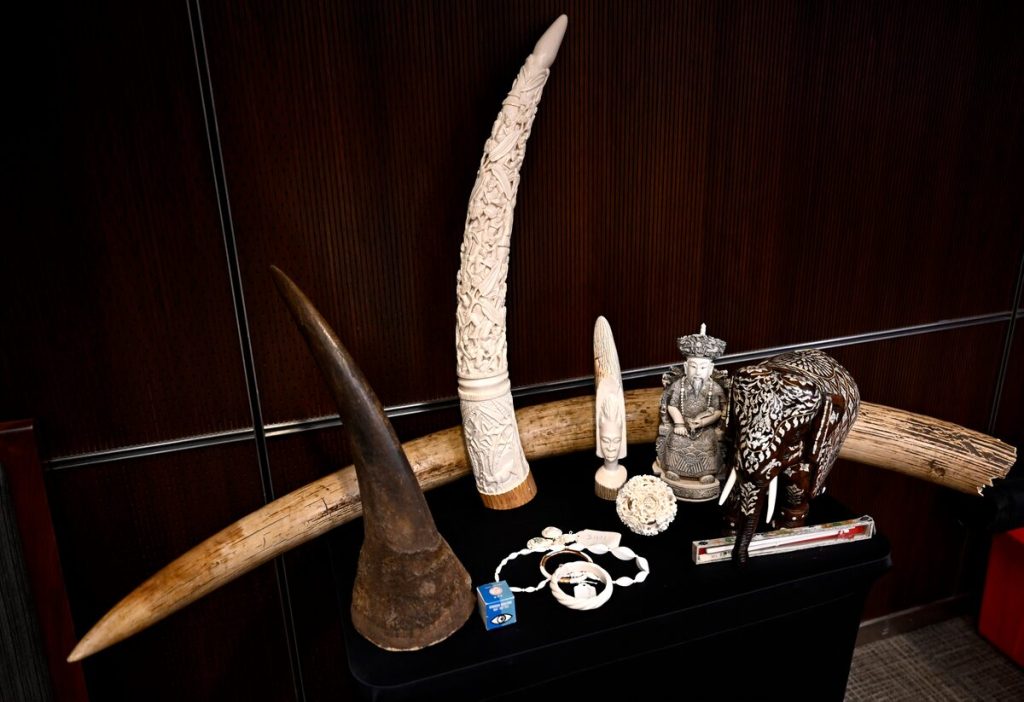
Minister Guilbeault announced the ban on the import of ivory from Elephant tusks and Rhino horns, including hunting trophies and articles carved from ivory, for which it is necessary to obtain a permit. Few exceptions are planned for museums and scientific research.
Elephant ivory and rhino horn imports have been banned by Ottawa
Tightening the laws
The law banning the captivity of great Apes and Elephants is part of a series of laws adopted to better protect animals in Canada and elsewhere in the world.
In 2019, Canada also banned the keeping of Whales and Dolphins in captivity.
WHAT YOU CAN DO TO HELP ANIMALS IN NEED
You can support our work by donating as little as £5 – It only takes a minute but it can last a lifetime for an animal in need.
Everyone who donates will receive a Certificate of Appreciation as a thank you for helping animals in need.
The Mission of Protect All Wildlife is to prevent cruelty and promote the welfare of ALL animals. We believe EVERY animal should be treated with respect, empathy, and understanding. We raise awareness to protect and conserve wild, captive, companion and farm animals.
It is vital that we protect animals against acts of cruelty, abuse, and neglect by enforcing established animal welfare laws and, when necessary, take action to ensure that those who abuse animals are brought to justice.
Protect All Wildlife are involved in many projects to protect animals’ rights, welfare, and habitats. Money contributed to Protect All Wildlife supports ALL of our worthy programmes and gives us the flexibility to respond to emerging needs. Your donations make our work possible.
As the number of Rhinos killed by poachers keep rising and more traumatized orphaned calves are in need of care, Kirsten Everett, a volunteer at Nikela, takes us on a touching journey as she looks at the horrors of a poacher attack though the eyes of a young Rhino calf.
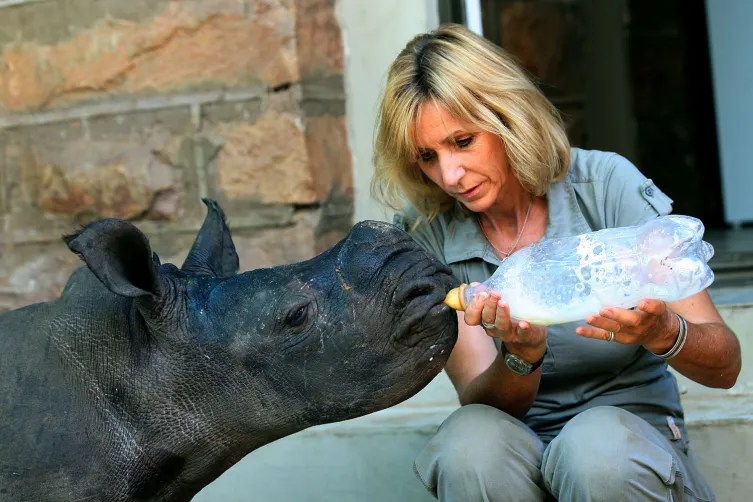
LIMPOPO, SOUTH AFRICA: Karen Trendler cares for Ntombi, a two-month old White Rhino. Ntombi survived a brutal attack, when poachers killed her mother earlier in the week. She sustained severe head injuries and was cared for in a rhino orphanage. Credit: Kevin Sutherland.
“My mother and I were contently filling our hungry stomachs when we heard a strange noise. I carried on eating but she smelt the air for unknown scents. I saw the terrified look in her eye before she managed to control it; the unnatural smell meant something. A few minutes later we heard the ‘whop, whop’ of a metal monster flying closer towards us. Just when my mother focussed on it the men crept out of the bushes with a crunch of sticks. Something seemed to hit her and she grunted in surprise. The birds abandoned their posts heading away from the danger. I stood helplessly as she tried to run but ended up falling to the ground. The men surrounded her and tried to chase me away. I ran forward scared enough to not care about the men as they had done something to my mother, I needed her and they must go away.
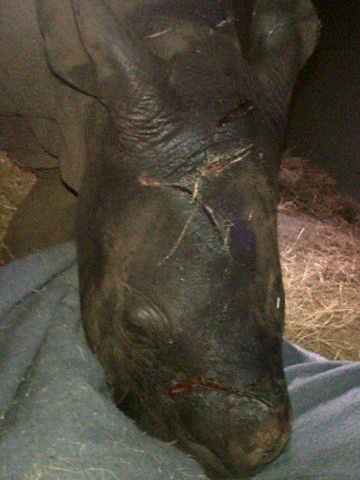
Out of nowhere one of the big men spun on me and hit me hard with something sharp. Blood oozed from my wound as my mother answered my cry for help with a weak beg, ‘Away, away’. I backed away nursing my wound, how could I get to her?? She grunted again so I didn’t give up. I ran forward again but this time the angry man was merciless, determined to get his message across. As quietly as possible I took the cuts to my poor head trying not to worry my mother even more.
Confused I backed away into the bushes calling to her to get up, but the eerie silence dragged on and she didn’t move a muscle. Fear glued me to the floor as I felt my young heart pulsing with anger and fear. A breeze blew, as I waited for the monsters to go so I could go to my poor mommy and find out what was wrong. My heart skipped a beat when I realised this was what my cousin had gone through only a full moon ago. It was terrible, my body couldn’t stop shaking and I couldn’t think clearly, I felt lightheaded from all my blood loss.
Finally when the monsters left I ran to her side, ‘Mom wake up.’ My voice cracked with emotion but still she didn’t respond. I took a step back and saw the pool of blood. Her horn had been brutally cut off and she lay lifeless. Above me a crow flew over.
I turned to run then I asked myself some important questions… where would I go? I wasn’t old enough to know the way to the dam yet. Who would protect me from predators? The truth was that I wasn’t strong enough to survive by myself yet. Would I be with my mother in the sky sooner than I thought? The last question scared me the most; out in the wild without my mother I might just be able to survive a week.
I heard the snap of a twig, I wasn’t alone. This time I didn’t have the strength to care what these humans wanted with me. I collapsed and slept for a few hours. I was almost completely unconscious though I sensed kindness near me. Too traumatised to do anything I lay as they treated my wounds. The people who tried to comfort me planted a seed of hope. Hope that I could survive and hope that the rest of the human race would come to its senses and help my species and all the others out there”.
Let’s stop the babies’ cries! Let’s Save The Last Rhin0!
Written by Kirsten Everett. Based loosely on the story of “Ntombi” who was rescued by Karen Trendler and her team.
Ntombi bears the poacher’s scars
WHAT YOU CAN DO TO HELP ANIMALS IN NEED
You can support our work by donating as little as £5 – It only takes a minute but it can last a lifetime for an animal in need.
Everyone who donates will receive a Certificate of Appreciation as a thank you for helping animals in need.
The Mission of Protect All Wildlife is to prevent cruelty and promote the welfare of ALL animals. We believe EVERY animal should be treated with respect, empathy, and understanding. We raise awareness to protect and conserve wild, captive, companion and farm animals.
It is vital that we protect animals against acts of cruelty, abuse, and neglect by enforcing established animal welfare laws and, when necessary, take action to ensure that those who abuse animals are brought to justice.
Protect All Wildlife are involved in many projects to protect animals’ rights, welfare, and habitats. Money contributed to Protect All Wildlife supports ALL of our worthy programmes and gives us the flexibility to respond to emerging needs. Your donations make our work possible.
A Mozambican national serving a prison sentence for Rhino poaching has been slapped with another lengthy jail term after being convicted of killing a second Rhino in the Skukuza National Park.
Convicted poacher Lucky Mabunda
The National Prosecuting Authority said 47-year-old Lucky Mabunda, was sentenced in the town’s Regional Court on Thursday to ten years direct imprisonment.
NPA spokesperson, Monica Nyuswa, said he was already serving a 19-year jail term for Rhino poaching and was convicted and sentenced for the second incident in 2019.
She said the court heard that Mabunda had entered the Skukuza National Park between February and September 2019. Field Rangers were patrolling and found the accused in possession of a firearm, axe, ammunition, and other items geared for hunting. They also found the carcasses of two Rhinos.
Nyuswa said he pleaded guilty to killing one rhino, before ballistic evidence taken from the Rhino killed in February, later provided the link back to him.
“It confirmed that the bullets found on the carcass were fired from the rifle found in the accused’s possession,” she said.
State prosecutor Lot Mgiba underscored the gravity of the offense, advocating for an appropriate sentence in court.
Consequently, the accused was found guilty and received a ten-year jail term. The importance of such legal actions in combating poaching, which poses a severe threat to endangered species and the potential for species extinction, was highlighted by Director of Public Prosecutions Advocate Nkebe Kanyane.
SANParks spokesperson, Ike Phaahla, says they welcome the sentence.
“We are elated at the sentencing, which is in addition to the 18 years he has already served since he was found inside the park. In this instance, a projectile was discovered next to the carcass and taken for ballistics. They came back pointing towards the accused, and he was requisitioned from the Department of Correctional Services to get an additional 10-year sentence. It’s a well-known fact that we still have people who, around this time, want to come in, but we want to warn them that Kruger National Park is a dangerous place to come.”
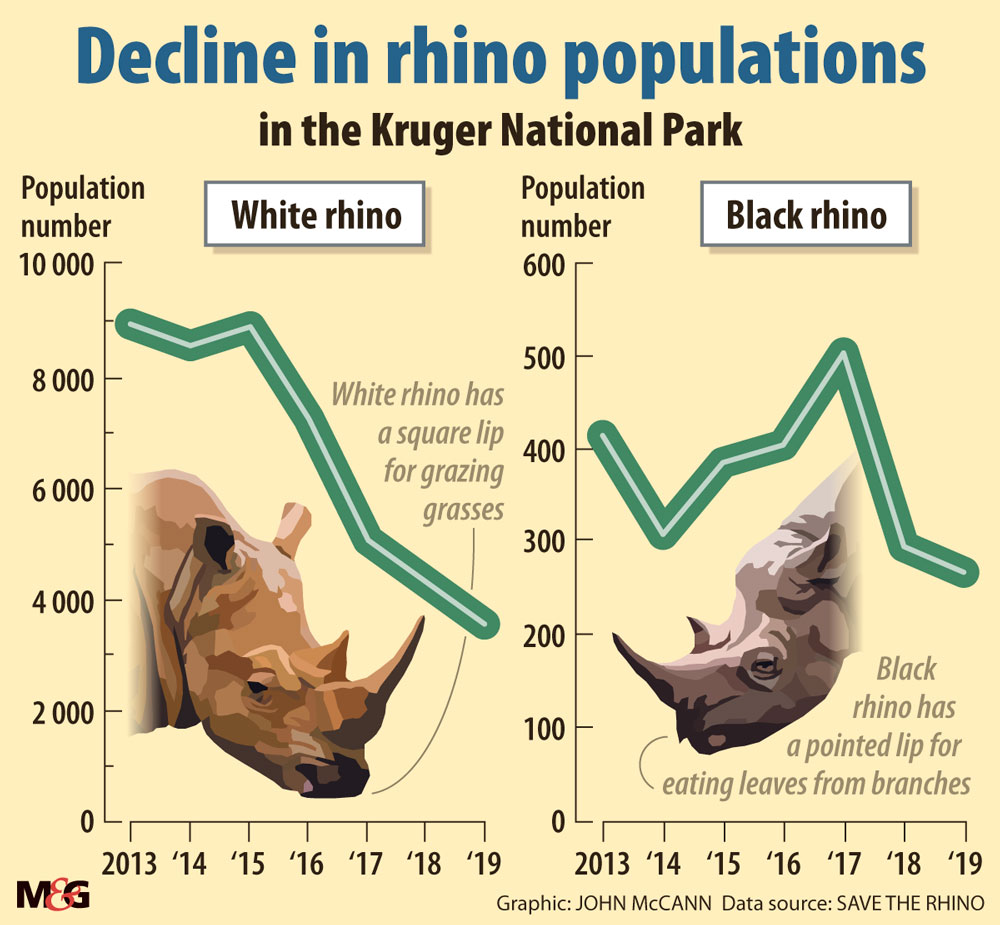
Kruger has lost 70% of ITS Rhinos in 10 years
The Decline In Rhino Populations In KNP Graph: Save The Rhino
Rhino populations in the Kruger National Park have dropped by about 70% in the past decade because of the onslaught of poaching and prolonged drought. In its 2019-20 annual report, SANParks said that only about 3 549 White Rhinos and 268 Black Rhinos remain in the Kruger.
The environment department said poachers killing cows also ultimately kill dependent calves and cause future loss of calves — this effect equates to an additional five rhinos lost to the population per loss of one cow, now and in future. “Poaching also causes factors such as social disruption of Black Rhino societies. Cows then conceive less often.”
WHAT YOU CAN DO TO HELP ANIMALS IN NEED
You can support our work by donating as little as £5 – It only takes a minute but it can last a lifetime for an animal in need.
Everyone who donates will receive a Certificate of Appreciation as a thank you for helping animals in need.
The Mission of Protect All Wildlife is to prevent cruelty and promote the welfare of ALL animals.
We believe EVERY animal should be treated with respect, empathy, and understanding. We raise awareness to protect and conserve wild, captive, companion and farm animals.
It is vital that we protect animals against acts of cruelty, abuse, and neglect by enforcing established animal welfare laws and, when necessary, take action to ensure that those who abuse animals are brought to justice.
Protect All Wildlife are involved in many projects to protect animals’ rights, welfare, and habitats. Money contributed to Protect All Wildlife supports ALL of our worthy programmes and gives us the flexibility to respond to emerging needs. Your donations make our work possible.
World Rhino Day helps us to understand how these animals are struggling to survive and how they are endangered. We should find ways to save them from becoming extinct.
Here is a small collection of thought provoking poems.
Get Together! (Protect The Rhino) by Kitty Lam.
Sometimes I wish that I wasn’t born with a tall, magnificent, towering horn Because I might be killed soon while my horn were torn. Every 8 hours, one of us is dreadfully killed, Only to make their dream fulfilled?
If I were to say we’re nothing special, we’re just like you it’s just not fair. And if I say our horns are made like your nails and your hair. Would people still kill us or let us be free? Maybe they’ll laugh, as you can see.
We’re neither for sale, nor for medicine or as your house souvenirs. I don’t want to be a display and stay there for years! How can it be a work that they’re so proud of? Then does that mean we’re just “stuff”?
There are not many of us now, only 5 species left and yes it is true. White, Black, Greater One- Horned, Sumatran and Javan too. However, I’m afraid that one day we’ll be gone, And by then whom will they look upon?
I know by far that many of you had protected us, and gave us support. Though is it not enough to reach the hunter’s heart? Don’t you think that we’ve had enough? We have to stay strong and tough.
This is why we need your help, to spread the word and show us you care. Help us make a difference, since we are considered as rare. I want us to all get together and to be a part of this. For a happy future that you’ll never miss!
On Seeing A Documentary On Black Rhino by Francis Duggan.
The poachers only shoot them for their horn And they even kill the young and newly born And their numbers in the wild State only few And their last hope of survival now the zoo.
It’s sad to think that African tribal child May not now see black rhino in the wild May live his whole lifetime and never see Black rhino on savanna living free.
Some men don’t kill to eat they kill for greed And only think of their financial need For cash reward rich dealers they supply And Rhino for their horn condemned to die.
The Black Rhino in Africa now so few And some were flown to Australia to Dubbo Zoo In hope they might breed in captivity At least of poachers guns they now are free.
I watched a program on them on T.V. And I felt sad so sad at what I see To think that men would shoot them for their horn And even kill their young and newly born.
Blankets For Baby Rhinos by Anne Moth.
I wear black for the rhinos killed and maimed For what men do they should be so ashamed They take the lives of creatures wild and free For Gods sake will you listen, leave them be.
I wear black for the orphans left behind Because of cruelty caused by some of mankind The babies left behind, they have no mums Evil men shot and killed them with their guns.
I wear black for the stupidity of man’s greed The ones who plant the ever growing evil seed Saying horn so good, it’ll make you strong If only people listened because it is so wrong.
When all the rhinos are allowed to thrive and live For that wonderful day my very soul I’d give Until that day the clothes upon my back Will have no colour, I’ll be the woman dressed in black!
Son by Ray Dearlove.
As we wander through the glade I watch my first born, searching for shade Soon it will be night With the full moon burning bright.
No natural enemies on the plains Certainly confident, perhaps a little vain So little but already has the strut Superior to all animals, no ifs, no buts.
The moon is high, it could be daytime I am blessed with my little man, approaching his prime I feel the pain before I hear the shot A deep burning pain in my side, burning hot.
My son runs towards me, terrified I breathe hard, running for the forest, must hide We crash through the bushes, through the trees More shots, so close, when will it cease.
Deep in the bush we stop, searching for a thicket of thorns All these people want is my horns Why must they kill me to win their gory prize I wish that mine were not such a great size.
I lay down to rest, my boy by my side We must be deathly quiet and hide How long can I withstand this terrible pain I must rise, I stand, but then I fall again.
We stumble a few steps, him nuzzling my neck Sobbing, crying, am I ok, he wants to check My world goes dark and black Someone, anyone, please save my son from this cruel attack.
One Rhino by Tessa Botha
One Rhino Two horns Sitting atop its head Two eyes Resting on its face Two tons Of a big body One rhino Grazing.
One bullet Entering the thick grey skin One Rhino Crashing To the dirt underneath its feet Blood dripping down.
One rhino gone Away from its family Away from its home. One rhino that was killed for its horns One rhino that was taken to Asia Made into medicine Curing nothing.
One rhino wasted One horn made of keratin One head full of hair made of keratin Two different things made of one Both not able to cure anything But one still being used Being hurt Being killed All for nothing!
Leave Us Alone by Nobby Clarke.
PLEASE leave us alone we are tired of running and all we want to do is roam. Our horn is useless so the experts have said. Remember there will be no more horn left once all my family are dead!
RHINOS ARE IN DANGER , AND WE MUST ACT!
Save Rhino slogans are powerful phrases that unite us to save these magnificent creatures. With poaching and habitat loss threatening their existence, it’s time to take a stand.
“Save the Rhino, Save the World” and “Protect Rhinos, Save Tomorrow” are rallying cries that spread awareness and inspire action. Let’s come together and be their guardians.
Say no to ivory and support conservation efforts. “Rhinos Deserve a Future” – let’s make it happen! Together, we can ensure these gentle giants continue to thrive on our planet for generations to come. Join the movement and save the rhinos now!
WHAT YOU CAN DO TO HELP WILDLIFE
You can support ‘Protect All Wildlife’ by donating as little as £1 – It only takes a minute but it can last a lifetime for an animal in need. Please donate below.
Everyone who donates will receive a Certificate of Appreciation as a thank you for helping animals in need.
The Mission of Protect All Wildlife is to prevent cruelty and promote the welfare of ALL animals.
We believe EVERY animal should be treated with respect, empathy, and understanding. We raise awareness to protect and conserve wild, captive, companion and farm animals.
It is vital that we protect animals against acts of cruelty, abuse, and neglect by enforcing established animal welfare laws and, when necessary, take action to ensure that those who abuse animals are brought to justice.
Protect All Wildlife are involved in many projects to protect animals’ rights, welfare, and habitats. Money contributed to Protect All Wildlife supports ALL of our worthy programmes and gives us the flexibility to respond to emerging needs. Your donations make our work possible.
“Animals are not here for us to do as we please with. We are not their superiors. We are their equals. We are their family. Be kind to them.” ~ Ricky Gervais.
Cruelty to animals, also called animal abuse, animal neglect or animal cruelty, is the infliction by omission (neglect) or by commission by humans of suffering or harm upon any animal. More narrowly, it can be the causing of harm or suffering for specific achievement, such as killing animals for entertainment; cruelty to animals sometimes encompasses inflicting harm or suffering as an end in itself, defined as zoosadism.
Animal cruelty can be broken down into two main categories: active and passive. Passive cruelty is typified by cases of neglect, in which the cruelty is a lack of action rather than the action itself. Oftentimes passive animal cruelty is accidental, born of ignorance. In many cases of neglect in which an investigator believes that the cruelty occurred out of ignorance, the investigator may attempt to educate the pet owner, then revisit the situation. In more severe cases, exigent circumstances may require that the animal be removed for veterinary care.
Whether it is Elephants killed for their tusks or beaten so they comply in the Asian tourism ‘industry’, Rhino slaughtered for their horns for ‘traditional Chinese medicine (TCM), animals skinned alive for the fur trade etc, animal activists need to stand together to fight for their rights.
At many elephant ‘sanctuaries’ across Thailand and in other countries, the elephants are taught to fear humans. This is so that they will act with compliancy. From babies they are tied up, starved and beaten in what is known as a ‘crush’. This is the act of breaking a young elephant’s spirit. And it’s mostly true what they say: an elephant never forgets. This means that, with their long memories, elephants remember this period of abuse for the rest of their lives. It ensures that the elephants will do what the trainers (also known as mahouts) say, and are more easily trained.
They are also commonly beaten with hooks and sticks that have nails poking out of them – this is when they are seen to be misbehaving or not following orders, or being too slow to respond. The mahouts want the animals to be constantly putting on a performance for those tourists who are there for elephant riding in Thailand.
UNDERCOVER FOOTAGE SHOWS CRUEL TRAINING USED ON BABY ELEPHANTS TO BOOST THAILAND TOURISM
As poaching and habitat loss ravage rhinoceros and elephant populations, protections for these species are vitally important. Today, all five rhino species and both elephant species are threatened with extinction. Efforts are underway across the globe to save these iconic animals.
Elephants and rhinos often experience painful deaths when poached. Rhinos may have their horns cut off while they are still alive and contrary to belief, elephants do not lose their tusks; they are hacked out by poachers.
More than a thousand rhinos and tens of thousands of elephants are killed each year to feed demand for ivory and rhino horn. The international trade in elephants, rhinos, and other species is the second-largest threat to wildlife after habitat loss. If the market continues to drive poaching, both rhinos and elephants could vanish from the wild as early as 2034.
HORRIFIC IMAGES OF ELEPHANTS POACHED FOR THEIR TUSKS AND A RHINO FOR ITS HORN
Every year, hundreds of badgers meet a horrific death in the name of ‘sport’ in the UK at the hands of terriermen. Many of those who have been caught digging into badger setts have used the excuse that they were after foxes – and many have escaped prosecution by so doing.
The Lychee and Dog Meat Festival, commonly referred to as the Yulin Dog Meat Festival is an annual event starting on 20th of June where an estimated 10,000 – 15,000 dogs and cats are slaughtered for their meat.
The ‘festival’ began in 2010 to celebrate summer solstice. Advocates and restaurant owners say that eating dog is traditional in the summertime. Around 10-20 million dogs are killed for their meat each year in China. However, critics argue there is no cultural value in the festival and it was mainly devised as a way of making money.
While slaughtering dogs is common in China, the festival is seen as representative of the cruelty and lack of hygiene associated with the largely unregulated industry. In addition, many of the animals killed are stolen pets some of which have been seen still wearing their collars.
Some are sent to the festival in small cages without food or water on trucks that can travel hundreds of miles.
Slaughtering takes place in front of the live animals, usually with a club or with a blow-torch to induce the pain and fear that some restaurant owners claim makes their adrenaline-rich meat tastier.
“Psychologically and mentally, they have already died many times,” said Peter Li, a China policy specialist with the Humane Society International.
DOGS ARE TORTURED TO DEATH IN THE BELIEF THAT IT MAKES THE MEAT TASTIER
Trophy hunters pay large sums of money, often tens of thousands of dollars, to travel around the world to kill wild animals. Who can forget the killing of Cecil the Lion in 2015 in Zimbabwe? He was hunted over many hours with a bow and arrow, before being skinned and beheaded by Dentist Walter Palmer.
More often than not animals in their prime and in breeding age are targeted by trophy hunting because of their specific characteristics; their black mane, their long tusks, the size of their antlers, in fact Safari Club International offers prizes for the largest animals killed. Where older males are targeted this can have extreme negative consequences for the herd or pride; older males offer protection to groups and keep juvenile males in line, when they are killed less experienced animals move in, increasing the risk of human wildlife conflict and killing the cubs of the older male. When the elephants with the largest tusks are killed, we have seen the size of elephant tusks in the population decrease over time, making it harder to find food and defend themselves.
CECIL THE LION WAS SHOT BY DENTIST WALTER PALMER IN JULY 2015 AND CAUSED INTERNATIONAL OUTRAGE
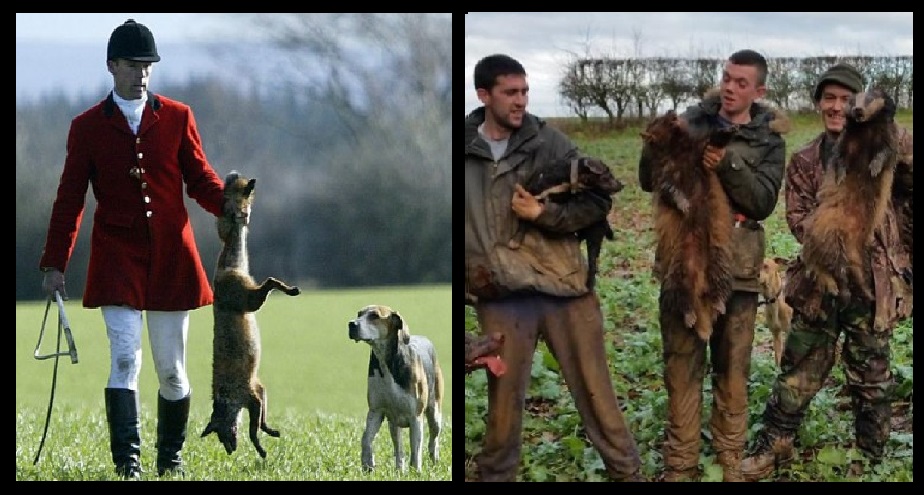
More than 10,000 are caught, tortured and killed in the UK each year by huntsmen with terriers – with almost a third of these illegal acts being carried out in Wales. Alarmingly, this figure is rising constantly. Terry Spamer, a former RSPCA inspector, believes that there are around 2,000 people involved in badger baiting currently. However, only around three people are caught and convicted of badger baiting each year, while the majority carry on breaking the law.
Traditional fox hunting was banned in England and Wales under the Hunting Act 2004. In spite of existing legislation, there has been 500 successful prosecutions under the Act. However, many incidents of illegal hunting have gone unpunished.
FOX HUNTING AND BADGER BAITING IS ILLEGAL IN THE UK BUT CARRIES ON WITH WITH APPARENT IMPUNITY
Dogfighting is an inhumane ‘bloodsport’ where dogs who have been bred, conditioned and trained to fight are placed in a pit to fight each other for spectator ‘entertainment’ and profit. Fights average one to two hours, ending when one of the dogs cannot continue.
Dog fights usually take part in quiet, private locations, such as in an industrial unit or farm building. Participants will spend months training their dogs in preparation, much like boxing, the fighters will have to hit a target weight to take part. Organisers will create a fighting ‘pit’ for the dogs to fight within.
Dogs who have been used in fighting often have serious injuries to their head, ears, front legs and chest that are caused as they go head-to-head in a pit. They will also have injuries of different ages, some old scars and some fresh wounds.
IT IS BELIEVED OVER 16000 DOGS DIE EACH YEAR IN ORGANIZED DOG FIGHTS
Each year, thousands of bulls are barbarically slaughtered in bullrings around the world. Over the centuries, bullfighters have found countless ways to rig the “fight” in their favor. Bulls are often weakened with drugs or by having sandbags dropped on their backs. Their horns have been shaved to keep them off balance, or petroleum jelly has been rubbed into their eyes to impair their vision.
Every year, approximately 250,000 bulls are killed in bullfights. Bullfighting is already banned by law in many countries including Argentina, Canada, Cuba, Denmark, Italy and the United Kingdom. Although legal in Spain, some Spanish cities, such as Calonge, Tossa de Mar, Vilamacolum and La Vajol, have outlawed the practice of bullfighting. There are only a few countries throughout the world where this practice still takes place (Spain, France, Portugal, Mexico, Colombia, Venezuela, Peru, and Ecuador). ~ HSI.
BULLS ARE TORTURED IN THE NAME OF CULTURE AND TRADITION
Each year from approximately September 1 to March 1, a large-scale hunt of dolphins takes place in the small village of Taiji, Japan, as featured in the 2010 Academy Award-winning documentary The Cove. During this six month season, dolphin hunters utilize drive hunt techniques to herd large numbers of dolphins to shore, resulting in their capture or death.
The captured dolphins may be selected for live trade to aquariums and marine parks for display, while others are slaughtered for their meat. The price for live captures is many times higher than those killed.
THE ANNUAL TAIJI DOLPHIN SLAUGHTER
What you can do to help end animal abuse
We believe EVERY animal should be treated with respect, empathy, and understanding. We raise awareness to protect and conserve wild, captive, companion and farm animals.
It is vital that we protect animals against acts of cruelty, abuse, and neglect by enforcing established animal welfare laws and, when necessary, taking action to ensure that those who abuse animals are brought to justice.
The Mission of Protect All Wildlife is to prevent cruelty, promote the welfare of ALL animals EVERYWHERE, and help END animal abuse.
Please support our work by donating ANY amount, large or small. It only takes a minute and your donations make it all possible. Thank you for your support.
What else you can do to help
Please SHARE to raise awareness to wildlife and environmental issues from around the world.










 PROTECT ALL WILDLIFE