China Cracks Downs On Stray And Pet Dogs Following Attack On A Toddler

A small, stray dog on a university campus in Chongqing was filmed being grabbed in a net by a dog catcher, prior to being killed. The “smiling” appearance of the dog has prompted a social media hashtag using the name it was given #XiaoHuang.

Officials in China have launched a crackdown on stray, unregistered, and “oversized” dogs.

But the move has been widely criticised after reports that dogs without owners are being rounded up and sometimes euthanised.

It comes after a vicious attack on a two-year-old girl by a Rottweiler last week that shocked the country.

The Rottweiler that attacked the child in Chongzhou, Sichuan Province, WAS NOT A STRAY. It was unleashed and approached the mother who was walking her child to preschool inside their housing compound.

The toddler suffered a ruptured kidney, fractured ribs and lacerations across her body. She is reportedly stable.

The crackdown prompted by the mauling has however, been questioned on social media and by pet owners after several shocking stories came to light.

Community workers in Leshan broke into a house to hunt and kill pet dogs

In one case, security guards and a landlord entered an office without the permission of the tenant and killed both of their dogs.

In another case – which has drawn considerable attention online – a small, stray dog on a university campus in Chongqing was filmed being grabbed in a net by a dog catcher, prior to being killed. The “smiling” appearance of the dog has prompted a social media hashtag using the name it was given #XiaoHuang. University officials said the dog had chased a student.
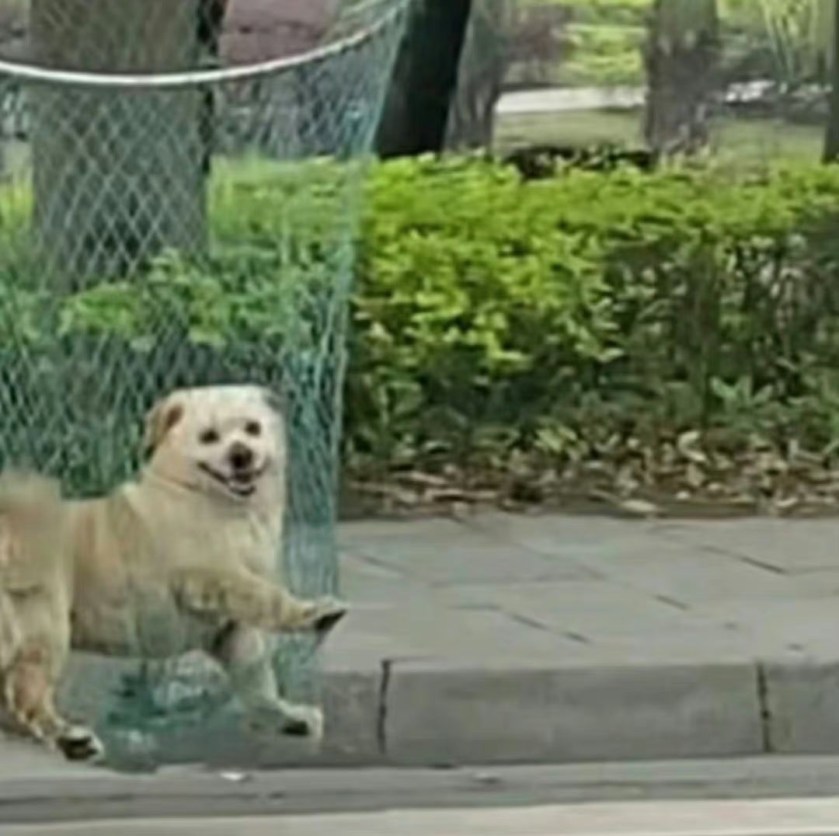
A small, stray dog on a university campus in Chongqing was filmed being grabbed in a net by a dog catcher, prior to being killed. The “smiling” appearance of the dog prompted a social media hashtag using the name it was given #XiaoHuang.

Some users of Chinese microblogging site Weibo posted pictures claiming security personnel in their residential compounds had started killing strays and dumping their bodies in the trash. Their posts sparked an online outcry, with many calling for more humane measures, including adoption and neutering.

Chinese celebrities have also joined the social media discussion, saying the crackdown across the country was not warranted by the initial attack, terrible though it was.

Chinese actress Cya Liu Ya-se posted on Weibo on Friday, stating that “not all stray dogs are bad dogs” and called for “an end to the killing of animals.”

Celebrity Yang Di also posted a video on short video platform Douyin the same day, saying that people don’t have to all love dogs, but “please do not harm them.” Both accounts were banned shortly after the posts.

Xiao Feng calls for the killing of stray cats and dogs to stop.

However, the Rottweiler that attacked the child in Chongzhou, Sichuan Province, was not a stray. It was unleashed and approached the mother who was walking her child to preschool inside their housing compound.

Statements issued from officials in Shandong, Jiangxi and Hubei Provinces have said that captured stray dogs would be put down if an owner cannot be found for them.

In another instance, a security guard at a university in Liaoning Province was suspended after beating a beloved on-campus stray to death.

Chen Minjie, a staffer from the Cat and Dog Welfare Program with the Animals Asia Foundation, told the Global Times on Monday that the heated debate surrounding uncivilized incidents reflects the expanded pet ownership in the country and the varying quality of pet owners. Attention should be focused on addressing the behavior of uncivilized dog owners, rather than a widespread antagonism between dog owners and non-dog owners.

Internet users also called on the public to go to the State Council website and leave a message asking the government to stop abusing and killing stray animals, to reasonably disclose the way stray cats and dogs are handled, and to call on the state to legislate for the protection of animals.

Editor’s Note: Whilst it is agreed that attacks by dogs should be dealt with severely, in this case the dog(s) involved were not strays. They were pets that were not on leads. No stray dogs were anywhere in the vicinity of the awful attack. Why persecute strays for something they had nothing to do with?
WHAT YOU CAN DO TO HELP RESCUE ANIMALS

You can support our work by donating as little as £5 – It only takes a minute but it can last a lifetime for an animal in need.

CLICK HERE TO DONATE https://donorbox.org/miracles-mission

Everyone who donates will receive a Certificate of Appreciation as a thank you for helping rescue animals in need.

OUR MISSION STATEMENT

‘Animals that use wheels and prosthetics can live as good a  quality of life as fully able-bodied animals and this is what we want to show people’ ~ Victoria Bryceson, founder of Miracle’s Mission.

We do not receive financial support from the government or other institutions. We rely solely on donations from generous animal lovers. 

Animal rescues cost a lot of money to run. While we get donations and funding through events like charity runs etc, the costs are EXTREMELY high. We need to pay for food, heating and other bills, as well as any staff costs and expenses like petrol for home visits. 

The average cost to feed a dog for one month typically costs somewhere from £16 to £50, depending on the breed. Microchipping costs about £10 to £15. The average cost of essential vaccinations is £64. A routine vet appointment costs between £40-£60, surgery can cost anywhere over £1000. Physiotherapy, Hydrotherapy – the average cost is £50 for a 30-minute session. Prosthetics and dog wheels etc can cost up to £500.

Please help Miracle’s Mission continue to rescue, rehabilitate and rehome MANY MORE sick, injured and disabled animals by kindly donating ANY amount, large or small, today. Thank you.
Donate at: https://donorbox.org/miracles-mission

The Wonderful Story Of Camberley Kate: A Dog Rescuer Extraordinaire

CAMBERLEY KATE AND HER MANY RESCUES
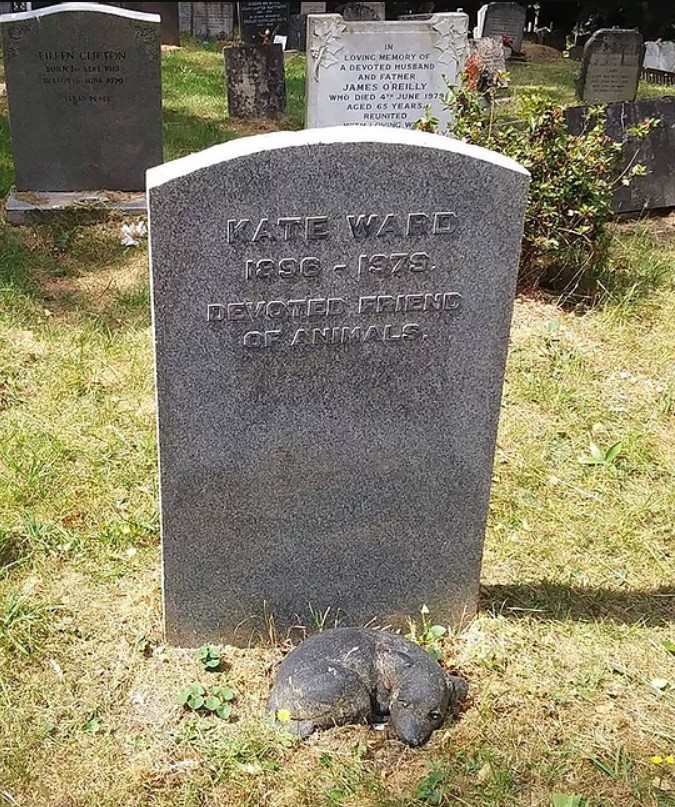
Kate Ward’s nickname “Camberley Kate” is said to have been given to her by historian Sir Arthur Bryant in his book “The Lion and the Unicorn”. It became the title by which she became known to everyone.

Kate’s early history is somewhat hazy – When interviewed she stated that she was born in Middlesbrough on June 13th 1895, and remained proud of her Yorkshire roots. Orphaned before she was ten, she was brought up by an aunt in a strict religious atmosphere. As a young girl she went into service, in Yorkshire and eventually found her way to Camberley. In 1943 Kate bought a cottage in Yorktown, and soon afterwards took in her first stray, a dog which had been about to be put down due to lameness.

As word grew, the number of dogs in her cottage increased – some being tied to her door, some left in carrier bags, others brought in by the police or other agencies. At the end of her life she estimated that she had looked after more than 600 dogs and local vet Geoffrey Craddock, a great admirer of Kate work testified that they were well looked after. An entry in the 1957 directory FOR Camberley reads “Ward K 218 London Road., Cam., Dogs Home”. In 1976 she stated that she had 34 dogs, although by 1977 she had cut this down to 19, as she had been told to go easier at the age of 82! The growth of other dog rescue centres helped in this regard. She also had at least one cat.


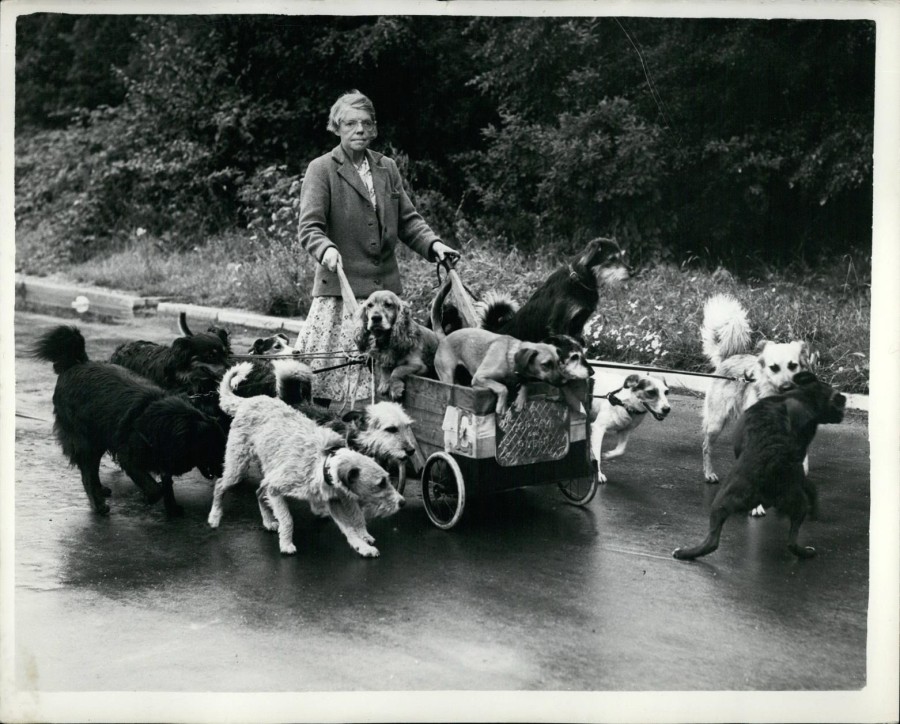
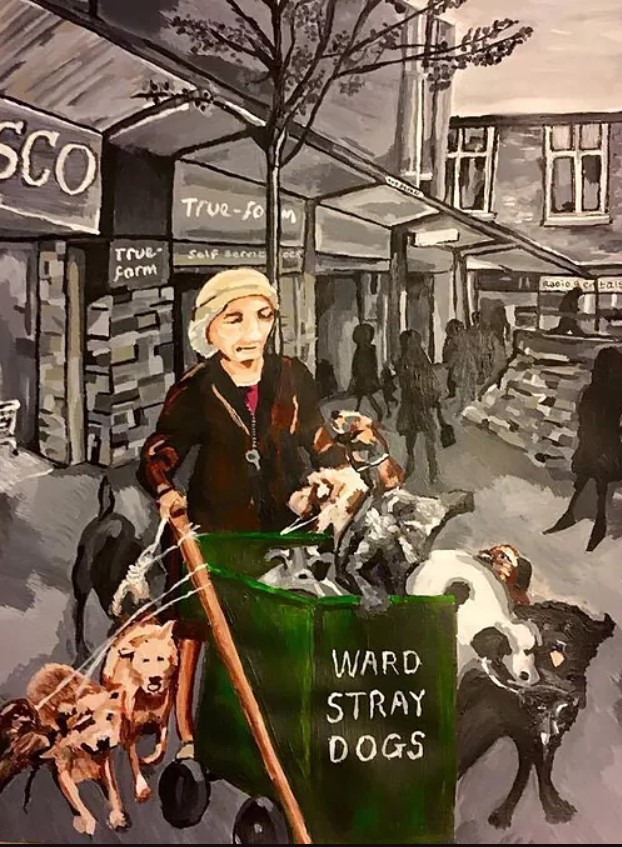
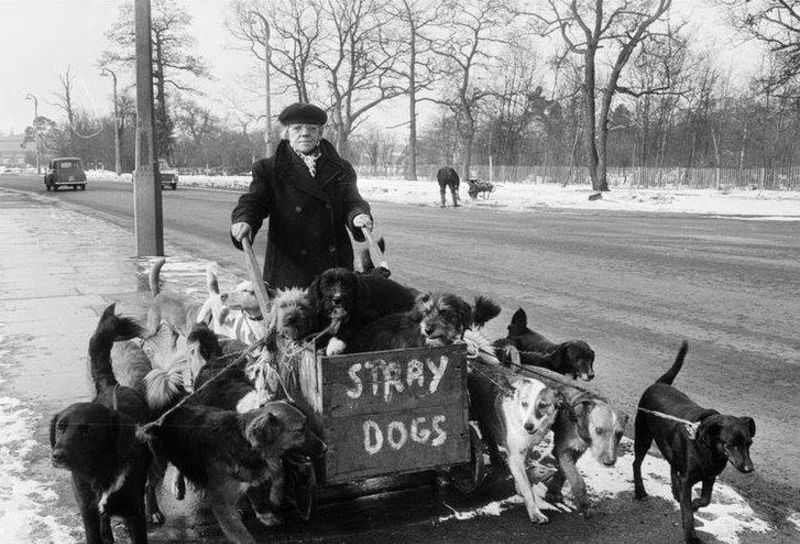
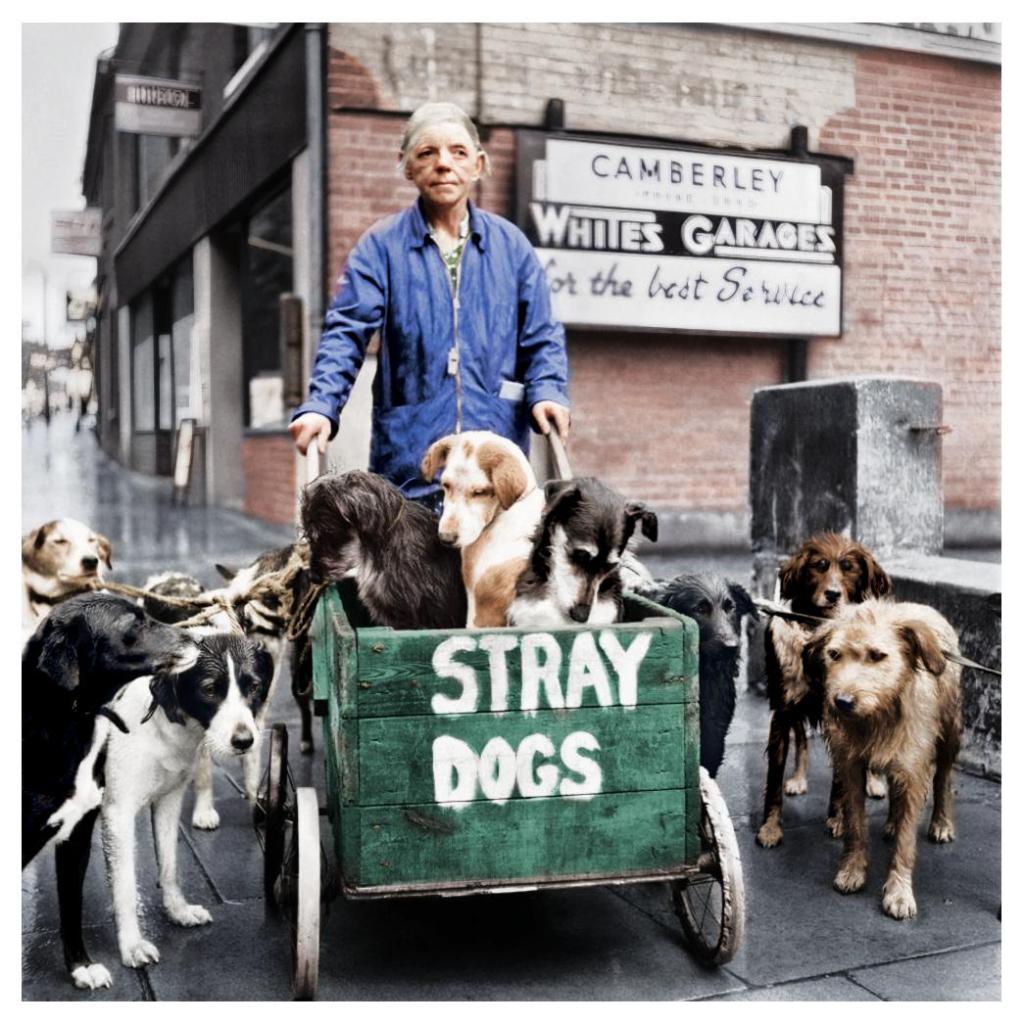
Kate and her olive-green painted hand cart, labelled STRAY DOGS, was a familiar sight locally as she pushed it from Yorktown to Camberley each day, through the town centre and up to Barossa Common, on a route suggested by the police. Some of the dogs were allowed to ride in the cart, others were attached to it with lengths of string, and occasionally a favoured few ran loose alongside. Inside the cart, there was usually some meat for the dogs and a shovel to clean any mess away. The dogs were controlled with the help of a whistle. Locals became used to the sight of Kate pushing her cart along the busy London Road although it never ceased to amaze outsiders.

As a local celebrity Kate and her dogs were much photographed, a situation she tolerated as long as the photographer gave a donation for the upkeep of the animals. She also sold her own photographic postcards, and gave short shrift to those who tried to take their own pictures. Generous supporters gave money to assist her work and some even left bequests. She was scrupulous that this money should be used only for its intended purpose: the dogs had their own bank account, administered by 2 trustees. She left money in trust for the few dogs left at her death.

If you gave her some money, she would INSIST you take a photo. That way she could not be accused of begging.


A diminutive figure with her shock of white hair and her beret, Kate defended herself and her work passionately against her critics, such as those who wanted her out of the town centre or who regarded the dogs as dangerous or a health or traffic hazard. On one occasion she rammed a new car which was blocking her way. She also had a number of disputes with the authorities. These clashes were often recorded in the columns of the press. However she won the backing of the local police for her work in taking abandoned dogs in off the streets.

In 21 August 1969 Kate was in the Camberley News fighting plans to introduce a bye law making it illegal for dogs to be out without a lead. This followed complains from residents of new housing estates, and concerns about road accidents caused by stray dogs. In her customary forthright fashion she condemned “The Council is nothing more than a collection of dog-haters. I think this will be rotten. It means that dogs will be chained up all day”. A proposal to ban dogs from the new precinct in Camberley also met with a terse response, particularly since she was in the habit of shopping at Sainsbury’s and leaving some of the dogs tied up outside. When protests about the local drag-hounds running out of control when being exercised attracted her support Kate, in typical fashion, addressed her complaint directly to the King. The Royal family continued to be a favourite route for correspondence. When a local schoolteacher complained that she had seen her beat her dogs with a stick, Kate immediately wrote in protest to the Queen. This was not their first encounter – when Princess Elizabeth got married one of the dogs sent a present of a dog lead.


As these anecdotes show, Kate was an excellent publicist. A local policemen recalled that occasionally a dog would get loose and be brought to the dog pound. If the Police Station was empty she would pay the fine quietly and readily, but if there was an audience she would protest vocally!

Following a series of strokes old age and ill-health forced her to leave her cottage and her remaining seven dogs were put into kennels. Her last weeks were spent at Kingsclear residential home and she died on 4th August 1979. Her funeral was at St Michael’s, Yorktown.

Despite her avowed dislike of people, Baptist Minister the Rev Chris Russell who officiated at her funeral, remembers her private generosity to those in need. This aspect of her life she kept anonymous, passing on her donations through third parties.

After her death, Camberley vet Geoffrey Craddock was quoted in the Camberley News as saying “Camberley has lost its most celebrated and best known character. She will be greatly missed by those of us who had the rare privilege of knowing her”.


During her lifetime, Kate’s fame spread far and wide. She featured In the national press and on television programmes such as “Nationwide” and “Tonight”. was featured on NBC in the United States and her story appeared in publications across Europe from France to Rumania. She also received the ultimate accolade of a feature in “Time” Magazine, and was photographed by Lord Snowdon. To her surprise, in 1967 she received an award from the magazine “Dog’s Life” for her work. In answer to the inevitable question, why she did it? her invariable reply was that she preferred dogs to humans.


Her home at 218 London Road was just a few doors along from the former Lamb pub, near the present Meadows roundabout, but Is no longer standing. The Katherine Court retirement flats were named after her at the suggestion of a local resident in 2000.

There are so many great lessons we can learn from the life of Kate Ward, both as responsible dog owners, human beings, and as pet rescue charities. Most of all Kate recognized the value of a photograph and how it could be used for the positive influence of others, to bring light to a cause, and to help raise money.

Please share for others to enjoy.

WHAT YOU CAN DO TO HELP ANIMALS IN NEED

You can support our work by donating as little as £5 – It only takes a minute but it can last a lifetime for an animal in need.

PLEASE DONATE HERE

Everyone who donates will receive a Certificate of Appreciation as a thank you for helping animals in need.

The Mission of Protect All Wildlife is to prevent cruelty and promote the welfare of ALL animals.

We believe EVERY animal should be treated with respect, empathy, and understanding. We raise awareness to protect and conserve wild, captive, companion and farm animals.

It is vital that we protect animals against acts of cruelty, abuse, and neglect by enforcing established animal welfare laws and, when necessary, take action to ensure that those who abuse animals are brought to justice.

Protect All Wildlife are involved in many projects to protect animals’ rights, welfare, and habitats. Money contributed to Protect All Wildlife supports ALL of our worthy programmes and gives us the flexibility to respond to emerging needs. Your donations make our work possible.

A Greek Coffee Shop Opens Its Doors Every Night To Stray Dogs

HOTT SPOTT: THE KINDNESS CAFE

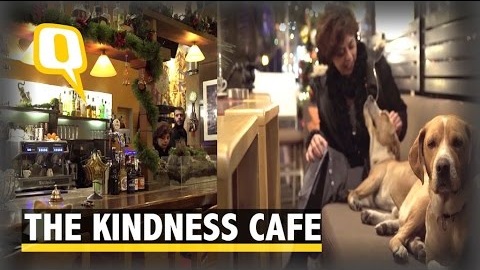
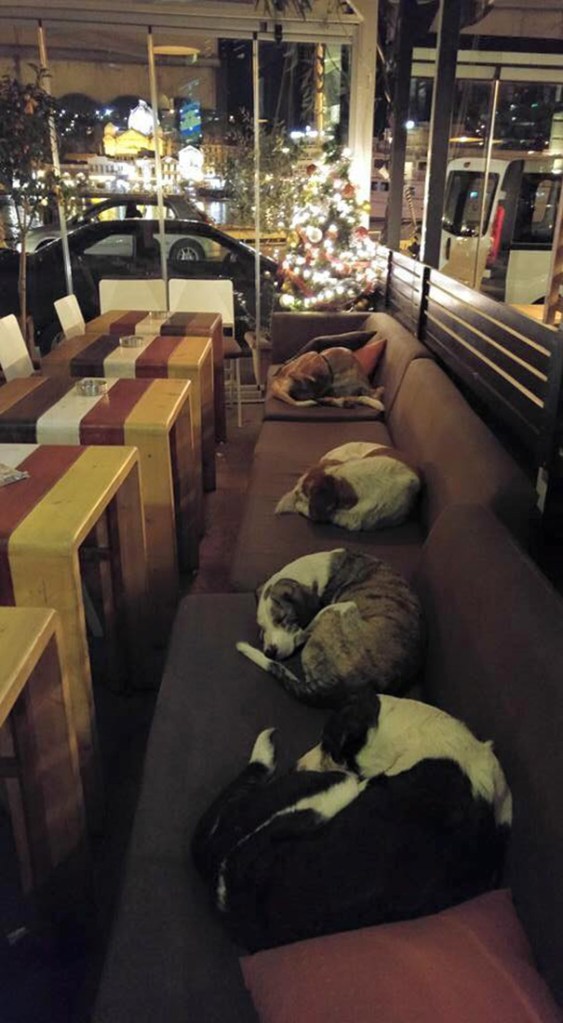
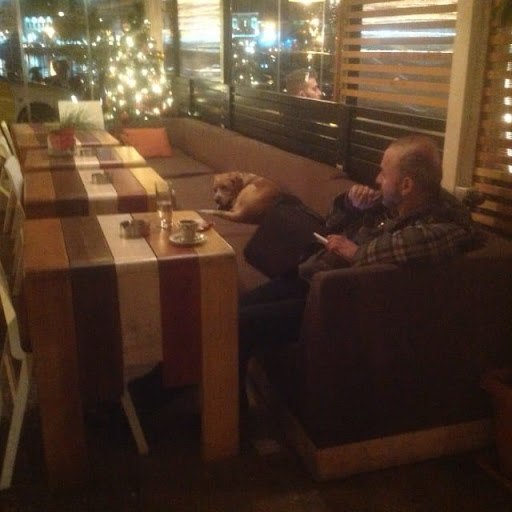
Greece has a large stray dog population where stray dogs roam the city looking for a meal, a home, and some warmth. On the Greek island of Lesbos in the north Aegean Sea there is a small coffee shop along the waterfront in the town of Mytilene where all the stray dogs come to hang out. It goes by the kitschy name Hott Spott and offers a warm spot for the dogs to spend a bit of evening and catch up on some sleep for the night. It is kind of a hostel for strays.

Once all customers are gone, Hott Spott welcomes the city’s homeless dogs to come in and enjoy a safe, warm spot to sleep for the night. Most of them can be seen on the couches of the café, getting that sacred good night sleep that strays on the street are never able to find.

a safe pLace for HOMELESS dogs to sleep

While it may not be possible to open your home to every stray pet in need, an open heart can be just as accommodating.

“When the bar closes each night, the dogs come and sleep here,” says one of the café’s waiters.  “We don’t have a problem. From July, every night there is a dog on the couch.”

The Greek Isles are home to over 1 million stray dogs, says Greek charities, according to White Wolf Pack. So this one café, the Hott Spott, located on the island of Lesbos, is stepping up and doing its part in an act of sheer humanity. Many dogs in Greece without a permanent home receive a collar and are cared for by the community, instead of placing them in overcrowded shelters.

Such random acts of generosity toward animals isn’t uncommon in Greece, which has a large number of stray dogs. Despite being without a permanent home or family, these animals are often collared and cared for by the community — an alternative to putting them into crowded shelters.

“Here in Greece our homes are not large enough for all of us to house animals,” said an Athens resident. “The island of Lesbos has also been the epicenter of the refugee crisis,” said Eustratios Papanis, a 46-year-old assistant professor of sociology at the University of the Aegean on Lesbos island, who posted the pictures and story of the dogs sleeping peacefully on social media. “The locals have increased levels of solidarity towards environmental and humanistic issues. The new generation is more sensitive and well informed.”

It only took this one simple kind act to change the lives of the sweet dogs who come to the café at night, where they now matter to someone.

To learn more about Greece’s stray pet population, and to find out how you can help, visit Greek Animal Rescue and The Friends Of The Strays Of Greece.

The Coffee Shop That Opens Its Doors Every Night To Stray Dogs  VIDEO

Please SHARE this feelgood story for others to enjoy. If you would like to receive updates and news please enter your email address in the box in the right-hand column.